
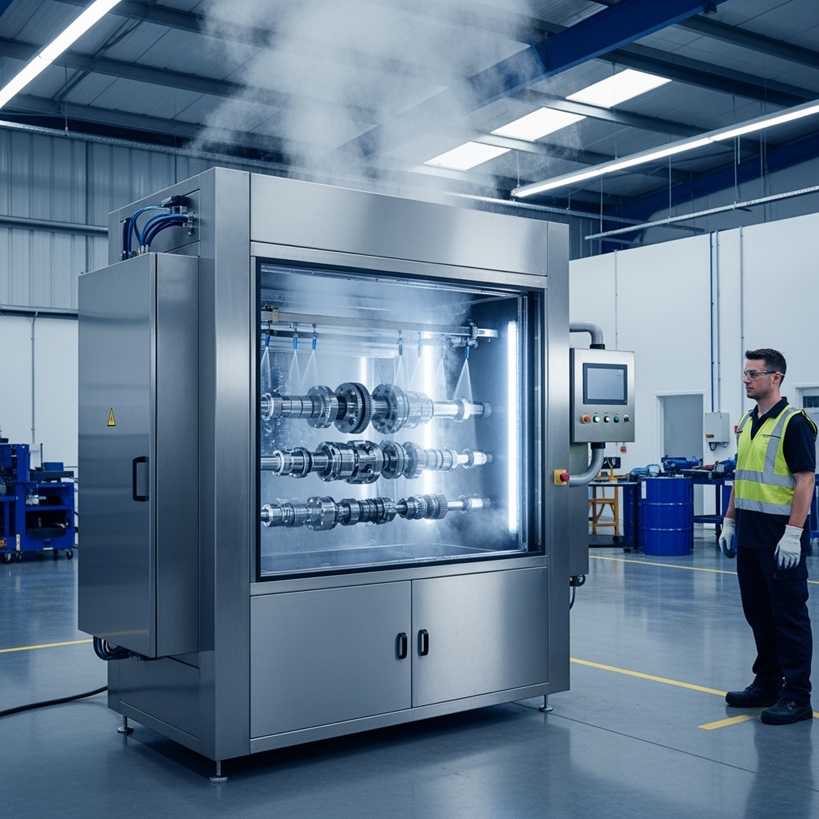
The sharp smell of mineral spirits and the sight of parts soaking in petroleum-based degreasers once defined mechanical workshops across Australia. That era is ending. From mining maintenance facilities to automotive workshops nationwide, operations are switching to water based parts cleaner systems – and the reasons extend far beyond regulatory pressure.
The shift represents more than environmental compliance. Workshop managers report measurable improvements in worker safety, operational efficiency, and long-term cost structures. When a mining equipment maintenance facility replaced its solvent parts cleaning operation with automated aqueous systems, the operation eliminated 840 litres of hazardous waste annually while cutting parts cleaning time by 60%. These outcomes aren’t isolated incidents – they reflect systematic advantages that make solvent-based cleaning increasingly obsolete for modern mechanical operations.
The Hidden Costs of Solvent-Based Parts Cleaning
Traditional solvent cleaning carries expenses that extend beyond the purchase price of chemicals. A typical automotive workshop using petroleum-based degreasers faces disposal costs averaging $2,400-$4,800 annually for hazardous waste removal. These figures exclude the administrative burden of maintaining Safety Data Sheets, conducting air quality monitoring, and documenting chemical handling procedures for workplace health and safety compliance.
Worker exposure represents another cost category that rarely appears in initial budget calculations. Prolonged contact with petroleum-based solvents causes dermatitis in approximately 15-20% of workshop technicians, according to Australian workplace injury data. Each case typically requires 2-4 weeks of modified duties, creating staffing disruptions and workers’ compensation claims that compound over time.
Solvent evaporation creates additional financial drain. An open-top solvent parts washer loses 20-30% of its fluid volume monthly through evaporation, requiring constant replenishment. A workshop processing 50 parts daily might consume 600-900 litres of solvent annually just to replace evaporated fluid, before accounting for actual cleaning consumption.
Regulatory Pressure Accelerating the Transition
Australian environmental regulations have tightened considerably around volatile organic compound (VOC) emissions and hazardous waste generation. State environmental protection authorities now require detailed tracking of solvent purchases, usage volumes, and disposal methods. Non-compliance penalties range from $5,000 to $50,000 for small to medium operations, with larger fines for repeat violations.
The administrative requirements alone consume 4-8 hours monthly for a typical workshop – time spent maintaining chemical registers, updating risk assessments, and coordinating licensed waste removal. Operations managers increasingly question whether solvent-based cleaning justifies this regulatory burden when alternatives eliminate most compliance requirements.
Solvent-free parts cleaning systems using heated alkaline detergents fall outside hazardous substance regulations in most applications. The wastewater, while requiring appropriate disposal through trade waste systems, doesn’t carry the same classification or handling requirements as spent petroleum solvents. This regulatory simplification reduces documentation requirements by approximately 70% compared to solvent-based operations.
Performance Advantages of Heated Aqueous Cleaning
The assumption that solvents clean better than water-based systems doesn’t withstand technical scrutiny. Modern heavy duty parts washers using heated water (60-90°C) combined with alkaline detergents match or exceed solvent cleaning performance across most applications.
The cleaning mechanism differs fundamentally. Solvents dissolve oils and greases through chemical action, requiring extended soak times. Heated aqueous systems combine thermal energy, chemical action, and mechanical agitation through high-pressure spray systems. This multi-mechanism approach removes contamination faster and more completely than passive solvent soaking.
A comparative test conducted at a heavy vehicle workshop demonstrated this performance gap. Engine components soaked in mineral spirits for 20 minutes achieved 85% contamination removal. The same components processed through a heated spray cabinet at 80°C for 8 minutes achieved 98% contamination removal. The aqueous system delivered superior results in less than half the time.
Temperature plays a critical role. Heating water to 80-90°C reduces the viscosity of oils and greases by 60-70%, allowing them to flow away from metal surfaces. The thermal energy breaks molecular bonds that hold contamination to metal, while alkaline detergents emulsify the freed oils into suspension. High-pressure spray (40-60 PSI) provides the mechanical force to flush contamination away completely.
This combination proves particularly effective on baked-on carbon deposits, heat-treated oils, and heavy greases that resist solvent cleaning. Mining operations cleaning excavator components report that super heavy duty parts washers remove contamination that previously required manual scrubbing, even after solvent soaking.
Workplace Safety Improvements Driving Adoption
The safety advantages of eliminating petroleum-based solvents extend across multiple risk categories. Fire hazard reduction ranks among the most significant. Mineral spirits and petroleum distillates carry flash points between 38-60°C – temperatures easily reached in Australian workshops during summer months. Water-based parts cleaner systems eliminate this ignition risk entirely.
Respiratory protection requirements change dramatically. Workers using petroleum-based solvents in poorly ventilated spaces require organic vapour respirators and mandatory air quality monitoring. Heated aqueous cleaning produces water vapour and mild alkaline mist that requires minimal respiratory protection in most applications. This simplification reduces personal protective equipment costs and improves worker comfort during extended cleaning operations.
Skin contact risks decrease substantially. Petroleum solvents strip natural oils from skin, causing irritation, cracking, and increased absorption of other chemicals. Alkaline detergents used in water-based systems require standard chemical-resistant gloves but don’t cause the same degree of dermal damage. Workshop managers report 60-80% reductions in hand dermatitis cases after transitioning away from solvent-based cleaning.
The elimination of hazardous substance storage creates additional safety improvements. A typical workshop storing 200-400 litres of flammable solvents faces requirements for bonded storage, spill containment, and emergency response procedures. Transitioning to water-based detergents (typically supplied in 20-litre containers) reduces these requirements to standard chemical storage protocols.
Operational Efficiency Gains from Automated Systems
Manual solvent cleaning follows a labour-intensive process: degrease, soak, scrub, rinse, dry. A technician might spend 15-20 minutes cleaning a transmission housing or differential assembly. Multiply this across 20-30 parts daily, and parts cleaning consumes 5-7 hours of productive technician time.
Automated industrial spray washers compress this timeline dramatically. Load contaminated parts, close the door, and select the wash cycle. The system handles heating, washing, rinsing, and initial drying automatically. A typical cycle runs 8-15 minutes, depending on contamination levels. The technician invests perhaps 2 minutes of actual labour – loading and unloading.
The efficiency improvement extends beyond time savings. Automated systems deliver consistent results regardless of operator fatigue, experience level, or workload pressure. Every part receives the same spray pressure, temperature, and cycle duration. This consistency eliminates the quality variation inherent in manual cleaning, where thoroughness depends on individual technician diligence.
Workshop productivity improves when technicians spend time on skilled mechanical work rather than scrubbing parts. A diesel mechanic earning $45-55 per hour represents expensive labour for manual cleaning tasks. Redirecting those hours toward diagnostic work, repairs, and assembly improves overall workshop efficiency and revenue generation.
The automation advantage scales with operation size. A mining maintenance facility processing 200+ parts daily might achieve 25-30 hours weekly in labour savings – equivalent to adding a full-time technician without increasing headcount.
Long-Term Cost Analysis Favouring Water-Based Systems
The capital cost of automated aqueous cleaning systems exceeds basic solvent parts washers significantly. A three-stage solvent sink costs $2,000-4,000, while a hot tank system or automated spray cabinet ranges from $15,000-45,000, depending on capacity and features. This upfront difference causes some operations to maintain solvent-based cleaning despite its operational disadvantages.
The long-term cost equation tells a different story. Consider a medium-sized workshop processing 40 parts daily:
Solvent-Based Annual Costs:
- Solvent purchases: $4,800-7,200
- Hazardous waste disposal: $2,400-4,800
- Evaporation replacement: $1,200-1,800
- Compliance administration: $2,400 (labour hours)
- PPE and safety equipment: $800-1,200
- Total: $11,600-17,400 annually
Water-Based Annual Costs:
- Detergent concentrate: $1,200-1,800
- Water consumption: $400-600
- Electricity (heating): $1,800-2,400
- Maintenance and parts: $600-1,000
- Total: $4,000-5,800 annually
The annual operational savings of $7,600-11,600 allow most operations to recover the higher capital cost of automated aqueous systems within 2-3 years. Beyond that payback period, the ongoing savings compound annually.
These calculations exclude the value of labour time savings, which can add another $8,000-15,000 annually in productivity improvements for operations with sufficient parts cleaning volume.
Industry-Specific Applications Proving Water-Based Effectiveness
Different mechanical sectors face unique cleaning challenges that test whether solvent-free parts cleaning systems can truly replace solvents across all applications.
Mining and Heavy Equipment Maintenance
Mining operations present some of the most demanding parts cleaning requirements – components caked with mud, grease, coal dust, and hydraulic oil. Extra heavy duty parts washers designed for these environments use extended wash cycles (15-20 minutes), elevated temperatures (85-90°C), and high-pressure spray (50-60 PSI) to remove extreme contamination.
A copper mine reported that its automated aqueous system successfully cleaned excavator bucket pins, hydraulic cylinders, and gearbox housings that previously required overnight solvent soaking followed by manual scrubbing. The heated spray system completed the same cleaning in 18 minutes with zero manual scrubbing.
Automotive and Light Vehicle Workshops
Automotive applications typically involve engine components, transmission parts, suspension assemblies, and brake system cleaning. These parts carry contamination from engine oil, transmission fluid, brake dust, and road grime – all responsive to heated aqueous cleaning.
The advantage for automotive workshops extends beyond cleaning performance. Water-based parts cleaner systems leave parts completely dry and residue-free, ready for immediate inspection and reassembly. Solvent-cleaned parts often retain an oily film that interferes with gasket adhesion and requires additional wiping.
Food Industry and Commercial Kitchen Equipment
Food processing facilities and commercial kitchens face strict hygiene requirements that make petroleum-based solvents completely unsuitable. Stainless steel parts washers using food-grade detergents meet these requirements while providing effective cleaning of mixers, slicers, conveyor components, and processing equipment.
The ability to use the same cleaning system for both maintenance parts and food-contact equipment creates operational flexibility that solvent-based cleaning cannot match.
Environmental Impact Beyond Regulatory Compliance
The environmental advantages of water-based cleaning extend beyond meeting minimum regulatory standards. Petroleum-based solvents contribute to ground-level ozone formation through VOC emissions, affecting air quality in urban and industrial areas. Even with proper ventilation and vapour recovery, solvent parts washers release measurable VOC quantities during normal operation.
Water consumption in aqueous cleaning systems raises environmental questions, but the actual usage proves modest. A typical spray cabinet uses 80-150 litres per wash cycle, with most systems incorporating filtration and recirculation that extends fluid life to 2-4 weeks, depending on contamination levels. Annual water consumption for a workshop processing 40 parts daily totals approximately 15,000-25,000 litres – equivalent to household water use for 2-3 people.
Modern systems incorporate waste minimisation features, including oil skimmers, sediment filtration, and extended bath life formulations. These technologies reduce wastewater generation by 40-60% compared to first-generation aqueous systems, making the environmental footprint increasingly favourable.
Making the Transition: Practical Implementation Considerations
Workshops considering the switch from solvent to water-based cleaning face several practical questions about implementation timing, system selection, and operational changes.
System Sizing and Capacity Selection
Matching system capacity to actual cleaning volume prevents both overcapacity (excessive capital cost) and undercapacity (operational bottlenecks). Operations should calculate average daily parts cleaning volume, peak demand periods, and maximum part dimensions. A workshop processing 30-50 parts daily typically requires a cabinet with 600-900mm width and 500-700mm height to accommodate most automotive and light industrial components.
Mining operations handling larger components (gearbox housings, hydraulic cylinders, excavator bucket teeth) require proportionally larger systems. The investment in appropriate capacity prevents the need for continued solvent cleaning for oversized parts that don’t fit the aqueous system.
Installation Requirements
Automated aqueous systems require electrical power (typically 415V three-phase for heating elements), a water supply connection, and trade waste drainage. Most installations require 2-4 hours for a qualified electrician and plumber. Workshop layout should position the system near parts disassembly areas to minimise handling of contaminated components.
Ventilation requirements decrease substantially compared to solvent cleaning, but adequate air movement remains beneficial for operator comfort and moisture management.
Staff Training and Procedure Changes
The operational simplicity of automated systems requires minimal training – typically 30-60 minutes covering loading procedures, cycle selection, and basic maintenance tasks. The greater challenge involves changing established work patterns where technicians habitually reach for solvent spray bottles or degreasers for quick cleaning tasks.
Successful transitions include a complete removal of solvent cleaning supplies to prevent reversion to old methods. Providing water-based spray degreasers for quick wipe-down tasks helps bridge this operational gap.
The Australian Manufacturing Advantage
Australian-designed and manufactured parts washing systems offer specific advantages for local operations. Equipment built by Hotwash Australia incorporates design features addressing Australian conditions – high ambient temperatures, dust exposure, and the robust construction required for mining and heavy industry applications.
Local manufacturing ensures parts availability, service response times, and technical support aligned with Australian business hours and operational requirements. When a critical component fails, waiting weeks for international shipping creates costly downtime. Local suppliers typically provide next-day parts delivery and same-week service calls for most Australian locations.
Australian electrical and safety standards compliance comes standard with locally manufactured equipment, eliminating the compliance verification required for imported systems. This simplification proves particularly valuable for operations in regulated industries where equipment certification forms part of broader operational licensing.
Conclusion: The Transition Accelerates
The movement away from solvent-based parts cleaning reflects converging pressures – regulatory requirements, workplace safety improvements, operational efficiency gains, and long-term cost advantages. These factors combine to make solvent-free parts cleaning systems the logical choice for mechanical workshops evaluating equipment upgrades or addressing aging solvent cleaning infrastructure.
The performance question has been answered. Modern heated aqueous systems match or exceed solvent cleaning effectiveness across virtually all mechanical workshop applications. The remaining consideration centres on implementation timing and system selection appropriate to specific operational requirements.
Operations continuing with solvent-based cleaning face escalating costs, increasing regulatory scrutiny, and growing competitive disadvantage relative to workshops that have modernised their parts cleaning processes. The two-to-three-year capital recovery period for quality water-based systems makes the financial case increasingly compelling, particularly for operations with moderate to high parts cleaning volumes.
Australian workshops ready to eliminate hazardous solvent use and improve operational efficiency should evaluate how automated aqueous cleaning systems align with their specific requirements. Contact us to discuss system capacity, installation requirements, and expected performance outcomes for particular applications. The transition away from petroleum-based parts cleaning represents more than regulatory compliance – it delivers measurable improvements in safety, efficiency, and long-term operational costs that strengthen workshop competitiveness across all mechanical service sectors.

Leave A Comment