
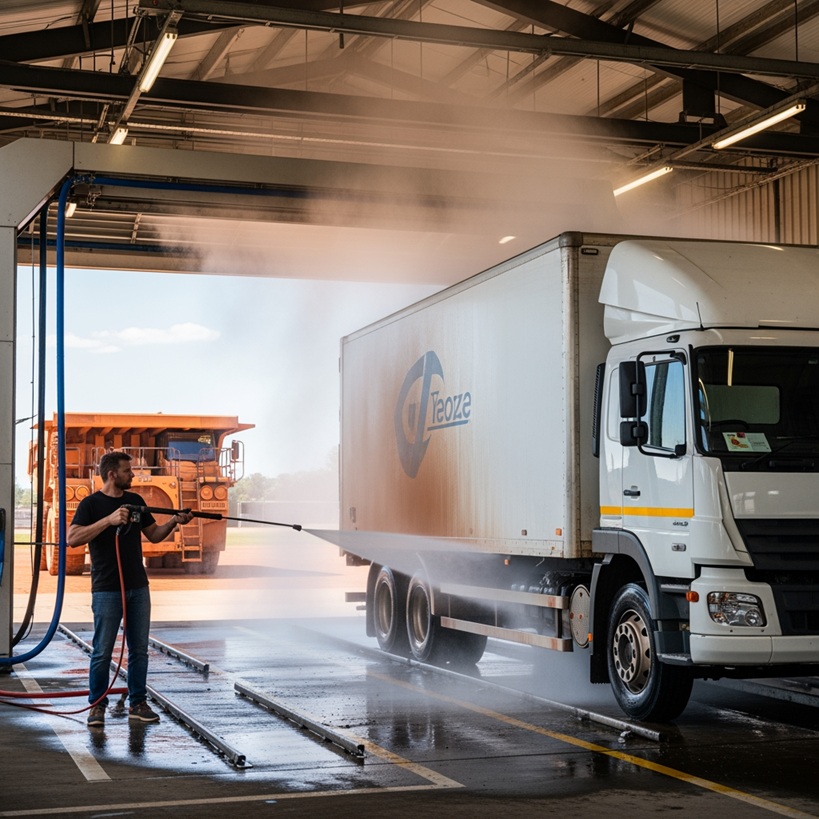
Fleet vehicles accumulate different types of contamination depending on their operational environment. A mining haul truck caked in red dust requires a fundamentally different cleaning approach than a food delivery vehicle that needs daily hygiene compliance. Understanding fleet detailing service tiers – and matching them to operational requirements – determines whether fleet managers waste budget on excessive detailing or risk compliance failures with inadequate washing.
The distinction between washing and detailing extends beyond thoroughness. These represent separate service categories with different time investments, cost structures, and operational outcomes. Mining operations running 24/7 schedules cannot afford eight-hour detailing sessions for routine cleaning. Conversely, corporate fleets maintaining brand presentation standards cannot rely on basic pressure washing alone. Hotwash Australia manufactures industrial cleaning systems that address both ends of this spectrum, from high-volume spray washers to intensive immersion tanks.
What Defines Basic Fleet Washing
Basic washing removes surface-level contamination – road grime, dust, mud, and light oil residue. This service tier prioritises speed and volume over precision. A standard wash cycle takes 15-30 minutes per vehicle and focuses on exterior surfaces that affect operational safety and basic presentation.
Truck washing services address immediate contamination without disassembling components or treating stubborn deposits. The process relies on high-pressure water (1500-3000 PSI), heated water (60-80°C), and industrial detergents designed for bulk application. This combination handles daily or weekly cleaning requirements for vehicles operating in standard conditions.
Typical washing applications include:
- Daily truck fleet cleaning for logistics companies
- Weekly wash schedules for delivery vehicles
- Post-shift cleaning for construction equipment
- Routine maintenance washing for municipal fleets
- Regular cleaning between detailed services
Mining operations exemplify high-volume washing requirements. Haul trucks returning from pit operations carry tonnes of dust and mud that compromise visibility and accelerate component wear. These vehicles require daily washing to maintain operational safety, but detailed cleaning would create unacceptable downtime. Heavy-duty parts washers handle this volume requirement with automated spray systems that process multiple vehicles per shift.
The economic model for basic washing emphasises throughput. Fleet managers calculate cost per vehicle rather than cost per hour. A washing system processing 20 vehicles per day at $45 per wash delivers better ROI than detailed cleaning at $300 per vehicle requiring full-day turnaround. This calculation changes when compliance, presentation, or component inspection requirements enter the equation.
When Detailing Becomes Operationally Necessary
Detailing addresses contamination that basic washing cannot remove – baked-on grease, chemical residues, corrosion, and deposits in component crevices. This service tier involves manual intervention, specialised cleaning agents, component disassembly, and extended processing time. A thorough detail takes 4-8 hours per vehicle and targets both aesthetic presentation and mechanical inspection access.
Fleet detailing service tiers serve three primary functions: compliance preparation, pre-sale conditioning, and maintenance access. Food transport vehicles undergo detailed cleaning before health inspections. Mining equipment receives detailed cleaning before major component inspections. Corporate fleets detail vehicles before remarketing to maximise resale value.
Detailing applications that justify extended processing time:
- Pre-inspection cleaning for compliance audits
- Component-level cleaning for maintenance access
- Resale preparation for fleet turnover
- Quarterly deep cleaning for premium fleets
- Contamination removal after hazardous material exposure
Oil and gas operations demonstrate when detailing becomes mandatory rather than optional. Valves, fittings, and pipeline components exposed to crude oil and drilling fluids require complete contamination removal before inspection or reassembly. Surface washing leaves residues that compromise seal integrity and mask component wear. Hot tank systems provide the immersion cleaning necessary for these applications, with heated caustic solutions dissolving deposits that pressure washing cannot touch.
The cost structure for detailing reflects labour intensity and chemical specialisation. A detailed cleaning costing $300-500 per vehicle becomes economically justified when it prevents $15,000 in failed inspection penalties or adds $3,000 to resale value. Fleet managers track these metrics quarterly to determine optimal detailing frequency rather than scheduling arbitrary deep cleans.
Matching Service Frequency to Operational Contamination
Contamination accumulation rates determine washing frequency more accurately than calendar schedules. A concrete mixer operating in coastal conditions accumulates corrosive salt spray that demands daily washing. An identical mixer in inland operations might operate on weekly wash cycles without operational impact. This variability requires fleet managers to assess actual contamination rather than following generic maintenance schedules.
Mining fleets illustrate extreme contamination environments. Vehicles operating in coal mines accumulate fine black dust that penetrates every gap and coats every surface. Iron ore operations deal with red dust that becomes abrasive when mixed with moisture. Coal operations might require truck washing services twice per shift, while iron ore fleets wash daily with monthly detailed cleaning for component inspection.
Contamination factors that accelerate washing requirements:
- Dust concentration in operating environment
- Exposure to corrosive materials (salt, chemicals, acids)
- Oil and grease accumulation from mechanical operations
- Organic material (food residue, agricultural products)
- Weather conditions (mud, rain, snow, humidity)
Food processing facilities demonstrate contamination-driven frequency requirements. Refrigerated delivery vehicles transporting raw meat require daily detailed cleaning to prevent bacterial growth and odour retention. Dry goods vehicles might operate on weekly wash schedules with monthly detailing. The contamination type – not the mileage – dictates service frequency.
Automated truck washing services shift the frequency equation by reducing per-wash cost. When washing takes 20 minutes instead of two hours, daily washing becomes economically viable for fleets that previously washed weekly. This increased frequency prevents contamination buildup that would otherwise require detailed intervention, creating a cost reduction cycle where frequent basic washing eliminates expensive detailing needs.
Cost Analysis: Time Investment vs Outcome Value
Fleet cleaning costs extend beyond invoice prices. Downtime represents lost productivity, delayed deliveries, and idle labour. A $50 wash that takes 30 minutes costs less than a $40 wash requiring two hours when factoring vehicle utilisation rates. This calculation becomes critical for fleets operating continuous schedules where every hour offline represents measurable revenue loss.
Mining operations calculate downtime in tonnes per hour rather than dollars per wash. A haul truck moving 400 tonnes per hour generates $8,000-12,000 in operational value depending on commodity prices. A washing process requiring 30 minutes costs $4,000-6,000 in lost productivity before factoring the actual cleaning cost. This economic reality drives investment in super heavy-duty parts washers that process equipment in 15-20 minutes rather than manual washing requiring 60-90 minutes.
Complete cost factors for fleet cleaning decisions:
- Direct washing cost (labour, water, chemicals, equipment)
- Vehicle downtime (lost productivity, delayed schedules)
- Labour allocation (skilled mechanics vs cleaning staff)
- Compliance risk (inspection failures, operational shutdowns)
- Asset preservation (corrosion prevention, component longevity)
- Resale value impact (presentation, condition documentation)
Food industry fleets face different cost calculations. A refrigerated truck costing $180,000 loses $25,000-35,000 in resale value when contamination creates permanent odours or staining. Daily detailed cleaning costing $200 per vehicle ($73,000 annually) becomes justified when it preserves $30,000 in asset value while preventing health inspection failures that could cost $50,000 in penalties and lost contracts.
Workshop operations serving multiple clients demonstrate the ROI of in-house cleaning systems. A mechanical workshop washing 15 vehicles daily at $60 per external wash spends $234,000 annually. An industrial spray washer costing $45,000-65,000 delivers payback within 3-4 months while improving turnaround time and service consistency. This calculation drives investment in stainless steel parts washers for food industry workshops where hygiene compliance justifies premium equipment.
Equipment Selection Based on Fleet Composition
Fleet diversity determines equipment requirements more than fleet size. A 50-vehicle fleet of identical delivery vans requires different cleaning infrastructure than a 20-vehicle mixed fleet including trucks, trailers, and specialised equipment. Standardised fleets benefit from automated systems optimised for specific vehicle dimensions. Mixed fleets require flexible cleaning solutions that accommodate varying sizes and contamination types.
Mining fleets demonstrate equipment specialisation requirements. Light vehicles (utilities, service trucks) wash effectively in standard spray cabinet systems. Haul trucks require drive-through wash bays with overhead gantries. Excavator buckets and drill components need immersion cleaning in heated tanks. A comprehensive mining operation might deploy three different cleaning systems rather than forcing all equipment through a single washing process.
Fleet characteristics that determine equipment selection:
- Vehicle size range (smallest to largest units)
- Contamination type consistency (uniform vs varied)
- Daily processing volume (vehicles per shift)
- Operational schedule constraints (available downtime)
- Space availability (indoor vs outdoor installation)
- Water and power infrastructure (recycling requirements)
Manufacturing facilities with mixed equipment demonstrate the value of modular cleaning systems. Production machinery components require precision cleaning in manual parts washers where operators control spray direction and chemical concentration. Larger fabrication components need automated spray cabinets. Heavily contaminated parts from casting operations require hot tank immersion. Rather than selecting a single system, these operations deploy complementary equipment matched to specific cleaning requirements.
Automotive workshops illustrate scalability considerations. A workshop servicing 8-12 vehicles daily operates efficiently with a single heavy-duty spray washer for engine components and undercarriage cleaning. Growth to 25-30 vehicles daily requires either a second washer or upgrading to higher-capacity equipment. Fleet composition changes – adding diesel trucks to a passenger vehicle focus – might necessitate heated washing systems rather than simply adding capacity.
Integration with Existing Fleet Maintenance Workflows
Cleaning system effectiveness depends on workflow integration rather than equipment specifications alone. A high-performance washer that creates bottlenecks in the maintenance bay delivers less value than a moderate-capacity system that synchronises with inspection and service schedules. Fleet managers assess cleaning system placement, processing time, and staff allocation as part of overall maintenance efficiency rather than evaluating cleaning performance in isolation.
Mining maintenance facilities demonstrate workflow-critical integration. Haul trucks entering scheduled maintenance follow a standardised sequence: initial wash, inspection, component removal, detailed cleaning, repair, reassembly, final wash, and return to service. The initial wash must complete before inspection begins. Detailed cleaning must finish before reassembly. Industrial spray washers positioned at workflow entry points prevent inspection delays, while hot tanks near the repair bay eliminate waiting time for component cleaning.
Workflow factors affecting cleaning system integration:
- Maintenance bay layout and vehicle flow patterns
- Inspection schedule coordination (cleaning before assessment)
- Staff shift timing (cleaning capacity matching service capacity)
- Parts inventory access (component cleaning near storage)
- Waste management infrastructure (water treatment, disposal)
- Documentation requirements (cleaning verification for compliance)
Food processing fleets require cleaning verification as part of quality management systems. Vehicles returning from delivery undergo documented washing before reloading. The cleaning system must integrate with tracking software that records wash time, temperature, chemical concentration, and operator identification. This integration transforms washing from a maintenance task into a compliance checkpoint where incomplete cleaning triggers operational holds rather than proceeding to loading.
Workshop operations serving external clients demonstrate scheduling integration requirements. A mechanical workshop promising 24-hour turnaround on brake services cannot wait three hours for component cleaning. Parts washing must synchronise with disassembly timing so cleaned components are ready when mechanics reach the reassembly phase. This coordination drives investment in faster cleaning systems rather than accepting delays from inadequate equipment.
Australian Standards and Compliance Considerations
Australian industrial operations face specific regulatory requirements that influence cleaning service specifications. Workplace health and safety regulations mandate proper handling of contaminated materials. Environmental protection requirements govern wastewater discharge and chemical disposal. Industry-specific standards – food safety, mining safety, transport regulations – establish minimum cleaning thresholds that determine whether basic washing or detailed cleaning becomes mandatory.
Mining operations across Australia operate under state-specific safety regulations that require equipment cleanliness for inspection access. Contamination that obscures component wear or prevents proper inspection creates compliance violations regardless of operational functionality. This regulatory requirement makes detailed cleaning mandatory before major inspections rather than optional for aesthetic purposes.
Australian compliance factors affecting fleet detailing service tiers:
- WHS regulations for chemical handling and worker exposure
- Environmental protection requirements for water discharge
- Food safety standards (HACCP, dairy authority requirements)
- Transport regulations for hazardous material carriers
- Mining safety regulations for equipment inspection access
- Local council requirements for commercial vehicle washing
Food industry fleets demonstrate stringent compliance requirements under Australian food safety standards. Refrigerated vehicles transporting dairy products must undergo daily sanitisation with documented temperature verification. Cleaning chemicals must be food-safe and approved for contact with food surfaces. Water temperature must reach minimum thresholds for bacterial elimination. These requirements eliminate basic washing as an option, mandating detailed cleaning processes with verification documentation.
The Australian-made advantage becomes relevant for compliance-critical operations. Equipment manufactured to Australian standards ensures compatibility with local electrical systems, water quality, and environmental regulations. Imported equipment might require modifications for regulatory compliance, adding cost and complexity to installation. Local manufacturing also ensures access to replacement parts and technical support without international shipping delays that could extend equipment downtime during compliance-critical periods.
Making the Economic Case for Service Tier Investment
Fleet managers justify cleaning system investment through measurable outcomes rather than generic efficiency claims. A proposal requesting $85,000 for industrial washing equipment requires specific ROI calculations: current external washing costs, projected in-house costs, payback period, and operational improvements beyond cost savings. These calculations separate successful equipment investments from underutilised assets that seemed cost-effective on paper but failed to integrate with actual operations.
A logistics company operating 40 delivery trucks demonstrates typical ROI analysis. External washing at $55 per vehicle twice weekly costs $228,800 annually. An industrial spray washer costing $75,000 with $45,000 annual operating costs (labour, water, chemicals, maintenance) delivers $183,800 annual savings and 4.9-month payback. Additional benefits include scheduling flexibility (washing during off-peak hours), faster turnaround (30 minutes vs 3-hour external service), and improved vehicle presentation consistency.
ROI components for cleaning system investment justification:
- Direct cost comparison (external service vs in-house operation)
- Downtime reduction (faster processing, on-site availability)
- Labour reallocation (mechanics vs cleaning specialists)
- Compliance improvement (consistent standards, documentation)
- Asset preservation (regular cleaning preventing corrosion)
- Operational flexibility (24/7 access vs service hours)
Mining operations calculate ROI differently, emphasising downtime reduction over direct cost savings. A haul truck generating $10,000 per operating hour loses $5,000 in productivity during a 30-minute wash. Reducing wash time to 15 minutes through automated systems saves $2,500 per wash. With daily washing across a 50-truck fleet, this time reduction delivers $45.6 million in annual productivity preservation – a calculation that justifies $500,000+ investments in comprehensive washing infrastructure.
Workshop operations demonstrate the revenue generation aspect of cleaning system investment. A mechanical workshop that adds in-house parts washing can offer faster turnaround times and premium service packages. A brake service that previously required 24 hours (including external component cleaning) is completed in 4 hours with in-house washing. This improvement enables same-day service at premium pricing while increasing daily service capacity from 4 to 12 vehicles. The cleaning system investment generates revenue rather than simply reducing costs.
Conclusion: Aligning Service Specifications with Operational Reality
Fleet cleaning requirements emerge from contamination types, operational schedules, compliance obligations, and asset management strategies rather than arbitrary service tiers. A mining operation washing haul trucks twice per shift addresses different needs than a food delivery fleet maintaining hygiene compliance or a corporate fleet preserving resale value. Effective cleaning programs match service intensity to actual requirements rather than applying uniform approaches across diverse operational contexts.
The distinction between truck washing services and fleet detailing service tiers represents a service spectrum rather than binary choices. High-volume operations benefit from frequent basic washing that prevents contamination buildup requiring detailed intervention. Compliance-critical operations invest in detailed cleaning at frequencies determined by regulatory requirements rather than contamination visibility. Mixed fleets deploy both approaches strategically, washing frequently while detailing selectively based on vehicle function and inspection schedules.
Equipment selection determines whether cleaning programs deliver projected outcomes or create new operational constraints. Undersized systems create bottlenecks that delay maintenance schedules. Oversized systems waste capital on unused capacity. Mismatched systems force compromises between cleaning quality and processing time. Australian-manufactured industrial cleaning equipment provides the durability and support infrastructure necessary for continuous operation in demanding mining, manufacturing, and food processing environments.
Fleet managers evaluating washing versus detailing requirements should assess actual contamination accumulation, compliance obligations, and operational downtime costs rather than comparing service prices in isolation. The most cost-effective approach combines frequent automated washing that maintains baseline cleanliness with strategic, detailed cleaning when inspection access, compliance verification, or asset preservation justifies extended processing time.
For assistance matching industrial cleaning systems to specific fleet requirements, contact us to discuss operational needs, contamination challenges, and equipment specifications that deliver measurable improvements in cleaning efficiency, compliance consistency, and fleet maintenance productivity.

Leave A Comment