
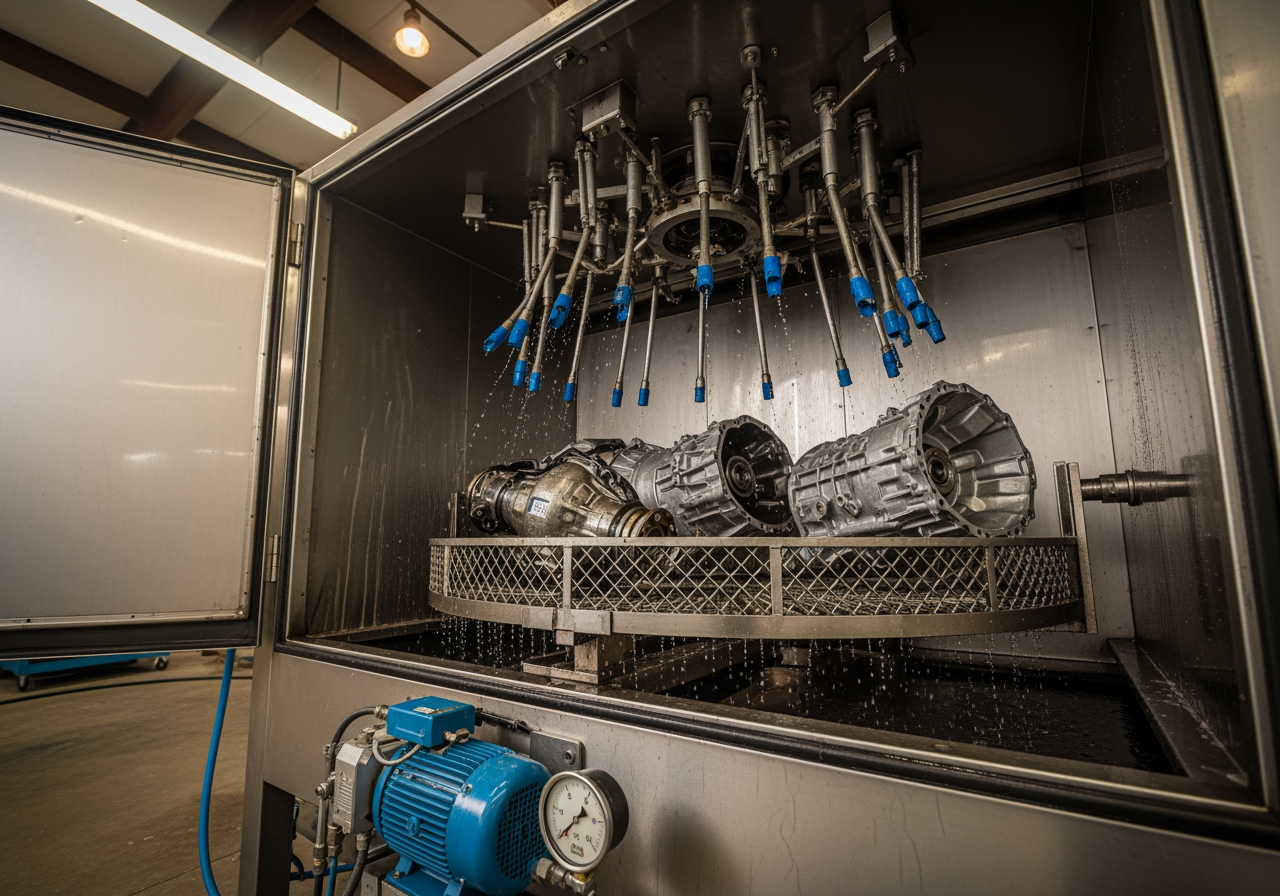
Two rotary parts washers with identical 400-litre tanks can deliver very different cleaning results. The difference comes down to pump pressure specifications and flow rate. Workshop managers who focus only on tank size when comparing machines miss the most important performance factors.
A heavy-duty parts washer running 80 PSI delivers faster cleaning, better contamination removal, and fewer re-wash cycles than a machine running 60 PSI. Understanding how pump pressure and flow rate work together helps you select equipment that cleans parts properly – not one that leaves your mechanic doing touch-up work by hand.
This guide explains how rotary washer pump performance is determined, what pressure levels different applications need, and how to match pump specifications to your actual cleaning requirements.
How Pump Pressure Affects Cleaning Performance
PSI Ratings and Mechanical Cleaning Impact
Pump pressure is measured in pounds per square inch (PSI) or bar. It determines how forcefully heated water and detergent strike contaminated surfaces. Higher pressure creates mechanical impact that dislodges baked-on grease, carbon deposits, and heavy contamination faster than low-pressure systems.
The parts washer range covers multiple pressure tiers matched to different applications. Light workshop cleaning suits 40-50 PSI for hand tools and components with surface-level oil. Most automotive and light industrial applications run 60-80 PSI. Mining operations and heavy industry require 80-100+ PSI for extreme contamination.
Rotary washer pump performance depends on more than the PSI number alone. A well-configured 60 PSI system with properly positioned spray jets outperforms a poorly designed 100 PSI machine every time. Pump pressure only delivers results when spray jets are correctly positioned to direct force at contaminated surfaces.
Temperature and Pressure Working Together
Temperature and pressure work together in rotary parts washing. Heat softens grease and carbon, making them easier to dislodge. Pressure then delivers the mechanical force to remove them.
A system running 80 PSI with 85°C water cleans faster than the same pressure at 60°C. Investing in heavy duty cleaning equipment with proper heating and pressure specifications eliminates the need for repeat cycles on heavily contaminated components.
Temperature amplifies pressure effectiveness particularly on carbon deposits. At low temperatures, high pressure alone may not break down baked-on carbon in cylinder head ports or diesel injector bores. Combined with appropriate heat, the same pressure cleans thoroughly in a single cycle.
Flow Rate and Spray Coverage in Rotary Systems
Litres Per Minute and Coverage Distribution
Flow rate, measured in litres per minute (LPM), determines how much heated water circulates through spray jets. Higher flow rates mean more water contacting parts per minute. This speeds cleaning and improves coverage across large components.
Parts washer spray pressure effectiveness depends on how flow rate is distributed. A pump delivering 150 LPM through four jets puts 37.5 litres per minute through each. The same pump feeding eight jets drops to 18.75 LPM per jet – less volume per nozzle extends cleaning times. Cabinet design must balance jet quantity, positioning, and flow rate for complete coverage.
Extra heavy duty parts washers use higher-capacity pumps to maintain flow rate across larger spray jet arrays. This ensures effective cleaning pressure at every nozzle even when cleaning complex components with multiple spray zones active.
How Basket Rotation Maximises Spray Effectiveness
Rotary basket systems solve the coverage problem mechanically. The basket rotates parts through fixed spray jets. Every surface passes through the spray pattern multiple times during the wash cycle. A 15-minute cycle with a basket rotating at 3 RPM exposes each part surface to spray impact 45 times.
This rotation compensates for fewer jet positions by moving parts through the spray zone repeatedly. Industrial spray washer flow rate requirements are lower in rotary systems than in static spray cabinets because rotation ensures complete surface exposure without requiring jets at every angle.
Rotary systems also keep loosened contamination moving. The rotation prevents dislodged grease and carbon from settling back onto cleaned surfaces before the cycle completes.
The Pump Pressure and Flow Rate Relationship
Why Increasing Pressure Reduces Flow Rate
Pump pressure and flow rate have an inverse relationship. A pump rated for 100 PSI at 200 LPM will not deliver both maximums simultaneously. Increasing pressure reduces flow rate. Increasing flow reduces available pressure.
Hotwash Australia engineers rotary washer pump performance to optimise the pressure-flow balance for each machine’s intended application. Nozzle orifice size controls this balance – smaller openings increase spray velocity and pressure but reduce flow. Larger openings flow more water at lower pressure.
Understanding this trade-off prevents selecting a machine based on a single specification number. Always ask for both pump pressure and flow rate when comparing rotary parts washer models.
Matching Pressure-Flow Balance to Contamination Type
Different contamination types respond better to different pressure-flow combinations. Heavy carbon and baked-on grease respond to high pressure. Fresh oil and loose debris respond to higher flow volume.
Stainless steel washers for food processing applications prioritise flow rate over maximum pressure. Food residue and grease emulsify with volume and temperature rather than mechanical aggression. Gentler pressure also avoids damage to delicate food processing equipment. These systems typically run 55-65 PSI with higher flow rates of 220-260 LPM.
Mining industry washers reverse this priority. High contamination loads benefit from maximum pressure even at the cost of some flow rate. Industrial spray washer flow rate of 180-200 LPM at 90 PSI removes baked-on crude oil and drilling compound that higher flow at lower pressure leaves behind.
Calculating Pressure Requirements by Application
Automotive and Light Industrial Applications
Automotive workshops cleaning engine components need minimum 60 PSI to remove carbon deposits from cylinder heads, pistons, and intake manifolds. Lower pressure leaves carbon in valve seats and port passages, requiring repeat cycles or manual scraping.
A system running 70-80 PSI cleans these parts in one 15-20 minute cycle with biodegradable detergent at 80°C. This pressure range balances cleaning power with reasonable operating costs. It suits most daily workshop cleaning needs across automotive, engineering, and transport maintenance applications.
Mining and Heavy Industry Requirements
Mining maintenance facilities face contamination that automotive pressure settings cannot handle. Excavator bucket teeth, loader arms, and haul truck chassis components arrive caked with mud, rock dust, grease, and hydraulic oil.
Super heavy duty parts washers provide 85-100+ PSI for the most demanding contamination. This pressure cuts through packed mud and dislodges debris from bolt holes and pivot points. Component geometry also drives pressure requirements – complex internal passages and threaded holes need 70+ PSI to flush contamination from recessed areas effectively.
Food Processing and Precision Applications
Food processing equipment cleaning requires moderate pressure – typically 55-65 PSI. Higher pressure can damage seals and bearings in mixers, slicers, and conveyor systems.
The cleaning strategy shifts to flow rate and temperature instead. Water at 75-85°C with food-safe detergent provides sanitation without mechanical damage. Hot tank cleaning systems complement rotary spray washers for food processing facilities where some components benefit from extended soak cleaning rather than spray pressure alone.
Pump Types and Motor Power
Centrifugal Pumps for Industrial Washers
Centrifugal pumps dominate industrial parts washer applications because they handle contaminated water without clogging. These pumps use rotating impellers to accelerate water outward. They tolerate small debris particles and maintain consistent pressure across long operating periods.
Quality systems use heavy-duty centrifugal pumps with stainless steel or bronze impellers that resist corrosion from hot detergent solutions. External pump mounting allows easy maintenance access. Technicians inspect seals, bearings, and impellers without draining the tank or disassembling the wash chamber – a significant time saving during routine servicing.
Motor Power and Three-Phase Supply
Pump motor power determines sustainable pressure and flow rate during extended cycles. A 2.2kW motor suits workshop washers running 60-70 PSI at 150-180 LPM. Mining applications need 3.7-5.5kW motors to sustain 85-100 PSI at 200+ LPM across extended cleaning cycles.
Three-phase power delivers more consistent motor performance for larger systems. Workshops with three-phase supply should specify three-phase motors for improved efficiency and longer motor life. Single-phase motors suit smaller washers and light-duty applications. Confirm your power supply before specifying pump motor size.
Filtration and Long-Term Pressure Maintenance
Mesh and Cartridge Filtration Systems
Contamination removed from parts gradually loads the detergent solution. Without adequate filtration, this contamination clogs spray jets and reduces effective pressure even when the pump maintains rated PSI.
Mesh filters trap large particles before they reach the pump. Workers clean these filters daily in high-use applications. Bag or cartridge filters provide finer filtration, removing smaller particles and carbon dust. Systems operating at 80+ PSI need finer filtration – smaller particles can erode spray jet orifices over time, enlarging openings and reducing pressure.
Regular filter maintenance directly protects rotary washer pump performance. Systems with difficult filter access get neglected. This leads to clogged jets and reduced cleaning effectiveness within months.
Skimmer Systems and Tank Cleanliness
Skimmer systems remove floating oil from the tank surface before it recirculates through spray jets. Oil buildup gradually coats parts with a film during washing. This requires longer cycles or repeat cleaning to achieve the same result.
Effective skimming maintains detergent effectiveness and prevents oil from loading filters prematurely. It also keeps industrial spray washer flow rate consistent by preventing emulsified oil from building up in pump housings and impeller assemblies over time.
Conclusion
Pump pressure specifications determine whether a rotary parts washer delivers consistent cleaning results or leaves contamination requiring manual work. Match pressure and flow rate to your contamination types. Heavy carbon and baked-on grease need 80+ PSI. Fresh oil and loose debris respond to moderate pressure with higher flow rates.
Proper rotary washer pump performance comes from the right combination of pressure, flow rate, spray jet configuration, and effective filtration. These factors work together to deliver cleaning results that eliminate manual scrubbing whilst improving workplace safety.
For expert advice on pump specifications for your cleaning application, speak with our industrial cleaning experts or email us at sales@hotwash.com.au.

Leave A Comment