
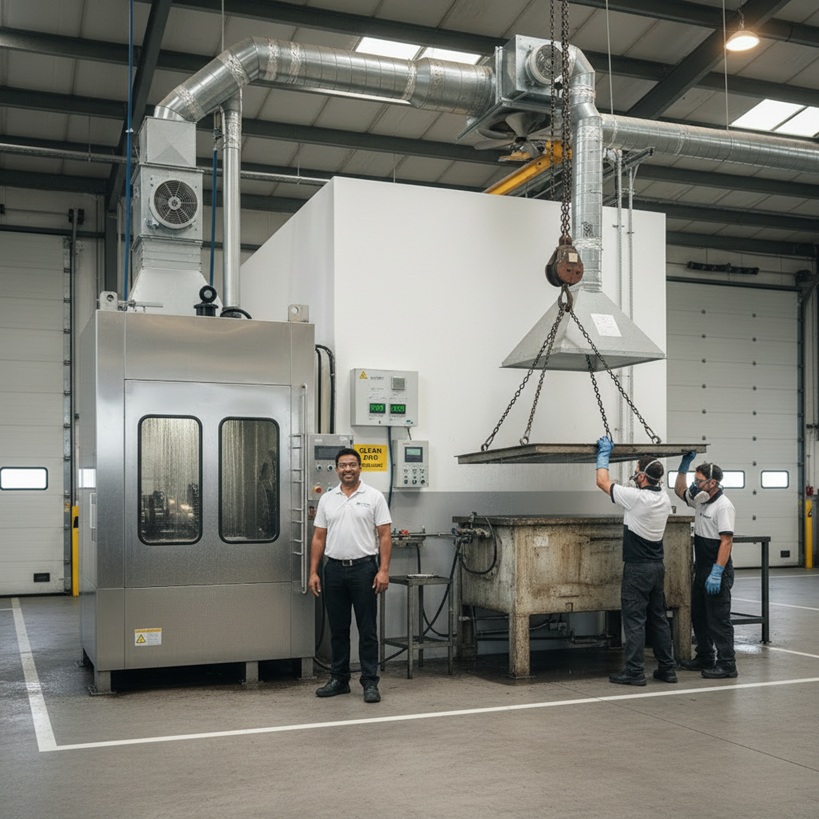
Workshop air quality represents one of the most underestimated occupational hazards in Australian industrial facilities. While visible safety risks like heavy machinery and electrical systems receive constant attention, the invisible threat of solvent vapour exposure quietly accumulates in enclosed spaces, creating serious health consequences for workers who spend hours breathing contaminated air. Volatile organic compounds (VOCs) from traditional solvent-based parts cleaning operations don’t simply disappear after use – they linger in workshop atmospheres, building to concentrations that exceed safe exposure limits and creating regulatory compliance issues for facility managers.
The financial and operational impacts extend beyond immediate health concerns. Solvent vapour exposure contributes to increased sick leave, reduced productivity, potential WorkSafe Australia citations, and long-term liability exposure. For operations managers and maintenance supervisors responsible for both worker safety and operational efficiency, understanding the true scope of VOC exposure risks – and implementing effective mitigation strategies – has become a critical priority.
Understanding VOC Exposure in Industrial Workshops
Volatile organic compounds are carbon-based chemicals that easily evaporate at room temperature, releasing vapours into the surrounding air. In workshop environments, the primary sources include mineral spirits, acetone, toluene, xylene, and other petroleum-based solvents commonly used for parts cleaning, degreasing, and surface preparation. These substances effectively dissolve oils, greases, and contaminants, which explains their widespread use across mining, manufacturing, and automotive maintenance facilities.
Volatility and Dispersion Characteristics
The volatility that makes these solvents effective also makes them dangerous. A single open parts washer using solvent-based cleaning fluid can release significant VOC concentrations into workshop air throughout an eight-hour shift. Unlike dust or visible contaminants, solvent vapours disperse invisibly throughout enclosed spaces, accumulating in areas with inadequate ventilation. Workers often cannot detect dangerous concentration levels until symptoms appear, as many common industrial solvents have odour thresholds higher than their safe exposure limits.
Australian Workplace Exposure Standards
Australian workplace exposure standards set by Safe Work Australia establish time-weighted average (TWA) exposure limits for common solvents. For example, mineral spirits carry an eight-hour TWA of 525 mg/m³, while toluene has a limit of 191 mg/m³. These thresholds represent maximum safe exposure levels – yet monitoring data from enclosed workshops frequently reveals concentrations exceeding these limits, particularly in facilities relying on traditional solvent-based cleaning methods without adequate ventilation systems.
Health Consequences of Chronic Solvent Vapour Exposure
Short-term exposure to elevated VOC concentrations produces immediate symptoms that many workshop personnel dismiss as minor annoyances. Headaches, dizziness, nausea, eye irritation, and respiratory discomfort commonly occur during shifts in poorly ventilated spaces. These acute symptoms reduce worker alertness and productivity, increasing the likelihood of operational errors and workplace accidents. A maintenance technician experiencing solvent-induced dizziness faces heightened injury risk when operating machinery or working at heights.
Chronic Exposure Effects
The more serious concern involves chronic exposure effects that develop over months and years of repeated VOC inhalation. Long-term solvent vapour exposure damages the central nervous system, causing persistent cognitive impairment, memory problems, and coordination difficulties. Medical research documents cases of toxic encephalopathy – permanent brain damage – in workers with extended solvent exposure histories. Liver and kidney damage also occur as these organs process and eliminate absorbed chemicals from the bloodstream.
Specific Solvent Risks
Certain solvents carry additional specific risks. Benzene exposure links directly to leukaemia and other blood disorders. Trichloroethylene and perchloroethylene classify as probable human carcinogens. Even commonly used mineral spirits contain aromatic hydrocarbons associated with neurological damage at chronic exposure levels. For facility managers, these health risks translate into workers’ compensation claims, increased insurance premiums, and potential legal liability – particularly when exposure occurs in environments where safer alternatives exist.
Regulatory Obligations
The Australian Work Health and Safety Act places clear obligations on persons conducting a business or undertaking (PCBUs) to eliminate or minimise risks to worker health. When solvent vapour exposure exceeds safe limits, facilities face regulatory action from state and territory WHS authorities. Documented cases of inadequate exposure control have resulted in improvement notices, prohibition orders, and substantial penalties for Australian businesses.
Why Enclosed Workshops Amplify VOC Risks
Workshop design significantly influences VOC safety enclosed workshops considerations. Enclosed facilities – particularly those in mining operations, manufacturing plants, and urban locations where buildings must remain sealed for climate control – create environments where VOCs accumulate rather than dissipate. Without adequate air exchange rates, vapours released from parts cleaning operations build throughout the workday, reaching concentrations far exceeding those in open or well-ventilated spaces.
Temperature Factors
Temperature factors compound the problem. Australian workshops in northern regions or those housing heat-generating equipment experience elevated ambient temperatures that accelerate solvent evaporation rates. A parts washer operating at 30°C releases significantly more vapour than the same unit at 20°C. Facilities attempting to reduce air conditioning costs by limiting ventilation inadvertently create conditions where solvent vapour concentrations escalate rapidly.
Multiple VOC Sources
Multiple VOC sources within a single workshop create cumulative exposure scenarios. A facility might operate several manual parts washers, use aerosol degreasers for specific applications, and store solvent-contaminated parts awaiting cleaning. Each source contributes to the total VOC load in workshop air. When multiple workers perform solvent-intensive tasks simultaneously in an enclosed space, exposure levels spike beyond what individual task assessments might predict.
Confined Task Microenvironments
The confined nature of certain workshop tasks further increases risk. Maintenance technicians cleaning large equipment components inside enclosed machinery spaces, or workers operating parts washers in storage rooms converted to cleaning areas, face localised VOC concentrations substantially higher than general workshop levels. These microenvironments create acute exposure scenarios that standard facility-wide ventilation systems fail to address.
Measuring and Monitoring Solvent Vapour Exposure
Accurate exposure assessment requires more than subjective observation. Facilities serious about controlling VOC risks implement systematic monitoring programs using calibrated detection equipment. Direct-reading instruments provide real-time measurements of total VOC concentrations, allowing supervisors to identify problem areas and evaluate control measure effectiveness. Personal exposure monitors worn by workers during typical shifts generate time-weighted average data showing actual inhalation exposure levels.
Safe Work Australia Recommendations
Safe Work Australia recommends exposure monitoring when workplace assessments indicate potential exceedance of exposure standards. For workshops using significant quantities of solvents, this typically means conducting initial baseline monitoring, followed by periodic reassessment whenever processes change or new chemicals enter use. Third-party industrial hygienists can provide objective exposure assessments and recommend specific control strategies based on measured data.
Monitoring Pattern Discoveries
Monitoring results often reveal surprising patterns. Facilities might discover that exposure levels peak during specific tasks, certain times of day when ventilation systems operate at reduced capacity, or in particular workshop zones where air circulation proves inadequate. This data-driven understanding enables targeted interventions rather than facility-wide modifications that may prove unnecessarily expensive.
Documentation Requirements
Documentation of monitoring results serves multiple purposes beyond immediate safety management. Records demonstrate regulatory compliance during WorkSafe inspections, provide evidence of due diligence in potential compensation claims, and establish baseline data for evaluating the effectiveness of control measures. Australian WHS regulations require retention of exposure monitoring records for 30 years, reflecting the long latency period of some solvent-related health effects.
Engineering Controls That Reduce VOC Exposure
The hierarchy of controls principle prioritises elimination and substitution over personal protective equipment. For VOC safety enclosed workshops, this means fundamentally changing how parts cleaning occurs rather than simply providing respirators to workers. Hotwash Australia specialises in aqueous-based cleaning systems that eliminate solvent use entirely, removing VOC exposure at the source rather than attempting to control it through ventilation or protective equipment.
Aqueous Parts Washer Benefits
Aqueous parts washers use heated water combined with specifically formulated detergents to achieve cleaning results comparable to solvent-based methods. These systems operate as closed-loop units where cleaning solution recirculates through spray nozzles or immersion tanks, with minimal vapour release. The detergents used in quality aqueous systems break down oils and greases through surfactant action rather than chemical dissolution, producing cleaning effectiveness without the health hazards associated with VOC inhalation.
Heavy-Duty System Features
Heavy duty parts washers designed for workshop applications incorporate features that maximise cleaning performance while maintaining operator safety. High-pressure spray systems deliver mechanical cleaning action that compensates for the reduced chemical aggression compared to solvents. Heated water – typically operating at 60-80°C – enhances detergent effectiveness and reduces cleaning cycle times. For facilities transitioning from solvent-based methods, these systems demonstrate that safety improvements need not compromise operational efficiency.
Extra Heavy-Duty Capacity
Larger operations handling extensive parts cleaning volumes benefit from extra heavy duty parts washers with increased chamber capacity and enhanced spray coverage. These systems process multiple components simultaneously, maintaining throughput rates while eliminating solvent vapour exposure for entire work crews. The enclosed cabinet design contains any minor vapours from heated detergent solutions, preventing dispersal into general workshop air.
Comparing Solvent-Based and Aqueous Cleaning Performance
Operations managers evaluating the transition from solvent to aqueous cleaning frequently question whether water-based systems can match the cleaning effectiveness of traditional methods. Real-world performance data from mining, manufacturing, and heavy equipment maintenance facilities demonstrates that properly specified aqueous systems achieve comparable or superior results for most applications.
Multi-Mechanism Cleaning Approach
Solvent cleaning relies on chemical dissolution – the solvent molecules surround and break down contaminant molecules, allowing them to be wiped or rinsed away. Aqueous cleaning combines multiple mechanisms: surfactants reduce surface tension allowing water to penetrate contaminant layers, alkaline builders saponify oils and greases converting them to water-soluble soaps, and mechanical action from spray pressure or agitation physically removes loosened contamination. This multi-mechanism approach often proves more effective than solvents alone, particularly for complex contamination mixtures.
Temperature Role in Performance
Temperature plays a crucial role in aqueous cleaning performance. Cold water with detergent provides limited effectiveness, which explains why early aqueous systems sometimes disappointed users. Modern hot blaster systems maintain optimal water temperatures throughout cleaning cycles, delivering the thermal energy required for effective contamination removal. The combination of heat, pressure, and chemical action creates cleaning results that satisfy even demanding applications in oil and gas component maintenance.
Immersion Cleaning Applications
Certain specialised applications require immersion cleaning for thorough contamination removal from complex geometries. Hot tank systems provide aqueous alternatives to traditional solvent tanks, using heated detergent solutions to soak and clean intricate parts without VOC exposure risks. These systems prove particularly effective for components with internal passages, threaded connections, and other features where spray washing alone may not achieve complete cleaning.
Regulatory Compliance and Liability Considerations
Australian WHS legislation establishes clear employer obligations regarding hazardous substance exposure. The model WHS Regulations require businesses to identify reasonably foreseeable hazards, assess associated risks, and implement control measures following the hierarchy of controls. When monitoring data or health assessments reveal solvent vapour exposure exceeding safe limits, facilities must take corrective action – failure to do so constitutes a regulatory violation potentially resulting in prosecution.
Inspection and Enforcement
State and territory WHS authorities conduct workplace inspections and investigate worker complaints regarding exposure concerns. Inspectors reviewing solvent use in enclosed workshops examine ventilation systems, exposure monitoring records, and implemented control measures. Facilities demonstrating inadequate controls face improvement notices requiring specific corrective actions within defined timeframes. Serious or repeated violations can result in prohibition notices halting operations until compliance is achieved.
Workers’ Compensation Claims
The financial consequences of inadequate exposure control extend beyond regulatory penalties. Workers’ compensation claims for solvent-related health conditions create direct costs through claim payments and increased insurance premiums. Permanent impairment claims involving neurological damage or organ disease can exceed hundreds of thousands of dollars. For businesses, these costs significantly outweigh the capital investment required for safer cleaning systems.
Civil Liability Risks
Civil liability represents another risk dimension. Workers suffering health effects from solvent exposure may pursue common law damages claims alleging negligent failure to provide a safe workplace. Successful claims can result in substantial damages awards, particularly when evidence shows the employer knew safer alternatives existed but failed to implement them. The documented availability of effective aqueous cleaning systems strengthens plaintiff arguments that continued solvent use represents negligent risk management.
Implementing Safer Parts Cleaning Systems
Transitioning from solvent-based to aqueous cleaning requires systematic planning rather than simple equipment substitution. Successful implementations begin with thorough assessment of current cleaning requirements – what contamination types require removal, what component materials need cleaning, what cleanliness standards must be achieved, and what throughput rates maintain operational efficiency. This assessment data guides appropriate system selection and ensures the chosen solution meets actual operational needs.
Detergent Selection Importance
Detergent selection significantly influences aqueous cleaning performance. Industrial cleaning detergents formulated for specific contamination types – heavy oils, cutting fluids, carbon deposits, or mixed contamination – deliver superior results compared to general-purpose products. Facilities should work with equipment suppliers to identify optimal detergent chemistry for their particular applications, and conduct trial cleaning evaluations before full implementation.
Worker Training Essentials
Worker training ensures successful adoption of new cleaning methods. Employees accustomed to solvent-based processes need instruction in proper aqueous system operation, appropriate detergent concentrations, optimal cleaning cycle times, and routine maintenance procedures. Training should emphasise both the safety benefits of eliminating VOC exposure and the operational advantages of modern automated systems. When workers understand how the new equipment protects their health while maintaining productivity, acceptance and proper use follow naturally.
Manual System Flexibility
Facilities requiring manual cleaning flexibility alongside automated systems can implement manual parts washers using aqueous detergent solutions. These units provide hands-on cleaning capability for odd-sized components or quick cleaning tasks while maintaining the VOC elimination benefits of water-based chemistry. The combination of automated and manual aqueous systems creates comprehensive parts cleaning capability without solvent vapour exposure risks.
Cost-Benefit Analysis of VOC Elimination
Operations managers evaluating aqueous cleaning systems naturally consider capital costs against current solvent-based methods. While quality aqueous equipment requires higher initial investment than simple solvent tanks, comprehensive cost analysis reveals significant long-term savings. Solvent purchase costs, hazardous waste disposal fees, regulatory compliance expenses, and health-related costs all decrease or disappear with aqueous system implementation.
Solvent and Disposal Cost Accumulation
Solvent costs accumulate continuously. A facility using 200 litres of mineral spirits monthly at $8-12 per litre spends $19,200-28,800 annually on cleaning fluid alone. Hazardous waste disposal for contaminated solvent adds additional costs typically ranging from $1-3 per litre, creating annual disposal expenses of $2,400-7,200 for the same operation. Over a typical 10-year equipment lifespan, these recurring costs total $216,000-360,000 – substantially exceeding the capital cost of quality aqueous cleaning equipment.
Aqueous System Operating Costs
Aqueous systems generate operating costs primarily from water, electricity for heating, and detergent consumption. These costs typically run 40-60% lower than equivalent solvent operations. Water usage remains modest in recirculating systems, electricity costs prove manageable with efficient heating elements, and industrial detergents cost significantly less per litre than speciality solvents. The elimination of hazardous waste disposal requirements removes a major recurring expense entirely.
Productivity Improvement Returns
Productivity improvements often offset capital costs within 12-24 months. Automated aqueous systems clean components while workers perform other tasks, eliminating the labour hours required for manual solvent cleaning. Faster cleaning cycles enabled by high-pressure spray and optimal temperatures increase throughput. Reduced sick leave from elimination of VOC exposure maintains workforce availability. These operational improvements deliver measurable returns that justify initial equipment investment.
Creating a Comprehensive Exposure Control Program
Effective VOC safety enclosed workshops management requires more than equipment changes alone. Comprehensive programs integrate engineering controls, administrative procedures, and monitoring systems into cohesive workplace safety management. Facilities should develop written exposure control plans documenting identified hazards, implemented control measures, monitoring schedules, and worker training requirements.
Administrative Controls
Administrative controls complement engineering solutions by minimising exposure duration and intensity. Work scheduling can limit the number of personnel in areas where any residual solvent use continues, restrict cleaning operations to times when ventilation systems operate at full capacity, and rotate workers through exposure tasks to reduce individual cumulative exposure. These procedural controls provide additional protection layers while equipment upgrades progress.
Personal Protective Equipment
Personal protective equipment represents the last line of defence in the hierarchy of controls. When engineering and administrative measures cannot reduce exposure below safe limits, appropriate respiratory protection becomes mandatory. However, respirator programs create substantial administrative burden – medical evaluations, fit testing, training, maintenance, and ongoing compliance monitoring all require dedicated resources. The complexity and cost of effective respirator programs provide additional motivation for implementing engineering controls that eliminate exposure at the source.
Regular Program Review
Regular program review ensures continued effectiveness as operations evolve. Annual assessments should evaluate monitoring data trends, review any exposure-related health concerns, assess new cleaning requirements that might affect exposure, and identify opportunities for further improvement. This systematic review process demonstrates management commitment to worker safety and maintains regulatory compliance.
Conclusion
Solvent vapour exposure in enclosed workshops represents a serious occupational health hazard that many Australian facilities have inadequately addressed. The invisible nature of VOC contamination, combined with the gradual onset of chronic health effects, has allowed dangerous exposure conditions to persist in operations that would never tolerate visible safety hazards of equivalent severity. For operations managers and maintenance supervisors, the evidence is clear – traditional solvent-based parts cleaning creates unacceptable health risks, regulatory compliance challenges, and financial liabilities that far outweigh the costs of implementing safer alternatives.
Modern aqueous cleaning technology eliminates VOC exposure at the source while delivering cleaning performance that meets demanding industrial requirements. The transition from solvent to water-based systems requires initial capital investment and operational adjustment, but facilities that complete this transition consistently report improved worker safety, reduced operating costs, and enhanced regulatory compliance. The combination of health protection, cost savings, and operational efficiency makes aqueous parts washing the logical choice for any facility serious about workplace safety and long-term operational sustainability.
Australian-made stainless steel parts washers and industrial-grade systems provide proven solutions for operations ready to eliminate solvent vapour exposure. The investment in worker health through proper equipment selection delivers returns measured not just in financial terms, but in the wellbeing of the people whose daily labour drives operational success. For facilities still relying on solvent-based cleaning in enclosed workshops, the question is no longer whether to transition to safer methods, but how quickly that transition can be accomplished. Contact us to discuss aqueous cleaning solutions tailored to specific operational requirements and begin the process of eliminating VOC exposure risks from workshop environments.

Leave A Comment