
Australia’s automotive workshops face a crisis that goes far beyond empty job listings. The automotive technician shortage Australia currently experiences has created a cascade of operational inefficiencies that directly impact workshop profitability, customer satisfaction, and workplace safety. While industry reports focus on recruitment challenges, the hidden costs of this shortage are quietly eroding workshop margins through extended turnaround times, increased labour expenses, and compromised service quality.
The Australian Automotive Dealer Association reports that 78% of workshops struggle to fill technician positions, with the average vacancy remaining open for 4-6 months. This shortage forces existing staff to shoulder heavier workloads, leading to burnout rates that perpetuate the cycle. Yet many workshop managers overlook a critical solution: strategic workshop equipment efficiency solutions that multiply technician productivity and reduce dependency on manual labour-intensive processes.
The Real Financial Impact of Technician Shortages
Workshop managers typically calculate technician shortage costs in terms of unfilled positions and recruitment expenses. The actual financial damage runs considerably deeper. When workshops operate below optimal staffing levels, every remaining technician becomes more valuable – and more expensive.
Average automotive technician wages in Australia have increased 23% since 2020, with experienced technicians commanding $75,000-$95,000 annually in metropolitan areas. Mining regions see even higher rates, with workshop technicians earning $110,000-$130,000 to compete with resources sector wages. These labour costs represent 40-50% of total workshop operating expenses, making efficiency improvements in this area particularly impactful.
The shortage creates three hidden cost centres that most workshops fail to quantify:
Extended turnaround times directly reduce workshop throughput. When technicians spend 45-60 minutes manually cleaning engine components, transmissions, or heavy equipment parts, that’s billable time lost to non-revenue-generating activities. A workshop processing 20 major services weekly loses approximately 15-20 hours to manual parts cleaning – equivalent to half a technician’s productive capacity.
Increased overtime expenses compound labour costs. Workshops struggling with backlogs regularly authorise overtime at 1.5x to 2x standard rates. A workshop paying $45/hour standard rates faces $67.50-$90/hour overtime costs. When 10-15 hours of weekly overtime becomes routine, annual additional labour costs reach $35,000-$70,000.
Quality inconsistencies emerge when rushed technicians skip thorough cleaning steps. Inadequately cleaned components lead to premature failures, warranty claims, and reputation damage. The Australian Competition and Consumer Commission reported a 34% increase in automotive service complaints between 2019 and 2023, with cleaning-related issues featuring prominently in warranty disputes.
How Manual Parts Cleaning Compounds Staffing Challenges
Manual parts cleaning represents one of the most labour-intensive, least-skilled tasks in automotive workshops – yet it consumes disproportionate technician time. The traditional three-sink method requires technicians to manually scrub components with brushes, solvents, and degreasing agents, spending 30-90 minutes per job depending on contamination levels.
This process creates multiple operational inefficiencies. Qualified technicians performing manual cleaning work represent a fundamental misallocation of skilled labour. A technician earning $40-$50/hour manually scrubbing brake components delivers minimal return on that labour investment compared to diagnostic work, complex repairs, or customer consultations.
The physical demands of manual cleaning accelerate technician fatigue and contribute to workplace injuries. Repetitive scrubbing motions, prolonged standing, and chemical exposure create ergonomic risks that increase workers’ compensation claims and sick leave. Safe Work Australia data shows automotive workshop injury rates 2.3 times higher than general industry averages, with manual handling and chemical exposure among leading causes.
Manual cleaning also produces inconsistent results that vary by technician effort, experience, and time pressure. Components cleaned during morning shifts typically receive more thorough attention than those cleaned during end-of-day rushes. This variability creates quality control challenges and occasional rework requirements.
The Productivity Multiplier Effect of Automated Cleaning Systems
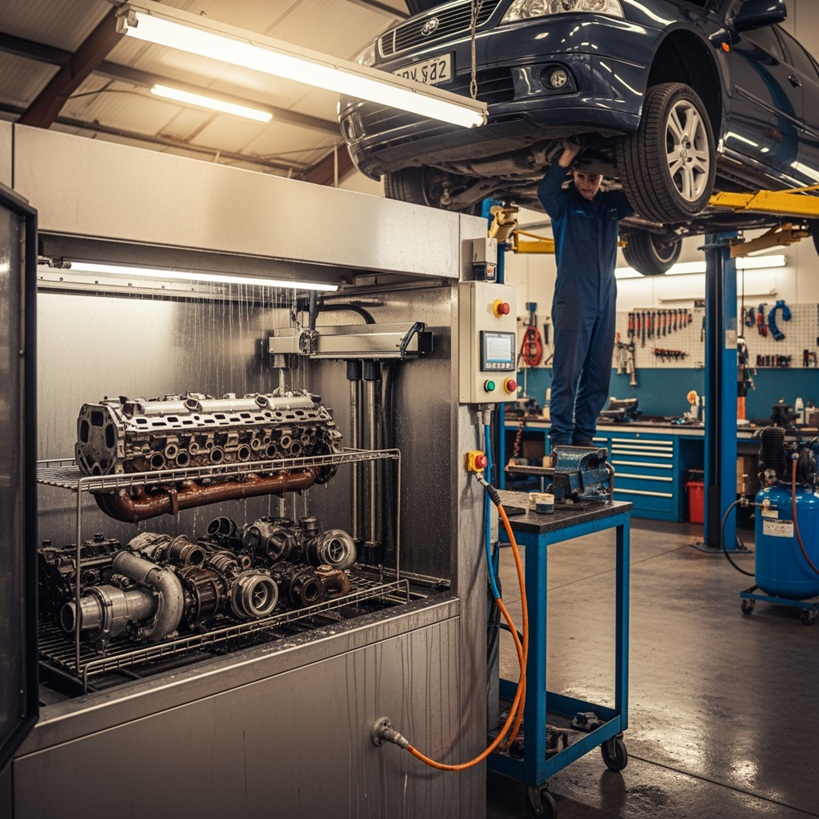
Strategic workshop equipment efficiency solutions transform workshop economics by multiplying individual technician output. Automated parts washing systems eliminate the labour-intensive manual cleaning process, allowing technicians to focus on skilled diagnostic and repair work that justifies their wages.
The productivity gains prove substantial. Where manual cleaning requires 45-60 minutes of active technician time, automated systems complete the same task in 10-15 minutes of machine time with zero technician involvement. The technician loads contaminated components, starts the cycle, and returns to revenue-generating work while the machine handles cleaning.
This efficiency improvement effectively adds productive capacity equivalent to 0.3-0.5 full-time technicians without additional labour costs. A workshop processing 15-20 major services weekly recovers 12-15 hours of technician time – enough to complete 3-4 additional services or focus on higher-margin diagnostic work.
The consistency advantage proves equally valuable. Automated systems deliver identical cleaning results regardless of time pressure, technician fatigue, or experience levels. Every component receives the same high-pressure spray coverage, heated detergent exposure, and rinse cycle duration. This consistency eliminates the quality variations that create warranty issues and customer complaints.
Matching Equipment Capacity to Workshop Operations
Workshop managers evaluating automated cleaning equipment must match system capacity to operational demands. Undersized equipment creates bottlenecks that limit productivity gains, while oversized systems represent unnecessary capital expenditure.
Small to medium automotive workshops (5-15 technicians) typically benefit from manual parts washers or heavy duty parts washers with 600-800mm chamber dimensions. These systems accommodate engine components, transmissions, brake assemblies, and suspension parts while fitting within typical workshop floor space constraints.
Larger workshops, fleet maintenance facilities, and heavy vehicle operations require extra heavy duty parts washers with 1000-1200mm chambers. These systems handle larger components like diesel engine blocks, heavy equipment hydraulics, and mining machinery parts. The increased capacity allows multiple smaller items or single large components per cycle.
Workshops serving mining operations, earthmoving contractors, or agricultural equipment face extreme contamination levels from mud, grease, coal dust, and hydraulic fluids. These applications demand maximum cleaning power from super heavy duty systems with high-pressure spray capabilities (1500-2000 PSI) and heated water (60-80°C) to dissolve stubborn contaminants.
Return on Investment: The Numbers That Matter
Workshop managers justify equipment investments through clear ROI calculations based on labour savings, increased throughput, and reduced operating costs. The financial case for automated parts washing proves compelling when properly quantified.
Labour cost recovery provides the primary ROI driver. A workshop recovering 12 hours weekly of technician time valued at $45/hour saves $28,080 annually in direct labour costs. This calculation assumes the technician redirects recovered time toward billable work rather than reducing total hours – a reasonable assumption given the chronic automotive technician shortage in Australia.
Increased service capacity generates additional revenue without proportional cost increases. A workshop completing 3-4 additional services weekly at $400-$600 average revenue generates $62,400-$124,800 additional annual revenue. Even accounting for parts costs and overhead allocation, this represents $25,000-$50,000 yearly additional profit contribution.
Reduced chemical and consumable costs provide ongoing savings. Manual cleaning consumes significant quantities of solvents, degreasers, brushes, and rags. Automated systems use concentrated detergents more efficiently, with typical annual chemical costs of $1,200-$2,400 compared to $3,500-$5,000 for manual cleaning supplies.
Workers’ compensation and safety improvements reduce insurance premiums and lost-time injury costs. Workshops eliminating manual cleaning tasks reduce chemical exposure incidents, repetitive strain injuries, and back injuries from awkward positioning. These improvements can reduce workers’ compensation premiums by 5-15% while eliminating the productivity loss from injured workers.
A typical ROI calculation for a $15,000-$25,000 automated parts washer shows payback periods of 12-24 months through combined labour savings, increased capacity, and reduced operating costs. Workshops with higher labour costs or greater service volumes achieve faster payback.
Integration Strategies for Maximum Impact
Equipment purchases deliver maximum value when integrated into comprehensive workflow improvements. Simply installing automated cleaning equipment without process redesign leaves productivity gains unrealised.
Workflow sequencing ensures technicians utilise equipment efficiently. Establishing standard procedures where technicians load components into washers immediately upon disassembly prevents equipment from sitting idle while components await cleaning. This requires positioning parts washers near disassembly areas rather than isolating them in separate cleaning rooms.
Batch processing maximises equipment utilisation. Rather than running half-empty cleaning cycles, workshops should accumulate components throughout the day for consolidated cleaning runs. This approach optimises water, energy, and detergent consumption while ensuring equipment operates near capacity.
Cross-training ensures all technicians understand equipment operation and maintenance. When only one or two staff members know how to operate parts washers, the equipment sits unused during their absence. Simple operation training (typically 15-30 minutes) allows any technician to load, start, and unload cleaning cycles.
Preventive maintenance schedules protect equipment investments and maintain performance. Regular filter cleaning, pump inspections, and heating element checks prevent unexpected failures that disrupt workflow. Most automated parts washers require 15-30 minutes of monthly maintenance – a minimal time investment to protect system reliability.
Australian Manufacturing Advantage
Workshop managers evaluating parts washing equipment should prioritise Australian-manufactured systems that meet local standards and provide accessible support. Equipment designed and built for Australian industrial conditions offers distinct advantages over imported alternatives.
Australian-built stainless steel parts washers are manufactured specifically for Australian workshop environments, mining operations, and heavy equipment maintenance facilities. Local manufacturing ensures compliance with Australian electrical standards, pressure vessel regulations, and workplace safety requirements without modification or certification delays.
The durability advantage proves particularly relevant for workshops in regional and remote areas. Australian-built equipment withstands harsh operating conditions, including temperature extremes, dust exposure, and heavy contamination levels common in mining and agricultural service operations. Rugged construction using heavy-gauge steel, industrial-grade pumps, and commercial heating elements ensures reliable long-term performance.
Local manufacturing also provides responsive technical support and parts availability. When equipment requires service or replacement components, Australian manufacturers offer same-week parts delivery and technical assistance from engineers familiar with local operating conditions. This support infrastructure minimises downtime compared to imported equipment requiring international parts ordering and remote troubleshooting.
Addressing the Skills Gap Through Equipment Strategy
The automotive technician shortage Australia faces won’t resolve quickly. Industry projections suggest continued shortages through at least 2030 as baby boomer technicians retire faster than new apprentices enter the trade. Workshops waiting for labour market improvements will face competitive disadvantages against operations that adapt through strategic workshop equipment efficiency solutions.
Smart equipment strategy doesn’t replace skilled technicians – it multiplies their effectiveness. By eliminating time-consuming manual tasks, automated systems allow each technician to accomplish more revenue-generating work. This productivity improvement helps workshops maintain service capacity despite staffing constraints while improving workplace satisfaction by removing physically demanding, repetitive tasks that contribute to burnout.
The competitive advantage extends beyond immediate productivity gains. Workshops offering faster turnaround times, more consistent quality, and better workplace conditions attract and retain the limited pool of available technicians. In tight labour markets, equipment investments that improve working conditions become recruitment and retention tools that reduce the costly cycle of technician turnover.
Moving Forward: Making Strategic Equipment Decisions
Workshop managers facing technician shortages should evaluate equipment investments through the lens of productivity multiplication rather than simple cost reduction. The question isn’t whether automated parts washing costs less than manual cleaning – it’s whether the equipment investment generates sufficient additional capacity to justify the capital expenditure.
The business case strengthens when managers quantify all relevant factors: direct labour savings, increased service throughput, improved quality consistency, reduced workplace injuries, and competitive positioning advantages. These combined benefits typically justify equipment investments within 12-24 months while providing ongoing operational improvements throughout the equipment’s 10-15 year service life.
Workshops should begin by documenting current manual cleaning time requirements, calculating the hourly value of technician labour, and identifying workflow bottlenecks that limit service capacity. This baseline assessment reveals the productivity gaps that equipment can address and provides concrete metrics for ROI calculations.
The next step involves matching equipment specifications to operational requirements. Chamber dimensions, pressure ratings, heating capacity, and automation features should align with the types and quantities of components requiring cleaning. Oversized equipment wastes capital and floor space, while undersized systems create new bottlenecks that limit productivity gains.
Conclusion
The automotive technician shortage Australia currently experiences creates operational pressures that extend far beyond recruitment challenges. Hidden costs, including extended turnaround times, increased labour expenses, and quality inconsistencies, quietly erode workshop profitability while competitive pressures intensify. Workshop managers who recognise these challenges as equipment strategy opportunities position their operations for sustainable competitive advantage.
Automated parts washing systems multiply individual technician productivity by eliminating labour-intensive manual cleaning tasks that consume 12-15 hours weekly in typical workshops. This recovered time translates directly into increased service capacity, faster turnaround times, and improved workplace satisfaction – critical advantages in tight labour markets where attracting and retaining skilled technicians determines business success.
The financial case for strategic workshop equipment efficiency solutions proves compelling when managers quantify all relevant factors. Labour savings, increased throughput, reduced operating costs, and improved safety outcomes typically justify equipment expenditures within 12-24 months while providing ongoing operational benefits throughout extended service lives. These improvements help workshops maintain service capacity despite staffing constraints while creating workplace conditions that attract available technicians.
Australian-manufactured equipment offers distinct advantages, including local standards compliance, rugged construction suited to harsh operating conditions, and responsive technical support that minimises downtime. These factors prove particularly valuable for regional workshops and operations serving mining, agricultural, and heavy equipment sectors where equipment reliability directly impacts business continuity.
Workshop managers ready to address technician shortage impacts through strategic equipment investments should contact us to discuss operational requirements, evaluate system specifications, and develop ROI projections based on specific workshop conditions. The conversation starts with understanding current workflow challenges and identifying equipment solutions that deliver measurable productivity improvements.

Leave A Comment