
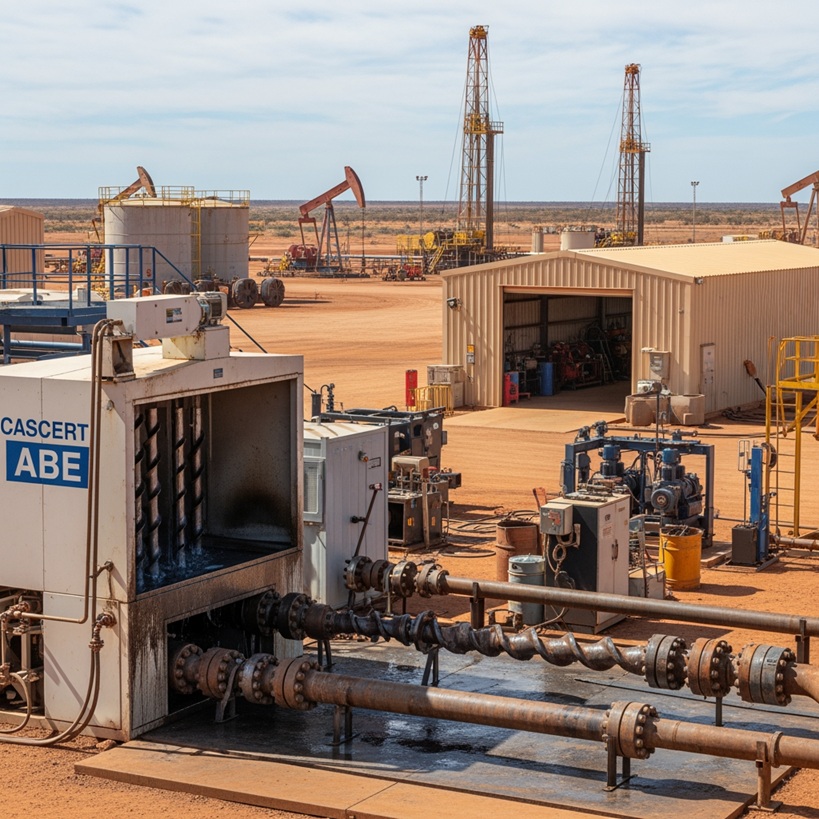
Oil field operations generate some of the most challenging cleaning requirements in industrial environments. Drill bits caked with drilling mud, valves coated in crude oil, and pipeline components contaminated with heavy grease demand thorough, reliable cleaning to maintain operational efficiency and equipment longevity.
The decision between on-site vs off-site cleaning comparison carries significant financial implications beyond the immediate cleaning costs. Transportation expenses, equipment downtime, labour allocation, and operational continuity all factor into the total economic impact. For oil field operators managing multiple sites across remote locations, understanding the on-site vs off-site cleaning comparison determines whether investing in dedicated oil field cleaning equipment delivers genuine ROI or whether outsourcing remains the more viable option.
This analysis examines the true costs of both approaches, revealing where oil field cleaning equipment delivers measurable financial advantages and where off-site services maintain their value proposition.
The Hidden Costs of Off-Site Parts Cleaning
Off-site cleaning services appear cost-effective on invoices, but the total economic impact extends far beyond the cleaning charges.
Transportation and Logistics Expenses
Moving contaminated parts from remote oil field locations to cleaning facilities creates substantial recurring costs. Transport vehicles require specialised containment for hazardous materials, drivers must hold appropriate certifications, and fuel costs accumulate rapidly across long distances. For operations in Western Australia’s petroleum regions, round-trip distances of 200-400 kilometres to specialised cleaning facilities translate to $150-$300 per transport run, excluding the actual cleaning charges.
Multiple weekly shipments compound these expenses. An operation generating 50 contaminated components weekly faces annual transportation costs exceeding $39,000 before any cleaning work begins.
Downtime and Operational Delays
Equipment waiting for off-site cleaning cannot generate revenue. A drill bit requiring cleaning sits idle during transport, cleaning, and return journey – typically 3-5 business days for standard service levels. Rush services reduce this timeline but increase costs by 40-60%.
For critical components, this downtime forces operations to maintain larger spare parts inventories. A drilling operation requiring continuous access to cleaned drill bits must stock 3-4 times the working quantity to account for cleaning cycle delays, tying up capital in redundant inventory.
Quality Control and Specification Compliance
Off-site facilities clean parts to their standard specifications, which may not align with specific operational requirements. Oil field components often need cleaning to precise contamination thresholds for reassembly or inspection. When external facilities fail to meet these specifications, parts require re-cleaning, doubling both costs and delays.
The inability to inspect parts during the cleaning process creates quality assurance gaps. Operators discover inadequate cleaning only after components return to site, forcing additional transport cycles and extended downtime.
The Capital Investment Reality of On-Site Systems
On-site cleaning requires upfront capital investment that off-site services avoid. Understanding this investment’s scope and payback timeline determines economic viability.
Equipment Acquisition Costs
Industrial-grade oil field cleaning equipment designed for severe contamination levels represents significant capital expenditure. Super heavy-duty parts washers capable of handling crude oil, drilling fluids, and heavy grease contamination typically range from $45,000 to $85,000 depending on chamber capacity, automation features, and construction specifications.
For operations requiring immersion cleaning of large components, hot tank systems provide the necessary capacity and thermal cleaning power, with investment levels between $35,000 and $65,000 for industrial-capacity units.
These figures exclude installation costs, which add 8-12% to total investment depending on site infrastructure and utility connections required.
Infrastructure and Facility Requirements
On-site cleaning systems need appropriate infrastructure. Concrete pads capable of supporting equipment weight, adequate drainage systems for wash water management, electrical supply meeting equipment specifications (typically three-phase power for industrial units), and proper ventilation for enclosed cleaning areas all contribute to setup costs.
Remote oil field locations may require infrastructure upgrades totalling $12,000-$25,000 before equipment installation. Established facilities with existing maintenance workshops typically face lower infrastructure costs, often under $8,000.
Operational Expenses
Running on-site cleaning equipment generates ongoing costs including electricity consumption, water usage, cleaning detergent purchases, and periodic maintenance. Industrial parts washers operating 6-8 hours daily typically consume $180-$280 monthly in electricity, $40-$70 in water (where municipal supply exists), and $120-$200 in industrial-grade detergents.
Annual maintenance requirements – pump inspections, heating element checks, filter replacements – add approximately $1,800-$2,500 to operational costs for heavy-duty systems.
Break-Even Analysis: When On-Site Investment Pays Off
The economic crossover point where on-site cleaning becomes more cost-effective than off-site services depends on parts volume, contamination levels, and operational patterns.
Volume Thresholds
Operations cleaning 30-40 components weekly typically reach break-even within 18-24 months of equipment purchase. At this volume, off-site cleaning costs (including transportation) range from $85-$140 per component, totalling $132,600-$291,200 annually. An on-site system with $65,000 acquisition cost plus $15,000 annual operating expenses delivers positive ROI by month 22.
Higher volumes accelerate payback. Operations processing 60-80 components weekly break even within 12-16 months, while facilities handling 100+ weekly components often achieve payback in under 12 months.
Contamination Severity Impact
Heavy contamination levels increase off-site cleaning costs while having minimal impact on on-site equipment expenses. Crude oil-saturated components requiring multiple cleaning cycles cost $180-$250 per unit at external facilities, compared to standard $85-$140 rates. Heavy-duty parts washers handle severe contamination with marginally higher detergent consumption – perhaps $15-$30 additional monthly expense.
For operations dealing predominantly with severe contamination, break-even timelines compress by 25-35% compared to standard contamination scenarios.
Geographic Considerations
Remote locations with long transport distances to cleaning facilities dramatically favour on-site investment. Operations located 300+ kilometres from specialised cleaning services face transportation costs exceeding $200 per shipment, accelerating on-site equipment payback by 6-9 months compared to operations near urban cleaning facilities.
Operational Flexibility and Control Benefits
Beyond direct cost comparisons, on-site cleaning delivers operational advantages that carry economic value difficult to quantify but genuinely impactful.
Immediate Parts Availability
On-site cleaning reduces component turnaround from 3-5 days to 1-3 hours. This availability eliminates the need for extensive spare parts inventories, releasing capital tied up in redundant equipment. A drilling operation reducing spare drill bit inventory from 12 units to 4 units frees $120,000-$180,000 in working capital.
Cleaning Schedule Control
On-site systems allow cleaning schedules aligned with operational requirements rather than external facility availability. Night shift operations can clean components during production downtime, maximising equipment utilisation. Emergency cleaning of critical components proceeds immediately rather than waiting for transport scheduling and facility availability.
Specification Customisation
On-site cleaning enables precise control over cleaning specifications. Operators adjust water temperature, pressure settings, cycle duration, and detergent concentration to match component requirements. This customisation ensures parts meet exact cleanliness standards for reassembly, inspection, or storage without negotiating specifications with external facilities.
Labour Economics: Internal vs External Resources
Labour represents a significant portion of total cleaning costs, whether handled internally or outsourced.
On-Site Labour Requirements
Operating industrial parts washers requires minimal specialised training. Existing maintenance staff typically operate cleaning equipment as part of broader responsibilities, with 2-3 hours training sufficient for competent operation. Heavy-duty parts washers with automated cycles reduce labour to loading, starting cycles, and unloading – approximately 15-20 minutes per batch.
For operations cleaning 40 components weekly in batches of 8-10 parts, total labour commitment averages 3-4 hours weekly. At maintenance technician wage rates ($35-$45 per hour), this represents $5,460-$9,360 annual labour cost.
Off-Site Service Labour Costs
Off-site cleaning embeds labour costs in service charges, but additional internal labour handles logistics coordination, parts tracking, quality verification, and inventory management. Operations using external cleaning services typically assign 6-8 hours weekly to these coordination activities, representing $10,920-$18,720 annual internal labour cost.
The combined external service charges plus internal coordination labour often exceeds on-site cleaning labour by 40-60%.
Risk Factors and Hidden Liabilities
Economic analysis must account for risk exposure differences between the on-site vs off-site cleaning comparison.
Supply Chain Vulnerability
Off-site cleaning creates dependency on external service availability. Facility maintenance shutdowns, transport disruptions, or capacity constraints at cleaning facilities directly impact operational continuity. Oil field operations experiencing 2-3 cleaning service disruptions annually face unplanned downtime costs averaging $15,000-$35,000 per incident.
On-site equipment eliminates this supply chain vulnerability. Equipment maintenance occurs during scheduled downtime, and backup cleaning methods (manual washing) remain available during equipment service.
Contamination Control and Environmental Compliance
Transporting contaminated parts creates environmental liability exposure. Spills during transport, improper containment, or documentation errors generate compliance risks and potential penalties. On-site cleaning contains contamination within controlled facility boundaries, reducing environmental liability exposure.
Waste disposal from on-site cleaning remains the operator’s responsibility, but contaminated wash water management occurs in controlled conditions with established site environmental protocols.
Hybrid Approaches: Optimising Both Strategies
Some operations achieve optimal economics by combining both approaches strategically in the on-site vs off-site cleaning comparison.
Routine vs Specialised Cleaning
Maintaining oil field cleaning equipment for routine cleaning of frequently contaminated components while outsourcing specialised cleaning of unusual parts or components requiring specific processes optimises cost efficiency. Operations clean 80-90% of parts on-site while sending complex or oversised components to specialised facilities.
This approach delivers most on-site cleaning benefits while avoiding capital investment in specialised equipment for occasional requirements.
Multi-Site Operations
Companies operating multiple oil field sites may centralise cleaning equipment at primary facilities while using off-site services for satellite locations. Parts from smaller sites consolidate to the central facility for cleaning, reducing per-site equipment investment while maintaining significant in-house cleaning capacity.
The Australian Manufacturing Advantage
For Australian oil field operators, equipment sourcing decisions carry additional economic implications.
Australian-manufactured cleaning systems from companies like Hotwash Australia offer advantages including local technical support, faster parts availability, and equipment designed for Australian industrial conditions. These factors reduce long-term operational costs and equipment downtime compared to imported alternatives requiring international parts ordering and offshore technical support.
Equipment built to Australian standards ensures compliance with local workplace health and safety requirements without modification, avoiding retrofit costs and compliance delays.
Making the Economic Decision
The on-site vs off-site cleaning comparison requires comprehensive cost analysis extending beyond immediate cleaning expenses.
Calculate Total Cost of Ownership
Accurate comparison demands five-year total cost projections including equipment acquisition, installation, operational expenses, labour, maintenance, and capital cost of money for on-site options compared to service charges, transportation, coordination labour, downtime costs, and inventory carrying costs for off-site approaches.
Assess Operational Priorities
Operations prioritising maximum uptime, rapid turnaround, and operational independence typically find stronger economic justification for on-site investment. Facilities with lower parts volumes, proximity to quality cleaning services, and capital constraints may find off-site services more economically viable.
Consider Growth Trajectory
Expanding operations with increasing parts cleaning requirements favour on-site investment. Extra heavy-duty parts washers provide capacity that accommodates growth without proportional cost increases, while off-site service costs scale linearly with volume.
Conclusion
The economics of on-site vs off-site cleaning comparison in oil field operations extend far beyond simple per-component cleaning costs. Transportation expenses, equipment downtime, inventory requirements, labour allocation, operational flexibility, and supply chain reliability all contribute to total economic impact.
For operations processing 30+ components weekly, particularly those in remote locations or handling severe contamination, oil field cleaning equipment typically delivers positive ROI within 12-24 months while providing operational advantages that enhance productivity and reduce vulnerability to external service disruptions.
Extra heavy-duty parts washers designed for oil field contamination levels represent significant capital investment, but this investment often proves economically superior to ongoing external service dependencies when total costs receive proper analysis.
Australian oil field operators benefit from evaluating their specific operational patterns, parts volumes, contamination levels, and site locations against comprehensive cost models. The resulting analysis reveals whether on-site cleaning equipment, off-site services, or strategic hybrid approaches deliver optimal economic outcomes for their operations.
To discuss parts cleaning economics specific to your oil field operations and explore equipment options designed for petroleum industry requirements, contact us for detailed ROI analysis and system recommendations tailored to your operational profile.

Leave A Comment