
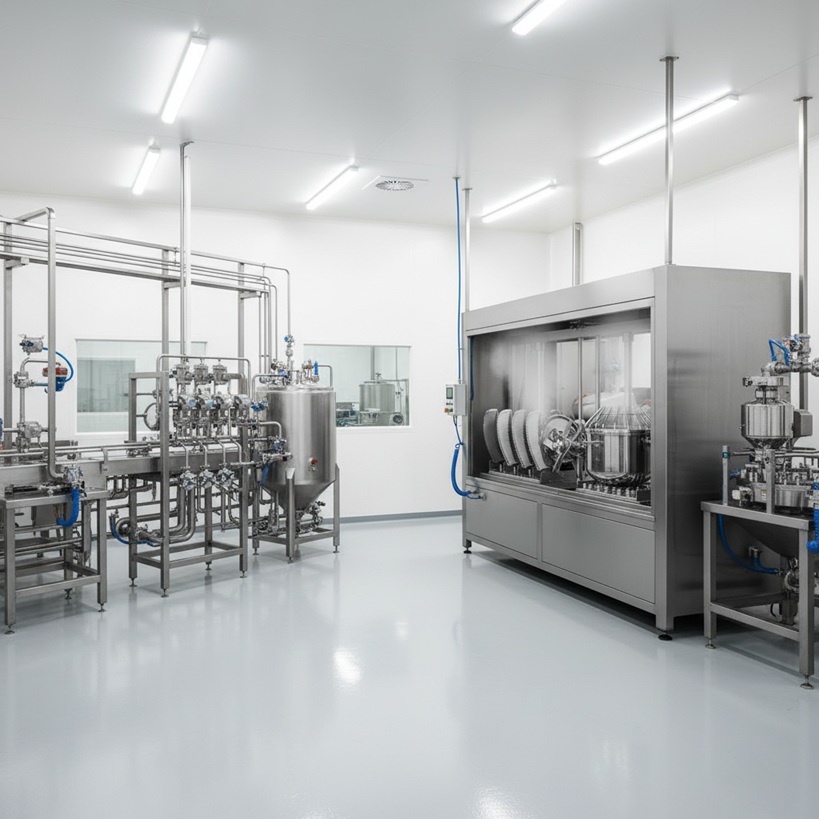
Food manufacturers face a critical financial decision that impacts every shift: how to clean processing equipment without bleeding labour hours and production time. The choice between manual cleaning and automated clean-in-place systems determines not just hygiene outcomes, but profit margins, throughput capacity, and competitive positioning in an industry where downtime costs thousands per hour.
Manual cleaning protocols dominate smaller food processing operations across Australia, but the economics tell a different story. A typical manual cleaning cycle for a mid-sized mixing tank consumes 2-3 hours of labour time, requires production shutdown, and delivers inconsistent results that risk batch contamination. Clean-in-place (CIP) systems complete the same task in 45 minutes with zero manual scrubbing, consistent sanitation results, and minimal production interruption.
The question isn’t whether CIP systems cost more upfront – they do. The question is whether the operational savings, risk reduction, and capacity gains justify the capital investment. For most food manufacturers processing more than one shift daily, the mathematics favour automation within 18-24 months. Hotwash Australia specialises in manufacturing food-grade cleaning equipment that delivers measurable ROI through reduced labour costs and increased production capacity.
Direct Labour Cost Comparison: Manual vs Automated Cleaning
Manual cleaning in food manufacturing isn’t just about scrubbing equipment. The full labour cost includes pre-cleaning preparation, disassembly, actual cleaning, sanitation verification, reassembly, and documentation. For a processing line with three tanks, two heat exchangers, and associated pipework, this typically requires:
- 2-3 operators per cleaning cycle
- 3-4 hours per cycle including setup and breakdown
- 6-12 total labour hours per cleaning event
- At $35/hour loaded labour cost: $210-$420 per cleaning cycle
Food manufacturers running two shifts daily perform this cleaning twice per 24-hour period, consuming 12-24 labour hours daily at a cost of $420-$840. Annually, manual cleaning labour for a single processing line reaches $153,300-$306,600.
CIP System Labour Requirements
Clean-in-place systems eliminate this manual labour. Automated cleaning cycles run programmatically, requiring only supervisory oversight. A single operator monitors multiple CIP cycles simultaneously, reducing labour requirements to:
- 0.25 operator hours per cycle (monitoring only)
- Two cycles daily: 0.5 labour hours
- At $35/hour loaded labour cost: $17.50 daily
- Annual labour cost: $6,388
The labour cost differential between manual cleaning and automated CIP systems reaches $146,912-$300,212 annually for a single processing line. For facilities running multiple lines, these savings multiply proportionally.
Production Capacity and Downtime Economics
Labour costs represent only half the economic equation. Production downtime during cleaning directly impacts manufacturing capacity and revenue potential. Manual cleaning requires complete production shutdown, equipment cooldown, disassembly, cleaning, reassembly, and restart procedures.
Manual Cleaning Production Losses
A typical manual cleaning cycle consumes 3-4 hours of production time. For a food manufacturing line producing $800 worth of finished goods per hour, each cleaning cycle sacrifices $2,400-$3,200 in potential output. With two cleaning cycles daily, production losses reach $4,800-$6,400 per day or $1,752,000-$2,336,000 annually.
CIP System Capacity Recovery
Stainless steel CIP systems reduce cleaning time to 45-60 minutes while maintaining production temperature and system readiness. This 60-75% reduction in downtime recovers 2-3 hours of production capacity per cycle. At $800/hour production value, this represents $1,600-$2,400 recovered daily or $584,000-$876,000 annually.
The capacity recovery alone often justifies CIP system investment. For manufacturers operating at full capacity with order backlogs, the ability to produce an additional 500-750 hours annually represents pure incremental profit at marginal cost.
Water and Chemical Consumption Economics
Manual cleaning protocols consume significant water and chemical volumes through inefficient application methods. Operators spray, rinse, and re-rinse equipment surfaces using hoses and manual application, with much of the cleaning solution and water running to drain without effective cleaning action.
Manual Cleaning Resource Waste
- 800-1,200 litres water per cleaning cycle
- 3-5 litres concentrated cleaning chemicals per cycle
- 2-3 litres sanitiser per cycle
- Inconsistent chemical concentration and contact time
- High water heating energy costs
CIP System Resource Optimisation
CIP systems optimise resource consumption through precise chemical dosing, controlled circulation, and strategic rinse cycles. Automated systems recirculate cleaning solutions, recover rinse water, and maintain optimal chemical concentrations throughout the cleaning cycle.
- 400-600 litres water per cycle (50% reduction)
- 1.5-2.5 litres concentrated chemicals per cycle (40% reduction)
- 1-1.5 litres sanitiser per cycle (35% reduction)
- Consistent chemical effectiveness
- Optimised water heating through heat recovery
For a facility performing two cleaning cycles daily, the resource savings compound significantly. Annual water consumption drops from 584,000-876,000 litres to 292,000-438,000 litres – a reduction of 292,000-438,000 litres worth $1,168-$1,752 at commercial water rates. Chemical costs decrease by $8,760-$14,600 annually through optimised usage and elimination of waste.
These operational savings reduce the net cost of CIP system ownership by $9,928-$16,352 annually while delivering superior cleaning consistency and reduced environmental impact.
Hygiene Compliance and Risk Mitigation Value
Food manufacturing operates under strict hygiene regulations where cleaning failures trigger costly consequences. Manual cleaning introduces human variability – some operators scrub thoroughly, others rush through procedures, and fatigue degrades performance during night shifts. This inconsistency creates contamination risks that threaten product safety, brand reputation, and regulatory compliance.
Contamination Cost Breakdown
A single contamination event in food manufacturing cascades into multiple cost centres:
- Product recall costs: $150,000-$500,000 for regional recalls
- Production shutdown during investigation: $50,000-$200,000
- Regulatory penalties and increased inspection: $25,000-$100,000
- Brand damage and customer loss: difficult to quantify but substantial
- Litigation risk for foodborne illness claims: $500,000-$5,000,000+
Food-Grade CIP System Consistency
Food-grade cleaning systems deliver identical cleaning performance every cycle through programmed sequences that eliminate human error. Automated systems maintain precise chemical concentrations, contact times, and temperatures that manual operators cannot replicate consistently. Every tank, valve, and pipeline receives the same thorough cleaning regardless of operator fatigue, experience level, or shift timing.
The risk mitigation value of CIP systems is difficult to quantify precisely, but food manufacturers with strong safety records value this consistency at $50,000-$150,000 annually in avoided risk. For facilities with previous contamination incidents or operating under heightened regulatory scrutiny, this value increases substantially.
Capital Investment and Payback Analysis
Clean in place system cost varies significantly based on processing line complexity, tank volumes, and automation sophistication. A basic CIP system for a small food processing line starts at $45,000-$75,000, while comprehensive systems for complex multi-line facilities reach $150,000-$300,000.
Mid-Sized Facility Investment Example
For a mid-sized food manufacturer operating a single processing line with moderate complexity, a typical clean in place system cost of $85,000 includes:
- Automated CIP skid with chemical dosing, heating, and circulation
- Programming for multiple cleaning cycles and product types
- Integration with existing processing equipment
- Installation, commissioning, and operator training
- Stainless steel construction meeting food-grade standards
ROI Calculation and Payback Period
Comparing this capital investment against operational savings:
- Labour cost reduction: $146,912-$300,212
- Production capacity recovery: $584,000-$876,000
- Water and chemical savings: $9,928-$16,352
- Risk mitigation value: $50,000-$150,000
- Total Annual Benefit: $790,840-$1,342,564
Against an $85,000 capital investment, the payback period ranges from 0.76-1.29 months – essentially immediate return on investment. Even conservative calculations excluding production capacity gains show payback within 6-8 months from labour savings alone.
For food manufacturers evaluating industrial cleaning equipment, few capital investments deliver comparable financial returns with simultaneous risk reduction and quality improvements.
Maintenance and Lifecycle Cost Considerations
CIP systems introduce maintenance requirements that manual cleaning avoids. Automated equipment requires preventive maintenance, pump servicing, valve replacement, and occasional control system repairs. These ongoing costs partially offset operational savings.
Annual Maintenance Cost Breakdown
- Preventive maintenance and inspections: $3,500-$5,000
- Pump and valve replacements: $2,000-$3,500
- Control system updates and repairs: $1,500-$2,500
- Calibration and verification testing: $1,000-$2,000
- Total Annual Maintenance: $8,000-$13,000
Total Cost of Ownership Analysis
However, Australian-manufactured CIP systems built to industrial standards typically operate 10-15 years with proper maintenance. Spreading the $85,000 capital investment across a 12-year lifecycle yields $7,083 annual capital cost. Combined with $10,500 average annual maintenance, the total annual CIP system cost reaches $17,583.
Comparing this to the $153,300-$306,600 annual manual cleaning labour cost demonstrates that even including all capital and maintenance expenses, automated cleaning costs 88-94% less than manual protocols while delivering superior results.
Scalability and Growth Capacity
Food manufacturers planning facility expansion face a strategic decision: scale manual cleaning operations or invest in automation infrastructure. Manual cleaning scales linearly – each additional processing line requires proportional labour increases. A facility expanding from one to three production lines triples cleaning labour requirements from 12-24 hours daily to 36-72 hours daily.
CIP System Scalability Advantages
CIP systems scale more efficiently. A properly designed CIP infrastructure serves multiple processing lines through strategic valve sequencing and scheduling. The same CIP skid that cleans one line can service 2-4 lines through programmed rotation, requiring only modest capacity increases rather than complete system duplication.
For a three-line facility, manual cleaning requires 36-72 labour hours daily at an annual cost of $459,900-$919,800. A scaled clean-in-place system serving three lines costs approximately $165,000 capital investment with $24,000 annual maintenance, delivering the same 88-92% cost advantage while maintaining cleaning consistency across all production lines.
This scalability advantage positions automated cleaning systems as growth enablers rather than fixed costs. Manufacturers can expand production capacity without proportionally expanding cleaning labour, improving operational leverage as throughput increases.
Real-World Implementation Considerations
The theoretical economics of CIP systems assume optimal implementation and operation. Real-world results depend on several practical factors that food manufacturers must address:
Facility Design Integration
Facility Design Integration: Retrofitting CIP systems into existing facilities with equipment not designed for automated cleaning requires additional piping, drainage modifications, and sometimes equipment replacement. These integration costs can add 30-50% to base system pricing.
Operator Training Requirements
Operator Training Requirements: CIP systems require different operator skills than manual cleaning. Staff must understand automated sequences, troubleshoot system faults, and maintain equipment properly. Facilities with high operator turnover face ongoing training costs that reduce net savings.
Product Changeover Complexity
Product Changeover Complexity: Food manufacturers producing multiple products with different allergen profiles or contamination risks require validated cleaning procedures for each changeover scenario. Developing and validating these CIP programs requires significant upfront time and expertise.
Regulatory Validation
Regulatory Validation: Food safety regulations require documented validation that cleaning procedures effectively remove contaminants and allergens. CIP validation studies cost $15,000-$35,000 initially but provide documented evidence that manual cleaning cannot match.
Despite these implementation considerations, the fundamental economics favour automation for any food manufacturer operating multiple shifts daily. The labour savings, capacity gains, and risk reduction justify the investment complexity for facilities processing more than 2,000 hours annually.
CIP vs Manual Cleaning Comparison Framework
Food manufacturers evaluating clean-in-place systems should calculate their specific economics based on actual operational parameters. The CIP vs manual cleaning comparison framework includes:
Current Cost Assessment
- Labour hours per cleaning cycle × hourly loaded labour rate
- Production downtime hours × hourly production value
- Water, chemical, and energy consumption costs
- Multiply by annual cleaning frequency
Investment Analysis
- Capital investment including installation and commissioning
- Annual maintenance and service costs
- Operator training and validation expenses
- Amortise capital cost over expected 10-15 year lifecycle
Strategic Value Factors
- Risk reduction value based on contamination probability and cost
- Capacity expansion potential without labour increases
- Improved cleaning documentation for regulatory compliance
- Reduced worker exposure to chemicals and physical demands
For most food manufacturers, this CIP vs manual cleaning comparison reveals payback periods under 24 months even with conservative assumptions. Facilities operating multiple shifts with high production values often achieve payback in 6-12 months.
The economic case strengthens further when considering strategic factors beyond immediate cost savings. Clean-in-place technology enables production scheduling flexibility, supports capacity growth without labour scaling, and provides documented hygiene assurance that increasingly demanding customers and regulators require.
Conclusion: The Clear Economic Advantage of Automation
The economics of clean-in-place systems versus manual cleaning in food manufacturing aren’t ambiguous. Automated cleaning delivers 88-94% lower annual costs than manual protocols while simultaneously improving hygiene consistency, reducing contamination risk, and recovering production capacity worth hundreds of thousands annually.
For a typical mid-sized food manufacturer, CIP systems generate $790,840-$1,342,564 in annual benefits against capital investments of $85,000-$165,000 and maintenance costs of $8,000-$13,000. Payback periods under 12 months make this one of the highest-return capital investments available to food processors.
The strategic advantages extend beyond immediate cost savings. Automated cleaning enables production scaling without proportional labour increases, provides documented regulatory compliance, and eliminates the human variability that threatens product safety. As labour costs continue rising and food safety regulations tighten, the economic gap between manual and automated cleaning will only widen.
Food manufacturers still relying on manual cleaning protocols aren’t just accepting higher costs – they’re limiting production capacity, increasing contamination risk, and constraining growth potential. The question isn’t whether to invest in CIP technology, but how quickly to implement it before competitors capture the operational advantages automation provides.
Hotwash manufactures stainless steel clean-in-place systems designed specifically for Australian food manufacturing conditions, with local engineering support and compliance with food-grade standards. For food processors ready to eliminate manual cleaning costs and recover production capacity, contact us to discuss system specifications matched to specific processing requirements and calculate precise ROI based on actual operational parameters.

Leave A Comment