
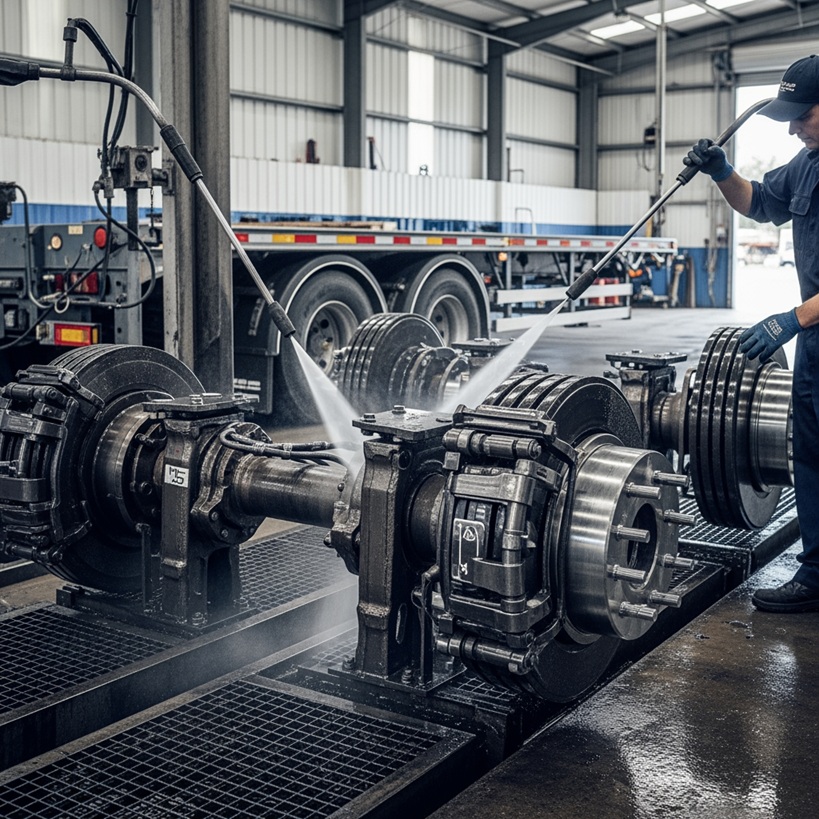
Transport operators running heavy-duty trailers across Australian mining routes, agricultural regions, and industrial supply chains face a persistent challenge – hidden component damage that escalates from minor wear to catastrophic failure between standard service intervals. A trailer hauling iron ore through the Pilbara operates under vastly different stress conditions than one moving containerised freight along the Hume Highway. Yet, both accumulate damage patterns that visual inspections alone fail to detect.
The 90-day trailer inspection cleaning cycle represents a critical intervention point where thorough component cleaning transforms routine maintenance into a diagnostic opportunity. When brake assemblies, suspension components, and coupling mechanisms emerge from industrial parts washers, maintenance teams can identify stress fractures, corrosion penetration, and material degradation that dirt, grease, and road grime typically conceal. This systematic approach to trailer maintenance inspection prevents roadside breakdowns, extends component life, and satisfies increasingly stringent compliance requirements across Australian transport operations.
Why Standard Visual Inspections Miss Critical Damage
Workshop supervisors conducting standard trailer inspections face an inherent limitation – contaminants mask the very damage indicators they’re trained to identify. A brake drum coated in 5mm of baked-on brake dust and road grime conceals hairline cracks that will propagate into structural failures within weeks. Suspension components covered in mud and oil hide corrosion pitting that compromises load-bearing capacity.
The problem intensifies with high-utilisation trailers operating in harsh environments. Mining operations in the Pilbara, agricultural transport through the Riverina, and coastal freight routes expose components to abrasive dust, corrosive salt spray, and thermal cycling that accelerates material degradation. Visual inspections conducted on contaminated components deliver false confidence – the trailer appears serviceable while hidden damage progresses toward failure.
Transport operators managing fleets of 20-50 trailers cannot afford the labour hours required for manual component cleaning during standard inspections. A maintenance technician spending 45 minutes hand-cleaning a single brake assembly with degreaser and wire brushes creates an inspection bottleneck that delays fleet availability. Most workshops compromise by conducting visual assessments on contaminated components, accepting the inherent risk of missed damage.
This compromise carries measurable consequences. A study of heavy vehicle component failures across Australian transport operations found that 37% of roadside breakdowns involved components that had passed visual inspection within the previous 30 days. The failure modes – stress fractures in suspension arms, corrosion-weakened coupling mechanisms, and thermally-damaged brake components – were present during inspection but concealed beneath operational contamination.
Component Damage That Cleaning Reveals
Stress fractures in suspension components represent one of the most dangerous hidden damage patterns. Trailing arm assemblies, spring hangers, and axle mounts develop fatigue cracks from repeated load cycling and shock impacts. These fractures initiate at stress concentration points – weld transitions, bolt holes, and material thickness changes – where visual detection requires clean, well-lit surfaces.
A suspension arm removed from service and processed through heavy duty parts washers emerges with all surface contamination removed, exposing the underlying metal condition. Maintenance inspectors can then apply dye penetrant testing or magnetic particle inspection to identify cracks measuring less than 1mm in width. Detecting these fractures at the 90-day trailer inspection cleaning interval allows for scheduled replacement during planned downtime rather than emergency roadside repairs.
Corrosion damage in brake assemblies progresses rapidly once protective coatings fail. Brake drums, backing plates, and caliper brackets exposed to road salt, agricultural chemicals, or coastal environments develop surface corrosion that penetrates into load-bearing material. Visual assessment of contaminated brake components typically identifies only advanced corrosion – the rust blooms and material scaling visible through dirt accumulation.
Thorough cleaning through hot tank systems removes all surface contamination and reveals the true extent of corrosion penetration. Maintenance teams can measure remaining material thickness, assess structural integrity, and make evidence-based decisions about component replacement. This approach prevents the common scenario where brake components appear serviceable during visual inspection but fail catastrophically under emergency braking loads.
Bearing race damage and seal deterioration remain invisible until components are disassembled and cleaned. Hub assemblies operating with contaminated bearings develop pitting, spalling, and race damage that contamination conceals. The grease surrounding these components hides the metal particles, discolouration, and surface irregularities that indicate bearing failure progression.
Processing hub components through industrial cleaning systems removes all lubricant and contamination, allowing detailed bearing inspection. Maintenance technicians can identify early-stage damage – light pitting on ball races, cage wear, and seal lip deterioration – that warrants bearing replacement before complete failure occurs. This preventive approach eliminates the bearing failures that account for 23% of trailer roadside breakdowns across Australian transport operations.
Coupling mechanism wear develops gradually through thousands of connection cycles. Fifth wheel plates, kingpin assemblies, and locking mechanisms experience material wear that reduces coupling integrity. Visual inspection of contaminated coupling components rarely identifies wear patterns until they reach advanced stages where dimensional changes become obvious.
Systematic cleaning during the 90-day trailer inspection cleaning protocols exposes wear surfaces for precise measurement. Maintenance teams can assess kingpin diameter reduction, fifth wheel plate wear depth, and locking mechanism engagement tolerances against manufacturer specifications. This data-driven approach to coupling maintenance prevents the partial engagement failures that cause trailer separation incidents.
The Industrial Cleaning Advantage in Inspection Protocols
Transport workshops implementing systematic component cleaning during trailer maintenance inspection cycles achieve three distinct advantages: diagnostic accuracy, time efficiency, and documentation quality. These benefits transform routine maintenance from a compliance obligation into a strategic asset that reduces total cost of ownership.
Diagnostic accuracy improves dramatically when inspectors examine clean components under proper lighting. A brake assembly processed through an industrial spray washer emerges with all contamination removed, exposing surface conditions for detailed assessment. Inspectors can identify stress risers, material defects, and early-stage damage that contaminated surfaces conceal. This accuracy reduces the false-negative rate – components that appear serviceable but harbour hidden damage – that drives unexpected failures.
The cleaning process itself provides diagnostic information. Components that emerge from washing cycles with persistent discolouration indicate thermal damage. Brake drums showing blue-black heat tinting have experienced temperatures exceeding design limits, suggesting brake system problems that require investigation. Suspension components retaining corrosion staining after cleaning indicate coating failure that warrants protective treatment or replacement.
Time efficiency improves when automated cleaning systems replace manual degreasing. A maintenance technician hand-cleaning a brake assembly requires 30-45 minutes of labour using solvents, brushes, and compressed air. The same component processed through an automated parts washer requires 12-15 minutes of machine time with minimal technician involvement. This efficiency allows workshops to implement thorough cleaning protocols during standard inspection intervals without extending maintenance duration.
Hotwash Australia systems designed for transport maintenance applications accommodate the component sizes and contamination levels typical of trailer inspections. Brake assemblies, suspension components, and coupling mechanisms fit within standard wash chambers, and high-pressure spray systems remove the baked-on contamination that manual methods struggle to address. The result is consistent cleaning quality that supports reliable damage detection.
Documentation quality improves when inspection photographs capture clean components. Digital inspection records showing contaminated components have limited diagnostic value – damage indicators remain obscured, and condition assessment relies on subjective interpretation. Photographs of cleaned components provide clear visual evidence of component condition, supporting maintenance decisions and warranty claims.
Transport operators managing multi-state fleets benefit from standardised inspection documentation. When Brisbane, Perth, and Melbourne workshops all implement systematic component cleaning during trailer maintenance inspection protocols, the resulting documentation maintains consistent quality across locations. Fleet managers can compare component condition trends, identify operation-specific wear patterns, and optimise replacement intervals based on empirical evidence rather than manufacturer recommendations.
Implementing Systematic Cleaning in 90-Day Inspection Cycles
Transport workshops transitioning to cleaning-based inspection protocols require three elements – appropriate equipment capacity, revised workflow procedures, and technician training in damage recognition. These components work together to transform component cleaning from an occasional deep-maintenance task into a standard inspection practice.
Equipment capacity must match workshop throughput requirements. A regional transport operation maintaining 30-40 trailers requires cleaning capacity that processes inspection components without creating workflow bottlenecks. Extra heavy duty parts washers designed for transport applications accommodate the component sizes and contamination levels typical of trailer maintenance while delivering cycle times that align with inspection schedules.
Workshops conducting 6-8 trailer inspections daily benefit from batch processing capabilities. Brake assemblies from multiple trailers can be loaded into larger wash chambers, processed simultaneously, and returned to their respective inspection bays. This approach maintains inspection flow while ensuring thorough cleaning quality.
Workflow procedures must integrate cleaning into standard inspection sequences. The traditional approach – visual assessment followed by selective disassembly if problems are identified – changes to systematic disassembly, cleaning, and detailed inspection. This revised sequence requires additional time during the initial implementation phase but delivers efficiency gains as technicians become proficient in the new process.
The optimal workflow sequence positions component cleaning early in the inspection cycle. Technicians remove brake assemblies, suspension components, and coupling mechanisms during the initial disassembly phase and transfer them to the cleaning system. While these components undergo washing cycles, technicians proceed with other inspection tasks – tyre assessment, lighting system checks, and chassis examination. Cleaned components return to inspection bays ready for detailed assessment, minimising idle time.
Technician training in damage recognition becomes more critical when components emerge from cleaning systems in pristine condition. Surface indicators that experienced mechanics instinctively recognise on contaminated components – discolouration patterns, wear polish, and corrosion textures – appear different on cleaned surfaces. Training programmes must address this transition, teaching technicians to identify damage indicators on clean components.
Effective training incorporates comparative examples – the same component photographed before and after cleaning, with damage indicators highlighted in both conditions. Technicians learn to recognise how stress fractures, corrosion penetration, and material degradation appear on cleaned surfaces. This visual reference library supports consistent damage identification across workshop teams.
Component-Specific Inspection Advantages
Different trailer components reveal distinct damage patterns when subjected to thorough cleaning during 90 day trailer inspection cleaning cycles. Understanding these component-specific advantages allows maintenance teams to prioritise cleaning efforts and focus inspection attention on high-risk areas.
Brake system components benefit most dramatically from systematic cleaning. Brake drums, backing plates, and caliper assemblies accumulate contamination that conceals thermal damage, corrosion penetration, and structural cracks. Processing these components through high-temperature cleaning cycles removes all surface contamination while revealing the damage indicators that predict imminent failure.
Brake drums showing circumferential cracking after cleaning indicate thermal stress from prolonged brake application – a condition that visual inspection rarely identifies until cracks propagate into obvious failures. Backing plates displaying corrosion penetration through mounting ears reveal structural degradation that compromises brake assembly integrity. These findings allow maintenance teams to replace damaged components during scheduled inspections rather than responding to roadside brake failures.
Suspension components develop fatigue damage that cleaning exposes for detailed assessment. Trailing arms, spring hangers, and torque rods experience cyclic loading that initiates stress fractures at weld joints and material transitions. These cracks remain invisible beneath operational contamination but emerge clearly on cleaned surfaces.
The cleaning advantage extends to corrosion assessment. Suspension components operating in coastal environments or agricultural applications develop corrosion that protective coatings initially conceal. Thorough cleaning removes failed coatings and exposes underlying corrosion, allowing maintenance teams to assess whether protective treatment or component replacement is warranted.
Coupling mechanisms require dimensional accuracy that contamination assessment cannot provide. Fifth wheel plates develop wear patterns that reduce contact area and compromise load distribution. Kingpin assemblies experience diameter reduction that affects locking mechanism engagement. These dimensional changes require clean surfaces for accurate measurement.
Processing coupling components through industrial cleaning systems removes the grease and road grime that interferes with precision measurement. Maintenance technicians can then use calibrated gauges to assess wear dimensions against manufacturer specifications, making evidence-based decisions about coupling serviceability.
The Safety and Compliance Advantages
Transport operators implementing systematic component cleaning during trailer maintenance inspection cycles achieve measurable safety improvements and enhanced compliance documentation. These advantages extend beyond individual vehicle reliability to affect fleet-wide risk profiles and regulatory standing.
Safety improvements result from earlier damage detection. Components that develop hidden damage between inspection intervals no longer progress to catastrophic failure before detection. The 90 day trailer inspection cleaning protocol identifies developing problems while they remain manageable, preventing the roadside failures that create safety hazards for drivers and other road users.
The safety advantage is particularly significant for brake system components. Brake failures account for 18% of heavy vehicle incidents across Australian transport operations, with many failures involving components that had recently passed visual inspection. Implementing thorough cleaning during brake inspections eliminates the contamination that conceals thermal damage, corrosion penetration, and structural cracks – the primary indicators of impending brake failure.
Compliance documentation improves when inspection records include photographs of cleaned components. National Heavy Vehicle Regulator audits increasingly scrutinise maintenance documentation quality, seeking evidence that inspections identify developing problems before they compromise vehicle safety. Photographs showing contaminated components provide limited evidence of inspection thoroughness, while images of cleaned components demonstrate systematic assessment.
Transport operators facing compliance investigations benefit from documentation that shows proactive maintenance practices. Inspection records demonstrating systematic component cleaning, detailed damage assessment, and evidence-based replacement decisions support the operator’s safety management system. This documentation quality becomes particularly valuable during incident investigations where maintenance practices face scrutiny.
Cost Analysis: Cleaning Investment Versus Failure Prevention
Transport operations evaluating systematic component cleaning during 90 day trailer inspection cleaning protocols must weigh equipment investment and operational costs against the failure prevention benefits. The financial analysis becomes favourable when workshops quantify the true cost of roadside breakdowns, emergency repairs, and premature component replacement.
Equipment investment for transport maintenance applications typically ranges from $15,000-$35,000 depending on capacity requirements and automation features. A regional operation maintaining 30-40 trailers requires capacity that processes brake assemblies, suspension components, and coupling mechanisms without creating inspection bottlenecks. This investment delivers 10-15 years of service life when systems receive appropriate maintenance.
The per-inspection cleaning cost remains modest. Processing components from a single trailer maintenance inspection consumes approximately 45-60 minutes of machine operation, translating to $8-$12 in operating costs including water, detergent, and energy consumption. This cost compares favourably to the labour expense of manual component cleaning, which requires 90-120 minutes of technician time at typical workshop labour rates.
Failure prevention benefits provide the primary financial justification. A roadside brake failure requiring emergency service costs $2,500-$4,500 when accounting for service call-out fees, emergency parts pricing, and cargo delay penalties. Suspension component failures average $3,500-$6,000 in total costs including towing, repairs, and operational disruption. Preventing three major component failures annually through improved inspection practices justifies the equipment investment within the first operating year.
The financial advantage extends to component life optimisation. Transport operations replacing brake drums, suspension arms, and coupling components based on visual assessment of contaminated surfaces often discard components with significant remaining service life. The conservative replacement approach protects against failure risk but increases parts consumption and disposal costs. Accurate condition assessment of cleaned components allows maintenance teams to extend component service life while maintaining appropriate safety margins.
Transport operators implementing systematic component cleaning during trailer maintenance inspection cycles report 40-55% reduction in unexpected component failures during the first operating year. This reliability improvement translates directly to reduced maintenance costs, improved vehicle availability, and enhanced operational predictability – benefits that compound across multi-vehicle fleets operating on tight delivery schedules.
Conclusion
The 90 day trailer inspection cleaning cycle represents a critical opportunity for transport operators to identify hidden component damage before it progresses to catastrophic failure. Systematic component cleaning transforms routine maintenance from a compliance obligation into a diagnostic advantage that reveals stress fractures, corrosion penetration, and material degradation that contaminated surfaces conceal. This approach prevents the roadside breakdowns that disrupt operations, endanger drivers, and inflate maintenance costs across Australian transport fleets.
Transport workshops implementing cleaning-based trailer maintenance inspection protocols achieve measurable improvements in diagnostic accuracy, time efficiency, and documentation quality. These advantages support evidence-based maintenance decisions that optimise component life, prevent premature failures, and satisfy increasingly stringent compliance requirements. The investment in industrial cleaning capacity delivers rapid financial returns through reduced failure rates and extended component service life.
Australian transport operations seeking to implement systematic component cleaning during maintenance inspections benefit from locally-manufactured equipment designed for heavy-duty applications. The combination of appropriate cleaning capacity, revised inspection workflows, and enhanced technician training creates a maintenance system that identifies problems early while maintaining operational efficiency. For maintenance supervisors and fleet managers ready to transform their inspection protocols, contact us to discuss equipment specifications matched to actual operational requirements – before the next hidden component failure creates a roadside emergency.

Leave A Comment