
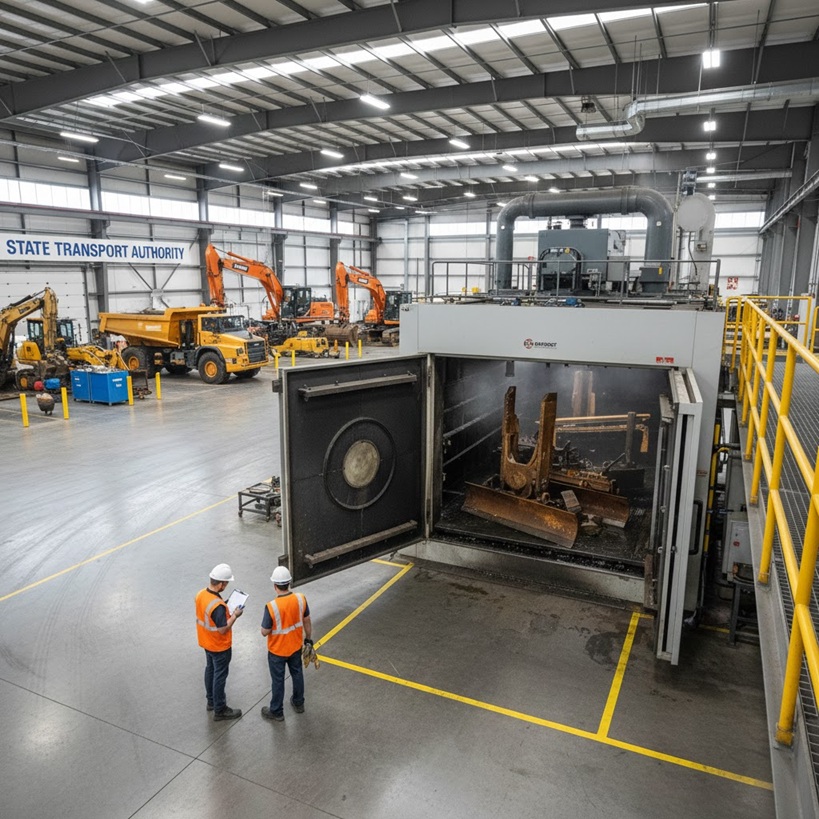
State transport departments across Australia manage billions of dollars in infrastructure projects annually. Equipment procurement represents a critical component of this operational success. Winning these contracts requires more than just competitive pricing. Suppliers must demonstrate their equipment meets stringent capability requirements.
Government agencies demand high standards for safety, performance, and environmental compliance. The procurement landscape has shifted significantly since 2020. Departments now implement more rigorous evaluation frameworks. Equipment suppliers who understand these transport contract requirements position themselves for long-term success. Those who underestimate the complexity often waste months on unsuccessful bids.
Understanding State Transport Department Priorities
Transport departments evaluate equipment through multiple lenses. Each factor carries specific weight in the decision matrix. Safety performance tops every evaluation. This is followed by operational efficiency, environmental compliance, and whole-of-life costs.
Recent data suggests that a large percentage of failed bids stumble on capability demonstration rather than price. Suppliers often assume their equipment specifications speak for themselves. They miss the crucial requirement to prove real-world performance under local conditions.
Safety Performance as the Top Priority
State departments prioritise equipment that reduces worker exposure to risk. This means automated systems score higher than manual alternatives. This applies even when initial costs run higher.
Hot tanks and automated parts washing systems exemplify this shift. Departments recognise that removing workers from chemical exposure delivers measurable safety improvements. Eliminating repetitive strain injuries from manual scrubbing is also a key factor. These safety gains are worth the investment.
Environmental Compliance Expectations
Environmental compliance has become non-negotiable. Equipment must meet current emission standards. It must also demonstrate pathways to future compliance.
Departments now require detailed environmental impact assessments. This includes water usage, chemical disposal methods, and energy consumption metrics. You cannot just tick a box; you must prove your environmental credentials.
Technical Capability Requirements
State transport contracts demand comprehensive technical documentation. This goes beyond standard product brochures. Departments require detailed performance data and testing certifications. They also need operational parameters specific to their use cases.
Hotwash Australia understands these demands. We help suppliers and internal fleet managers meet the strict criteria set by state transport bodies.
Performance in Real-World Conditions
Performance specifications must address real-world conditions. Laboratory test results carry less weight than field trials conducted in similar environments.
For heavy equipment cleaning systems, this means demonstrating effectiveness on actual road construction machinery. The equipment must handle bitumen, concrete dust, and hydraulic fluids. Standard automotive grease is not the benchmark.
Surface preparation equipment like wet abrasive blasters must prove they can remove road paint, traffic line markings, and concrete residue from heavy machinery. These real-world applications matter more than controlled test results.
Capacity requirements reflect operational realities. Transport departments maintain diverse fleet compositions. This ranges from light vehicles to heavy earthmoving equipment. Successful suppliers demonstrate how their equipment handles this range efficiently.
Reliability Metrics and Standards
Reliability metrics matter more than maximum performance figures. Departments evaluate mean time between failures (MTBF). They look at maintenance intervals and parts availability.
Equipment that delivers consistent 85% performance with minimal downtime beats systems promising 100% performance but requiring frequent service.
Australian standards compliance remains mandatory. Equipment must meet AS/NZS electrical safety standards. Pressure vessel codes apply where relevant. Workplace health and safety requirements are non-negotiable. International certifications help, but they do not replace local compliance documentation requirements.
Demonstrating Operational Efficiency
Transport departments measure efficiency through multiple metrics. They look at throughput rates and labour requirements. Resource consumption and integration with existing workflows are also critical. Successful demonstrations quantify these factors with precision.
Labour Efficiency and Workforce Deployment
Time savings calculations must reflect actual operational conditions. Claims of “50% faster cleaning” mean nothing without context. Effective demonstrations show specific scenarios.
For example, “Cleaning a grader blade set takes 4 hours manually versus 45 minutes in our automated system.” This frees three workers for preventive maintenance tasks. Labour efficiency extends beyond direct time savings.
Departments evaluate how equipment reduces skilled labour requirements. They want to eliminate dangerous tasks. This enables workforce redeployment to higher-value activities. Industrial spray washers operate with minimal supervision. This allows workers to perform other tasks, demonstrating multiplicative efficiency.
Resource Consumption Transparency
Resource consumption data requires granular detail. You need to track water usage per cleaning cycle. Chemical consumption rates must be clear. Energy requirements during peak and idle periods are tracked.
Suppliers who provide comprehensive consumption data demonstrate serious commitment to transparency. Cost projections over 5 to 10-year periods help departments plan budgets accurately.
Safety Compliance and Risk Mitigation
Safety documentation forms the cornerstone of successful transport contract bids. Departments require comprehensive hazard assessments. You need control measures and incident prevention strategies for all equipment.
Automated Risk Management
Risk assessments must address specific transport department scenarios. Generic workplace safety documents fail to impress evaluators. They need evidence that you understand their unique operational risks.
For parts washers, this means addressing risks from handling contaminated components. It includes managing chemical exposure and preventing slip hazards.
Automated safety features score highest in evaluations. Systems with automated lids, temperature controls, and emergency shutoffs demonstrate proactive risk management. Manual override capabilities with proper lockout/tagout procedures show operational flexibility without compromising safety.
Training and Operator Safety
Training requirements influence procurement decisions. Equipment requiring extensive operator certification creates ongoing costs. It also creates operational constraints.
Systems with intuitive controls better suit departments managing diverse workforces. Manual parts washers are useful for specific tasks, but automated systems reduce training loads. Minimal training requirements allow staff to move between locations easily.
Incident history and safety performance data from similar installations build credibility. Departments want evidence of safe operation in comparable environments. Documenting safety records from mining or heavy industry demonstrates proven performance.
Environmental Performance Standards
Environmental capability goes beyond basic compliance. Departments seek equipment supporting their sustainability commitments. Successful suppliers demonstrate how their equipment advances environmental goals while maintaining effectiveness.
Water and Waste Management
Water recycling capabilities have become essential. Closed-loop systems filter and reuse wash water. This reduces consumption by 70% to 90% compared to flow-through designs.
Wet abrasive blasters with water reclamation show environmental responsibility. They maintain cleaning effectiveness while minimizing waste. Wet abrasive blasters are particularly valued for infrastructure projects because they eliminate dust pollution that dry blasting creates.
Chemical selection impacts procurement decisions. Biodegradable, non-toxic cleaning agents score higher than traditional solvents. This applies even at premium prices. Departments calculate total environmental cost. This includes disposal, spill risk, and worker exposure.
Modern wet abrasive blasters use environmentally friendly abrasive media that breaks down naturally. This reduces disposal costs and environmental impact compared to traditional sandblasting methods.
Energy Efficiency Documentation
Energy efficiency metrics require detailed documentation. Power consumption during operation must be documented. Standby modes and peak demand periods factor into evaluations.
Heat recovery systems and variable-speed drives demonstrate commitment to energy reduction. Intelligent control systems that reduce idle time are also valued. Waste stream management plans show operational maturity. You must explain how contaminated water gets processed and where removed contaminants go.
Maintenance and Support Capabilities
Long-term support capabilities often determine contract awards. Departments need confidence that equipment will operate reliably throughout its lifecycle. They cannot afford disruption to operations.
Local Support Presence
Local support presence carries significant weight. Response times for service calls matter. Parts availability and technician coverage across the state influence procurement decisions.
Suppliers with established service networks demonstrate commitment to ongoing support. Stainless steel parts washers are durable, but they still need support. Equipment built in Australia often has a distinct advantage regarding parts availability.
Remote Monitoring and Upgrades
Preventive maintenance programs show operational sophistication. Detailed maintenance schedules and cost projections help departments plan budgets. Equipment with clear maintenance requirements reduces operational risk.
Remote monitoring and diagnostic capabilities increasingly influence decisions. Modern industrial washers with IoT connectivity enable predictive maintenance. This reduces unexpected failures. Departments value visibility into equipment performance.
Upgrade pathways demonstrate long-term thinking. How will equipment adapt to changing requirements? Can capacity increase through modular additions? Addressing future flexibility helps departments avoid premature obsolescence.
Creating Compelling Capability Demonstrations
Successful demonstrations combine technical documentation with practical proof points. Written proposals must tell a coherent story supported by verifiable evidence.
Validating Claims through Trials
Case studies from similar operations provide powerful validation. A mining company using identical extra heavy duty parts washers for similar applications offers relevant proof. Quantified results transform anecdotes into evidence.
Site visits and live demonstrations accelerate decision-making. Seeing equipment operate in real conditions answers questions specifications cannot address. Successful suppliers facilitate visits to reference sites.
Trial periods reduce procurement risk. Offering 30 to 90-day trials with clear success metrics demonstrates confidence. Structured trials with defined evaluation criteria often convert to long-term contracts.
Total Cost of Ownership (TCO) Modelling
Total cost of ownership (TCO) modelling proves financial capability. Comprehensive TCO calculations include purchase price and installation. They also cover training, operation, maintenance, and disposal costs.
Calculating this over 10+ years helps departments justify investments. Comparing TCO against current methods quantifies value propositions.
Compliance Documentation Requirements
Transport departments require extensive documentation packages. Understanding compliance documentation requirements prevents delays. It demonstrates professional capability.
Certifications and Quality Assurance
Technical manuals must be comprehensive yet accessible. Engineering specifications serve their purpose, but departments also need simplified operator guides. Quick reference cards and troubleshooting procedures are essential.
Compliance certificates require careful organisation. Australian standards certifications and test reports must be current. Missing or expired certificates can disqualify otherwise superior equipment.
Insurance and liability documentation proves business stability. Departments need confidence suppliers can support warranty claims. Quality assurance processes indicate operational maturity. Departments want evidence of actual quality control procedures, such as pre-delivery inspections.
Building Long-Term Partnerships
Successful transport contracts often span multiple years. They include extension options. Suppliers who approach contracts as partnerships rather than transactions position themselves for sustained success.
Continuous improvement commitments resonate with departments. Suppliers who propose regular performance reviews and efficiency audits demonstrate long-term thinking.
Knowledge transfer programs add value beyond equipment supply. Training maintenance staff and sharing best practices strengthen supplier relationships. Departments value partners who enhance internal capabilities.
Innovation roadmaps show future alignment. How will equipment evolve to meet changing needs? For large-scale infrastructure projects, super heavy duty parts washers might be the future requirement. Suppliers who share development plans build collaborative relationships.
Conclusion
Winning state transport contracts requires more than quality equipment. Success demands comprehensive capability demonstration across safety, efficiency, and environmental dimensions. Departments evaluate total value propositions. They seek suppliers who understand operational realities.
Preparation remains critical. Suppliers must document technical capabilities and quantify operational benefits. You must provide verifiable evidence of successful implementations. Understanding department priorities guides effective proposals. Safety comes first, efficiency is always required, and environmental performance is increasingly critical.
The investment in comprehensive capability demonstration pays dividends. Contracts typically run multiple years with extension options. This provides stable revenue streams for successful suppliers. More importantly, meeting one department’s requirements often opens doors with others.
For equipment suppliers ready to meet these demanding transport contract requirements, the rewards justify the effort. Get in touch with our government contract equipment advisors or email us on sales@hotwash.com.au to start the conversation.

Leave A Comment