
Food processing facilities face a critical challenge that most manufacturers never encounter – maintaining equipment cleanliness standards where even microscopic contamination can trigger product recalls, regulatory penalties, or serious health consequences. When a single batch of contaminated product can cost hundreds of thousands in recalls and permanent brand damage, the stakes around equipment hygiene become exponentially higher than standard industrial operations.
Stainless steel dominates food processing environments precisely because it resists corrosion and harbours fewer bacteria than alternative materials. Yet this advantage disappears rapidly when cleaning protocols fail to account for the metal’s specific requirements. Improper cleaning agents, inadequate rinsing, or mechanical damage during washing creates microscopic surface defects where bacteria colonise and multiply between production runs.
The intersection of food processing contamination prevention and corrosion control defines effective food-grade stainless steel cleaning. These aren’t separate objectives – they’re interconnected challenges where solving one incorrectly creates the other. Harsh cleaning chemicals that eliminate bacteria may simultaneously pit stainless steel surfaces, creating rough textures where future contamination becomes virtually impossible to remove. Conversely, gentle cleaning that preserves metal integrity may leave biofilm residues that compromise food safety.
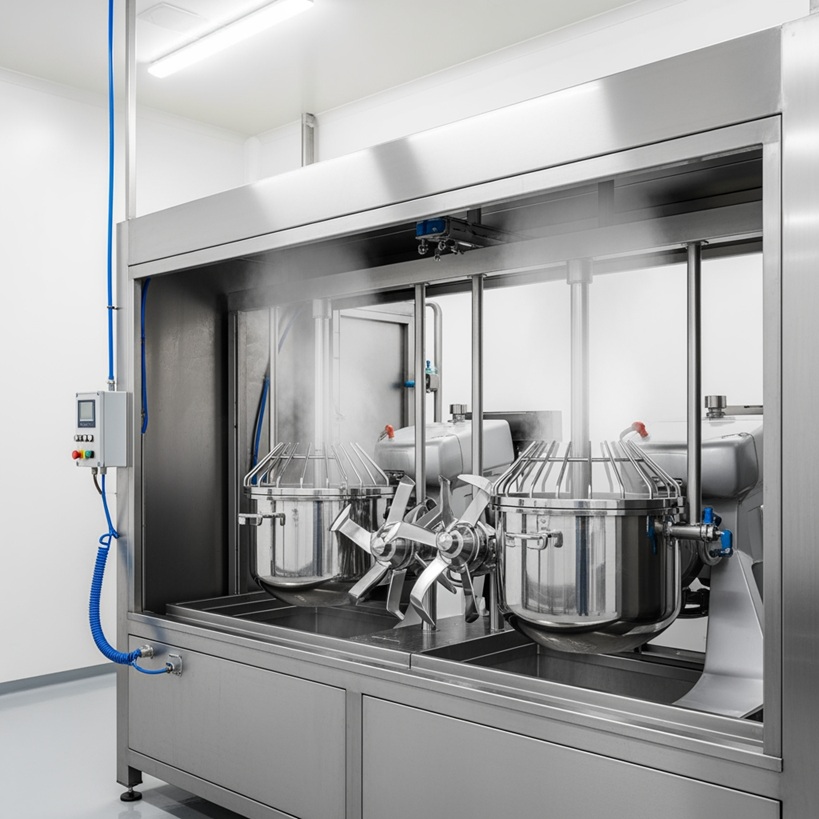
Hotwash Australia manufactures automated cleaning systems specifically engineered for food processing applications, where equipment must meet both hygiene standards and material preservation requirements simultaneously.
The Hidden Cost of Surface Damage in Food Processing
Most contamination incidents don’t originate from visible equipment damage. They develop in microscopic surface irregularities created through years of improper cleaning – scratches from abrasive pads, pitting from chloride exposure, or crevice corrosion from incomplete rinsing. These defects measure micrometres in depth, invisible to routine inspection, yet provide sufficient shelter for bacterial colonies to survive standard sanitisation protocols.
Research from food safety laboratories demonstrates that bacteria survival rates increase by 300-400% on damaged stainless steel surfaces compared to properly maintained equipment. A single scratch 50 micrometres deep – thinner than a human hair – can harbour thousands of bacterial cells protected from cleaning solutions and sanitisers. When production resumes, these protected colonies contaminate the next product batch.
The economic implications extend beyond immediate contamination risks. Equipment with compromised surfaces requires replacement years earlier than properly maintained alternatives. A mixing tank that should deliver 15-20 years of service may need replacement after 7-8 years when cleaning practices gradually degrade the protective chromium oxide layer that gives stainless steel its corrosion resistance.
Food processors operating on tight margins cannot afford premature equipment replacement. A single large mixing vessel or processing tank represents $50,000-$200,000 in capital investment. Multiply this across an entire facility’s equipment inventory, and improper cleaning practices can cost millions in accelerated replacement cycles.
Why Standard Industrial Cleaning Fails Food Processing Standards
Industrial cleaning protocols developed for mining equipment, automotive parts, or general manufacturing prove inadequate for food processing applications. The fundamental difference lies in tolerance levels – manufacturing operations accept surface residues measured in milligrams per square centimetre, while food processing requires detection limits measured in micrograms or colony-forming units.
Standard alkaline cleaners used across industrial applications often contain chlorides, phosphates, or other compounds that attack stainless steel’s passive layer. These chemicals work effectively for removing heavy grease and carbon deposits from mining components, but they leave microscopic surface damage that’s unacceptable in food contact applications.
Temperature control presents another critical distinction. Many industrial cleaning systems operate at maximum temperatures to accelerate cleaning chemistry, sometimes exceeding 90°C for extended periods. While high temperatures kill bacteria, prolonged exposure to extreme heat in the presence of certain chemicals accelerates localised corrosion on stainless steel surfaces.
Water quality matters more in food processing than any other industrial sector. Municipal water containing chlorides, sulfates, or heavy metals may prove acceptable for rinsing mining equipment but creates contamination and corrosion risks on food contact surfaces. Even trace chloride concentrations below 50 parts per million can initiate pitting corrosion on stainless steel when combined with heat and extended exposure times.
Stainless steel parts washers designed specifically for food industry applications incorporate water treatment systems, temperature controls, and chemistry management that standard industrial equipment lacks.
The Chemistry of food-grade Stainless Steel Cleaning
Effective food-grade stainless steel cleaning requires understanding stainless steel’s metallurgical properties. The material’s corrosion resistance comes from a passive chromium oxide layer approximately 1-3 nanometres thick on the surface. This invisible film self-repairs when damaged in oxygen-rich environments, but certain chemicals and conditions prevent reformation or actively dissolve it.
Chloride ions present the most significant corrosion threat to stainless steel in food processing. These ions penetrate the passive layer and initiate localised pitting corrosion that accelerates rapidly once started. Chlorides enter cleaning systems through municipal water supplies, chlorinated cleaning compounds, or sanitisers containing sodium hypochlorite. Concentrations as low as 25 ppm can initiate corrosion under certain temperature and pH conditions.
pH extremes – both highly acidic and highly alkaline – stress stainless steel differently. Strong acids (pH below 3) can dissolve the passive layer directly, while strong alkalis (pH above 12) attack the underlying metal structure. food-grade stainless steel cleaning protocols typically operate in the pH 10-11 range, aggressive enough to remove organic soils but mild enough to preserve metal integrity when properly formulated and rinsed.
Temperature interacts with chemistry to determine corrosion rates. Cleaning effectiveness generally improves with temperature, but corrosion rates also accelerate exponentially above 60°C. The optimal temperature window for food-grade stainless steel cleaning typically falls between 50-65°C – hot enough for effective soil removal and bacterial kill, but cool enough to minimise corrosion acceleration.
Contact time creates another variable in the corrosion equation. Brief exposure to aggressive chemistry causes minimal damage, while extended contact allows progressive attack. Automated cleaning systems that precisely control exposure duration prevent the over-cleaning that manual processes often create when operators leave parts soaking indefinitely.
Contamination Risks Beyond Bacterial Pathogens
Food processing contamination extends beyond bacterial threats to include chemical residues, allergen cross-contact, and foreign material. Each contamination category requires different cleaning approaches, and solutions for one may conflict with requirements for another.
Chemical residues from cleaning compounds themselves create significant contamination risks. Alkaline cleaners that aren’t completely rinsed leave caustic residues that alter food pH and flavour. Acidic cleaners may leave metal ions that catalyse oxidation reactions in sensitive products. Even “food safe” cleaning compounds become contaminants when residues remain on equipment surfaces.
Allergen cross-contact presents particular challenges in facilities processing multiple product lines. Milk proteins, peanut residues, gluten, or shellfish allergens can persist on equipment surfaces even after cleaning that eliminates bacterial contamination. These molecules bind tightly to metal surfaces and require specific cleaning chemistry and mechanical action to remove completely.
Foreign material contamination – metal fragments, gasket pieces, or degraded equipment components – often originates from cleaning processes themselves. Abrasive cleaning that removes soil also removes microscopic metal particles that contaminate subsequent production. Aggressive chemicals that attack gaskets and seals create polymer fragments that end up in product streams.
The regulatory framework for food processing contamination prevention has evolved to address these multifaceted contamination risks. Modern food safety protocols require validation that cleaning processes remove all soil types to specified detection limits, not just achieve visual cleanliness. This validation requires analytical testing that measures residues in parts per million or colony-forming units per square centimetre.
Automated Systems vs Manual Cleaning in Food Processing
Manual cleaning dominates many food processing facilities because operators perceive it as more thorough and controllable. This perception rarely matches reality. Human factors – fatigue, distraction, training gaps, and simple variability between individuals – create consistency problems that automated systems eliminate.
Research tracking manual cleaning effectiveness in food facilities reveals disturbing patterns. The same operator cleaning identical equipment on consecutive days achieves bacterial removal rates varying by 40-60%. Different operators working from identical procedures produce results spanning an even wider range. This variability makes validation nearly impossible and creates contamination risks that manifest unpredictably.
Manual cleaning also exposes workers to chemical hazards, thermal burns, and ergonomic injuries. Regulations requiring personal protective equipment acknowledge these risks, but PPE creates its own problems – reduced dexterity, heat stress, and communication difficulties. The safest approach eliminates human exposure entirely through automation.
Industrial spray washers deliver consistent results by controlling every variable that affects cleaning outcomes – water temperature, pressure, chemistry concentration, contact time, and mechanical action. Every cleaning cycle replicates the previous one exactly, making validation straightforward and maintaining consistent food processing contamination prevention.
Automated systems also achieve superior results on complex geometries that manual cleaning struggles to address. Internal channels, threaded connections, and recessed areas that brushes can’t reach receive thorough cleaning from high-pressure spray jets that penetrate every surface. This comprehensive coverage eliminates the hidden contamination reservoirs that manual cleaning often misses.
Water Quality Requirements for Food Processing Equipment Cleaning
Municipal water supplies meet drinking water standards but often fail to meet food processing equipment cleaning requirements. The difference lies in dissolved mineral content, particularly chlorides, sulfates, calcium, and magnesium. These minerals interfere with cleaning chemistry, leave deposits on equipment surfaces, and initiate corrosion on stainless steel.
Chloride concentration represents the most critical water quality parameter for stainless steel cleaning. Levels acceptable for drinking water (up to 250 ppm under Australian standards) far exceed safe limits for hot water cleaning of stainless steel equipment. Concentrations above 50 ppm combined with temperatures exceeding 60°C create conditions where pitting corrosion initiates rapidly.
Water hardness – primarily calcium and magnesium content – creates different problems. These minerals react with alkaline cleaning compounds to form insoluble precipitates that deposit on equipment surfaces. These deposits create rough textures where bacteria colonise and require acidic cleaning to remove, adding process steps and chemical exposure.
Food-grade equipment cleaning systems increasingly incorporate water treatment to address these quality issues. Reverse osmosis, deionisation, or softening systems remove problematic minerals before water enters the cleaning process. This treated water improves cleaning effectiveness, eliminates mineral deposits, and protects stainless steel from chloride-induced corrosion.
Final rinse water quality matters even more than wash water. Residual cleaning chemistry and dissolved soils from washing stages must be completely removed to prevent contamination and corrosion. High-purity water with minimal dissolved solids provides superior rinsing because it actively dissolves and removes residues rather than simply diluting them.
Temperature Control and Its Dual Role
Temperature serves dual purposes in food processing equipment cleaning – it accelerates chemical reactions that remove soil and kills microorganisms. However, temperature also accelerates corrosion reactions that damage stainless steel. Optimising cleaning effectiveness while minimising corrosion damage requires precise temperature control throughout the cleaning cycle.
The relationship between temperature and bacterial kill follows logarithmic curves. Modest temperature increases from 50°C to 60°C dramatically improve pathogen destruction, while further increases to 70°C or 80°C provide diminishing returns. Most food processing pathogens experience rapid die-off at 60-65°C with appropriate contact time.
Corrosion rates follow similar exponential relationships with temperature. Every 10°C increase roughly doubles corrosion rates for most mechanisms affecting stainless steel. This means cleaning at 80°C causes approximately four times more corrosion damage than cleaning at 60°C, even with identical chemistry and exposure time.
The optimal temperature window for food-grade stainless steel cleaning typically ranges from 55-65°C. This zone provides effective soil removal and bacterial kill while minimising corrosion acceleration. Exceeding 70°C should only occur when specific soil types or pathogen concerns require it, and exposure duration should be minimised.
Temperature consistency matters as much as absolute values. Fluctuating temperatures create thermal stress that can crack welds, degrade seals, and accelerate fatigue damage. Automated cleaning systems maintain stable temperatures throughout the cycle, eliminating the thermal shock that occurs when manual processes mix hot cleaning solutions with cold rinse water.
Validation and Documentation Requirements
Food processing facilities operate under regulatory frameworks requiring documented evidence that cleaning processes achieve specified outcomes. This validation extends beyond visual inspection to include microbiological testing, chemical residue analysis, and allergen detection. The documentation burden makes consistent, repeatable cleaning processes essential.
Validation protocols typically require demonstrating that cleaning processes reduce bacterial populations by specified log reductions – often 5-6 logs (99.999-99.9999% reduction). Achieving these targets requires not just effective cleaning but also consistent execution that produces identical results across every cleaning cycle.
Chemical residue testing adds another validation requirement. Facilities must demonstrate that cleaning compound residues remain below specified limits, typically measured in parts per million. This requires complete rinsing that removes essentially all cleaning chemistry from equipment surfaces.
Allergen validation presents particular challenges because detection limits continue dropping as analytical methods improve. Facilities must demonstrate allergen removal to levels measured in parts per million or even parts per billion for highly sensitive allergens. This requires cleaning processes specifically validated for allergen removal, not just general cleanliness.
Automated cleaning systems simplify validation by eliminating variables. When every cleaning cycle uses identical parameters – temperature, pressure, chemistry concentration, duration – validation testing from representative cycles provides confidence that all subsequent cycles achieve equivalent results. Manual cleaning’s inherent variability makes this level of confidence impossible to achieve.
Preventing Biofilm Formation on Processing Equipment
Biofilms represent one of the most challenging contamination issues in food processing. These structured bacterial communities attach firmly to stainless steel surfaces and resist removal through standard cleaning protocols. Once established, biofilms continuously seed product contamination and can persist for months despite daily cleaning.
Biofilm formation begins when planktonic (free-floating) bacteria attach to surfaces and secrete extracellular polymeric substances that anchor them firmly to the metal. Within hours, multiple bacterial species colonise this foundation, creating complex three-dimensional structures protected by polymer matrices that block cleaning chemicals and sanitisers.
The key to biofilm control lies in prevention rather than removal. Established biofilms require aggressive treatments – strong acids, oxidising agents, or mechanical removal – that risk damaging stainless steel surfaces. Preventing initial attachment through thorough daily cleaning proves far more effective and less damaging than remedial treatments.
Surface finish quality directly affects biofilm formation rates. Rough surfaces with scratches, pits, or weld defects provide protected sites where bacteria attach more easily and resist removal more effectively. Maintaining smooth, undamaged surfaces through proper food-grade stainless steel cleaning techniques prevents the surface degradation that facilitates biofilm establishment.
Cleaning frequency matters more for biofilm prevention than cleaning intensity. Biofilms require 12-24 hours to establish firm attachment and begin forming protective matrices. Daily cleaning that removes bacteria before they establish permanent attachment prevents biofilm formation more effectively than less frequent but more aggressive cleaning.
The Economics of Proper Food Processing Equipment Cleaning
Food processors often view cleaning as a cost centre requiring minimisation rather than an investment protecting far larger assets. This perspective misses the broader economic picture where inadequate cleaning creates costs far exceeding the investment in proper equipment and procedures.
Product recalls represent the most obvious cost of inadequate cleaning. A single recall event typically costs $10-30 million when accounting for product destruction, logistics, customer notification, regulatory response, and brand damage. Major recalls can exceed $100 million and permanently destroy smaller companies. Proper cleaning equipment costing $50,000-$200,000 represents insurance against these catastrophic losses.
Equipment replacement costs accumulate more gradually but ultimately exceed recall risks for most facilities. Stainless steel processing equipment should deliver 15-20 years of service when properly maintained. Corrosive cleaning practices can reduce this to 7-10 years, forcing premature replacement of assets worth millions across a typical facility.
Production efficiency losses from manual cleaning reduce profitability daily. A processing line that requires 2-3 hours of manual cleaning between production runs operates fewer hours than equipment cleaned in 30-45 minutes through automation. This lost production time compounds across every shift, every day, throughout the equipment’s lifetime.
Labour costs for manual cleaning continue rising while automated systems’ costs remain fixed after initial investment. Three workers spending two hours cleaning equipment at $35/hour costs $210 per cleaning cycle. Automated systems performing the same cleaning cost $15-25 in utilities and chemistry. This $185 difference per cycle accumulates to $47,000-67,000 annually for facilities cleaning once daily.
Selecting Appropriate Cleaning Systems for Food Processing Applications
Food processing facilities require cleaning equipment meeting more stringent standards than general industrial applications. Material selection, construction methods, and design features that prove acceptable for mining or manufacturing equipment fail to meet food industry requirements.
Construction materials must comply with food contact regulations. Stainless steel models using 304 or 316 grade stainless steel meet these requirements, while powder-coated carbon steel systems common in other industries do not. Even stainless steel components require electropolished or passivated finishes that enhance corrosion resistance and cleanability.
Design features must eliminate contamination harbourage sites. Crevices, dead legs, and difficult-to-clean areas that might be acceptable in general industrial equipment become contamination risks in food processing. Smooth internal surfaces, self-draining configurations, and accessible designs that facilitate cleaning of the cleaning equipment itself are essential.
Chemistry management systems must deliver precise control over cleaning compound concentrations. Food processing contamination prevention requires maintaining pH, concentration, and temperature within narrow windows that optimise soil removal while minimising corrosion. Manual chemical addition creates variability that automated dosing systems eliminate.
Water treatment integration becomes necessary in areas with poor municipal water quality. Systems incorporating filtration, softening, or deionisation protect both the equipment being cleaned and the cleaning system itself from mineral deposits and chloride corrosion.
Temperature control precision separates food-grade systems from industrial alternatives. The ability to maintain temperatures within ±2°C throughout the cleaning cycle ensures consistent results and prevents the corrosion acceleration that temperature spikes cause.
Maintaining Cleaning System Performance Over Time
Installing appropriate cleaning equipment represents only the first step in establishing effective food processing hygiene. Maintaining system performance requires ongoing attention to preventive maintenance, calibration verification, and periodic validation testing.
Spray nozzles gradually clog with mineral deposits or wear from high-pressure operation, reducing cleaning effectiveness. Monthly inspection and quarterly replacement of worn nozzles maintains the spray pattern geometry and impact force that drive soil removal. Facilities that neglect nozzle maintenance often discover cleaning failures only after contamination incidents occur.
Temperature sensors drift over time, causing actual operating temperatures to diverge from programmed setpoints. Quarterly calibration verification using reference thermometers ensures displayed temperatures match actual conditions. A 5°C temperature error – too small to notice without testing – significantly affects both cleaning effectiveness and corrosion rates.
Chemical dosing systems require periodic calibration to maintain accurate concentration control. Pump wear, valve deposits, or sensor fouling causes gradual drift in delivered concentrations. Monthly verification using titration or conductivity testing identifies drift before it compromises cleaning effectiveness or creates corrosion risks.
Water treatment components need scheduled maintenance to maintain performance. Filter cartridges require replacement, softener resin needs regeneration, and reverse osmosis membranes gradually foul. Neglecting these maintenance tasks allows treated water quality to degrade, reintroducing the mineral content and chlorides that treatment systems were installed to remove.
Conclusion: Protecting Products and Equipment Simultaneously
Food processing facilities face unique cleaning challenges where food processing contamination prevention and equipment preservation must be achieved simultaneously. Standard industrial cleaning approaches developed for mining, manufacturing, or automotive applications fail to meet food processing requirements because they prioritise soil removal over material protection, or vice versa.
Effective food-grade stainless steel cleaning requires specialised equipment engineered to balance these competing demands. Systems that maintain precise temperature control, manage water quality, control chemistry concentration, and deliver consistent mechanical action achieve thorough contamination removal while preserving the stainless steel surfaces that millions of dollars of processing equipment depend upon.
The investment in proper cleaning systems delivers returns far exceeding initial costs. Preventing a single product recall justifies equipment expenditure many times over, while extending processing equipment service life from 8 years to 18 years protects capital investments worth millions. Production efficiency gains and labour cost reductions provide ongoing financial benefits throughout the equipment’s operational life.
Australian food processing operations seeking to implement systematic food processing contamination prevention protocols benefit from locally-manufactured cleaning systems designed specifically for food industry applications. The combination of appropriate construction materials, precise process controls, and validated cleaning performance creates hygiene systems that satisfy both regulatory requirements and economic objectives. For food processing managers ready to protect both product safety and equipment investments, contact us to discuss cleaning system specifications matched to actual facility requirements and contamination challenges.

Leave A Comment