
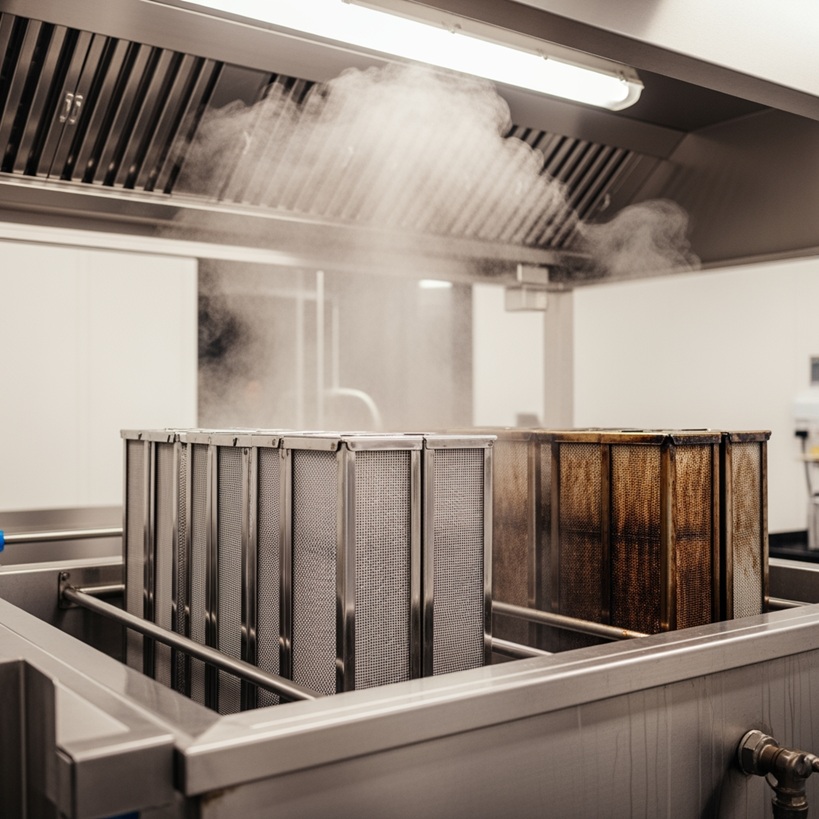
Commercial kitchens across Australia are failing health inspections at alarming rates, and contaminated grease filters sit at the centre of many violations. The Australian Institute of Food Safety reports that inadequate grease management remains one of the top three compliance failures during food safety audits. Manual scrubbing and soaking methods that worked for small operations decades ago cannot keep pace with the volume, intensity, and regulatory scrutiny facing modern commercial grease filter cleaning requirements.
The consequences extend beyond fines and temporary closures. Fire risk increases exponentially with grease accumulation – the NSW Fire Brigade attributes 60% of commercial kitchen fires to inadequate exhaust system cleaning. Insurance claims get denied when investigators trace fires to poorly maintained grease filters. Staff spend hours scrubbing filters that emerge still contaminated, only to face the same health inspector criticism during the next audit.
The gap between traditional cleaning methods and modern health standards continues to widen, forcing restaurant managers to rethink their entire approach to restaurant exhaust filter maintenance and contamination control.
The Hidden Cost of Manual Filter Cleaning
Restaurant managers calculate the obvious costs – labour hours, cleaning chemicals, hot water – but miss the substantial hidden expenses that manual grease filter cleaning generates.
Labour Inefficiency and Workplace Impact
A typical commercial kitchen with 12 grease filters requires 6-8 hours of manual scrubbing weekly. At $28 per hour (award wage plus superannuation), that’s $224 weekly or $11,648 annually just for the labour. Staff fatigue from this physically demanding work reduces productivity in other kitchen tasks and increases workplace injury claims.
Incomplete Contamination Removal
Manual scrubbing removes visible grease but leaves contamination in the filter mesh, baffles, and corners. This residual buildup becomes carbonised through heat exposure, creating a layer that manual methods cannot penetrate. Health inspectors now use ATP testing devices that measure biological contamination at microscopic levels – manual cleaning rarely achieves the required cleanliness standards for effective commercial grease filter cleaning.
Chemical Exposure Risks
Caustic degreasers strong enough to cut through carbonised grease pose serious safety hazards. WorkSafe Australia reports 340 hospitality workers suffered chemical burns from degreasing agents in 2023. Protective equipment requirements add cost, and proper ventilation during soaking operations often proves inadequate in cramped commercial kitchens.
Equipment Degradation
Aggressive scrubbing with wire brushes and abrasive pads damages filter mesh, reducing effectiveness and requiring premature replacement. A commercial baffle filter costs $180-$450 depending on size – multiply that across 12 filters replaced every 18 months instead of every 3 years, and the financial impact becomes substantial.
Why Health Inspectors Reject ‘Clean’ Filters
The definition of clean has evolved. What passed inspection five years ago fails today’s standards because food safety authorities have tightened requirements and improved testing methods.
ATP Testing Standards
Health inspectors increasingly use adenosine triphosphate (ATP) meters that measure organic contamination in Relative Light Units (RLU). Food Standards Australia New Zealand considers readings above 150 RLU unacceptable for food contact surfaces. Manually cleaned grease filters typically register 800-2,000 RLU even after thorough scrubbing because grease residue remains embedded in the mesh, demonstrating inadequate restaurant exhaust filter maintenance.
Visual Inspection Failures
Inspectors examine filter baffles under bright light, looking for grease buildup in corners, around rivets, and within the mesh structure. The brown discolouration that operators dismiss as “staining” actually indicates carbonised grease that manual methods failed to remove. This contamination reignites during cooking operations, creating fire hazards that trigger immediate violations.
Ventilation Performance Issues
Grease-clogged filters restrict airflow, causing kitchen ventilation systems to underperform. When inspectors measure exhaust velocity and find inadequate smoke removal, they trace the problem to contaminated filters. The Australian Standard AS 1851-2012 requires regular testing of kitchen exhaust systems, and contaminated filters cause measurable performance degradation.
Documentation Requirements
Modern food safety programmes require documented cleaning procedures with verification steps. “Scrubbed filters in sink” doesn’t meet the standard. Inspectors want to see cleaning temperatures, contact times, verification methods, and corrective actions when cleaning proves inadequate. Manual methods lack the consistency and measurability that compliance documentation demands.
The Temperature Problem Manual Methods Cannot Solve
Grease chemistry determines cleaning effectiveness, and manual methods operate at temperatures too low to break molecular bonds in carbonised contamination.
Grease Solidification Points
Animal fats solidify at 40-50°C. Manual cleaning in sinks rarely exceeds 45°C because staff cannot safely handle hotter water. At these temperatures, grease softens but doesn’t fully liquify, allowing it to resettle in the filter mesh as water cools. The result looks clean but retains substantial contamination that compromises commercial grease filter cleaning effectiveness.
Carbonisation Barriers
Repeated heating during cooking operations converts grease into carbonised polymers with molecular structures resistant to standard degreasers. Breaking these bonds requires sustained temperatures above 75°C combined with alkaline chemistry and mechanical action. Manual scrubbing provides mechanical action but cannot maintain the necessary temperature throughout the cleaning cycle.
Thermal Cleaning Advantages
Hot tank systems maintain water temperatures at 85-95°C throughout the cleaning cycle. At these temperatures, grease liquifies completely, allowing detergents to penetrate carbonised layers and lift contamination from deep within filter structures. The combination of heat, chemistry, and time achieves contamination removal that manual methods cannot replicate.
Energy Efficiency Considerations
Heating enough water to manually clean filters consumes substantial energy. A 100-litre sink heated from 15°C to 45°C requires 3.5 kWh of energy. Multiply that by multiple water changes during weekly cleaning, and the annual energy cost exceeds $800. Automated systems with insulated tanks and efficient heating elements reduce energy consumption per cleaning cycle.
Fire Risk – The Compliance Issue That Closes Kitchens
Fire safety violations trigger immediate closure orders because the risk to life and property outweighs all other considerations. Contaminated grease filters sit at the centre of this enforcement priority.
Ignition Temperature Data
Grease deposits ignite at 280-320°C. Commercial cooking equipment regularly reaches these temperatures, particularly under broilers, over char-grills, and near wok burners. A filter with 2mm of grease buildup contains enough fuel to generate flames that spread through exhaust ductwork, igniting accumulated grease throughout the ventilation system.
Fire Brigade Statistics
Fire & Rescue NSW data shows commercial kitchen fires cause $47 million in property damage annually across the state. Investigation reports consistently identify inadequate restaurant exhaust filter maintenance as a contributing factor. Insurance companies now require documented cleaning schedules and verification records before issuing or renewing policies.
Automatic Suppression System Failures
Kitchen fire suppression systems use fusible links that melt at 79°C, releasing fire suppressant chemicals. When grease filters are heavily contaminated, flames can bypass the suppression system or reignite after chemical discharge because fuel remains in the filters and ductwork. This scenario leads to total loss fires that destroy entire buildings.
Regulatory Enforcement Trends
Local councils and fire authorities have intensified enforcement after several high-profile kitchen fires. Unannounced inspections now occur quarterly in many jurisdictions. Operators found with contaminated filters face immediate closure orders, fines up to $50,000, and mandatory remediation including professional duct cleaning before reopening.
Why Outsourced Filter Cleaning Services Fall Short
Many restaurant managers outsource grease filter cleaning to avoid the labour burden, but service quality varies dramatically and compliance problems persist.
Service Frequency Gaps
Most cleaning services operate on fortnightly schedules, but high-volume kitchens need weekly or even twice-weekly cleaning to maintain compliance. The gap between service visits allows dangerous grease accumulation. Operators cannot easily adjust service frequency without renegotiating contracts and increasing costs.
Off-Site Cleaning Delays
Services that remove filters for off-site cleaning leave kitchens operating with spare filters that may not fit properly or have been used in other establishments. Cross-contamination concerns arise, and ill-fitting filters create gaps that allow grease to bypass filtration entirely. The time lag between removal and replacement extends to 24-48 hours, during which kitchen ventilation effectiveness decreases.
Quality Verification Challenges
Restaurant staff have no way to verify that returned filters were actually cleaned to required standards. Service providers may use inadequate methods – pressure washing with cold water, quick chemical dips without proper dwell time, or simple scrubbing that leaves contamination in place. Without on-site cleaning observation, operators cannot confirm compliance with their documented commercial grease filter cleaning procedures.
Cost Escalation
Outsourced cleaning services charge $15-$35 per filter depending on size and contamination level. For a kitchen with 12 filters cleaned weekly, annual costs reach $9,360-$21,840. These recurring expenses continue indefinitely, whereas capital investment in stainless steel parts washers provides long-term cost control with predictable operating expenses.
The Automated Cleaning Solution for Consistent Compliance
Modern commercial kitchens require cleaning systems that deliver consistent, verifiable results while reducing labour demands and operating costs for effective restaurant exhaust filter maintenance.
Immersion Cleaning Technology
Automated hot tank systems submerge filters in heated detergent solution maintained at 85-95°C. The combination of temperature, alkaline chemistry, and extended contact time (typically 20-30 minutes) dissolves grease and carbonised contamination without mechanical scrubbing. Filters emerge genuinely clean, consistently achieving ATP readings below 100 RLU.
Spray Washing for High-Volume Operations
Large hospitality operations benefit from heavy duty parts washers that use high-pressure heated spray to remove contamination. These systems accommodate multiple filters simultaneously, cleaning entire sets in 15-20 minute cycles. Rotating spray arms ensure coverage of all surfaces, including baffles, mesh, and frame corners that manual cleaning misses.
Stainless Steel Construction for Food Safety
Food industry applications demand hygienic equipment construction. Stainless steel systems meet Australian food safety standards, resist corrosion from alkaline detergents, and clean easily between uses. The material choice prevents contamination from the cleaning equipment itself – a consideration that health inspectors increasingly scrutinise.
Documentation and Verification
Automated systems provide consistent cleaning parameters that operators can document in food safety programmes. Temperature gauges, timer controls, and detergent concentration monitoring create verifiable records that satisfy inspector requirements. Some operations photograph ATP test results post-cleaning to demonstrate compliance during audits.
Return on Investment – The Financial Case for Automated Cleaning
Capital equipment purchases require financial justification. The business case for automated commercial grease filter cleaning systems becomes compelling when operators calculate total costs over 3-5 years.
Labour Cost Recovery
Eliminating 6-8 hours of weekly manual cleaning saves $11,648 annually in labour costs. Staff redeploy to food preparation, customer service, or other productive tasks instead of scrubbing filters. The labour savings alone typically recover equipment investment within 18-24 months for medium to large commercial kitchens.
Compliance Cost Avoidance
A single health inspection failure costs $2,500-$5,000 in fines plus revenue loss during closure for remediation. Fire damage from contaminated filters can reach hundreds of thousands of dollars, with insurance claims potentially denied due to inadequate maintenance. Preventing one major incident justifies equipment investment many times over.
Filter Lifespan Extension
Gentle automated cleaning extends filter life by 50-100% compared to abrasive manual scrubbing. Replacing 12 commercial filters costs $2,160-$5,400 depending on quality. Doubling lifespan from 18 months to 36 months saves $1,440-$3,600 annually.
Chemical Cost Reduction
Automated systems use optimised detergent concentrations and water volumes, reducing chemical costs by 30-40% compared to manual methods that often use excessive quantities. Annual chemical savings of $800-$1,200 contribute to overall return on investment.
Insurance Premium Considerations
Some insurers offer premium reductions for commercial kitchens with documented preventive maintenance programmes including automated grease filter cleaning. The premium savings, while modest (typically 5-10%), provide ongoing value throughout equipment life.
Choosing the Right System for Your Kitchen Operation
Equipment selection depends on kitchen size, cooking volume, filter quantity, and available space for cleaning operations.
Capacity Assessment
Count total filters requiring cleaning and determine realistic cleaning frequency. High-volume operations cooking 200+ meals daily need twice-weekly cleaning. Calculate whether batch processing (cleaning all filters during slow periods) or continuous processing (cleaning filters in rotation) better suits operational needs.
Space Constraints
Undercounter manual parts washers suit smaller kitchens with 4-6 filters, providing heated washing capability in compact footprints. Larger operations need dedicated cleaning areas for hot tank systems that accommodate multiple filters simultaneously.
Heating Requirements
Consider electrical capacity and installation requirements. Systems requiring 415V three-phase power need electrician installation and may require switchboard upgrades. Single-phase systems (240V) offer simpler installation but longer heating times.
Water Supply and Drainage
Automated systems need adequate water supply for filling and drainage for disposal. Consider whether existing plumbing supports equipment requirements or needs upgrading. Water recycling options reduce consumption and disposal volumes for environmentally conscious operations.
Australian Standards Compliance
Verify equipment meets AS/NZS electrical safety standards and carries appropriate certification. Australian-manufactured equipment ensures local support availability, parts supply, and compliance with workplace safety requirements.
Implementing a Compliant Cleaning Programme
Equipment alone doesn’t guarantee compliance – operators need documented procedures, staff training, and verification systems for effective restaurant exhaust filter maintenance.
Standard Operating Procedures
Document cleaning frequency, equipment settings (temperature, cycle time), detergent type and concentration, and verification methods. Include troubleshooting steps for common issues and corrective actions when cleaning proves inadequate.
Staff Training Requirements
Train kitchen staff on equipment operation, safety procedures, and verification testing. Ensure multiple staff members can perform cleaning operations to maintain consistency when primary operators are absent. Document training completion in personnel files.
Verification Testing
Implement ATP testing weekly to verify cleaning effectiveness. Establish baseline readings for newly cleaned filters (target below 100 RLU) and rejection criteria requiring re-cleaning. Photograph test results with date stamps for compliance documentation.
Maintenance Scheduling
Schedule preventive maintenance for cleaning equipment – descaling heating elements, replacing worn spray nozzles, checking pump operation, and verifying temperature accuracy. Equipment breakdowns that interrupt filter cleaning schedules create compliance gaps.
Inspector Communication
Proactively share cleaning procedures and verification records with health inspectors during routine visits. Demonstrate the cleaning process if possible. This transparency builds credibility and often results in more favourable inspection outcomes.
Conclusion
Traditional manual grease filter cleaning methods cannot meet modern health inspection standards, fire safety requirements, or operational efficiency demands facing commercial kitchens. The combination of inadequate contamination removal, excessive labour costs, workplace safety risks, and compliance failures makes manual approaches increasingly untenable for professional food service operations.
Automated commercial grease filter cleaning systems deliver consistent, verifiable results that satisfy health inspectors, reduce fire risk, and recover investment through labour savings and compliance cost avoidance. The technology exists, the business case proves compelling, and the regulatory environment increasingly demands this level of cleaning performance for proper restaurant exhaust filter maintenance.
Restaurant operators who continue relying on manual methods face mounting risks – failed inspections, closure orders, fire damage, and insurance complications. The question has shifted from whether to upgrade cleaning systems to which system best fits specific operational requirements.
Australian-manufactured stainless steel cleaning equipment provides the durability, hygiene compliance, and performance that commercial kitchens need for long-term success. Investing in proper grease filter cleaning capability protects the business, ensures regulatory compliance, and demonstrates the commitment to food safety that customers and regulators expect.
For commercial kitchens serious about compliance and operational efficiency, Hotwash Australia offers cleaning system options matched to specific operational requirements, filter quantities, and budget parameters. Contact us to discuss how the right equipment transforms grease filter cleaning from a compliance burden into a manageable, cost-effective process that protects the business.

Leave A Comment