
Workshop managers across Australia’s mining, manufacturing, and heavy industry sectors face a persistent challenge: skilled technicians and maintenance staff don’t stay long enough. The industry invests heavily in training, safety compliance, and competitive wages, yet turnover rates remain stubbornly high. Exit interviews reveal a pattern – experienced workers cite burnout, workshop physical demands, and frustration with repetitive manual tasks that waste their expertise. The solution isn’t necessarily higher pay or better benefits. It’s eliminating manual cleaning and the grinding, hazardous manual work that drives good people away.
Manual parts cleaning represents one of the most universally despised tasks in industrial workshops. Technicians spend hours scrubbing components in solvent tanks, breathing chemical fumes, developing dermatitis from constant exposure, and straining backs lifting heavy contaminated parts. This isn’t skilled work – it’s punishment that happens to be necessary. When workshops automate this process with heavy-duty parts washers, they don’t just improve cleaning efficiency. They fundamentally change the employee experience, transforming workshops into environments where skilled workers actually want to stay.
The Hidden Cost of Manual Parts Cleaning on Workforce Retention
Exit interview data from Australian industrial operations consistently identifies manual cleaning tasks as a primary source of job dissatisfaction. A maintenance technician with ten years of diesel engine experience doesn’t want to spend three hours daily scrubbing oil pans in a solvent tank. That same technician could diagnose complex hydraulic failures, train junior staff, or optimise maintenance schedules – activities that justify their salary and utilise their expertise.
The physical toll compounds the psychological frustration. Repetitive scrubbing motions cause shoulder and elbow injuries. Prolonged standing on concrete floors worsens knee and back problems. Chemical exposure leads to respiratory issues and skin conditions that require medical attention and time off work. Workers in their 40s and 50s – precisely when their experience becomes most valuable – start looking for less physically demanding roles. The workshop loses institutional knowledge and trains replacements who will face the same workshop physical demands and eventually leave.
Manual cleaning also creates safety incidents that damage morale. Slippery floors around solvent tanks cause falls. Chemical splashes injure eyes despite PPE requirements. Heavy parts drop during manual handling, crushing fingers or toes. Each incident generates paperwork, investigations, and heightened anxiety among remaining staff. Workers start questioning whether management genuinely prioritises their wellbeing or simply accepts these hazards as unavoidable.
Why Automation Addresses the Root Cause of Workshop Turnover
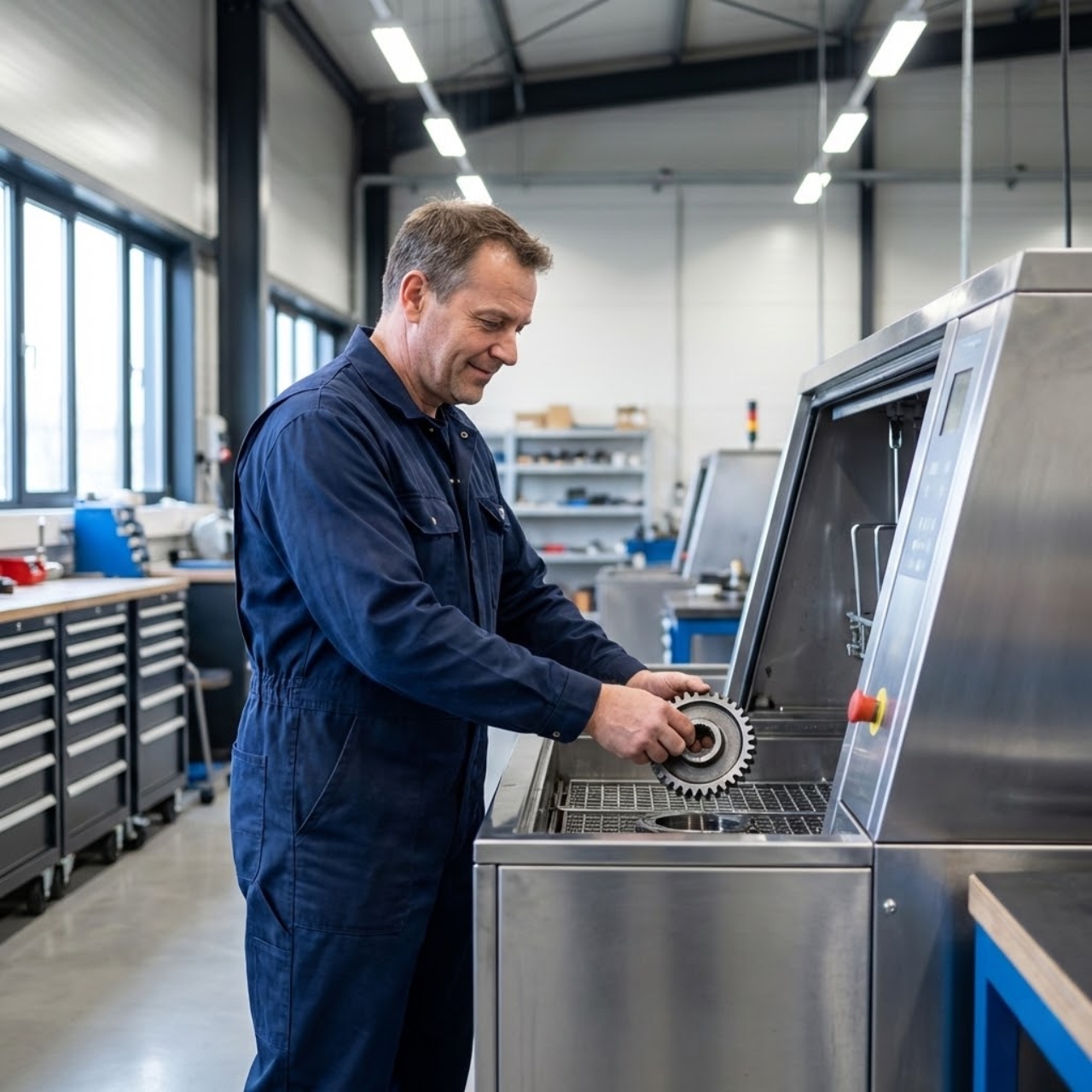
Cleaning task automation eliminates the specific tasks that drive workshop staff away. Instead of scrubbing components by hand, technicians load contaminated parts into a chamber, select a cleaning cycle, and retrieve spotless components 15-30 minutes later. The transformation goes beyond time savings – it fundamentally changes what the job entails.
Physical strain disappears almost entirely. Loading parts into automated industrial cleaning systems requires minimal effort compared to manual scrubbing. Technicians avoid repetitive motions that cause overuse injuries. They’re not bent over tanks breathing solvent fumes or standing in one position for hours. The reduction in workplace injuries translates directly to improved morale and reduced workers’ compensation costs.
Chemical exposure drops to negligible levels. Enclosed spray chambers contain cleaning solutions and heated water, eliminating the open solvent tanks that expose workers to harmful vapours. Automated systems use less aggressive chemicals because heated water and high-pressure spray provide superior cleaning power. Technicians interact with chemicals only during periodic tank refills – a five-minute task performed weekly rather than hours of daily exposure.
The psychological impact proves equally significant. Skilled workers feel respected when workshops invest in equipment that eliminates degrading manual labour. They interpret automation as management recognising their value and removing obstacles to productive work. Job satisfaction increases when technicians spend their shifts applying expertise rather than performing tasks a labourer could handle, delivering significant automated cleaning labour savings.
How Different Industries Benefit From Automated Parts Cleaning
Mining operations face particularly severe turnover challenges due to remote locations and demanding physical conditions. When a mine site workshop implements extra heavy-duty parts washers for cleaning drill bits, hydraulic components, and machinery parts, the operational benefits extend far beyond cleaning efficiency. Maintenance crews spend less time on physically exhausting manual cleaning and more time on skilled diagnostics and repairs. The workshop becomes a cleaner, safer environment where experienced technicians can envision working long-term rather than counting days until they can transfer to less demanding roles.
Oil and gas facilities require extreme cleaning standards for valves, pipeline components, and drilling equipment contaminated with crude oil and heavy greases. Manual cleaning of these components represents some of the most unpleasant work in industrial maintenance. Super heavy-duty parts washers handle the worst contamination without requiring technicians to manually scrub crude oil residue. The difference in working conditions proves dramatic – technicians maintain clean hands and clothing throughout their shifts rather than ending each day covered in petroleum products.
Food processing plants and commercial kitchens face unique challenges combining heavy contamination with strict hygiene requirements. Kitchen staff traditionally spend hours manually scrubbing commercial cooking equipment, fryers, and ventilation components – work that’s physically demanding, hot, and greasy. Stainless steel parts washers designed for food industry applications eliminate this manual labour while ensuring hygiene compliance. Staff retention improves significantly when kitchen workers avoid the burns, cuts, and chronic fatigue associated with manual equipment cleaning.
Manufacturing workshops across automotive, fabrication, and general engineering sectors struggle with parts cleaning that interrupts skilled work. A machinist or fabricator stops productive work to manually clean tooling, fixtures, or components – a context switch that wastes both time and expertise. Installing industrial spray washers allows these skilled workers to load contaminated items and immediately return to their primary work while automated cleaning proceeds, achieving measurable automated cleaning labour savings.
Quantifying the Retention Benefits of Workshop Automation
Australian industrial operations typically spend $15,000-$35,000 recruiting and training each skilled maintenance technician or tradesperson. This includes advertising, interviewing time, background checks, safety inductions, and the productivity loss during the learning curve. When annual turnover rates reach 25-30% in workshops with significant manual cleaning requirements, a 20-person maintenance team loses 5-6 workers yearly – representing $75,000-$210,000 in recruitment and training costs alone.
Cleaning task automation that reduces reducing workshop staff turnover by even 10-15% delivers substantial financial returns beyond operational benefits. A workshop that reduces turnover from 28% to 18% saves approximately $30,000-$70,000 annually in recruitment and training costs. These savings compound over the 10-15 year operational life of industrial cleaning equipment, representing $300,000-$1,000,000 in avoided turnover costs.
The productivity impact amplifies these savings. Experienced technicians work 40-60% faster than newly trained staff and make fewer costly mistakes. They understand equipment quirks, anticipate problems before failures occur, and mentor junior workers effectively. Retaining these experienced workers for an additional 2-3 years before natural retirement generates productivity value far exceeding the cost of automation equipment.
Workplace injury reductions contribute additional financial benefits. Manual parts cleaning generates numerous minor injuries – chemical burns, cuts, strains – that require first aid, medical attention, and lost time. More serious injuries trigger workers’ compensation claims, investigations, and potential regulatory penalties. Workshops that eliminate manual cleaning typically see 30-50% reductions in cleaning-related injuries, lowering insurance premiums and avoiding the productivity disruption that follows workplace incidents.
Implementing Automation to Maximise Retention Impact
Simply purchasing automated equipment doesn’t guarantee retention improvements – implementation approach matters significantly. Workshops achieve the strongest retention benefits when they involve maintenance staff in equipment selection, clearly communicate the reasoning behind automation investments, and demonstrate genuine commitment to improving working conditions.
Including experienced technicians in equipment evaluation builds buy-in and ensures selected systems match actual workflow requirements. When management asks senior staff to assess different Hotwash models and provide input on features, capacity, and placement, workers recognise their expertise is valued. They become advocates for the new equipment rather than viewing it sceptically as another management initiative that ignores shop floor realities.
Communication about automation investments should explicitly acknowledge eliminating manual cleaning as a primary objective. Framing automated parts washers as “efficiency improvements” misses the retention opportunity. Instead, management should directly state: “This equipment investment addresses eliminating manual cleaning because manual parts cleaning is physically demanding, potentially hazardous work that wastes skills. The goal is technicians spending time on diagnostics, repairs, and problem-solving – not scrubbing components in solvent tanks.”
Training and transition support ensures workers experience automation as a genuine improvement rather than another complication. Comprehensive training on industrial parts washing systems should emphasise how the equipment makes their jobs easier and safer. Allowing an adjustment period where workers can choose between manual and automated cleaning helps sceptical staff discover the benefits through direct experience rather than management directive.
Addressing Common Concerns About Workshop Automation
Some workshop managers worry that automation might actually increase turnover if workers fear job security or struggle with technology adoption. These concerns rarely materialise when automation targets universally disliked manual tasks rather than eliminating positions entirely. Workers don’t fear losing jobs to equipment that eliminates parts scrubbing – they’re relieved someone finally addressed a longstanding frustration.
Technology adoption concerns prove largely unfounded with modern industrial cleaning equipment. Automated parts washers feature straightforward controls – typically a selection of pre-programmed cycles matched to contamination levels. Workers who operate complex diagnostic equipment, CNC machines, or computerised maintenance management systems have no difficulty with washing system controls. The learning curve measures in hours, not weeks.
Budget constraints represent a more legitimate concern, particularly for smaller workshops. The capital cost of industrial cleaning equipment requires justification beyond retention benefits alone. However, the business case typically stands on operational efficiency improvements – time savings, labour reallocation, cleaning consistency – with retention benefits providing additional return. Workshops that cannot justify automation on operational grounds alone probably haven’t reached the scale where turnover costs warrant the investment.
Some operations question whether automated cleaning can match manual scrubbing effectiveness, particularly for heavily contaminated components. This concern reverses actual performance – heated high-pressure spray cleaning consistently outperforms manual scrubbing for removing baked-on grease, carbon deposits, and heavy contamination. Hot tank systems and thermal cleaning equipment achieve results impossible through manual methods, eliminating the frustration of spending hours scrubbing components that still aren’t properly clean.
The Broader Impact on Workshop Culture and Reputation
Workshops that eliminate the worst manual tasks through cleaning task automation develop reputations as desirable employers. Word spreads through industry networks – “That site has proper equipment, you’re not scrubbing parts all day like at other places.” This reputation advantage helps attract quality candidates during recruitment and reduces the salary premiums required to fill positions.
The cultural shift extends beyond cleaning tasks. When management demonstrates willingness to invest in equipment that improves working conditions, staff trust increases across all operational areas. Workers become more receptive to other changes, more willing to suggest improvements, and more invested in operational success. The workshop develops a problem-solving culture rather than a resignation that “this is just how things are.”
Younger workers entering trades and maintenance fields increasingly expect modern equipment and reasonable working conditions. They’ve grown up with automation and technology and question why industrial work requires manual labour that could be eliminated. Workshops still relying on manual parts cleaning struggle to attract apprentices and junior technicians who have options at more modern facilities. Automation becomes essential for accessing the next generation of skilled workers.
Safety culture improves measurably when workshops eliminate hazardous manual tasks. Workers notice when management invests in equipment that reduces workshop physical demands and injury risk rather than simply providing PPE and expecting them to manage hazards. Safety participation increases, near-miss reporting improves, and the workshop develops genuine safety commitment rather than compliance-focused box-checking.
Choosing the Right Equipment for Maximum Retention Impact
Not all automated cleaning equipment delivers equal retention benefits. Systems must actually eliminate the manual work rather than simply reducing it. A small underpowered washer that requires pre-scrubbing or multiple cycles frustrates workers and fails to deliver the working condition improvements that drive retention.
Capacity matters significantly – equipment must handle the actual parts requiring cleaning without forcing workers to break down assemblies or clean components in multiple batches. A mining workshop cleaning large hydraulic components needs extra heavy-duty capacity, while a general manufacturing facility might operate effectively with standard heavy-duty systems. Undersized equipment creates bottlenecks that force workers back to manual cleaning during busy periods, undermining retention benefits.
Cleaning power must match contamination levels encountered. Operations dealing with heavy grease, baked-on carbon, or crude oil contamination require heated high-pressure systems that eliminate manual pre-cleaning. Facilities with lighter contamination might operate successfully with less intensive equipment. The key question: does this system completely eliminate manual scrubbing, or does it merely reduce it?
Reliability and build quality directly impact retention outcomes. Equipment that frequently breaks down or requires constant maintenance frustrates workers and forces them back to manual methods during downtime. Australian-manufactured systems built to industrial standards provide the durability necessary for continuous operation in demanding workshop environments. Workers recognise quality equipment as a genuine investment in their working conditions rather than a token gesture.
Conclusion
Reducing workshop staff turnover requires addressing the root causes that drive experienced technicians away – not just offering higher wages or better benefits. Cleaning task automation eliminates the physically demanding, hazardous manual cleaning work that makes skilled workers question whether they can sustain their careers long-term. The investment delivers returns through reduced recruitment costs, retained expertise, improved productivity, and enhanced safety culture.
Hotwash manufactures industrial parts washing systems specifically designed for Australian mining, manufacturing, and heavy industry applications. The equipment handles the extreme contamination and demanding conditions that characterise these sectors while providing the reliability necessary for continuous operation. Systems are built locally to Australian standards, ensuring compliance and local support availability.
Workshop managers, maintenance supervisors, and operations directors facing persistent turnover challenges should evaluate how automated cleaning equipment could transform their working environment. The conversation starts with understanding current cleaning requirements, contamination levels, and throughput needs – then matching those requirements to appropriate system capacity and cleaning power.
Contact us to discuss how automated parts washing can reduce turnover in specific operations. The team provides technical consultation on system selection, capacity planning, and implementation approaches that maximise both operational efficiency and workforce retention benefits. Transform the workshop from a place people want to leave into an environment where skilled technicians build long-term careers.

Leave A Comment