
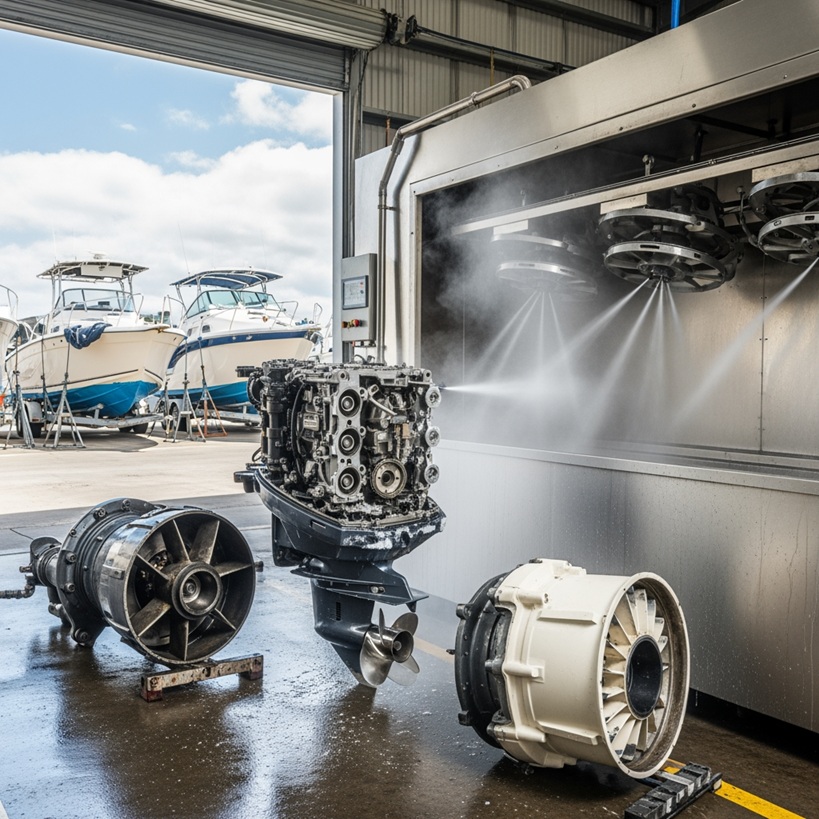
Marine workshops running recreational boat services face a persistent operational challenge – outboard motors, stern drives and jet units accumulate salt, fuel residue and carbon deposits that manual cleaning methods struggle to remove efficiently. A typical technician spends 45-90 minutes hand-scrubbing a single outboard powerhead, yet still leaves residue in cooling passages and around mounting surfaces. This labour-intensive approach creates bottlenecks during peak servicing periods when multiple units require attention simultaneously.
The marine service sector operates within tight seasonal windows. Boat owners expect fast turnarounds during prime boating months, yet workshops allocate disproportionate labour hours to cleaning tasks rather than billable diagnostic and repair work. Manual cleaning with brushes, solvents and compressed air removes surface contamination but fails to address carbon buildup in exhaust ports, salt crystallisation in cooling channels, and oil deposits on internal components. Automated boat engine cleaning service systems transform this operational inefficiency into a competitive advantage for marine workshops.
The True Cost of Manual Powerhead Cleaning
Direct Labour Cost Analysis
Marine workshops typically charge $80-120 per hour for technician labour. When a skilled mechanic spends 60 minutes manually cleaning an outboard motor before inspection, that represents $80-120 in non-recoverable labour costs – time that could generate revenue through diagnostic work, component replacement or system upgrades. Multiply this across 15-20 units during a busy service period, and workshops sacrifice $1,200-2,400 in potential revenue to cleaning tasks alone.
Hidden Operational Costs
Manual cleaning creates additional hidden costs beyond direct labour hours. Technicians develop repetitive strain injuries from sustained scrubbing motions, particularly when addressing stubborn carbon deposits on exhaust components. Solvent exposure presents ongoing WHS compliance concerns, requiring ventilation systems, personal protective equipment and safety monitoring. Inconsistent cleaning results lead to comeback work when residual deposits cause overheating issues or corrosion continues beneath inadequately cleaned surfaces.
Cumulative Fatigue Effects
The physical toll on workshop staff compounds during peak periods. A technician who manually cleans four outboard motors in a single day experiences significant hand and wrist fatigue, reducing efficiency on subsequent units and increasing error rates during reassembly procedures. This cumulative effect means the fourth motor takes 30-40% longer to clean than the first, further compounding labour inefficiencies.
Contamination Types Across Marine Propulsion Systems
Two-Stroke Outboard Challenges
Outboard motors, stern drives and jet units each present distinct cleaning challenges based on their operating environments and fuel systems. Two-stroke outboards accumulate heavy carbon deposits throughout exhaust passages, with oil and fuel residue coating powerhead surfaces and cooling system components. These deposits harden over time, creating insulating layers that reduce heat transfer efficiency and accelerate component wear.
Four-Stroke Outboard Requirements
Four-stroke outboards develop different contamination patterns. Engine oil residue mixes with salt spray to form tenacious deposits on external surfaces, while cooling passages accumulate calcium and magnesium scale from brackish water operation. Fuel injection components require meticulous cleaning to maintain precise spray patterns, yet manual methods risk damaging sensitive injector nozzles or throttle body sensors.
Stern Drive and Jet Unit Complications
Stern drives face unique challenges from their partially submerged operation. The gimbal housing and U-joint assemblies collect marine growth, salt crystallisation and gear oil contamination simultaneously. Lower units accumulate barnacle fragments, sand particles and corrosion products that manual brushing cannot fully remove from complex internal passages. Jet units compound these issues with impeller housings that trap debris, sand and vegetation in areas inaccessible to manual cleaning tools.
Automated Cleaning Performance Specifications
Pressure and Temperature Capabilities
Heavy-duty parts washers designed for marine applications deliver 1,500-2,000 PSI spray pressure at temperatures reaching 80-85°C. This combination breaks down carbon deposits, dissolves oil residues and removes salt crystallisation without mechanical scrubbing. A complete outboard motor cleaning cycle processes a powerhead in 15-20 minutes, reducing technician intervention to loading and unloading operations only.
Chamber Capacity and Coverage
The cleaning chamber accommodates components up to 900mm length, sufficient for most recreational outboard motors up to 300hp. Rotating spray arms ensure complete coverage of complex geometries, reaching cooling passages, exhaust ports and mounting surfaces that manual methods cannot access effectively. Heated cleaning solution maintains consistent temperature throughout the cycle, ensuring uniform contamination removal regardless of component size or configuration.
Filtration and Chemical Management
Filtration systems remove dislodged particles continuously, preventing redeposition on cleaned surfaces. This closed-loop operation maintains solution effectiveness across multiple cleaning cycles, reducing detergent consumption and waste generation compared to manual parts washers that discard contaminated solvent after each use. The automated process eliminates direct technician contact with cleaning chemicals, addressing WHS compliance requirements without additional protective equipment or ventilation infrastructure.
Workshop Workflow Integration
Parallel Processing Advantages
Marine service facilities integrate automated boat engine cleaning service equipment at strategic points in their service workflow. Upon removal, powerheads proceed directly to the washing system while technicians begin work on other units. The 15-20 minute cleaning cycle runs unattended, allowing one technician to manage multiple service jobs simultaneously rather than dedicating exclusive attention to manual cleaning tasks.
Revenue Capacity Recovery
This parallel processing capability transforms workshop throughput during peak periods. A facility servicing 20 outboard motors weekly previously allocated 20 hours to manual cleaning – equivalent to half a technician’s work week. Automated cleaning reduces this to 6-7 hours of loading/unloading time, recovering 13-14 hours for billable service work. At $100 per hour labour rates, this represents $1,300-1,400 in additional weekly revenue capacity.
Diagnostic Accuracy Improvements
The consistency of automated cleaning improves diagnostic accuracy. Technicians inspect components against clean surfaces, identifying hairline cracks, corrosion patterns and wear indicators that residual deposits would otherwise obscure. This thoroughness reduces comeback rates and builds customer confidence in service quality, particularly for higher-value powerhead rebuilds and performance upgrades.
Stern Drive and Jet Unit Applications
Gimbal Housing and U-Joint Cleaning
Stern drive lower units present cleaning challenges that manual methods address inadequately. The gimbal housing contains multiple bearing surfaces, seals and pivot points where salt and corrosion products accumulate in confined spaces. Hotwash Australia industrial spray washers deliver pressurised solution into these areas, removing contamination that would otherwise accelerate bearing wear and seal degradation.
The U-joint assembly requires particularly thorough cleaning before inspection. Carbon deposits from exhaust gases mix with gear oil and salt spray to form hardened layers around the joint surfaces and bellows connections. Automated outboard motor cleaning systems remove these deposits completely, allowing accurate assessment of bearing play, bellows condition and alignment specifications. This thoroughness prevents premature failures that result from reassembling inadequately cleaned components.
Jet Unit Impeller Housing Solutions
Jet unit impeller housings accumulate sand, vegetation fragments and marine growth that reduce performance and accelerate wear. The complex internal geometry of these housings makes manual cleaning extremely time-consuming, with technicians spending 60-90 minutes per unit attempting to reach all surfaces. Automated washing reduces this to a 20-minute cycle that delivers superior results, clearing debris from every passage and surface without disassembly of internal components.
Chemical Selection for Marine Applications
Marine-Specific Formulations
Marine propulsion systems require cleaning solutions explicitly formulated for salt contamination, carbon deposits and oil residues. Alkaline detergents at pH 11-12 effectively dissolve carbon buildup and saponify oil films, while maintaining compatibility with aluminium, stainless steel and composite materials common in modern powerhead construction. For particularly stubborn carbon deposits on exhaust components, hot tanks provide immersion cleaning that penetrates baked-on contamination through sustained heat and chemical action.
Salt Removal Effectiveness
Salt removal demands specific attention in marine applications. Sodium chloride crystallises in cooling passages and on external surfaces, creating corrosion sites that progress rapidly once the motor returns to service. Hot alkaline solutions dissolve these salt deposits completely, flushing them from internal passages that manual rinsing cannot reach. This thorough salt removal extends component life significantly, particularly for aluminium powerheads operating in saltwater environments.
Stainless Steel Equipment Benefits
Stainless steel parts washers provide corrosion resistance essential for marine workshop environments. The cleaning chamber withstands continuous exposure to salt-laden solutions without developing rust or pitting that would contaminate subsequent cleaning cycles. This durability maintains system performance across years of daily operation, eliminating the maintenance burden and replacement costs associated with powder-coated steel equipment in marine service applications.
Operational Cost Analysis
Chemical Consumption Economics
The financial case for automated boat engine cleaning service systems extends beyond labour recovery. Detergent consumption runs approximately $2-4 per cleaning cycle for standard marine applications, significantly less than the $8-12 in aerosol cleaners and solvents consumed during equivalent manual cleaning. The closed-loop system maintains solution strength across 40-60 cleaning cycles before requiring replacement, amortising chemical costs across multiple service jobs.
Energy and Water Usage
Energy consumption remains modest despite the heating requirements. A typical system draws 15-20 kW during the heating phase, then maintains temperature with 8-10 kW during cleaning cycles. At commercial electricity rates of $0.25-0.30 per kWh, this represents $0.80-1.20 per cleaning cycle – negligible compared to the labour cost recovery achieved. Water consumption averages 80-120 litres per cycle when using fresh solution, though recirculation systems reduce this substantially for workshops processing multiple units daily.
Investment Return Calculations
The equipment investment typically returns within 12-18 months for workshops servicing 15+ powerheads weekly. A facility charging $100 per hour labour rates and recovering 45 minutes per unit through automated cleaning generates $75 additional revenue capacity per service. Across 15 units weekly, this totals $1,125 weekly or approximately $58,000 annually – well exceeding the capital cost of heavy-duty cleaning systems designed for marine workshop applications.
Maintenance Schedule Optimisation
Turnaround Time Reduction
Automated cleaning enables marine workshops to offer faster turnaround commitments during peak season. A facility previously quoting 5-7 day service periods can confidently reduce this to 3-4 days when cleaning bottlenecks no longer constrain workflow. This competitive advantage attracts customers prioritising minimal downtime, particularly commercial operators and charter services where every day out of service represents lost revenue.
Fleet Service Efficiency
The time savings compound when workshops process multiple units from fleet operators or marina service contracts. A batch of six outboard motors from a charter operation previously consumed 6-9 hours of cleaning labour across two days. Automated processing completes all six units in 2 hours of total cycle time, with minimal technician intervention. This efficiency allows workshops to accept larger fleet contracts that would otherwise exceed their labour capacity during busy periods.
Quality Standardisation
Consistent cleaning quality reduces variability in service outcomes. Every powerhead receives identical treatment regardless of which technician loads the washer or what time of day processing occurs. This standardisation improves quality control, simplifies training for new staff, and ensures customers receive uniform service quality across multiple visits.
Safety and Compliance Improvements
Chemical Exposure Elimination
Automated outboard motor cleaning equipment substantially reduces technician exposure to cleaning chemicals and solvents. Manual cleaning methods require sustained contact with degreasers, carbon removers and aromatic hydrocarbons that present both acute and chronic health risks. The enclosed washing chamber eliminates airborne solvent vapours and prevents skin contact with aggressive cleaning agents, addressing WHS compliance requirements without additional ventilation infrastructure or personal protective equipment.
Physical Injury Risk Reduction
The physical demands of manual cleaning contribute to cumulative trauma injuries in marine workshops. Repetitive scrubbing motions, sustained grip force on brushes and tools, and awkward postures while accessing complex component geometries create risk factors for carpal tunnel syndrome, tendinitis and shoulder injuries. Automated cleaning eliminates these physical demands entirely, reducing injury rates and associated workers’ compensation costs.
Environmental Compliance
Environmental compliance becomes more straightforward with closed-loop washing systems. The contained process prevents cleaning solution from entering stormwater drains or contaminating workshop floors. Spent solution undergoes proper disposal through licensed waste contractors, with clear documentation of volumes and contamination levels. This controlled approach simplifies environmental reporting and reduces liability compared to manual cleaning methods where solvent use and disposal often lack comprehensive tracking.
Facility Requirements and Installation
Utility Infrastructure Needs
Marine workshops require minimal facility modifications to accommodate automated parts washing systems. Standard three-phase power supply (415V) provides adequate capacity for heating and pump operation. Floor space requirements range from 2.0-2.5 square metres for systems handling recreational powerhead sizes, fitting readily into existing workshop layouts without major reconfiguration.
Space and Layout Considerations
Drainage connections require capacity for 80-120 litres discharge when changing cleaning solution. Most workshops connect to existing floor drains with appropriate oil/water separation if required by local regulations. Fresh water supply connects via standard 20mm fittings, with flow rates of 15-20 litres per minute sufficient for system operation. These modest utility requirements allow installation in established facilities without extensive infrastructure upgrades.
The equipment footprint suits workshops with space constraints common in marine service facilities. Vertical loading configurations minimise floor space consumption while accommodating components up to 900mm length. Sliding door designs provide full chamber access for loading bulky stern drive assemblies or multiple smaller components simultaneously, maximising system utilisation across varied service jobs.
Competitive Differentiation in Marine Services
Turnaround Time Advantages
Marine workshops adopting automated cleaning technology gain tangible competitive advantages in their local markets. Faster turnaround times attract customers during peak season when competing facilities quote extended wait periods. The ability to confidently commit to 3-4 day service windows rather than 5-7 days captures business from boat owners prioritising minimal downtime, particularly commercial operators and serious recreational users.
Quality Reputation Building
Service quality improvements build reputation through customer referrals and online reviews. Boat owners notice the difference when powerheads return spotlessly clean with no residual oil films or carbon deposits. This attention to detail signals professional operation and thoroughness that extends to all service aspects, not just visible cleanliness. The consistency of automated boat engine cleaning service systems ensures every customer receives this elevated service standard, not just those fortunate enough to have their work performed by the most meticulous technician.
Marketing Material Opportunities
Workshop marketing materials effectively highlight automated cleaning capabilities. Before-and-after photographs demonstrate cleaning thoroughness that manual methods cannot match. Service descriptions emphasise the reduced contamination exposure for technicians and the environmental responsibility of closed-loop systems. These differentiators appeal particularly to environmentally conscious boat owners and commercial operators with corporate sustainability commitments.
Long-Term Equipment Durability
Marine Environment Resistance
Marine workshop environments present harsh conditions for industrial equipment. Salt-laden air, high humidity and temperature fluctuations challenge equipment longevity. Heavy-duty parts washers constructed with marine-grade stainless steel withstand these conditions without corrosion or degradation, maintaining performance across 10-15 years of daily operation.
Maintenance Accessibility
Component accessibility simplifies maintenance and reduces downtime. Heating elements, pump assemblies and filtration systems mount for straightforward inspection and replacement without specialised tools or extensive disassembly. This serviceability keeps systems operational with minimal interruption, critical for workshops dependent on consistent cleaning capacity during peak service periods.
Australian-manufactured equipment provides local support advantages for marine workshops. Parts availability, technical support and service calls occur within days rather than weeks, minimising downtime when maintenance becomes necessary. This local support infrastructure proves particularly valuable for workshops in regional coastal areas where equipment failures would otherwise create extended service interruptions.
Conclusion
Recreational boat workshops face intense pressure during peak service periods when manual cleaning methods create operational bottlenecks that limit revenue capacity and extend customer wait times. Outboard motors, stern drives and jet units accumulate contamination that demands 45-90 minutes of manual scrubbing per unit, consuming technician hours that could generate revenue through diagnostic and repair work. This labour-intensive approach costs workshops $1,200-2,400 weekly in lost productivity during busy periods while creating WHS compliance challenges and inconsistent service quality.
Automated outboard motor cleaning and boat engine cleaning service systems reduce cleaning time to 15-20 minutes per component with superior contamination removal and zero technician intervention during processing cycles. Marine workshops recover 13-14 labour hours weekly, generating $1,300-1,400 in additional revenue capacity at standard labour rates. The technology delivers 12-18 month payback periods for facilities servicing 15+ powerheads weekly while improving safety, environmental compliance and service consistency.
Australian-manufactured heavy-duty parts washers provide the durability, support infrastructure and performance specifications marine workshops require for reliable daily operation in harsh coastal environments. These systems transform cleaning from a labour-intensive bottleneck into an automated process that enhances workshop efficiency, service quality and competitive positioning. Marine service facilities ready to eliminate cleaning bottlenecks and recover billable technician hours should contact us to discuss system specifications matched to their operational requirements and service volumes.

Leave A Comment