
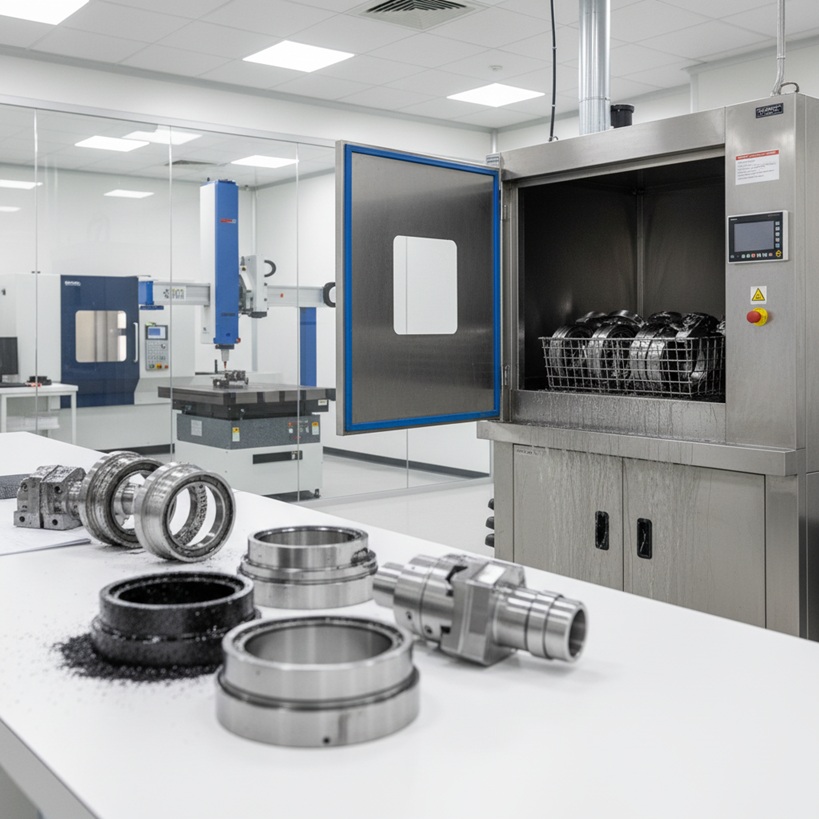
Coordinate measuring machines (CMMs) deliver micron-level accuracy – but only when measuring clean parts. A single speck of contamination measuring 0.025mm can throw off an entire inspection report, forcing costly re-measurements and delaying quality approval processes. For precision manufacturers working to tolerances of ±0.005mm or tighter, surface cleanliness isn’t optional preparation – it’s the foundation of reliable metrology.
Machine shops, aerospace manufacturers, and automotive component producers face a recurring challenge: parts arrive at the CMM station contaminated with cutting fluids, metal fines, grinding dust, and handling residues. Inspection teams spend valuable time manually cleaning components, or worse, measuring contaminated parts and discovering dimensional discrepancies that don’t actually exist. The result? Wasted inspection time, false rejection rates, and bottlenecks in quality control workflows.
How Contamination Compromises CMM Accuracy
CMMs work by touching precision probe tips to component surfaces, recording coordinates with submicron resolution. When contaminants sit between the probe and the actual part surface, the machine records the position of the contamination layer – not the true part geometry.
Measurement Interference Mechanisms
Precision parts cleaning eliminates the barrier between probe tips and actual component surfaces. Without proper cleaning, measurement errors compound across inspection cycles, creating false quality data that triggers unnecessary investigations and rework decisions.
Contamination Types and Measurement Impact
The impact varies by contamination type:
- Cutting Fluid Residues: Water-soluble and oil-based coolants leave films measuring 0.010-0.050mm thick. On precision bearing races or hydraulic valve bodies, this thickness exceeds the entire tolerance band.
- Metal Fines and Swarf: Machining operations embed tiny metal particles in surface textures. These particles create false high points, making features appear larger than actual dimensions.
- Grinding Dust: Abrasive particles from grinding operations stick to parts through electrostatic attraction and residual coolant. A single particle under a CMM probe tip can register as a surface defect.
- Handling Residues: Oils from gloves, fingerprints, and packaging materials create uneven surface films that affect optical measurements and touch probe readings.
- Corrosion Prevention Compounds: Rust inhibitors applied after machining provide necessary protection but add measurable thickness that skews dimensional data.
Precision manufacturers working with aerospace components report contamination-related measurement errors accounting for 15-30% of initial inspection failures. Parts get cleaned, re-measured, and approved – wasting inspection capacity and delaying production releases.
The True Cost of Measuring Contaminated Parts
Beyond measurement accuracy, contamination creates operational costs throughout quality control workflows.
Operational Impact
Inspection Time Multiplication: Metrology technicians spend 10-20 minutes manually cleaning each component before CMM inspection. For facilities measuring 50-100 parts daily, this represents 8-16 hours of non-value-added labour per day.
False Rejection Rates: Parts measuring out of tolerance due to surface contamination get flagged for rework or scrapping. After cleaning and re-inspection, 40-60% of these “failures” prove dimensionally acceptable – but the initial rejection has already triggered documentation, investigation time, and production delays.
Probe Tip Contamination: Dirty parts transfer residues to precision ruby probe tips, degrading measurement accuracy across subsequent inspections. Probe recalibration cycles increase from weekly to daily intervals, consuming CMM availability.
Quality Control Complications
Optical System Interference: Vision-based CMM systems rely on surface contrast and edge detection. Contamination films scatter light, creating fuzzy edges that reduce measurement repeatability and force manual intervention.
Documentation Complications: When contamination causes measurement variations, quality teams generate non-conformance reports, conduct root cause investigations, and implement corrective actions – all addressing phantom problems created by dirty parts rather than actual manufacturing issues.
For precision component manufacturers, precision parts cleaning before inspection isn’t about cleanliness standards – it’s about measurement validity and inspection efficiency.
Contamination Types Across Manufacturing Processes
Different machining operations create specific contamination challenges that affect CMM inspection.
CNC Milling and Turning
High-pressure coolant systems leave persistent fluid films. Chip evacuation systems miss fine swarf in blind holes, threaded features, and complex geometries. Parts arrive at inspection stations visibly wet, requiring drying time before measurement.
Grinding Operations
Abrasive particles embed in surface textures, particularly in ground bearing surfaces and precision flat faces. These particles are microscopic but dimensionally significant – grinding dust measuring 0.005-0.015mm directly impacts features with ±0.010mm tolerances.
EDM, Honing, and Specialised Processes
Electrical Discharge Machining (EDM): Dielectric fluids leave carbon deposits and recast layers. EDM-produced features like cooling channels and injection mould details require thorough cleaning before accurate dimensional verification.
Honing and Lapping: Fine abrasive compounds used in finishing operations create surface films that affect both dimensional and surface finish measurements. These compounds resist simple solvent wiping, requiring immersion cleaning.
Laser Cutting and Waterjet: Cutting processes leave edge burrs, slag deposits, and abrasive residues. CMM probe tips catch on these edge contaminants, creating measurement errors and potential probe damage.
Manufacturers addressing these varied contamination sources need cleaning systems that remove specific residues without introducing new measurement complications. Heavy-duty parts washers handle post-machining cleaning for general workshop components, while precision applications require controlled cleaning processes that maintain dimensional integrity.
Pre-Inspection Cleaning Requirements
Effective CMM inspection cleaning requirements demand processes that remove contamination without affecting part dimensions or introducing new measurement variables.
Critical Cleaning Parameters
Complete Residue Removal: Cleaning must eliminate all fluid films, particles, and handling residues. Partial cleaning leaves random contamination that creates measurement inconsistency – the worst scenario for quality control.
Dimensional Stability: Cleaning processes cannot alter part dimensions through material removal, thermal expansion, or induced stresses. For components with ±0.005mm tolerances, even minor dimensional changes invalidate inspection results.
Surface Integrity: Cleaning methods must not affect surface finish, create micro-scratches, or embed new contaminants. Optical CMM measurements particularly depend on consistent surface reflectivity.
Drying Completeness: Residual moisture creates measurement errors through thermal effects and surface films. Parts must reach complete dryness and thermal equilibrium before inspection.
Repeatability: Cleaning results must be consistent across production batches. Measurement variation caused by inconsistent cleaning defeats the purpose of precision metrology.
Manual vs Automated Cleaning
Manual cleaning with solvents and lint-free wipes addresses simple geometries but fails on complex parts with internal features, blind holes, and intricate surfaces. Solvent wiping also introduces handling risks – fingerprints and cloth fibres become new contamination sources.
Automated parts washers provide consistent cleaning through programmed cycles that eliminate operator variability. High-pressure spray patterns reach complex geometries, while heated cleaning solutions dissolve stubborn residues that resist manual methods.
Cleaning Technologies for Precision Components
Different cleaning technologies suit specific precision parts cleaning applications.
Heated Spray Washing
High-pressure spray systems using heated alkaline detergents remove cutting fluids, oils, and particulate contamination. Spray impingement reaches recessed features and internal passages. Typical specifications include 40-80°C wash temperatures, 30-60 PSI spray pressure, and programmable cycle times. This approach handles high-volume component cleaning before inspection.
Immersion and Ultrasonic Cleaning
Immersion Cleaning: Hot tank systems provide thorough cleaning for heavily contaminated parts. Components soak in heated cleaning solutions that dissolve stubborn residues, followed by high-pressure rinsing. Immersion cleaning suits large parts, complex assemblies, and components with extreme contamination levels.
Ultrasonic Cleaning: High-frequency sound waves create cavitation bubbles that remove microscopic particles from surface textures. Ultrasonic systems excel at cleaning precision ground surfaces, honed bores, and lapped faces where abrasive residues affect measurement accuracy.
Specialized Methods
Vapour Degreasing: Solvent vapour systems provide precision parts cleaning for critical aerospace and medical components. Parts are exposed to heated solvent vapour that condenses on cooler surfaces, dissolving contaminants through continuous solvent distillation.
Aqueous Detergent Systems: Water-based cleaning using formulated detergents removes coolants, oils, and particulates without harsh solvents. Multi-stage wash, rinse, and dry cycles deliver inspection-ready parts with no residual cleaning agent.
Precision manufacturers typically combine technologies – automated cleaning systems for production volumes, with ultrasonic or vapour degreasing for critical components requiring maximum cleanliness.
Implementing Pre-CMM Cleaning Workflows
Integrating cleaning into quality control processes requires systematic workflow design that addresses CMM inspection cleaning requirements.
Workflow Design Elements
Cleaning Station Positioning: Locate cleaning equipment adjacent to CMM areas, minimising transport distance and contamination reintroduction. Parts move directly from cleaning to inspection without intermediate handling or storage.
Batch Processing Coordination: Match cleaning capacity to inspection throughput. If CMM inspection processes 15 parts per hour, cleaning systems must deliver 15-20 cleaned parts hourly to prevent inspection bottlenecks.
Drying and Thermal Stabilisation: Allocate time for parts to reach ambient temperature after heated cleaning. Thermal gradients cause dimensional changes that affect precision measurements – a 10°C temperature difference creates 0.010-0.015mm expansion in a 300mm steel component.
Handling and Documentation
Handling Protocols: Establish procedures for moving cleaned parts to inspection. Use clean gloves, dedicated transport fixtures, and covered storage to prevent recontamination between cleaning and measurement.
Documentation Integration: Link cleaning records to inspection results. Track which cleaning cycle produced each inspected part, enabling correlation between cleaning parameters and measurement quality.
Maintenance Scheduling: Coordinate cleaning system maintenance with CMM calibration cycles. Both systems require regular verification to maintain precision manufacturing capability.
For facilities measuring hundreds of precision components weekly, systematic precision parts cleaning transforms quality control efficiency. Inspection time focuses on actual measurement rather than part preparation, false rejection rates drop, and CMM capacity increases.
Measuring Cleaning Effectiveness
Quantifying cleaning performance ensures consistent pre-inspection preparation that meets CMM inspection cleaning requirements.
Verification Methods
Visual Inspection Standards: Establish acceptance criteria for cleaned parts – no visible fluid films, no particulate residues, no discolouration. Train inspection personnel to identify insufficient cleaning before parts reach the CMM.
Measurement Repeatability Studies: Clean identical parts through different cycles, then measure on the CMM. Consistent dimensional results across cleaning cycles confirm effective contamination removal without dimensional impact.
Surface Cleanliness Testing: Use contact angle measurements, residue extraction testing, or fluorescent dye methods to verify complete contaminant removal. These tests provide objective cleanliness data beyond visual assessment.
Performance Metrics
False Rejection Rate Tracking: Monitor inspection failure rates before and after the cleaning process implementation. Significant reductions in contamination-related rejections confirm cleaning effectiveness.
CMM Probe Life Extension: Track probe tip replacement frequency. Effective pre-cleaning reduces probe contamination, extending probe life and reducing recalibration requirements.
Australian manufacturers implementing systematic precision parts cleaning before CMM inspection report 40-60% reductions in inspection time per part, 70-85% decreases in contamination-related measurement errors, and 25-35% improvements in overall CMM utilisation.
Industry-Specific Cleaning Considerations
Different precision manufacturing sectors face unique pre-inspection cleaning requirements.
Aerospace Components
Titanium and aluminium parts require complete removal of cutting fluids and metal fines without surface etching or dimensional change. Cleaning processes must meet aerospace cleanliness standards while preserving tight tolerances on flight-critical components.
Automotive and Hydraulic Applications
Automotive Transmission Parts: Gear sets, valve bodies, and clutch components arrive at inspection with heavy machining residues. High-volume production demands rapid cleaning cycles that deliver consistent results across thousands of components daily.
Hydraulic Valve Manufacturing: Precision valve spools, housings, and manifolds require absolute cleanliness – both for accurate CMM inspection and for functional performance. Particulate contamination affects both measurement validity and hydraulic system operation.
Medical Devices and Mould Tooling
Medical Device Components: Implantable devices and surgical instruments demand both dimensional accuracy and biocompatibility. Cleaning processes must remove manufacturing residues while meeting medical device cleanliness standards.
Injection Mould Tooling: Complex mould cavities with intricate cooling channels require thorough cleaning before dimensional verification. EDM residues and polishing compounds must be completely removed to verify precision surface geometries.
For operations producing components across multiple sectors, extra heavy-duty parts washers provide the capacity and flexibility to handle varied cleaning requirements while maintaining consistent pre-inspection preparation standards.
Return on Investment for Pre-CMM Cleaning Systems
Capital investment in automated cleaning equipment delivers measurable returns through improved inspection efficiency.
Labour and Capacity Benefits
Labour Cost Reduction: Eliminating 15 minutes of manual cleaning per part saves 12.5 hours daily in a facility inspecting 50 components per day. At $45/hour for skilled metrology technicians, this represents $140,000+ annual labour savings.
Inspection Capacity Increase: Reducing per-part inspection time from 35 minutes to 20 minutes increases CMM throughput by 75%. This additional capacity eliminates inspection bottlenecks that delay production releases and extends expensive CMM equipment utilisation.
Quality Cost Reductions
False Rejection Elimination: Contamination-related measurement errors generate non-conformance reports, investigation time, and re-inspection costs averaging $150-300 per occurrence. Facilities experiencing 10-15 contamination-related failures weekly save $78,000-234,000 annually through effective pre-cleaning.
CMM Maintenance Reduction: Probe tip contamination from dirty parts increases recalibration frequency and accelerates probe wear. Extending probe life from 3 months to 12 months saves $8,000-15,000 annually in replacement costs and calibration labour.
Quality Documentation Efficiency: Eliminating phantom quality issues reduces quality management system overhead. Less time investigating contamination-related measurement variations means more time addressing actual manufacturing process improvements.
Payback Period Analysis
For precision manufacturers, stainless steel parts washers and pre-inspection cleaning systems typically achieve payback within 8-18 months through combined labour savings, capacity gains, and quality cost reductions.
Conclusion
CMM inspection delivers the precision measurement data that validates manufacturing quality – but only when measuring truly clean parts. Contamination measuring 0.010-0.050mm thickness makes precision inspection impossible when working to tolerances of ±0.010mm or tighter. The solution isn’t more careful manual cleaning or longer inspection times – it’s systematic automated cleaning that removes all contamination before parts reach the CMM station.
Manufacturers implementing dedicated pre-inspection cleaning transform quality control from a bottleneck into a competitive advantage. Inspection capacity increases, false rejection rates drop, and metrology data becomes reliably accurate. The investment in precision parts cleaning equipment pays for itself through labour savings and inspection efficiency gains, while delivering the measurement confidence that precision manufacturing demands.
Hotwash Australia manufactures cleaning systems that provide the durability and performance precision manufacturers require. Built to handle continuous production cycles and engineered for Australian industrial standards, these systems deliver consistent pre-inspection cleaning that supports accurate dimensional verification. To discuss cleaning solutions for precision manufacturing applications, contact us for technical specifications and system recommendations tailored to specific CMM inspection cleaning requirements.

Leave A Comment