
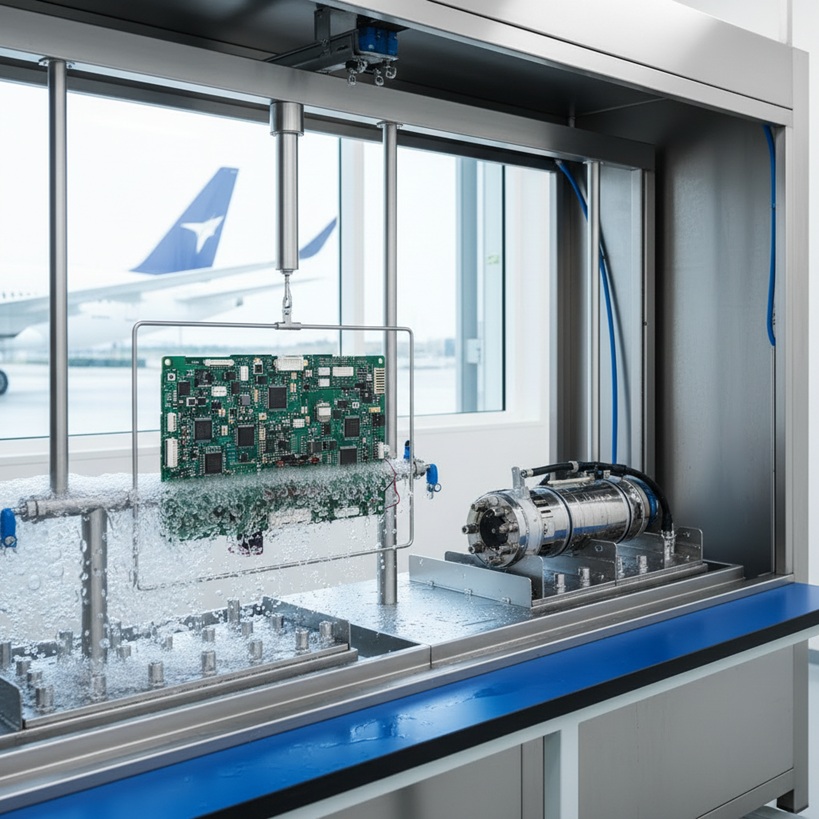
Aircraft electronics demand cleaning protocols that most industrial operations never encounter. A single microscopic contaminant on an avionic circuit board can trigger catastrophic system failures at 35,000 feet. Yet these same sensitive components accumulate hydraulic fluid mist, fuel vapours, and environmental contaminants that require removal without compromising delicate circuitry.
Traditional degreasing methods developed for mining equipment or automotive parts destroy the precision components that keep aircraft operational. The challenge extends beyond simple cleaning – avionics require contamination removal that preserves solder joints, protects gold-plated connectors, prevents moisture intrusion, and maintains the electromagnetic shielding critical for navigation and communication systems.
Hotwash Australia manufactures cleaning systems engineered for industries where contamination control determines operational safety. The principles governing avionics cleaning procedures differ fundamentally from conventional parts washing, requiring specialised equipment, chemistry, and validation protocols that meet aviation standards.
Understanding Contamination Risks in Aviation Electronics
Avionic components face contamination from multiple sources throughout their operational lifecycle. Hydraulic fluid mist migrates through aircraft systems, settling on circuit boards housed in avionics bays. Fuel vapours condense on cold electronics during altitude changes. Salt-laden moisture attacks connectors in coastal operations. Even microscopic particles from brake dust infiltrate ventilation systems, accumulating on sensitive electronics.
Contaminant Types and Associated Risks
Each contaminant type presents distinct risks. Hydraulic fluids leave residues that attract dust and create conductive pathways between circuit traces. Salt deposits cause galvanic corrosion on dissimilar metals. Carbonaceous deposits from incomplete combustion create electrical leakage paths. These contaminants don’t merely reduce performance – they create failure modes that manifest unpredictably during flight operations.
The aerospace industry quantifies contamination using particle count standards and ionic contamination measurements. A circuit board that appears visually clean may harbour ionic residues measured in micrograms per square centimetre, sufficient to cause corrosion failures within months. Avionics cleaning procedures must remove both visible contamination and molecular-level residues that escape casual inspection.
Component Sensitivity Variations
Component sensitivity varies across avionic systems. Navigation computers contain microprocessors operating at voltages where even fingerprint residues create short circuits. Radio frequency modules require surface cleanliness that maintains precise impedance characteristics. Sensor assemblies incorporate MEMS devices damaged by cleaning solutions that safely degrease engine components. Maintenance teams cannot apply universal cleaning protocols across these varied requirements.
Critical Differences Between Industrial and Avionic Cleaning Standards
Standard industrial parts washing removes bulk contamination to restore mechanical function. A mining equipment component emerges from a heavy-duty parts washer free of grease and operationally ready, even if microscopic residues remain. Aviation electronics operate under entirely different criteria – residual contamination levels that pose zero risk to mechanical parts cause electronic failures.
Aviation Standards and Specifications
Aviation standards specify maximum allowable contamination measured in micrograms rather than visible cleanliness. MIL-STD-2000 defines cleanliness levels for military electronics. IPC-A-610 establishes acceptability criteria for commercial aviation assemblies. These standards quantify ionic contamination, particulate counts, and residue films using laboratory instrumentation rather than visual inspection.
Temperature Control and Thermal Management
Temperature control becomes critical when cleaning temperature-sensitive components. Thermal shock from hot water spray systems designed for engine parts cracks ceramic capacitors and delaminates multilayer circuit boards. Rapid heating expands trapped moisture within sealed connectors, rupturing hermetic seals. Hot blaster systems effective for workshop degreasing exceed thermal limits for avionic assemblies.
Chemical Compatibility Requirements
Chemical compatibility requirements eliminate most industrial degreasers from aviation applications. Alkaline cleaners that rapidly emulsify hydraulic fluids attack aluminium housings and anodised coatings. Petroleum-based solvents leave residues that outgas in low-pressure environments, contaminating optical systems. Chlorinated solvents stress-crack polycarbonate components. Electronic degreasing aviation requires cleaning chemistry validated for material compatibility across dozens of alloys, plastics, and coatings within a single assembly.
Specialised Cleaning Methods for Sensitive Avionic Components
Precision cleaning for avionics employs methodologies fundamentally different from spray washing systems. Vapour degreasing using engineered solvents provides controlled cleaning without mechanical stress. Components sit in solvent vapour that condenses on cool surfaces, dissolving contaminants through chemical action rather than pressure. The process operates at precisely controlled temperatures that clean effectively while remaining below thermal damage thresholds.
Ultrasonic Cleaning Technology
Ultrasonic cleaning delivers mechanical energy through cavitation rather than spray impact. High-frequency sound waves create microscopic bubbles that implode against contaminated surfaces, dislodging particles from intricate geometries without physical contact. The method reaches recessed areas within multi-pin connectors and removes contamination from beneath surface-mount components where spray systems cannot penetrate.
Aqueous Cleaning Systems for Electronics
Aqueous cleaning systems designed for electronics use chemistry formulated specifically for low-residue applications. These solutions operate at neutral pH levels that clean without attacking sensitive materials. Surfactant packages lift contamination without leaving ionic residues. Rinse cycles use deionised water meeting resistivity specifications that prevent recontamination. Final drying occurs in controlled environments that eliminate water spotting and prevent moisture entrapment.
Validation Through Analytical Testing
Critical to all methods is validation through cleanliness testing. Ion chromatography measures ionic residues. Particle counters quantify contamination levels. Surface insulation resistance testing verifies electrical integrity. These analytical methods transform cleaning from a subjective process into a quantifiable operation with documented results meeting aviation quality standards.
Equipment Selection Criteria for Aviation Maintenance Facilities
Aviation maintenance facilities require cleaning equipment meeting fundamentally different specifications than general industrial operations. Chamber construction must prevent contamination introduction – stainless steel construction eliminates rust particles that powder-coated steel systems generate. Stainless steel parts washers designed for food industry applications provide the material compatibility aviation maintenance demands, though process parameters require modification for electronics cleaning.
Filtration Requirements and Water Quality
Filtration systems must achieve particle removal levels exceeding typical industrial requirements. Standard 25-micron filters adequate for workshop parts washing allow particle passage that damages avionic connectors. Aviation cleaning systems incorporate 5-micron or finer filtration with absolute ratings rather than nominal specifications. Multi-stage filtration removes both particulates and dissolved contamination.
Water quality control determines cleaning effectiveness for aqueous processes. Municipal water supplies contain minerals, chlorides, and organic compounds that leave residues on cleaned components. Deionisation systems produce water meeting resistivity specifications of 1 megohm-cm or higher. Continuous monitoring ensures water quality remains within specification throughout cleaning operations.
Temperature Control and Process Documentation
Temperature control precision exceeds requirements for conventional parts washing. Industrial systems maintain temperatures within ±5°C, adequate for mechanical cleaning but insufficient for thermal-sensitive electronics. Electronic degreasing aviation requires ±2°C control to prevent thermal stress while maintaining cleaning effectiveness. Programmable temperature profiles allow gradual heating that prevents thermal shock.
Process documentation capabilities become essential for aviation applications. Regulatory compliance requires cleaning validation with recorded parameters for each processed assembly. Data logging systems capture temperature profiles, cycle times, and chemistry concentrations. This documentation proves process control during audits and failure investigations.
Chemistry Considerations for Avionic Degreasing Operations
Cleaning chemistry selection determines both effectiveness and safety for electronic assemblies. Aviation-approved cleaning agents undergo extensive qualification testing that validates material compatibility, residue levels, and environmental safety. These formulations differ substantially from industrial degreasers optimised for heavy contamination removal.
Engineered Solvents and Vapour Degreasing
Engineered solvents for vapour degreasing include hydrofluoroethers (HFEs) and hydrofluoroolefins (HFOs) that clean effectively without ozone depletion or global warming impact. These materials dissolve oils and greases while evaporating completely without residue. Azeotropic blends combine solvents with complementary properties, expanding the range of removable contaminants while maintaining low toxicity.
Aqueous Formulations for Electronics
Aqueous cleaning formulations for electronics use surfactant systems that operate at neutral pH. These cleaners avoid the alkalinity that attacks aluminium and the acidity that corrodes ferrous metals. Builders and chelating agents prevent mineral deposition during cleaning. Corrosion inhibitors protect exposed metal surfaces during processing. Formulations rinse completely with deionised water, leaving no ionic residues.
Concentration Control and Waste Management
Chemistry concentration control maintains consistent cleaning performance. Automatic dosing systems add chemistry to compensate for dragout and decomposition. Titration methods verify solution strength. Conductivity monitoring detects contamination buildup that reduces cleaning effectiveness. These controls ensure each processed assembly receives identical cleaning regardless of solution age.
Waste management for aviation cleaning chemistry follows environmental regulations while preventing cross-contamination. Spent solvents undergo distillation for reuse or proper disposal. Aqueous solutions require pH neutralisation and oil separation before discharge. Material safety data sheets (MSDS) document handling requirements. Aviation maintenance facilities maintain chemical inventory tracking for regulatory compliance.
Process Validation and Quality Control Protocols
Aviation cleaning operations require validation protocols that document process capability and repeatability. Initial qualification establishes that avionics cleaning procedures remove target contaminants to specified levels. Ongoing monitoring verifies continued process control. This systematic approach differs from industrial cleaning where visual inspection constitutes quality verification.
Initial Qualification and Parameter Development
Qualification begins with contamination characterisation. Analytical methods identify contaminant types and concentrations on incoming assemblies. This baseline data determines required cleaning performance. Test coupons with known contamination levels validate that proposed cleaning procedures achieve specified cleanliness.
Process parameter development establishes temperature profiles, cycle times, and chemistry concentrations. Design of experiments methodology optimises multiple variables simultaneously. Statistical analysis determines parameter ranges that consistently achieve target cleanliness. These validated parameters become process specifications that operators must maintain.
In-Process Monitoring and Post-Cleaning Verification
In-process monitoring uses real-time measurements to verify parameter compliance. Temperature sensors confirm thermal profiles. Flow metres verify spray pressures. Conductivity probes monitor rinse water quality. Automated systems alert operators to deviations requiring corrective action before processing continues.
Post-cleaning verification employs analytical methods that quantify cleanliness. Ion chromatography measures ionic contamination in micrograms per square centimetre. Optically stimulated electron emission (OSEE) detects organic residues. Contact angle measurements verify surface energy characteristics. These objective measurements replace subjective visual assessment.
Documentation and Traceability Systems
Documentation systems record all process parameters and test results. Batch records trace each assembly through cleaning operations. Non-conformance reports document deviations and corrective actions. This quality management system provides traceability required for aviation regulatory compliance and supports failure investigations when field issues occur.
Integration with Aviation Maintenance Workflows
Effective avionics cleaning procedures integrate seamlessly with broader maintenance operations rather than creating workflow bottlenecks. Timing considerations balance thoroughness against aircraft downtime costs. A commercial airliner grounded for maintenance loses revenue exceeding $10,000 per hour – cleaning processes must deliver required results within maintenance windows.
Component Handling and Contamination Prevention
Component handling protocols prevent recontamination after cleaning. Clean assemblies move through controlled environments using procedures that minimise particle exposure. Packaging systems maintain cleanliness during storage and transport. Handling procedures specify glove types that prevent skin oil transfer. These controls protect cleaning investment by preventing contamination before installation.
Maintenance Documentation and Training
Maintenance documentation integrates cleaning records with overall aircraft maintenance logs. Traceability systems link cleaned assemblies to specific aircraft and maintenance events. This documentation supports warranty claims, failure analysis, and regulatory compliance. Digital systems streamline record-keeping while improving data accessibility.
Training programmes ensure maintenance personnel understand cleaning requirements and procedures. Technicians learn contamination sources, proper handling techniques, and quality verification methods. Certification programmes validate competency before personnel perform critical cleaning operations. Ongoing training addresses new procedures and equipment.
Facility Design for Contamination Control
Facility design supports contamination control throughout maintenance operations. Dedicated cleaning areas separate contaminated and clean zones. Air filtration systems maintain positive pressure in clean areas. Material flow prevents cross-contamination between dirty and clean processes. These environmental controls extend cleaning effectiveness beyond the washing equipment itself.
Cost-Benefit Analysis for Precision Cleaning Investment
Aviation maintenance facilities evaluating precision cleaning systems must analyse costs beyond equipment acquisition. Initial capital investment includes cleaning equipment, water treatment systems, chemistry management, and quality verification instruments. Extra heavy-duty parts washers designed for large-scale operations require modification for electronics applications, potentially increasing costs.
Operating Expenses and Chemistry Costs
Operating expenses include chemistry consumption, water treatment, energy usage, and waste disposal. Specialised aviation cleaning chemistry costs substantially more than industrial degreasers – $50-200 per litre versus $5-15 for conventional cleaners. However, lower usage rates and longer bath life reduce the cost differential. Deionised water production adds $0.50-2.00 per 1,000 litres compared to municipal water.
Labour Efficiency and Quality Improvements
Labour efficiency improvements offset operating costs. Automated cleaning systems process multiple assemblies simultaneously with minimal operator intervention. A technician manually cleaning avionic components spends 2-4 hours per assembly. Automated systems reduce hands-on time to 15-30 minutes for loading, unloading, and verification. This labour reduction frees skilled technicians for higher-value maintenance tasks.
Quality improvements deliver substantial value through reduced rework and warranty claims. Contamination-related failures in installed avionics require aircraft grounding, component replacement, and failure investigation. These events cost $25,000-100,000 in direct expenses plus revenue loss from aircraft unavailability. Preventing a single contamination failure annually justifies significant cleaning system investment.
Regulatory Compliance Value
Regulatory compliance value proves difficult to quantify but remains essential. Aviation authorities increasingly scrutinise maintenance procedures and cleanliness standards. Documented electronic degreasing aviation processes with validation data demonstrate due diligence during audits. This compliance reduces regulatory risk and supports operating certificate maintenance.
Emerging Technologies in Aviation Electronics Cleaning
Advanced cleaning technologies continue evolving to address increasingly complex avionic assemblies. Supercritical carbon dioxide cleaning uses CO₂ at pressures and temperatures where it exhibits both liquid and gas properties. This state provides excellent solvency for organic contaminants while leaving zero residue. The process operates at temperatures safe for sensitive electronics and eliminates chemical waste disposal.
Plasma and Laser Cleaning Systems
Plasma cleaning employs ionised gases to remove organic contamination at the molecular level. Low-pressure plasma systems generate reactive species that oxidise contaminants into volatile compounds that vacuum systems remove. The process operates at room temperature, eliminating thermal stress concerns. Plasma cleaning removes contamination from geometries inaccessible to liquid or vapour processes.
Laser cleaning uses pulsed laser energy to ablate surface contamination without affecting underlying substrates. Precise energy control removes specific contaminant types while leaving delicate surface finishes intact. The technology particularly suits localised cleaning where masking prevents traditional methods from accessing contaminated areas.
Automated Inspection and Chemistry Management
Automated inspection systems using machine vision and artificial intelligence assess cleanliness without destructive testing. High-resolution imaging captures surface conditions. AI algorithms trained on thousands of samples classify cleanliness levels matching human expert assessment. These systems provide 100% inspection rather than sampling-based quality control.
Closed-loop chemistry management systems continuously monitor cleaning solution condition and automatically adjust concentrations. Real-time contamination sensors detect when solution capacity approaches exhaustion. Predictive algorithms schedule chemistry changes based on actual contamination loading rather than arbitrary time intervals. These systems optimise chemistry usage while maintaining consistent cleaning performance.
Conclusion
Precision cleaning for avionics represents a specialised discipline requiring equipment, chemistry, and procedures fundamentally different from conventional industrial parts washing. The microscopic contamination tolerances, thermal sensitivity, and material compatibility requirements of aviation electronics demand systematic approaches validated through analytical testing rather than visual assessment.
Successful avionics cleaning procedures integrate specialised equipment with aviation-qualified chemistry, process validation protocols, and quality management systems. The investment extends beyond cleaning equipment to encompass water treatment, analytical instrumentation, and documentation systems supporting regulatory compliance. However, the costs prove justified through improved reliability, reduced warranty claims, and enhanced safety in aviation operations where electronic system failures carry catastrophic consequences.
Aviation maintenance facilities must evaluate cleaning requirements specific to their operations – component types, contamination levels, throughput requirements, and regulatory obligations. Solutions range from manual parts washers for small repair shops to automated systems for high-volume maintenance centres. Each application demands equipment selection and process development matching operational requirements.
Australian aviation maintenance facilities benefit from locally manufactured cleaning systems engineered to meet international aviation standards while supporting domestic operations. The combination of precision cleaning technology with proper procedures, training, and quality control delivers the contamination control essential for reliable avionic system performance.
Facilities seeking to implement or upgrade electronic degreasing aviation capabilities should contact us to discuss specific requirements and evaluate equipment options suited to aviation maintenance applications. Proper system selection and process development ensure cleaning operations meet both operational efficiency and aviation quality standards.

Leave A Comment