
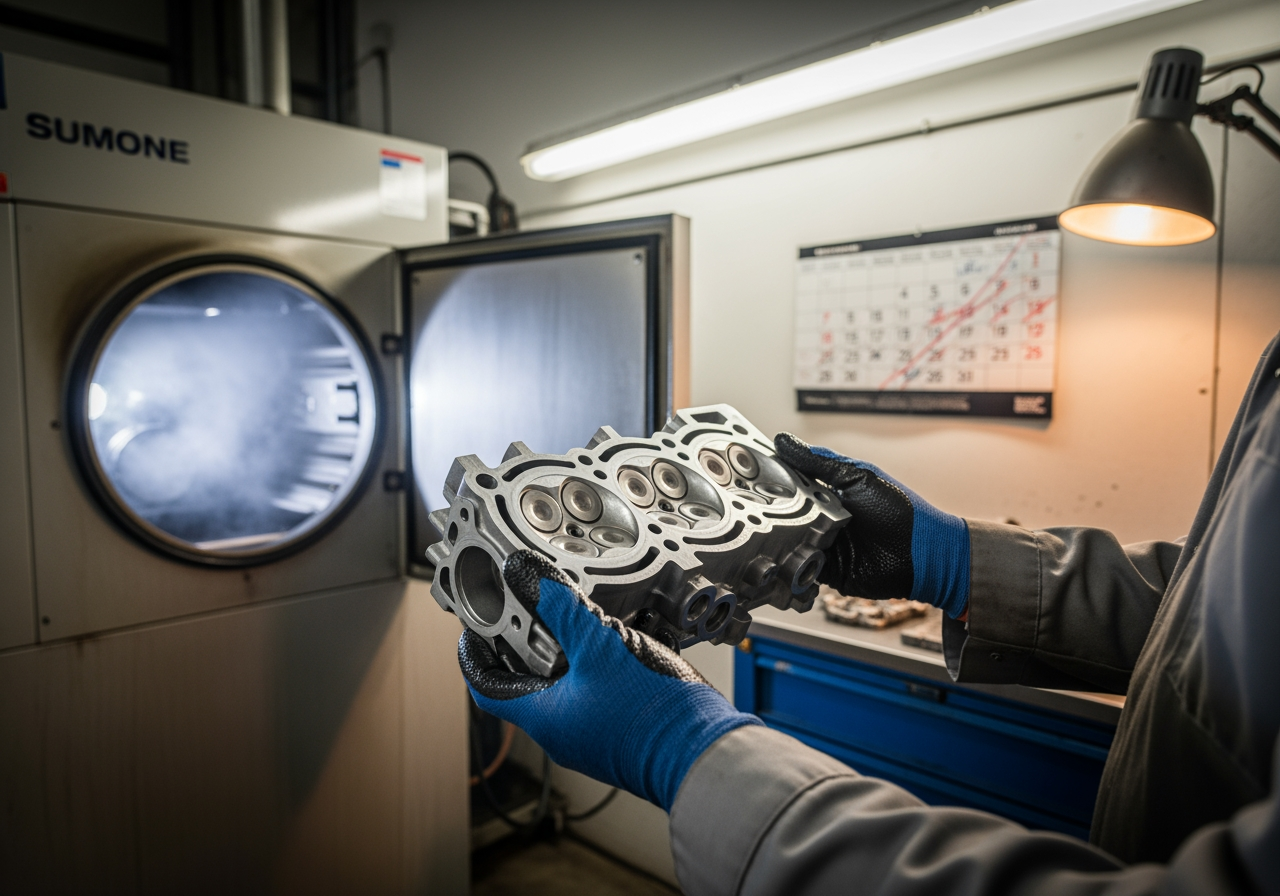
A mechanical workshop spending $160 in labour to clean a single batch of parts manually can reduce that cost to $12 with an automated parts washer. That is a $148 saving per cleaning cycle. But understanding the complete parts washer ROI timeline requires looking beyond individual batch savings.
Workshop owners evaluating capital equipment need concrete numbers, not vague promises of efficiency gains. This guide breaks down the actual costs, timeframes, and financial returns mechanical workshops experience when switching from manual cleaning to automated parts washers.
The True Cost of Manual Parts Cleaning
Labour and Opportunity Costs
Most workshops underestimate manual cleaning costs because they only count chemicals and water. The real expense is in labour hours that could generate revenue elsewhere.
A qualified mechanic earning $40 per hour who spends four hours cleaning engine components, transmission parts, or diff housings costs $160 in direct labour. Add the opportunity cost – that mechanic could have been completing billable work – and the real cost doubles.
Mechanical workshop labour savings begin the moment automated cleaning frees your technicians for productive tasks. A workshop cleaning 20 parts batches monthly spends $3,200 in direct labour alone. Over a year, that is $38,400.
Hidden Costs That Add Up
Manual cleaning creates additional hidden costs that rarely appear on any invoice.
Inconsistent results requiring re-cleaning add 30-60 minutes per batch. Worker fatigue reduces productivity in subsequent tasks. Chemical exposure causes skin irritation and lost work time. Floor mess from open cleaning bays requires additional cleaning hours each week.
These factors easily add 20-30% to the direct cost of manual cleaning. Including them in your equipment ROI analysis produces a more accurate payback projection.
Automated Parts Washer Operating Costs
Per-Cycle Cost Breakdown
Automated parts washers eliminate scrubbing labour whilst adding predictable operating expenses.
Per-cycle costs for a typical heavy-duty parts washer:
- Electricity: $1.50 (heating and pump for a 15-minute cycle)
- Biodegradable detergent: $2.00
- Water: $0.50 (recirculating systems minimise water use)
- Labour supervision: $10.00 (mechanic loads parts and returns to productive work)
Total per-cycle cost: $14.00 compared to $160 for manual cleaning. That 15-minute automated cycle returns the mechanic to billable work 3 hours and 45 minutes faster per batch.
Equipment Investment and Amortisation
Parts washer capital expenditure varies by capacity and duty rating. For mechanical workshops, the key categories are:
Manual parts washers run $3,500-6,000 for heated, circulation-pump models. Heavy duty parts washers in the automated spray category run $15,000-25,000. These handle engine blocks, cylinder heads, and transmission components with 400-600 litre capacity. Installation adds $1,500-3,000 depending on electrical requirements.
Parts washer capital expenditure of $22,000 (machine plus installation) amortised over 20 cleaning cycles monthly for 12 years works out to approximately $7.64 per cycle in capital cost. Add operating costs and the all-in cost per cycle is around $22-23.
Month-by-Month ROI Timeline
Months 1-3: Initial Investment Period
A workshop purchasing a $22,000 heavy-duty spray washer faces that capital outlay at the start. During the first three months, the team adapts to automated cleaning workflows.
Typical first-quarter performance at 20 cycles monthly:
- 60 cleaning cycles save $146 per cycle in labour costs
- Total labour savings: $8,760
- Operating costs: $840
- Net savings: $7,920
The workshop remains $14,080 from breakeven but has eliminated 180 hours of manual scrubbing. Those hours are now available for billable work. Running parts washers daily from week one is the fastest way to accumulate those savings.
Months 4-6: Workflow Optimisation
By the second quarter, automated cleaning is part of standard procedure. Parts go into the washer immediately after removal rather than sitting dirty whilst technicians finish other tasks.
Hotwash Australia has deployed over 1,200 automatic parts washers across Australia. Customers consistently report that workflow integration accelerates during this period. Mechanical workshop labour savings compound as teams stop treating cleaning as a separate activity.
Second-quarter performance: another $8,760 in labour savings at $840 in operating costs. Cumulative net savings: $15,840. The workshop reaches breakeven around month five.
Months 7-12: Positive Cash Flow
The final six months of year one deliver clear financial returns. The equipment investment is recovered and ongoing savings accumulate.
Months 7-12 performance: 120 cycles save $17,520 in labour costs at $1,680 in operating costs. Net savings for this period: $15,840. Total first-year net benefit after recovering initial investment: $9,660.
This equipment ROI analysis uses conservative estimates. Workshops running multiple shifts, processing larger parts volumes, or paying higher labour rates reach breakeven faster.
Beyond Year One: Cumulative Returns
Five-Year and Ten-Year Workshop Investment Returns
The parts washer ROI timeline extends well beyond breakeven. Quality industrial parts washers deliver 10-15 years of service with basic maintenance.
Five-year cumulative returns at 240 cycles annually:
- Annual labour savings: $35,040
- Annual operating costs: $3,360
- Annual net savings: $31,680
- Five-year total return: $158,400 minus $22,000 initial investment = $136,400 net gain
Over a decade, the same equipment generates $294,400 in net workshop investment returns whilst eliminating 7,200 hours of manual scrubbing labour.
Super heavy duty parts washers for large-scale industrial operations deliver even greater returns. Mining and earthmoving workshops with daily high-volume cleaning see annual net savings exceeding $95,000.
Factors That Accelerate the Payback Period
Several factors shorten the parts washer payback period significantly.
High-volume operations processing 40+ batches monthly cut payback time in half. Mining service workshops cleaning excavator components daily can reach full ROI within 10-12 weeks.
Premium labour markets where qualified mechanics earn $50-60 per hour increase per-cycle savings to $200 or more. Parts washer payback periods in these markets often sit under three months.
Hot tanks add immersion cleaning capability for engine components and carbon-heavy parts. Workshops replacing hazardous caustic tanks with safer aqueous hot tanks gain additional safety compliance savings that contribute to the overall equipment ROI analysis.
Industry ROI Comparisons
Automotive and Manufacturing Workshops
Automotive workshops see some of the strongest parts washer ROI outcomes. A workshop completing engine rebuilds four hours faster because parts cleaning does not bottleneck the process increases bay utilisation and revenue capacity significantly.
At 20 batches monthly, automotive operations save $35,040 annually in labour alone. Parts washer capital expenditure of $22,000 is recovered in under eight months in most cases. Manufacturing workshops with variable contamination see similar returns at slightly longer payback periods of 8-10 months.
Extra heavy duty parts washers suit automotive operations cleaning larger engine assemblies and transmission units that exceed standard heavy duty capacity.
Mining and Heavy Industrial Operations
Mining operations achieve the fastest parts washer ROI of any sector. Heavy contamination, high cleaning volumes, and premium labour rates combine to produce exceptional mechanical workshop labour savings.
A multi-shift mining maintenance workshop cleaning 40+ batches monthly at $55-per-hour mechanic rates can recover parts washer capital expenditure in under two months. Wet abrasive blasters complement parts washers investment by handling surface preparation and rust removal alongside routine parts cleaning.
Five-year workshop investment returns for mining operations consistently exceed $400,000 per machine when accounting for labour, chemical, water, and disposal cost savings combined.
Making the Investment Decision
Strong Indicators for Immediate Purchase
Equipment ROI analysis confirms the case, but workshop owners must also evaluate timing and cash flow.
Strong indicators for immediate purchase:
- Workshop currently cleaning 15+ parts batches monthly
- Manual cleaning creating production bottlenecks
- Workers compensation claims from chemical exposure or repetitive strain
- Difficulty retaining mechanics due to undesirable cleaning tasks
Stainless steel parts washers offer corrosion resistance for workshops running food-grade, marine, or chemical-exposed applications where standard steel construction is unsuitable.
Factors Suggesting Delayed Purchase
Factors suggesting a delayed purchase:
- Seasonal business with cleaning demand concentrated in 3-4 months annually
- Current cash flow constraints requiring capital preservation
- Uncertain workshop location or potential relocation within 12 months
For most established mechanical workshops, the equipment ROI analysis points to immediate positive returns. The question is not whether automated cleaning saves money. It is whether your current cash flow and operational priorities support the investment timing.
Conclusion
A mechanical workshop processing 20 parts batches monthly reaches breakeven on a $22,000 heavy-duty parts washer within five months. From month six, the equipment generates $2,640 in monthly net savings whilst eliminating 75 hours of manual scrubbing labour.
Parts washer ROI over five years delivers $136,400 in net savings – a 620% return on initial capital outlay. Mechanical workshop labour savings, chemical cost reductions, and productivity gains all contribute to these workshop investment returns.
For equipment specifications, capacity recommendations, and a detailed ROI projection based on your specific parts volumes and labour costs, contact our parts washer specialists or email us at sales@hotwash.com.au.

Leave A Comment