
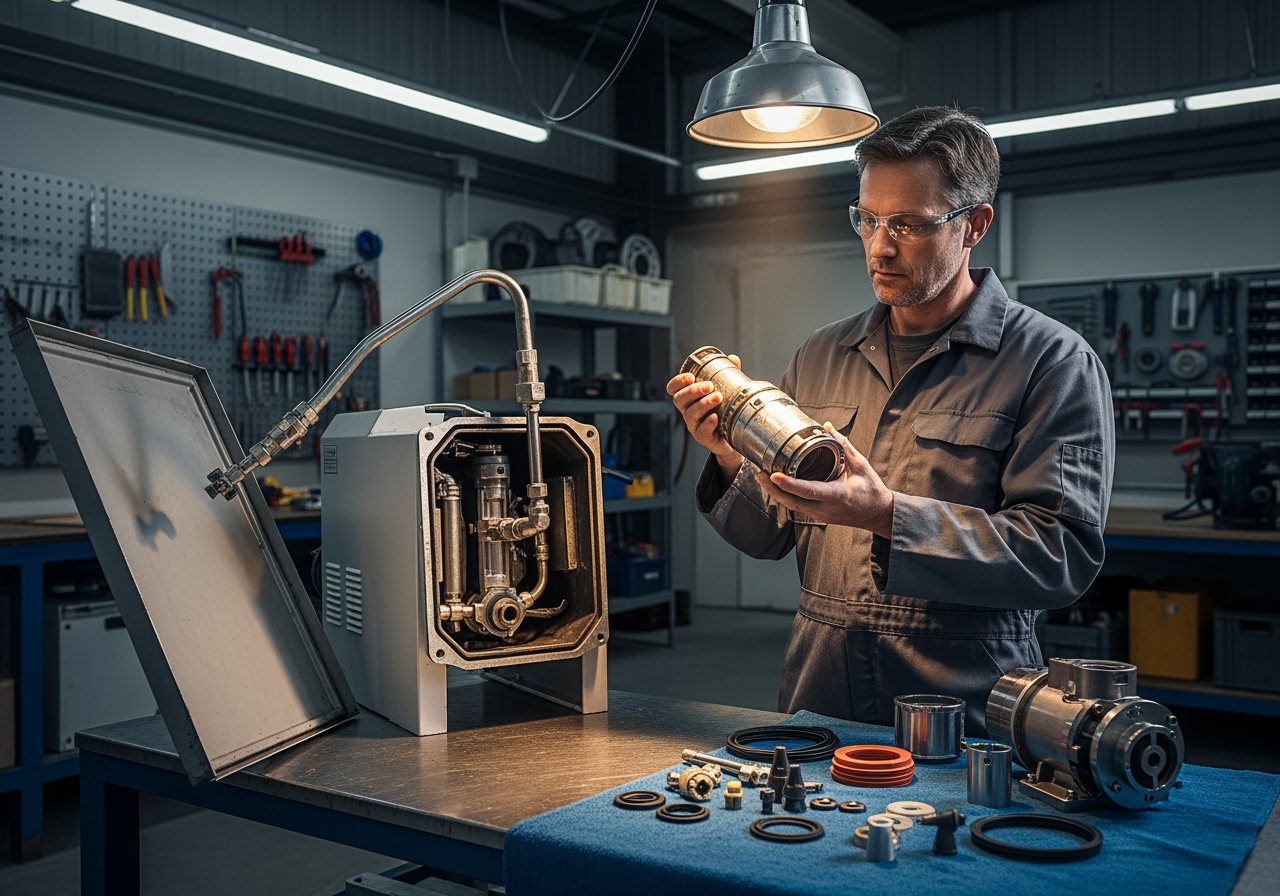
Workshop managers face a constant challenge: when should you replace parts washer components versus running them until they fail? The wrong decision costs money either way. Premature replacement wastes capital. Delayed maintenance causes downtime and production losses that cost far more than the component itself.
A typical heavy duty parts washer runs 8-12 hours daily in Australian mining and manufacturing operations. That is 2,000-3,000 operating hours annually. Each component has a predictable service life, but external factors like water quality, detergent type, and contamination levels dramatically affect replacement timing.
Operations that replace components reactively after failure experience 3-4 times more unplanned downtime than those following preventive schedules. This guide provides specific replacement intervals for critical components, along with a clear repair decision framework for each scenario, and covers spray nozzle wear indicators, heating element replacement schedules, and parts washer pump replacement intervals in detail.
Critical Component Lifespans and Replacement Intervals
Spray Pump Replacement Timing
Industrial spray pumps in parts washers typically last 3,000-5,000 operating hours under normal conditions. That translates to 12-20 months in continuous mining operations or 2-3 years in standard workshop use.
Four factors drive early pump failure. Hard water causes scale buildup in impellers. Contaminated detergent with particulate matter wears the impeller prematurely. Operating above the rated temperature over 85 degrees Celsius stresses internal components. Dry running from low tank levels causes immediate damage.
Component replacement timing varies significantly by location. Mining operations in the Pilbara, where water hardness regularly exceeds 300 ppm, report pump failures at 2,500-3,000 hours. Perth metro workshops with treated water see 4,500-5,500 hours before replacement is needed. Know your local water quality – it directly determines your parts washer pump replacement intervals.
Heating Element and Spray Nozzle Replacement Timing
Quality heating elements in heavy duty parts washers last 4,000-6,000 hours. Three factors accelerate failure. Scale buildup from hard water reduces heat transfer efficiency, causing elements to draw higher current and fail prematurely at 2,500-3,500 hours. Low water levels that expose elements to air cause immediate burnout – this accounts for a significant proportion of early heating element failures in Australian workshops. Power surges and voltage fluctuations at remote mining sites cause shorter element life.
Stainless steel spray nozzles last 2,000-3,000 hours before orifice wear reduces spray pressure and cleaning effectiveness. Brass nozzles wear faster at 1,500-2,500 hours.
Nozzle degradation is gradual and easy to miss. At 1,500 hours, the spray pattern looks normal but cleaning efficiency has already dropped. By 2,500 hours, efficiency loss is significant and parts require longer cycle times. Workshop managers often extend wash cycles from 15 to 20 minutes – then 25 minutes – without recognising worn nozzles as the root cause. Tracking spray nozzle wear indicators prevents this gradual productivity drain.
The labour cost of longer cycles exceeds nozzle replacement cost quickly. If cycle time extends from 15 to 20 minutes, you lose 5 minutes per cycle. At 8 cycles daily, that is 40 minutes of lost productivity. Complete nozzle set replacement pays for itself within weeks.
Repair vs Replacement Decision Framework
Pump Repair Economics and the Repair Decision Framework
A replacement spray pump costs $850-$1,400 depending on capacity. Professional pump rebuild costs $400-$600 including labour.
The repair decision framework for pumps depends on operating hours and condition. Rebuild is justified when the pump has under 4,000 operating hours, motor windings test within specification, shaft and bearings show minimal wear, and impeller damage is limited to minor edge wear.
Replace rather than rebuild when operating hours exceed 4,500, motor draws higher current (indicating winding degradation), shaft shows scoring or excessive play, or multiple rebuilds have already been performed.
Mining operations running 24/7 on super heavy duty parts washers typically replace pumps rather than rebuild. The rebuild saving does not justify the downtime risk when the machine is running continuously. Workshop operations with backup equipment can economically rebuild pumps and stock rebuilt units as spares.
Applying the repair decision framework consistently prevents both under-investment in critical equipment and unnecessary spend on low-risk components.
Heating Element and Seal Replacement Decisions
Never attempt heating element repair – replacement only. The decision is about timing: reactive after failure or preventive based on hours.
Reactive replacement costs: element $320-$580, labour 1.5-2 hours ($120-$180), production downtime 4-8 hours ($800-$2,400 in lost productivity), rush freight if parts are unavailable locally ($150-$300). Total unplanned cost: $1,390-$3,460.
Preventive replacement costs: element $320-$580, labour 1.5-2 hours ($120-$180), zero unplanned downtime when scheduled during planned maintenance. Total planned cost: $440-$760.
The saving from preventive scheduling ranges from $350-$1,900 per incident. For critical production equipment, schedule element replacement during planned maintenance shutdowns at 4,500-5,000 hours.
Door seal replacement intervals depend on operating temperature. At 60-70 degrees Celsius, seals last 18-24 months. At 70-80 degrees, expect 12-18 months. At 80-85 degrees, plan for 10-14 months. Replace seals when compression set exceeds 30% or when water seepage appears during operation.
Condition Monitoring for Failure Prediction
Pump Performance Monitoring Methods
Reliable component replacement timing starts with consistent condition monitoring. Three measurable parameters track spray pump health.
Pressure output: Install a pressure gauge on the pump discharge. New pumps deliver rated pressure within 5%. When pressure drops 15% below specification, pump rebuild or replacement is due within 500 hours.
Current draw: Measure motor current monthly with a clamp meter. Increasing current above the nameplate rating indicates bearing wear or impeller damage. A 10% current rise signals replacement is needed within 200-400 hours.
Noise and vibration: Bearing wear produces audible changes before failure. When noise becomes noticeably louder or vibration increases, bearing failure is imminent. Act within 100 hours.
Hotwash Australia recommends keeping a simple monitoring logbook at the machine. Record pressure readings, current draw, and any noise changes after each monthly service. Trends visible in this data are more reliable than any single reading.
Heating Element and Visual Inspection Protocols
Track heating element condition through two measurable parameters.
Temperature recovery time: Measure the time required to heat the tank from ambient to operating temperature. When recovery time increases 25% from your established baseline, element efficiency has declined significantly. This is the key heating element replacement schedule trigger – descale or schedule replacement within the next 500 hours.
Current draw: Elements drawing higher current are working harder due to scale buildup or winding degradation. A 15% current increase indicates replacement is needed within 500-800 hours.
Monthly visual inspections catch developing issues. Spray nozzle wear indicators to check: orifice edges should be sharp and clean – rounded or enlarged orifices mean replacement is due. Inspect door seals for compression set, cracking, or hardening. Check the tank interior for scale buildup on heating elements – scale over 2mm thick triggers descaling.
Operating Conditions That Affect Component Life
Water Quality, Detergent Selection, and Temperature Impact
Hard water above 200 ppm shortens component life measurably. Heating elements experience shorter service life from scale. Pump impellers face measurable reduction from mineral deposits. Spray nozzles wear faster. Monthly descaling with citric acid solution removes scale buildup effectively and restores components to rated service life.
Detergent selection directly affects component life. Quality biodegradable detergents maintain components at rated intervals. Poor-quality or inappropriate detergents accelerate wear in predictable ways. Highly alkaline cleaners above pH 12 attack pump seals and gaskets. Detergents with suspended solids clog spray nozzles and wear impellers. Petroleum-based solvents degrade rubber seals rapidly.
Operating temperature affects seal and gasket replacement intervals. At 60-70 degrees Celsius, components reach full rated lifespan. At 70-80 degrees, expect reduced seal life. At 80-85 degrees, plan for further reduction. Hot tank parts washer systems operating at maximum temperature require more frequent seal replacement, but the superior cleaning performance justifies the trade-off for heavy contamination applications.
For stainless steel parts washers in corrosive or high-moisture environments, seal and gasket replacement intervals follow the same temperature-based schedule. The stainless construction protects the cabinet and frame, but internal seals are still subject to the same wear factors as other machine types.
Environmental Factors and Site-Specific Adjustments
Remote mining sites require adjusted component stocking strategies. Standard lead times for common parts run 2-5 days in metro areas. Remote sites may face 1-2 week delays. Stocking one spare pump, two sets of seals, and one heating element per machine eliminates most downtime risks from parts unavailability.
Coastal workshops should increase electrical component inspection frequency. Salt air accelerates corrosion on terminals, connectors, and control boards. Monthly electrical inspections replace the standard quarterly schedule for sites within 10 kilometres of coastline.
Extra heavy duty parts washers running 3,000 or more annual hours need a maintenance budget 30-40% higher than the standard heavy duty schedule. Increased operating intensity accelerates all component wear proportionally – scale your replacement intervals and budget accordingly.
Workshops that also use wet abrasive blasters for surface preparation and rust removal should apply the same condition monitoring principles to blasting nozzles and pump components. Abrasive blasting equipment faces similar wear patterns to spray washer pumps, particularly in high-volume environments. For operations requiring abrasive blasting Perth-wide or nationally, monitoring intervals follow the same hour-based framework outlined above.
Annual Maintenance Budget Planning
Component Replacement Cost Schedule for Heavy Duty Systems
For a heavy duty parts washer running 2,500 hours annually, budget the following component replacement costs.
Spray nozzles (annual): $180-$320. Door seals (annual): $120-$180. Heating element (every 2 years – annual equivalent): $220-$290. Pump rebuild (every 2 years – annual equivalent): $200-$300. Filters and consumables: $150-$250.
Total annual maintenance: $870-$1,340.
For extra heavy duty systems at 3,000 or more hours annually, budget increases 30-40% due to accelerated wear rates. Parts washer pump replacement intervals shift from every two years to every 14-18 months at this operating intensity. Workshops adding hot blasters for cabinet cleaning should budget separately for blaster nozzle and seal replacement using the same hour-based intervals.
Preventive vs Reactive Maintenance Costs
Preventive versus reactive maintenance costs demonstrate the financial case clearly. An unplanned 4-hour pump failure during production costs $800-$2,400 in lost productivity plus $150-$300 rush freight – total impact of $950-$2,700. Preventive pump replacement during scheduled maintenance costs $600-$800 for component and labour only. The difference of $350-$1,900 per avoided incident makes the maintenance budget argument straightforward.
Manual cleaning equipment and smaller workshop systems require proportionally lower maintenance budgets, but the replacement intervals and repair criteria remain the same – only the component costs differ. Understanding preventive versus reactive maintenance costs at any scale makes the case for scheduled replacement clear.
For operations managing hot tank parts washer systems alongside spray washers, budget separately for hot tank seals and heating elements. Hot tanks running at higher temperatures and longer soak cycles experience accelerated seal wear compared to spray-only machines. Apply the temperature-based seal intervals from the section above to set accurate replacement budgets.
Conclusion
Component replacement timing directly determines parts washer operating costs and production uptime. Preventive replacement based on operating hours delivers 3-4 times less unplanned downtime than reactive maintenance, at lower total cost.
Replace spray pumps at 4,000-4,500 hours. Follow the heating element replacement schedule by scheduling elements at 4,500-5,000 hours. Replace spray nozzles when wash cycle time increases 20% from baseline. Door seals require annual replacement in high-temperature applications and 18-month intervals in moderate-temperature use.
Apply the repair decision framework at each decision point: assess age against rated lifespan, evaluate failure mode, consider downtime sensitivity, and compare labour cost against new component cost.
Budget $870-$1,340 annually for component replacement on heavy duty systems running 2,500 hours. Critical production equipment justifies preventive replacement to avoid downtime costs that exceed component costs significantly.
To discuss component replacement schedules specific to your machine model and operating conditions, contact our service and maintenance team or email us at sales@hotwash.com.au.

Leave A Comment