
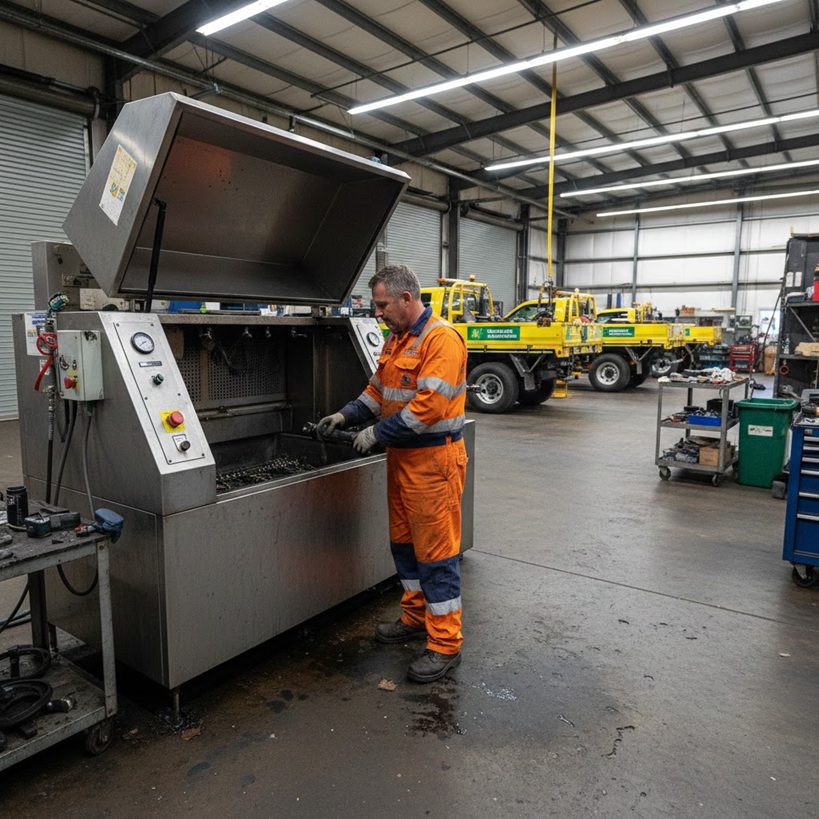
Government fleet vehicles carry critical responsibilities. They handle emergency response, infrastructure maintenance, and public safety operations. When a council grader breaks down during road repairs, or a police vehicle fails mid-patrol, the consequences extend beyond simple inconvenience.
These failures compromise service delivery. They waste taxpayer funds and potentially endanger communities. Australian government procurement standards exist for good reason. They ensure equipment reliability, worker safety, and value for money.
For parts washing systems maintaining these fleets, meeting those standards is not just bureaucratic box-ticking. It is about keeping essential services operational. Choosing the right parts washer ensures that maintenance teams can turn vehicles around quickly and safely.
Why Government Fleet Maintenance Demands Higher Standards
Government fleets operate under conditions that destroy poorly built equipment. Council trucks haul gravel through remote roads. Emergency vehicles run 24/7 shifts. Marine vessels face saltwater corrosion. Mining support vehicles handle extreme contamination.
Operating in Harsh Conditions
Standard workshop equipment often fails under this workload. Cheap imported units crack under thermal stress. Lightweight construction buckles when cleaning heavy excavator components. Inadequate heating systems cannot handle continuous operation.
Government procurement officers understand this reality. They have seen budget equipment fail within months. This creates warranty headaches and leaves operational gaps in the workshop.
The Financial Stakes
The financial stakes justify close scrutiny. A heavy duty cleaning system represents a significant capital expenditure. When you multiply that across regional councils, state transport departments, and federal agencies, procurement decisions affect millions in taxpayer funds.
Reliability is the primary goal of government fleet maintenance. Specifications must demand proven durability, Australian standards compliance, and documented performance.
Australian Standards Compliance for Industrial Equipment
Government tenders typically mandate AS/NZS compliance across multiple categories. Each standard addresses specific failure modes that compromise operations. Ignoring these leads to safety risks and liability exposure.
Electrical Safety Requirements
Industrial parts washers combine water, electricity, and high temperatures. This is a dangerous mix without proper engineering. Australian standards (AS/NZS 3000, AS/NZS 60335) require strict safety measures.
Equipment must have earth leakage protection. It needs appropriate IP ratings for wet environments. Thermal cutouts must prevent overheating. Non-compliant equipment creates electrocution risks and fire hazards. Procurement teams cannot accept these risks in government facilities.
Pressure Vessel and Heating Standards
Hot tanks and heated spray systems operate under pressure. Inadequate construction leads to catastrophic failures. This can cause ruptured tanks, scalding injuries, and property damage.
Standards like AS 1210 and AS 4343 govern pressure vessel construction. Government facilities require equipment that meets these rigorous specifications to ensure long-term safety.
Workplace Health and Safety (WHS)
Automated parts washers must include safety features to protect operators. AS/NZS 4024 covers safety of machinery. This includes interlocks that stop the machine if a lid is opened. It also covers emergency stops and guarding.
Manual handling risks also require attention. Chemical exposure and thermal hazards need engineered controls. Equipment lacking these certifications often gets rejected during tender evaluation, regardless of price.
Construction Standards That Survive Fleet Workloads
Government fleet maintenance handles everything from light vehicles to heavy earthmoving equipment. A council workshop might clean passenger car parts Monday morning. By the afternoon, they switch to grader components. The equipment must handle both tasks without compromise.
Heavy-Gauge Steel Durability
Thin-wall washers dent and deform under workshop abuse. Heavy duty parts washers built from 3mm+ steel plate withstand impacts. They handle dropped components and accidental forklift contact.
Reinforced chamber construction prevents warping. Thermal cycling, heating up and cooling down, stresses metal. Heavy-gauge steel resists this stress, ensuring the machine door seals correctly for years.
Corrosion Resistance with Stainless Steel
Coastal councils and marine operations face accelerated corrosion. Salt-laden air destroys powder-coated steel within years. Rust eventually leads to leaks and structural failure.
Stainless steel parts washers eliminate these concerns. They withstand hot, wet environments indefinitely. They also meet hygiene standards. This is vital for councils operating commercial kitchens or food processing facilities alongside their vehicle fleets.
Capacity Requirements for Multi-Vehicle Operations
Small workshops clean parts from one or two vehicles daily. Government fleet facilities handle dozens of vehicles across multiple categories. This requires parts washing capacity that matches the operational tempo.
A regional council might maintain 40 to 60 vehicles. This fleet includes utility trucks, graders, loaders, water trucks, and emergency response vehicles. Daily maintenance generates consistent parts cleaning demands.
Matching Chamber Dimensions to Fleet Size
Inadequate washer capacity creates bottlenecks. These delays slow down repairs and increase downtime costs. A 600mm chamber handles automotive components comfortably. However, large fleets need more space.
Excavator buckets, grader blades, and truck differentials require 1200mm+ chambers. Undersized equipment forces mechanics to pre-clean parts manually. It may also require multiple wash cycles for a single job. This eliminates the benefits of automation.
Turntable Load Capacity
Rotating turntables improve cleaning coverage. However, they must support the weight of the component. Light-duty turntables rated for 50kg fail when loading cast iron engine blocks.
Extra heavy duty parts washers feature robust turntables. Capacities of 200kg or more allow for cleaning steel fabrications and heavy machinery parts. This capability is essential for handling real fleet maintenance workloads.
Deep Cleaning Engines and Heavy Components
Surface grease is one problem. Deep internal contamination is another. Reconditioning engines for fleet vehicles requires thorough cleaning of internal passages.
Immersion Cleaning for Reconditioning
Some contaminants refuse to budge with spray jets alone. Carbon deposits inside manifolds or on valves are stubborn. Heavy layers of baked-on grease also present a challenge.
Hot tanks offer the solution for these tough jobs. Immersion cleaning soaks components in a heated chemical solution. This process breaks down carbon and grease in blind holes and internal galleries. It ensures engine components are chemically clean before reassembly.
Surface Restoration and Maintenance
Cleaning removes grease, but it does not remove rust or paint. Fleet maintenance often involves restoring older equipment or preparing surfaces for inspection.
Hot blasters use wet abrasive blaster technology. This cleans surfaces without creating dust. It is safer for workshop environments than dry blasting. It allows technicians to strip paint or rust from chassis parts and panels efficiently.
Heating Performance for Heavy Contamination
Government fleet vehicles accumulate contamination that defeats cold-water cleaning. Road grime, hydraulic oil, grease, carbon deposits, and salt buildup are common. Removing this requiring sustained high temperatures.
Temperature Requirements for Grease Removal
Light oil removal works at 60°C. Heavy grease and carbon deposits need 80-85°C. Underpowered heaters struggle to reach and maintain these temperatures.
If a machine takes hours to heat up, productivity suffers. Government facilities operating multiple shifts need equipment ready immediately. Powerful heating elements ensure the water is hot when the shift starts.
Energy Efficiency and Insulation
An inefficient washer might consume $3,000 to $5,000 annually in unnecessary electricity. This happens when tanks are uninsulated. Heat bleeds out continuously, forcing heaters to run constantly.
Quality systems use insulated chambers and lids. They retain heat between cycles. This reduces energy consumption while maintaining cleaning performance. Over a 10 to 15-year service life, poor heating design costs tens of thousands in wasted energy.
Automation Features Reducing Labour Costs
Government workshops face the same labour cost pressures as private industry. A mechanic earning $45 per hour who spends 3 hours daily scrubbing parts represents a significant cost. That is over $35,000 annually in cleaning labour.
Programmable Wash Cycles
Automation redirects that cost toward productive repair work. Manual parts washers are great for small jobs, but large fleets need automation.
Programmable cycles let technicians load parts, start the machine, and walk away. A 25-minute automated cycle frees 25 minutes of skilled labour. Across a busy workshop, that adds up to hours of saved time every day.
Integrated Drying Systems
Wet parts require manual drying before inspection. This takes time and uses consumables like rags or compressed air. Built-in hot air drying eliminates this step.
Automated drying delivers parts ready for immediate use. It saves another 10 to 15 minutes per batch. These time savings justify the investment in automation quickly.
Environmental Compliance and Chemical Safety
Government facilities operate under stricter environmental oversight than private workshops. Chemical handling, waste disposal, and worker exposure all face regulatory requirements.
Biodegradable Detergent Systems
Traditional solvent-based degreasers create disposal costs. They also carry environmental liability. Modern biodegradable detergents deliver equivalent cleaning performance without the hazardous waste.
Tender specification requirements increasingly mandate these systems. They align with government sustainability goals. Replacing solvents with water-based solutions demonstrates environmental commitment.
Closed-Loop Water Management
Councils often face water restrictions or trade waste charges. Closed-loop hot wash systems recirculate water and detergent. They filter the solution to extend its life.
This reduces water consumption and waste generation. It prevents contaminated runoff from entering stormwater drains. Using professional equipment proves a commitment to environmental responsibility.
Service Support and Spare Parts Availability
Government procurement evaluates total cost of ownership (TCO). This includes maintenance support, parts availability, and equipment longevity. A cheap washer becomes expensive when it breaks down.
The Australian Manufacturing Advantage
Equipment built in Australia means local parts availability. When a heating element fails, the replacement arrives within days, not months. This uptime reliability justifies a higher initial price.
Major government facilities exist across regional Australia. From Kalgoorlie to Broome, support is needed everywhere. Australian manufacturers maintain broader service networks than international importers.
Documentation for Tender Specification Requirements
Government tenders demand comprehensive documentation. Missing paperwork disqualifies technically compliant equipment. Procurement teams need certificates from recognized testing authorities.
Detailed spec sheets must document chamber dimensions and heating capacity. Installation requirements for electrical and water supply must be clear. Operating manuals covering maintenance and safety are mandatory. Suppliers must prepare this documentation proactively to meet tender specification requirements.
Conclusion
Government fleet maintenance equipment standards exist because failure is not acceptable. Emergency vehicles must respond immediately. Infrastructure maintenance cannot wait for equipment repairs.
Meeting those standards requires more than paperwork. It demands robust construction that survives heavy workloads. It requires heating systems that maintain performance under continuous use. Automation is essential for reducing labour costs and improving safety.
Procurement decisions should prioritise total cost of ownership over purchase price. The cheapest tender response often delivers the most expensive outcome through energy waste and downtime. Quality equipment costs less over its service life while delivering superior performance.
For government procurement teams evaluating parts washing systems, speak with our fleet equipment specialists or email us on sales@hotwash.com.au to discuss your specific requirements.

Leave A Comment