
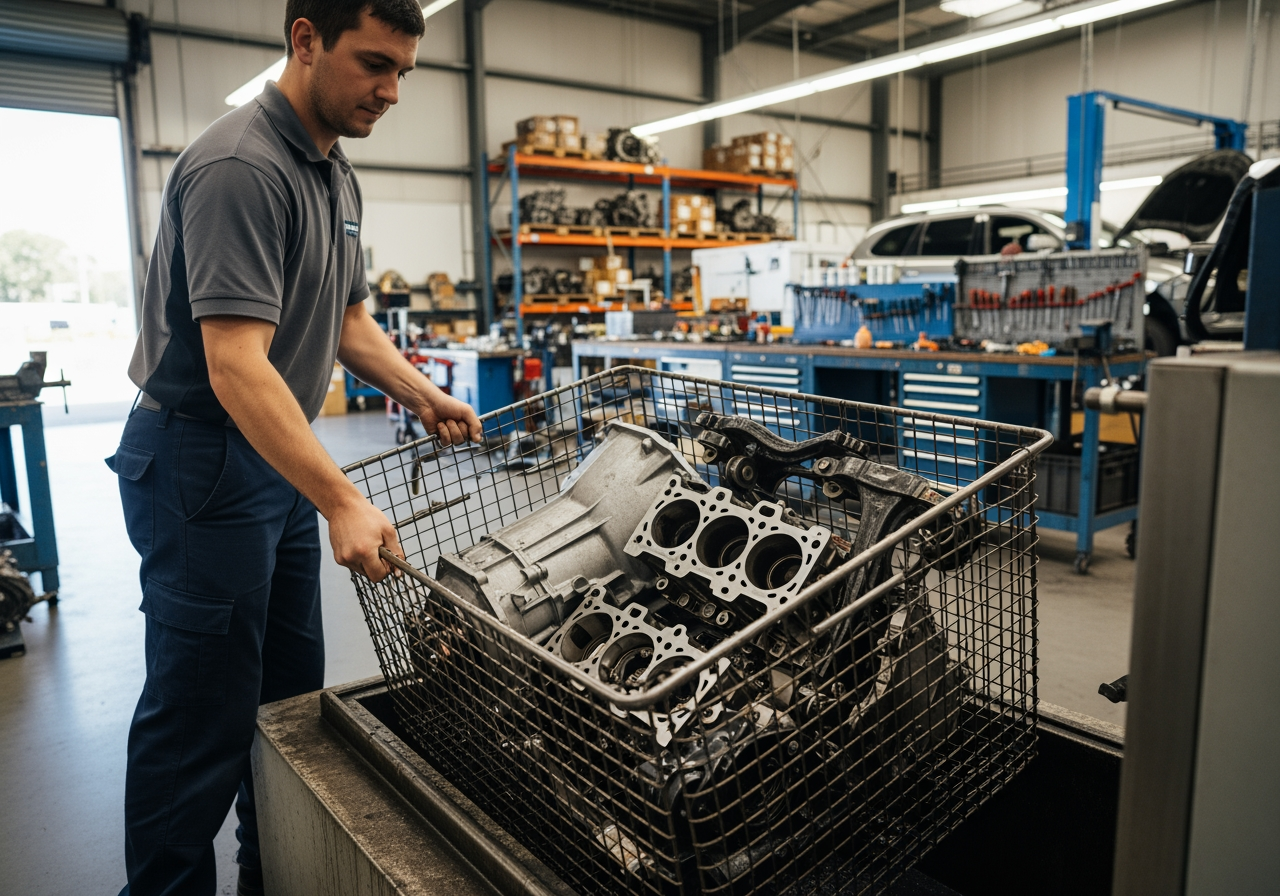
Running parts washers half-empty wastes power, water, and detergent on every cycle. Cramming oversized components into undersized baskets damages parts and creates constant workflow bottlenecks. Both mistakes cost your workshop money every day – but the causes and solutions are straightforward once you measure what you’re actually cleaning.
Proper basket size selection isn’t about buying the largest machine available. It’s about calculating your real daily component volume, understanding how basket geometry affects what actually fits, and selecting parts washer capacity that matches your workflow without wasting resources.
Calculating Your Real Daily Component Volume
Most workshops underestimate their parts washing volume because they’ve never measured it systematically. Guessing that you clean “a few gearboxes and engine blocks daily” tells you nothing useful about basket sizing.
Why Most Workshops Underestimate Their Volume
Start by tracking every component entering your parts washer for two weeks. Record the item type, approximate dimensions, and time of day. Don’t estimate – physically measure your most common components. Packing efficiency varies dramatically between component types, so accurate dimensions matter.
Common component volumes by workshop type:
- Automotive workshops: Cylinder heads (40L), engine blocks (120L), transmission cases (80L), suspension sets (25L)
- Mining maintenance: Excavator pins (15L each), hydraulic cylinders (60L), track links (8L each)
- Food processing: Mixer blades (35L per set), conveyor components (45L), slicing equipment (30L)
- Marine workshops: Outboard lower units (50L), diesel injectors (5L per set), propellers (20L each)
One heavy vehicle workshop tracked their volume and found they were washing 420 litres of components daily across 12 separate loads in a 150-litre basket machine. Three cycles with a 200-litre basket would have handled the same volume.
Peak Volume vs Average Volume
Peak volume matters more than average volume for basket size selection. If Monday mornings generate three times the parts volume of Wednesday afternoons because weekend breakdowns queue up, size your basket for Monday’s reality – not Wednesday’s average.
Track your highest-volume day over 90 days. That’s your design capacity requirement. A diesel workshop that recorded daily volumes found Monday and Friday consistently ran 40-60% above the weekly average. Sizing to the average created weekly bottlenecks on their two busiest days.
How Basket Geometry Affects Component Fit
A 400-litre basket doesn’t automatically accommodate all components totalling 400 litres in volume. Basket geometry determines what physically fits, and poor geometry wastes capacity regardless of total volume rating.
Matching Basket Shape to Component Type
Tall, narrow baskets suit long components like hydraulic cylinders, drive shafts, and excavator pins. A 1,600mm deep basket handles 2-metre pins that won’t fit in a 900mm unit regardless of volume capacity.
Wide, shallow baskets work better for engine blocks, transmission cases, and large flat components. A 1,200mm wide basket accommodates V8 engine blocks side-by-side. A 600mm basket forces single-block loads that waste capacity and multiply cleaning cycles.
For heavy duty parts washers handling mixed automotive loads, square baskets – typically 1,000mm x 1,000mm – offer the most versatile loading configurations. This suits workshops cleaning a variety of component shapes daily.
Rotating Basket Clearance Requirements
Rotating baskets require clearance calculations beyond static fit. A component that fits a static basket might contact spray arms or heating elements during rotation. Always measure your largest components and verify rotating clearance with the manufacturer before purchase.
This step is non-negotiable. A machine becomes ineffective if your most common component can’t complete a full rotation without striking internal parts. Confirm clearance requirements in writing before committing to a purchase.
Matching Cleaning Frequency to Production Schedules
Daily component volume means nothing without understanding how frequently you need clean parts available. The same daily volume creates very different capacity requirements depending on your production schedule.
High-Turnover Workshop Requirements
High-turnover workshops – automotive repair, mobile maintenance, production facilities – need basket capacity that handles daily volume in 2-3 cleaning cycles maximum. Running six cycles daily creates bottlenecks. Mechanics wait for clean parts whilst the washer runs half-empty loads.
For extra heavy duty parts washers in mining maintenance facilities, the standard is even tighter. Large components and heavy contamination demand fast turnaround. Cycle time multiplied by required daily cycles gives you the throughput test – if daily volume requires more cycles than your shift allows, you’re undersized regardless of basket capacity.
Frequency-based capacity guidelines:
- Continuous flow workshops: Basket capacity = 40-50% of daily volume per cycle, allowing 2-3 cycles
- Scheduled maintenance operations: Basket capacity = 60-70% of peak day volume, allowing 3-4 cycles
- Emergency and breakdown services: 80%+ of peak volume for immediate availability
Batch Cleaning and Scheduled Maintenance Operations
Batch cleaning operations – mining maintenance shutdowns, scheduled overhauls, periodic deep cleans – can use smaller baskets with multiple sequential cycles because timing flexibility exists. A site running monthly equipment maintenance doesn’t need parts washer capacity for daily volume. They need capacity for shutdown day volume.
Agricultural workshops servicing grain harvesters face extreme seasonal peaks. Size for peak season volume, accept lower utilisation off-season, or plan for overflow alternatives like contract cleaning during peak periods.
The Cost Impact of Undersized vs Oversized Baskets
Undersized baskets cost money through inefficiency. Oversized baskets cost money through waste. Both hurt your bottom line, but in different ways.
What Undersised Baskets Actually Cost
Per-cycle costs for a typical workshop parts washer add up quickly:
- Power consumption: approximately $0.53 per cycle
- Water consumption: approximately $0.36 per cycle
- Detergent concentrate: approximately $20.00 per cycle
- Labour for loading and unloading: approximately $10.50 per cycle
- Total per cycle: approximately $31.39
Running four cycles daily instead of two with a properly sized basket wastes more than $62 daily. Over a working year, that’s $16,000+ disappearing because parts washer capacity doesn’t match component volume.
Undersized baskets also create workflow bottlenecks with real labour costs attached. A mechanic waiting 45 minutes for clean components costs full hourly rate but produces zero billable work.
The Hidden Waste of Oversised Baskets
A super heavy duty parts washer operating at 33% capacity heats a large volume of empty space, circulates water through unused tank area, and runs high-capacity heating elements to maintain temperature unnecessarily. The efficiency loss isn’t as severe as undersizing – but poor capital allocation affects overall workshop investment.
Oversized baskets also tempt operators into loose, inefficient loading habits. Components piled loosely in oversized baskets don’t receive the spray coverage that properly loaded, right-sized baskets deliver. Cleaning quality drops even as operating costs rise.
Accounting for Component Mix Variability and Damage Risks
Few workshops clean identical components every day. An earthmoving workshop might wash excavator pins Monday, hydraulic cylinders Tuesday, bucket teeth Wednesday, and track links Thursday. Each component type has different volume characteristics and packing efficiency.
Calculating Packing Efficiency by Component Type
Calculate basket requirements based on your largest regular component – not average component size. A workshop cleaning cylinder heads 60% of the time and engine blocks 40% of the time needs basket dimensions accommodating engine blocks, or they’ll be undersized 40% of the time.
Packing efficiency by component geometry:
- Cylindrical components (pins, shafts, cylinders): 60-65% basket utilisation – significant void space between round objects
- Rectangular components (engine blocks, housings): 75-80% utilisation – stack efficiently with minimal gaps
- Irregular components (suspension arms, brackets): 50-55% utilisation – complex shapes create unusable space
- Small loose parts in mesh trays: 40-45% utilisation
A mining workshop with 350 litres of calculated daily volume but 55% average packing efficiency due to irregular components had an effective requirement of 636 litres. They needed a 400-litre basket running two cycles – not a 200-litre basket their raw volume calculation suggested.
Stainless steel parts washers designed for food industry applications include modular basket configurations for extreme component variability. Small slicer blades one shift, large mixer components the next – reconfigurable baskets handle this better than fixed-geometry systems. Hotwash Australia also offers modular basket dividers across other capacity ranges, letting you convert a single large basket into separate loading zones for mixed component batches.
Component Damage from Improper Basket Loading
Overloaded baskets don’t just reduce cleaning effectiveness – they damage components. Rotating baskets multiply damage risks. Components that fit safely static become hazards when rotation starts. Loose items in an overloaded rotating basket strike each other at high velocity, damaging machined surfaces and cracking castings.
Damage prevention through proper sizing:
- Minimum 150mm clearance between components during rotation
- Heavy components (50kg+) need dedicated basket sections or dividers
- Machined surfaces need protective spacing – no metal-to-metal contact
- Aluminium castings and fragile components require isolated basket zones
The manual parts washers range includes smaller basket options specifically designed for delicate components and precision parts. Forcing these into large automated washers alongside heavy industrial parts risks damage regardless of basket size.
Multi-Shift Operations and Return on Investment
Basket Utilisation Across Multiple Shifts
Workshops running multiple shifts can use smaller baskets with higher cycle frequency – but only if shift scheduling supports it. Two shifts running coordinated loading schedules can achieve the same throughput as one shift with a larger basket.
Hot blasters with automated controls enable overnight cleaning cycles, effectively adding unmanned capacity. Load the basket at end of shift, set the programme, and return to clean components in the morning. This approach works particularly well for workshops with consistent overnight component loads.
Single-shift operations should size baskets assuming 3-4 realistic cycles per shift. Mechanics handling their own parts cleaning between jobs rarely achieve more than this. An 8-hour shift allows maximum 8-10 cycles theoretically, but 3-4 is the practical limit in most workshop environments.
Calculating Return on Investment for Proper Sizing
A transport workshop comparing a 250-litre basket ($12,000 less upfront) against a 400-litre basket found:
250-litre basket:
- 3 cycles daily at $31.40 per cycle = $94.20 daily
- Annual operating cost: $24,492
- Bottleneck delays: 1.5 hours daily at $42/hour = $16,380 annually
- Total annual cost: $40,872
400-litre basket:
- 2 cycles daily at $35.80 per cycle = $71.60 daily
- Annual operating cost: $18,616
- Bottleneck delays: eliminated
- Total annual cost: $18,616
Annual savings: $22,256. The additional investment in proper basket size selection pays for itself in under seven months – and keeps paying for the life of the equipment.
Conclusion
Matching parts washer capacity to actual daily component volume eliminates the hidden costs that drain workshop profitability. Wasted energy from half-empty baskets, bottlenecks from undersized capacity forcing multiple cycles, and component damage from cramming oversized parts into inadequate space all have real dollar values.
Calculate your real daily volume by tracking components for two weeks. Size baskets for your highest-volume day, not your average. Account for component geometry and packing efficiency – irregular shapes need up to 40% more capacity than raw volume suggests. Plan for 2-3 cleaning cycles daily in single-shift operations.
For personalised advice on basket size selection and parts washer capacity for your specific workshop, speak with our parts washer capacity specialists or email us on sales@hotwash.com.au.

Leave A Comment