
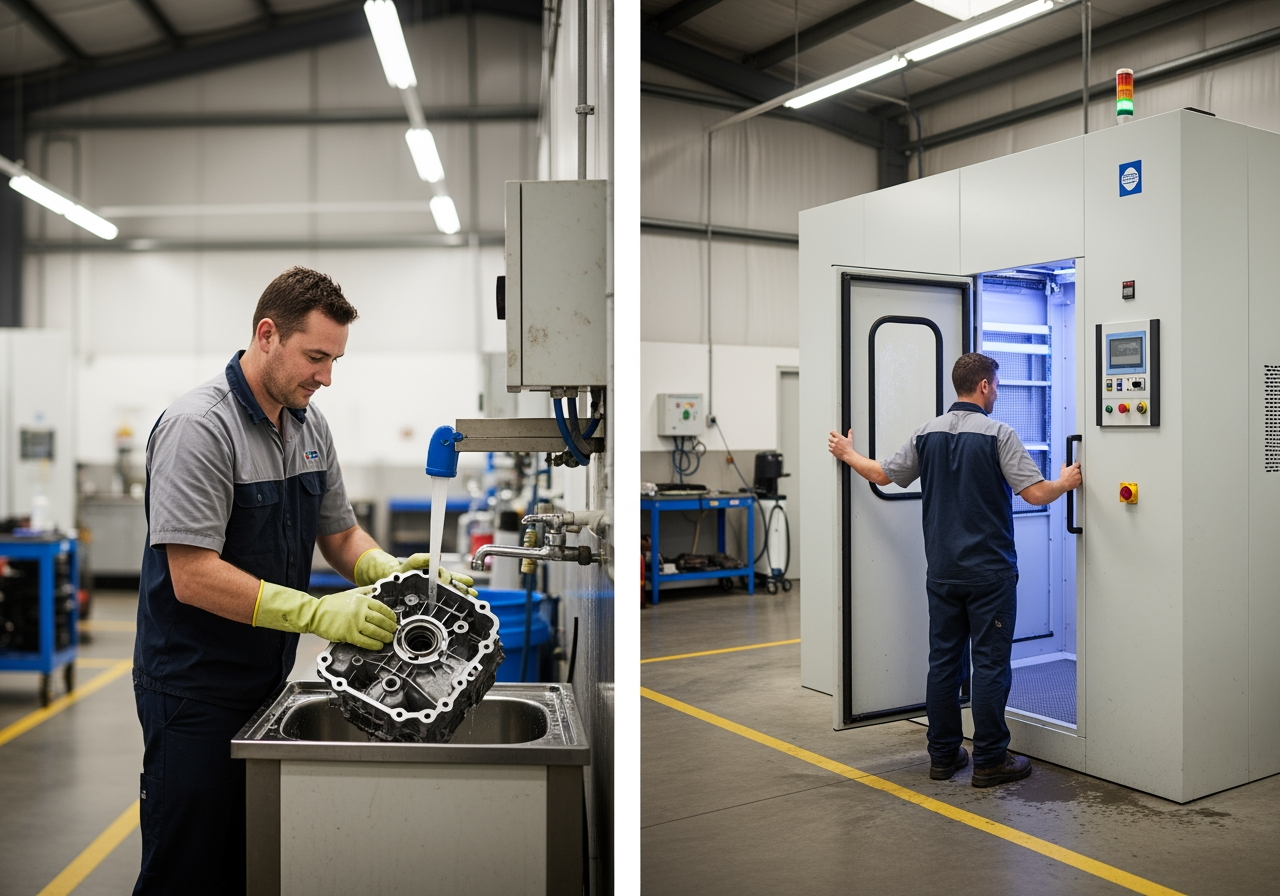
A mechanic earning $40 per hour spends three hours cleaning a transmission casing by hand. That’s $120 in labour before the actual repair begins. The same job takes 15 minutes in an automated spray washer, costing roughly $10 in labour plus $2 in detergent. That’s $108 saved on a single cleaning job.
The True Cost of Manual Parts Washing
Manual cleaning equipment looks cheap on a purchase order. But the real costs show up in labour hours – and they add up fast.
Purchase Price vs Operating Cost Reality
A basic 100-litre sink-style manual parts washer costs $800-$1,500. Fill it with solvent or detergent and workers scrub parts with brushes whilst the solution does some of the work.
The labour costs tell the real story. A workshop cleaning six batches of parts weekly – gearboxes, engine blocks, hydraulic components – burns 18 hours of mechanic time on scrubbing. At $40 per hour, that’s $720 weekly. Over a full working year, that’s $37,440 spent purely on cleaning labour.
Safety and Consistency Problems
Workers with hands in cleaning chemicals for hours each week face real health risks. Even biodegradable detergents cause skin irritation with prolonged exposure. Solvent-based cleaners are worse – dermatitis, chemical burns, and respiratory irritation are common complaints in workshops relying on manual cleaning equipment long-term.
Cleaning results also vary between operators. An experienced mechanic scrubs thoroughly. An apprentice rushing before knock-off misses critical areas. Carbon deposits remain in cylinder head ports. Oil residue stays in transmission housings. That inconsistency causes comebacks and warranty claims.
How Automated Spray Washers Work
An automated spray washer eliminates the scrubbing entirely. Load dirty parts into the chamber, close the door, press start. High-pressure spray jets blast hot water and biodegradable detergent at every surface from multiple angles.
The Spray Washing Process
Water temperature matters significantly. Cold water removes loose dirt. Hot water at 60-85°C cuts through baked-on carbon, polymerised oil, and heavy grease. The heat softens contaminants whilst pressure strips them away. Most automated spray washing systems maintain 80°C throughout the wash cycle.
Wash cycles run 10-20 minutes depending on contamination levels. Light grease and oil clears in 10 minutes. Carbon buildup and caked mud from earthmoving equipment needs 20 minutes. Either way, it’s faster than manual scrubbing – and the mechanic walks away to do productive work whilst the machine runs.
Detergent Recirculation and Efficiency
Detergent recirculates throughout the cycle. A 400-litre tank uses the same solution for multiple washes, filtering out debris between cycles. Solution changes happen weekly or monthly depending on usage – far less chemical consumption than constantly topping up manual washer sinks with fresh solution.
The Real Cost Comparison
Comparing annual operating costs shows why automated spray washing changes the economics of parts cleaning.
Annual Operating Cost for Manual Cleaning
For a typical automotive workshop cleaning 300 parts batches yearly:
- Equipment purchase: $1,200 (one-time)
- Labour: 900 hours at $40/hour = $36,000
- Detergent and solvent: $1,200 yearly
- Brush replacements: $200
- Skin protection (gloves, barrier cream): $400
- First-year total: $39,000
- Ongoing annual cost: $37,800
Annual Operating Cost for an Automated Spray Washer
For the same workshop with a mid-range automated system:
- Equipment purchase: $18,000 (one-time)
- Labour: 75 hours at $40/hour = $3,000
- Detergent: $600 yearly
- Electricity: $800 yearly
- Maintenance: $400 yearly
- First-year total: $22,800
- Ongoing annual cost: $4,800
The automated spray washer costs $16,800 more upfront but saves $33,000 annually in operating costs. Payback period: 6.1 months. After that, the workshop saves $33,000 yearly in cleaning labour costs alone.
For larger operations – mining workshops cleaning excavator components, transport depots maintaining truck fleets – the numbers multiply accordingly.
Cleaning Quality, Safety, and Consistency
Why Automated Cleaning Delivers Better Results
Automated spray washers deliver identical results on every cycle. Spray pattern, water temperature, and pressure stay constant regardless of the operator or time of day. A cylinder head cleaned on Tuesday comes out exactly as clean as one washed on Friday afternoon.
That consistency matters for engine rebuilds and transmission overhauls. High-pressure spray reaches internal oil galleries in engine blocks, narrow passages in hydraulic valve bodies, and blind holes in castings. These are areas that brushes simply can’t access properly. Parts come out genuinely clean, not just surface-clean.
Worker Safety Improvements
Automated washing removes workers from direct chemical exposure. Instead of hands in detergent for hours, mechanics load parts, close the door, and walk away. Skin contact drops from hours weekly to minutes. The enclosed chamber contains spray and fumes that open manual washer sinks release into workshop air.
Manual scrubbing also causes repetitive strain injuries. Hours of brushing on large heavy parts strains wrists, elbows, and shoulders. Automated systems eliminate that repetitive motion entirely. Workers load the part and let the machine handle the rest.
Workshop Space and Installation Requirements
Space and Power for Manual Systems
Manual parts washers need minimal space. A 100-litre sink fits in a 1.2m x 0.8m footprint, plugs into standard power if heated, or needs no power at all for cold-solvent systems. Installation takes under an hour.
Space, Power, and Drainage for Automated Systems
Automated spray washers need more room. A mid-size unit measures roughly 1.8m long x 1.2m wide x 1.6m high. Chamber capacity ranges from 400 litres for small workshops to 1,600 litres for mining operations.
Power requirements vary. Small 400-litre units run on 15-amp single-phase power. Larger systems need three-phase power – 20-32 amps depending on heating capacity. Water connection uses a standard hose tap. Drainage goes to workshop floor drains or collection tanks. Some councils require oil-water separators before drainage – check local requirements before installation.
What Each System Cleans Best
Components Suited to Manual Parts Washing
Manual cleaning equipment suits small, lightly soiled components: hand tools, small brackets, fasteners, and trim pieces. Workshops doing light mechanical work – basic servicing, brake jobs, minor repairs – can manage with manual systems.
They struggle with heavy contamination. Scrubbing carbon from a diesel injector pump housing by hand takes 45 minutes and still leaves deposits in internal passages. Manual washing simply can’t reach those areas.
Components Suited to Automated Spray Washers
Heavy duty parts washers handle everything from small fittings to large automotive components. They tackle engine blocks, diff housings, and transmission cases that manual cleaning can’t clean consistently.
Extra heavy duty and super heavy duty automated spray washers clean excavator buckets, haul truck differentials, and drilling equipment. These are jobs that simply aren’t feasible to do by hand at scale.
Stainless steel parts washers serve food processing facilities, commercial kitchen equipment, and marine components where corrosion resistance and hygiene standards apply. The high-pressure spray excels at removing baked-on contaminants that manual cleaning cannot touch.
Maintenance, Environmental Compliance, and Final Decision
Maintenance Requirements for Both Systems
Manual systems require regular solution changes. Solvent-based systems accumulate oil quickly. Used solvent is hazardous waste – collection and disposal runs $200-$400 per drum in most Australian locations. Detergent solutions are easier to dispose of but still need proper handling.
Automated spray washers need routine but infrequent attention. Check and clean filters weekly (10 minutes). Change detergent solution monthly for moderate use. Inspect spray nozzles quarterly. Annual servicing covers pump seals, heating elements, and door seals – typically 2-3 hours total.
Automated washers also reduce chemical consumption by 60-70% compared to manual systems through solution recirculation. Biodegradable detergents simplify disposal and reduce environmental compliance concerns.
Making the Decision for Your Workshop
Calculate your actual cleaning labour costs first. Track how many hours per week your mechanics spend cleaning parts. Multiply by your hourly labour rate. That baseline cost tells you whether an automated spray washer pays for itself quickly or slowly.
Small one-person operations where the owner handles cleaning might prefer lower capital cost. But any workshop with two or more mechanics saves money through automation. Skilled workers cost money when they’re scrubbing instead of doing billable repair work.
Mining and heavy transport workshops should also consider extra heavy duty parts washers for large component loads. Super heavy duty models suit continuous industrial operations where maximum capacity is non-negotiable.
Conclusion
Manual cleaning equipment costs less to buy but significantly more to operate. Annual labour costs of $30,000-$40,000 are common for multi-mechanic workshops. Cleaning quality varies with worker effort and experience. Chemical exposure and repetitive strain create ongoing safety concerns.
Automated spray washers eliminate scrubbing labour, deliver consistent results, and improve worker safety. The higher capital cost pays back in 4-12 months through labour savings alone. After payback, workshops save that money year after year whilst mechanics stay focused on productive, billable work.
For Australian workshops serious about efficiency, safety, and profitability, the numbers make a clear case for automation. Small operations might justify manual systems, but any workshop with multiple mechanics or regular heavy contamination saves money by automating parts cleaning. Super heavy duty parts washers handle the most demanding applications – continuous heavy industry and mining operations where manual cleaning is simply not a viable option.
For Hotwash Australia, the choice between manual parts washers and automated spray washing systems comes down to one thing: what does your workshop actually spend on parts cleaning annually? The answer usually settles the question clearly.
For expert advice on automated spray washer options for your workshop, contact our automated spray washer specialists or email us on sales@hotwash.com.au.

Leave A Comment