
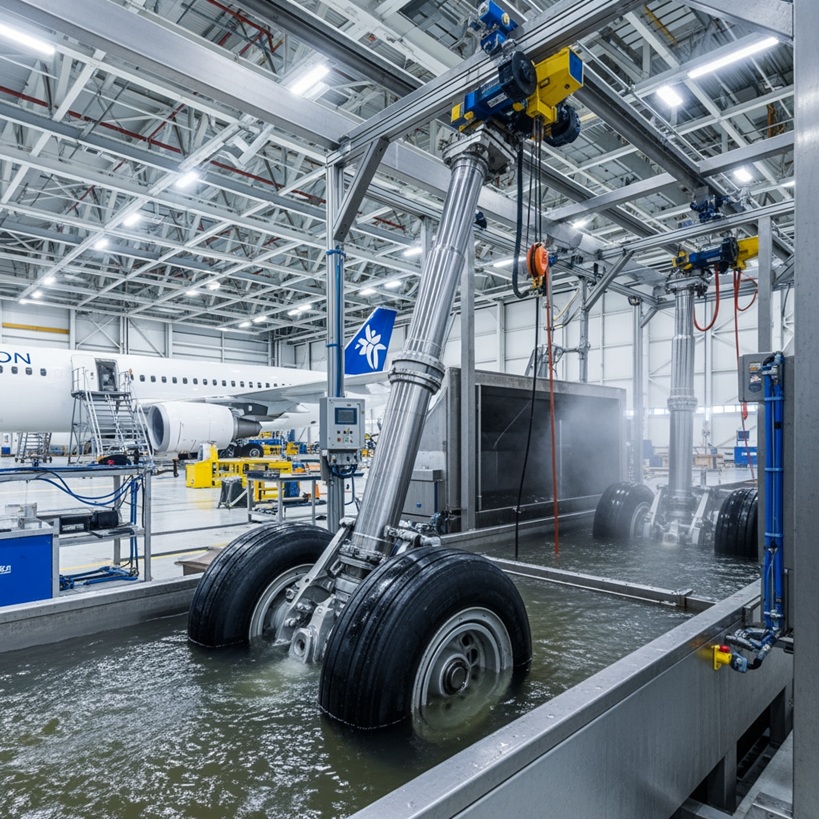
Aircraft landing gear components endure extreme operational stresses – repeated compression cycles, high-temperature braking friction, hydraulic system exposure, and constant contamination from runway debris. These conditions create layered deposits of hydraulic fluid, baked-on rubber particles, carbon residues, and metallic contaminants that compromise inspection accuracy, accelerate corrosion, and mask structural defects. Aviation maintenance facilities require landing gear cleaning systems that achieve aerospace-grade cleanliness standards whilst preserving the dimensional tolerances and surface integrity critical to airworthiness certification.
Traditional manual cleaning methods – solvent wiping, brush scrubbing, and chemical soaking – consume 6-12 hours per landing gear assembly whilst exposing technicians to hazardous chemicals and repetitive strain injuries. Automated industrial parts washers eliminate these inefficiencies, delivering consistent contamination removal in 45-90 minute cycles whilst meeting the stringent cleanliness requirements defined in aviation maintenance manuals and regulatory standards.
Understanding Landing Gear Contamination Types
Landing gear maintenance cleaning operations must address multiple contamination layers that require different cleaning approaches. Hydraulic fluid – typically MIL-PRF-83282 or MIL-PRF-5606 formulations – penetrates into threaded connections, bearing surfaces, and seal grooves. These fluids oxidise under operational heat cycles, forming tenacious varnish deposits that resist simple solvent dissolution.
Rubber Deposits from Tyre Contact
Rubber deposits originate from tyre contact during landing and taxiing operations. High-energy braking events generate temperatures exceeding 300°C, causing tyre rubber to partially pyrolyse and bond to wheel assemblies, brake components, and adjacent structures. These deposits contain vulcanised rubber compounds, carbon black fillers, and metallic particles from runway surfaces.
Carbon Deposits and Brake Contamination
Carbon deposits accumulate on brake assemblies from the controlled oxidation of carbon-carbon composite brake materials. These deposits combine with hydraulic fluid residues and metallic wear particles to form hardened scale that obscures crack detection during non-destructive testing procedures. Brake dust also contains beryllium and other hazardous materials requiring controlled removal methods.
Corrosion Products and Metal Degradation
Corrosion products – primarily aluminium oxides, cadmium salts, and iron hydroxides – form beneath contamination layers where moisture becomes trapped against metal surfaces. These corrosion deposits must be completely removed to enable accurate visual inspection and prevent progressive structural degradation during service intervals.
Why Aviation Maintenance Demands Specialised Cleaning Systems
Civil Aviation Safety Authority regulations require detailed visual inspection of landing gear components at prescribed intervals, with inspection effectiveness directly dependent on surface cleanliness. Contamination layers as thin as 0.05mm can mask fatigue cracks, corrosion pitting, and structural defects that compromise flight safety. Maintenance facilities must demonstrate cleaning process capability through documented procedures and validation testing.
Surface Cleanliness Standards
Aerospace specifications define cleanliness levels measured by residual contamination mass per surface area, typically requiring levels below 1mg/dm² for critical structural components. Achieving these standards demands cleaning systems with controlled temperature, pressure, and chemical concentration parameters that manual methods cannot consistently replicate.
Dimensional Tolerance Preservation
Landing gear components maintain tolerances measured in hundredths of millimetres. Aggressive cleaning methods – abrasive blasting, caustic chemical attack, or excessive mechanical scrubbing – can remove base material, alter surface finishes, or damage protective coatings. Automated spray washing systems deliver precisely controlled cleaning energy that removes contamination without affecting component dimensions.
Inspection Interval Economics
Modern commercial aircraft operate on condition-based maintenance schedules where component service life depends on inspection findings rather than arbitrary time limits. Thorough landing gear cleaning extends inspection intervals by enabling accurate assessment of component condition, reducing unnecessary part replacement costs that can exceed $50,000 per landing gear assembly.
Technician Safety Requirements
Traditional cleaning solvents – MEK, toluene, and chlorinated hydrocarbons – present acute toxicity hazards and long-term health risks. Enclosed automated cleaning systems eliminate direct chemical exposure whilst containing hazardous waste streams for compliant disposal, reducing workplace injury rates and regulatory liability.
Hot Tank Systems for Heavy Contamination Removal
Hot tank systems provide the immersion cleaning capability required for heavily contaminated landing gear assemblies. These systems heat aqueous cleaning solutions to 70-90°C whilst maintaining controlled agitation through solution circulation or ultrasonic energy. The combination of thermal energy, chemical action, and mechanical agitation breaks down layered contamination that spray washing alone cannot penetrate.
System Capacity and Construction
Large landing gear assemblies – main gear struts measuring 1.5-2.0 metres in length – require tank capacities exceeding 2,000 litres with sufficient clearance for component immersion and lifting operations. Heavy-duty construction using 304 or 316 stainless steel provides corrosion resistance against alkaline cleaning chemistries whilst supporting component weights exceeding 500kg.
Thermal and Chemical Action
Heated immersion cleaning excels at dissolving polymerised hydraulic fluid deposits and softening baked-on rubber contamination. Extended soak times – typically 30-60 minutes – allow cleaning chemistry to penetrate into complex geometries, blind holes, and internal passages that spray systems cannot directly reach. Solution temperatures above 80°C accelerate chemical reaction rates, reducing total cycle times whilst improving cleaning effectiveness for hydraulic fluid removal aircraft applications.
Ultrasonic Enhancement Technology
Adding ultrasonic transducers to hot tank systems increases cleaning performance on intricate components with complex surface geometries. Ultrasonic cavitation generates a microscopic cleaning action that reaches into threaded connections, seal grooves, and surface irregularities where contamination accumulates. Frequencies between 25-40 kHz provide optimal energy for aerospace cleaning applications without causing surface damage.
Solution Filtration Requirements
Landing gear maintenance cleaning generates substantial particulate contamination – rubber particles, carbon dust, metallic wear debris – that must be continuously removed from cleaning solutions. Integrated filtration systems using 25-50 micron cartridge filters maintain solution cleanliness, preventing redeposition of removed contamination and extending solution service life.
High-Pressure Spray Systems for Precision Cleaning
After initial contamination removal through immersion or manual pre-cleaning, heavy-duty parts washers deliver the high-pressure spray action required to achieve aerospace cleanliness standards. These systems combine heated cleaning solution (60-80°C) with spray pressures between 40-80 bar to mechanically dislodge remaining contamination whilst flushing residues from component surfaces.
Cabinet Design and Coverage
Cabinet-style spray washers accommodate landing gear components up to 1.5 metres in length, with rotating turntables ensuring complete coverage of complex geometries. Multiple spray manifolds – overhead, side-mounted, and underbody nozzles – direct cleaning solution from all angles, reaching recessed areas and internal passages that single-direction spray cannot adequately clean.
Programmable Wash Cycles
Modern spray washing systems offer multi-stage cleaning programmes that optimise cleaning parameters for different contamination types. Initial high-temperature alkaline wash stages (pH 11-12) remove oil and grease contamination, followed by neutral detergent stages for general cleaning, and concluding with heated rinse cycles that prevent water spotting and accelerate drying.
Pressure Control Capability
Landing gear assemblies contain sensitive components – seals, bearings, electrical connectors – that require reduced spray pressure to prevent damage. Variable-frequency drive pump controls allow technicians to adjust spray pressure between 20-80 bar within the same cleaning cycle, protecting vulnerable components whilst maintaining aggressive cleaning action on heavily contaminated surfaces.
Solution Heating Capacity
Maintaining consistent solution temperature throughout extended cleaning cycles requires substantial heating capacity – typically 18-36kW for industrial-scale systems. Electric immersion heaters or heat exchanger systems maintain temperature stability within ±2°C, ensuring consistent cleaning performance regardless of ambient conditions or component thermal mass.
Chemical Selection for Aerospace Applications
Aviation maintenance cleaning requires chemistries that effectively remove contamination whilst meeting stringent material compatibility and environmental requirements. Alkaline cleaning solutions – sodium hydroxide, potassium hydroxide, or sodium metasilicate formulations – provide excellent performance on hydraulic fluid and carbonaceous deposits but require careful concentration control to prevent aluminium alloy etching.
pH-Neutral Alternatives
Modern surfactant-based cleaners achieve effective contamination removal at neutral pH (6-8), eliminating concerns about caustic attack on aluminium components or acid damage to cadmium plating. These formulations combine anionic and nonionic surfactants with chelating agents that sequester metallic ions and prevent redeposition during rinse cycles.
Biodegradability Requirements
Environmental regulations increasingly mandate biodegradable cleaning chemistries that break down completely in wastewater treatment systems. Aerospace-approved formulations based on plant-derived surfactants and organic acids meet these requirements whilst maintaining cleaning effectiveness comparable to traditional petroleum-based solvents.
Corrosion Inhibition
Aqueous cleaning solutions must contain corrosion inhibitors – typically sodium nitrite, sodium benzoate, or proprietary amine compounds – that protect ferrous and non-ferrous metals during cleaning and prevent flash rusting after rinse cycles. Effective inhibitor packages maintain protection for 24-48 hours after cleaning, allowing time for complete drying and preservation coating application.
Integrating Cleaning Systems into Maintenance Workflows
Aviation maintenance facilities operate under time-constrained schedules where aircraft ground time directly impacts revenue generation. Cleaning system integration must minimise component turnaround time whilst ensuring compliance with maintenance manual requirements and regulatory standards. Extra heavy-duty parts washers designed for continuous operation support high-volume maintenance facilities processing multiple landing gear assemblies daily.
Workflow Optimisation
Efficient maintenance operations position cleaning systems adjacent to disassembly workstations, minimising component transport distances and handling operations. Overhead crane access or integrated lifting equipment facilitates safe loading of heavy assemblies, reducing manual handling injuries whilst improving operational efficiency.
Documentation Requirements
Quality management systems require documented evidence of cleaning process parameters – solution temperature, pressure readings, cycle duration, chemical concentration – for each component processed. Modern cleaning systems with integrated PLC controls automatically record these parameters, generating traceability records that satisfy audit requirements without additional administrative burden.
Waste Management Integration
Landing gear cleaning generates hazardous waste streams – contaminated cleaning solutions, oily sludge, and filter cartridges containing heavy metals. Effective waste management systems separate these streams at the point of generation, minimising disposal costs whilst ensuring regulatory compliance. Oil-water separators recover hydraulic fluid for recycling, whilst solution filtration extends cleaning chemistry service life from weeks to months.
Measuring Cleaning Effectiveness and Process Validation
Aviation maintenance organisations must validate cleaning processes through documented testing that demonstrates consistent achievement of required cleanliness levels. Validation protocols typically involve processing representative contaminated components, followed by quantitative cleanliness assessment using gravimetric analysis, fluorescent tracer methods, or surface energy measurements.
Gravimetric Testing
This method measures residual contamination by wiping defined surface areas with pre-weighed solvent-saturated cloths, then determining mass increase after solvent evaporation. Results expressed as mg/dm² provide direct comparison against aerospace cleanliness specifications, with typical acceptance criteria below 1mg/dm² for critical structural components.
Visual Inspection Standards
Trained inspectors assess cleaned components under controlled lighting conditions (minimum 1,000 lux) using magnification tools and comparison standards. Acceptance criteria prohibit visible oil films, particulate contamination, or residual deposits that could interfere with subsequent inspection procedures or compromise coating adhesion.
Water Break Testing
This simple field test assesses surface cleanliness by observing water behaviour on cleaned surfaces. Properly cleaned metal surfaces exhibit uniform water sheeting without beading or break-up, indicating complete hydraulic fluid removal aircraft contamination has been achieved. Water break testing provides immediate feedback on cleaning effectiveness without requiring laboratory analysis.
Conclusion: Achieving Aviation-Grade Cleanliness Standards
Landing gear maintenance cleaning demands systems engineered for the unique challenges of aerospace contamination – polymerised hydraulic fluid deposits, heat-bonded rubber residues, and hazardous carbon dust – whilst preserving dimensional tolerances measured in microns. Manual cleaning methods cannot consistently achieve the cleanliness levels required for accurate inspection and airworthiness certification, creating operational risks and regulatory exposure.
Automated cleaning systems eliminate these limitations, delivering documented cleaning performance that meets civil aviation standards whilst reducing component turnaround time from days to hours. Hot tank immersion systems penetrate heavy contamination layers, whilst high-pressure spray washers achieve the surface cleanliness required for non-destructive testing and protective coating application. Aerospace-approved cleaning chemistries remove contamination without attacking substrate materials, protecting the substantial capital investment represented by landing gear assemblies.
Australian aviation maintenance facilities benefit from locally engineered cleaning systems designed for the operational demands of high-volume maintenance environments. Hotwash Australia manufactures industrial cleaning equipment that meets the durability, performance, and documentation requirements of aerospace applications, with engineering support and service capability that keeps systems operational throughout demanding maintenance schedules.
For aviation maintenance organisations seeking to improve cleaning process capability whilst reducing technician exposure to hazardous chemicals, contact us to discuss system specifications matched to specific component cleaning requirements and facility operational parameters.

Leave A Comment