
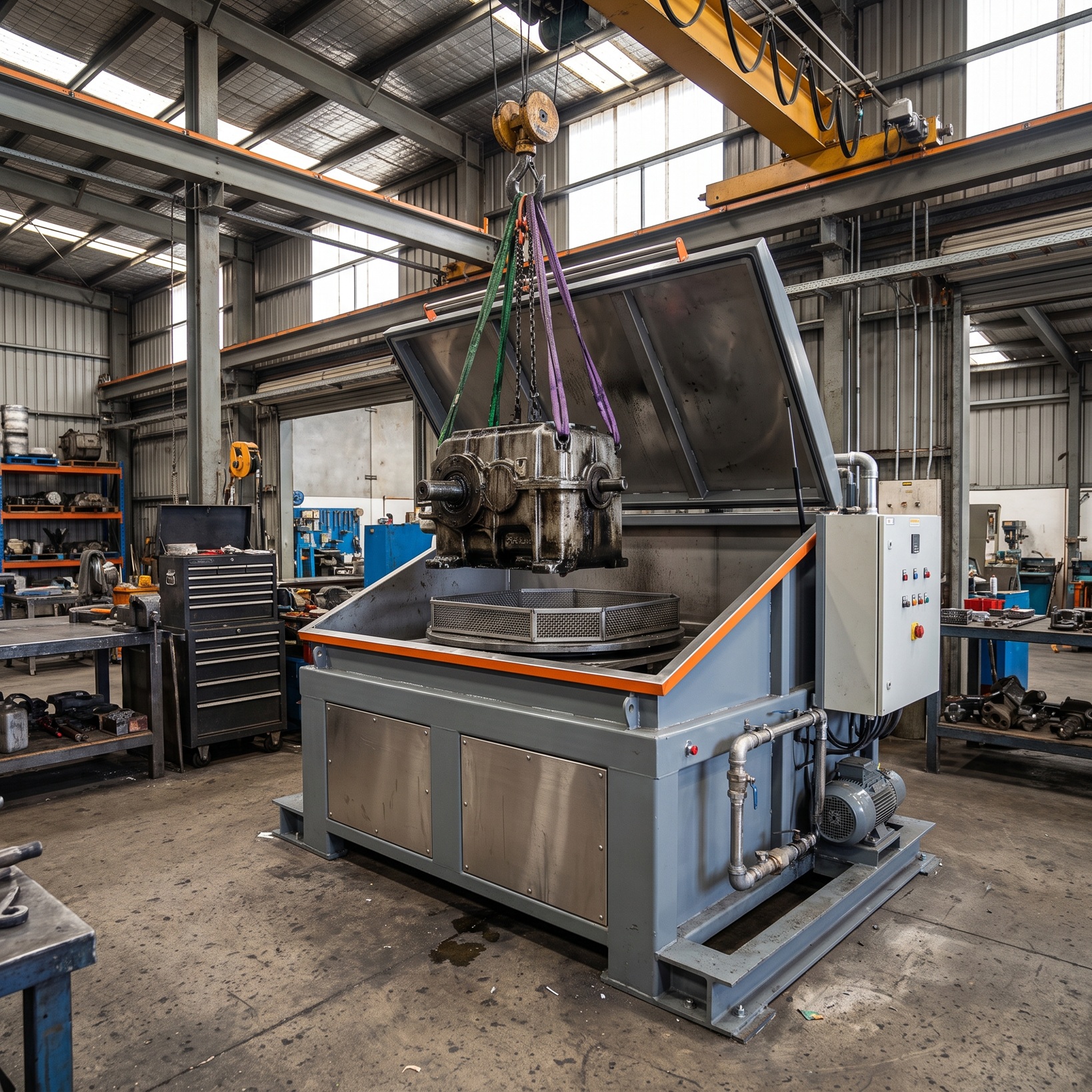
Large mechanical components can be difficult to move safely between disassembly, cleaning, and inspection. A washer placed outside the normal lifting route can create unnecessary transfers, awkward trolley movements, or repeated forklift handling.
Good integration starts before the machine is installed. The washer, lifting equipment, access route, and next work stage should operate as one handling system. This guide explains the planning points that matter when crane access is part of the cleaning workflow.
Plan the Crane-to-Washer Movement
Start With the Full Component Travel Path
An overhead workshop crane is most useful when it can support the whole movement path. That path may begin at a teardown bench and continue through cleaning, inspection, and reassembly.
A top-loading parts washer needs to sit where the lifting path remains practical. The operator should not need extra transfers just to move a component between the crane and washer.
Hotwash’s parts washer range includes automatic and specialised systems for different workshop requirements. The website also discusses crane and hoist access when larger components need mechanical handling.
Start by mapping where dirty components arrive. Then map where cleaned components go next. This creates a crane loading workflow based on real movement rather than spare floor space.
The same planning should account for turning or rotating a suspended component. A clear straight-line lift may still become awkward if the load needs repositioning before entering the machine.
Check Vertical and Side Clearance Together
Washer loading clearance is not only the space directly above the machine. It also includes lid travel, hook movement, rigging length, and access around the loading point.
Hotwash’s own installation guidance tells workshops to check ceiling height for top-loading systems and overhead crane clearance. That is a planning instruction, not a universal machine dimension.
Confirm the selected washer’s opening arrangement before fixing the location. Different Hotwash machines use different doors, lids, baskets, and loading methods.
Workshop equipment layout should also leave room for servicing. A machine that fits under crane coverage can still be difficult to maintain if walls or other equipment block access.
Build a Safe Loading Sequence
Keep the Suspended Load Path Clear
A crane loading workflow should keep suspended components away from unnecessary pedestrian movement. The route between the workbench and washer should be obvious to everyone using the area.
Avoid placing storage racks, portable equipment, or worktables inside the regular lifting path. These obstacles can encourage operators to swing loads around them.
The overhead workshop crane should be used within its approved operating limits and site procedures. Rigging selection and load control should match the component being moved.
For workshops handling larger parts, heavy duty washers are one Hotwash category designed for demanding industrial cleaning. Individual model suitability still depends on the part and loading arrangement.
Lower Components Without Contacting the Cabinet
Heavy component handling needs a controlled final placement. The goal is to lower the component into the intended basket or loading surface without striking the machine.
Keep enough visibility around the opening for the operator or spotter. Avoid using the washer cabinet as a guide for the suspended load.
The top-loading parts washer should be positioned so the hook can approach the loading point cleanly. Side pulling or awkward rigging angles should not become part of the normal process.
Hotwash’s extra heavy duty washers are described for demanding industrial applications and larger cleaning requirements. The live product information should be checked for the exact model’s loading features.
At this point, Hotwash Australia can help confirm the machine configuration that suits the workshop’s component handling method. The site should remain the reference for current model features.
Match Washer Style to Handling Needs
Large Spray Washers and Mechanical Handling
The phrase top-loading parts washer describes a loading arrangement, not a separate Hotwash product category. Hotwash groups its automatic machines by construction and duty level instead.
For larger industrial work, super heavy duty washers are presented for mining and manufacturing environments. The range includes features intended for heavy workshop use, but crane compatibility must still be confirmed for the selected model.
Heavy component handling should therefore start with the part, not the category name. Consider component shape, lifting points, contamination, and the cleaning process required.
Some loads may suit a spray washer basket. Others may need a different process or machine opening. Matching the equipment to the handling method prevents the crane from becoming an afterthought.
Hot Tanks and Vertical Loading
Hot tanks use immersion cleaning rather than spray washing. Components are lowered into heated cleaning solution for soaking.
Hotwash’s published guidance discusses using cranes or hoists to lower larger components into hot tank systems. That makes vertical lifting an important part of hot tank placement.
The loading sequence still needs proper planning. The component should move from the lifting point into the tank without crossing unrelated work areas.
A hot tank is not interchangeable with a spray washer. The cleaning method, component material, contamination, and workshop process should determine which system is appropriate.
Check Installation and Service Access
Do Not Let the Crane Solve One Problem and Create Another
An overhead workshop crane can simplify movement, but the washer still needs suitable services and access. Power, water, drainage, ventilation, and maintenance space remain part of the installation.
Washer loading clearance should be reviewed together with these services. A convenient crane position is not useful if the machine blocks drainage access or service panels.
Workshop equipment layout should also separate the lifting path from normal vehicle traffic where practical. Forklifts, mobile equipment, and suspended loads should not compete for the same narrow space.
Plan where wet components will pause after cleaning. A controlled set-down point can help prevent dripping parts from being carried through unrelated work zones.
Consider a Different Door Arrangement When Needed
Not every workshop has the ceiling height or crane path for vertical loading. A different washer configuration may fit the existing building more naturally.
Hotwash’s SS1600 sliding-door washer uses a pneumatic sliding door and a pull-out turntable. This provides a different loading approach from a lid-opening arrangement.
A sliding-door machine should not be described as a direct substitute for every crane-loaded washer. Its suitability depends on the components, duty, and cleaning requirements.
The useful question is not whether one door style is universally better. It is whether the machine can fit the workshop equipment layout without creating awkward handling steps.
FAQs
Does Hotwash Sell a Product Category Called Top-Loading Parts Washers?
Hotwash does not present “top-loading parts washers” as a standalone product category on its current product menu. The site groups automatic machines into stainless steel, heavy duty, extra heavy duty, and super heavy duty ranges.
The company does use top-loading terminology in installation guidance when discussing ceiling height and crane clearance. Always check the actual model page before assuming how a machine opens.
Can an Overhead Crane Load a Hotwash Parts Washer?
An overhead workshop crane may suit some larger Hotwash systems. The selected machine and site must be configured for that method. Hotwash also discusses crane or hoist loading for hot tanks and heavy components.
Compatibility should be confirmed for the exact washer, load, lifting method, and workshop. Do not assume every cabinet or basket is designed for crane loading.
What Should Be Checked Before Positioning the Washer Under Crane Coverage?
Check the complete lifting route, lid or door movement, hook approach, and rigging space. Also check service access, utilities, and the set-down area.
Also review heavy component handling procedures for the site. The crane and washer should fit an established safe workflow rather than creating a new improvised one.
Are Hot Tanks Suitable for Crane-Fed Loading?
Hotwash’s published hot tank guidance describes larger components being lowered using a crane or hoist. This can make hot tanks compatible with a crane-fed workflow where immersion cleaning suits the component.
The tank, component material, cleaning chemistry, and lifting arrangement should all be confirmed before use.
For application-specific advice, contact our equipment specialists or email sales@hotwash.com.au.
Conclusion
Crane integration works best when the washer is treated as part of the material-handling route. The lifting path, opening arrangement, services, and next work stage should be planned together.
Different Hotwash ranges use different machine layouts. Confirm the exact model before designing the crane approach, and avoid assuming every washer supports the same loading method.

Leave A Comment