
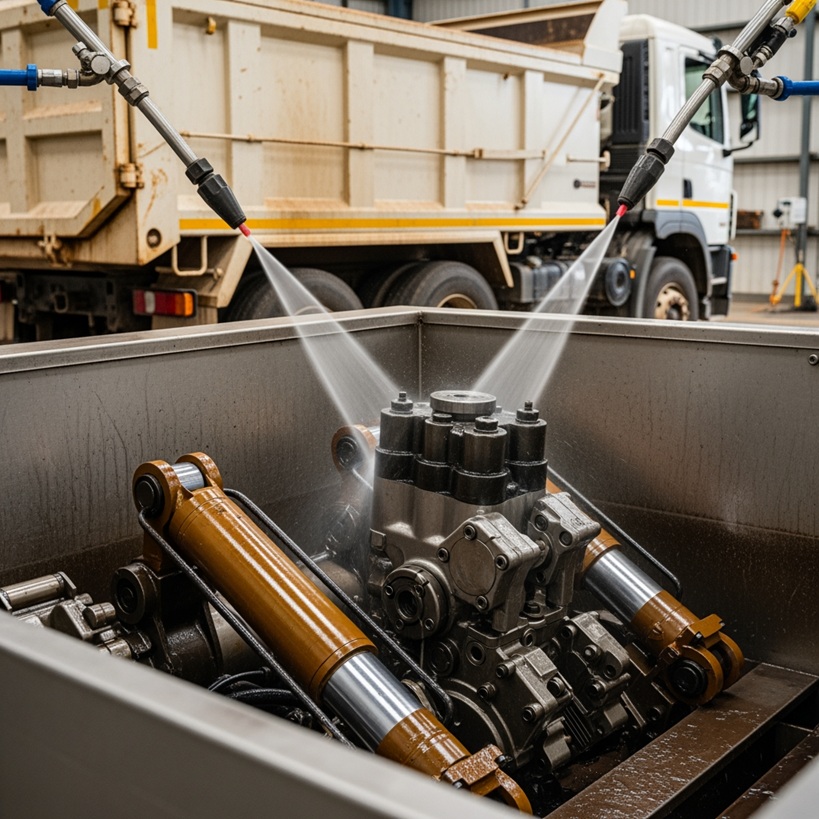
Hydraulic systems power the essential lifting, tipping, and loading functions that keep Australian transport and logistics operations running. When contamination enters these systems – whether on tippers, tail lifts, or heavy vehicle hydraulics – the consequences extend far beyond immediate performance issues. Hydraulic component failures cost Australian fleet operators an average of $2,800 per incident in parts and labour, with system downtime adding thousands more in lost productivity. The root cause in 78% of hydraulic failures traces back to a single factor: contamination from inadequate cleaning practices.
Hydraulic fluid operates under extreme pressure, often exceeding 3,000 PSI in modern tail lift systems. At these pressures, contaminants as small as 10 microns – invisible to the naked eye – act like grinding paste between precision-machined components. Dirt particles, metal shavings, rubber degradation products, and oxidised fluid residues accelerate wear on pumps, valves, cylinders, and seals. For fleet managers overseeing tipper trucks and vehicles with hydraulic tail lifts, implementing proper hydraulic equipment cleaning protocols represents the most cost-effective strategy for extending system longevity and preventing catastrophic failures.
How Contamination Destroys Hydraulic Components
Hydraulic systems achieve their power through precise clearances between moving parts – often measured in thousandths of a millimetre. Contamination particles disrupt these tolerances through three destructive mechanisms: abrasive wear, erosive wear, and chemical degradation.
Abrasive wear occurs when hard particles become trapped between moving surfaces, creating grooves and scoring on cylinder walls, valve spools, and pump elements. A single contamination event during component installation or maintenance can introduce thousands of particles that circulate through the system for months. These particles concentrate at high-pressure points, progressively widening clearances and reducing system efficiency. A hydraulic pump operating with contaminated fluid typically loses 15-20% of its volumetric efficiency within 2,000 operating hours compared to systems maintained with proper cleanliness protocols.
Erosive wear attacks components differently, with high-velocity fluid carrying particles that impact surfaces at angles. This erosion particularly damages directional control valves, where fluid changes direction rapidly. The sharp edges and corners inside valve bodies experience accelerated material loss, eventually causing internal leakage that manifests as sluggish operation or complete function loss. Tail lift operators notice this degradation as slower lifting speeds or reduced load capacity before complete failure occurs.
Chemical degradation represents the third contamination pathway. When hydraulic components aren’t properly cleaned before assembly or service, residual moisture, cleaning chemicals, or incompatible fluids remain in the system. These contaminants accelerate fluid oxidation, forming acids and sludge that attack seals, hoses, and metal surfaces. The resulting seal degradation creates new contamination pathways, allowing external dirt ingress while internal fluid leakage multiplies the contamination load.
The True Cost of Hydraulic System Failures
Fleet operators frequently underestimate the total cost of hydraulic failures by focusing only on immediate repair expenses. A comprehensive cost analysis reveals the broader financial impact across multiple operational areas.
Direct repair costs for hydraulic component replacement typically range from $1,500 to $5,000, depending on system complexity and component accessibility. A failed tail lift hydraulic pump, including labour, averages $2,200, while tipper ram cylinder replacement can exceed $4,000 when factoring in hydraulic system flushing requirements. These figures represent only the parts and labour directly attributed to the failed component.
Downtime costs often exceed repair expenses by 200-300% for commercial vehicles. A tipper truck generating $800 daily revenue loses $3,200 for each four-day repair period. Tail lift failures on delivery vehicles create cascading scheduling disruptions, requiring load transfers, route reassignments, and customer communication – administrative costs that rarely appear in maintenance reports but significantly impact operational efficiency.
Secondary damage multiplies costs when hydraulic failures aren’t immediately detected. A leaking seal that goes unnoticed for weeks allows contamination throughout the entire system, necessitating complete fluid replacement, filter changes, and thorough system flushing. What begins as a $300 seal replacement escalates to a $2,500 system restoration. Contaminated fluid that damages multiple components simultaneously – pump, valves, and cylinders – can push total repair costs beyond $8,000.
Preventive maintenance through systematic heavy duty parts washers eliminates 70-80% of contamination-related failures by ensuring components remain clean during service intervals and repairs. The investment in proper cleaning equipment delivers measurable ROI through extended component life and reduced failure frequency.
Critical Cleaning Points in Hydraulic System Maintenance
Hydraulic system longevity depends on contamination control at specific intervention points throughout the maintenance cycle. Each point represents an opportunity for contamination introduction – or prevention through proper cleaning protocols.
Component Removal and Disassembly: External contamination transfers to internal surfaces the moment hydraulic lines disconnect or components open to the atmosphere. Road grime, dust, and oil residue on external surfaces migrate into systems during routine maintenance. Thoroughly cleaning external component surfaces before disconnecting hydraulic lines prevents this contamination pathway. Industrial cleaning systems remove years of accumulated grime that hand-wiping leaves behind.
Replacement Part Preparation: New hydraulic components arrive with manufacturing residues, protective coatings, and storage contaminants that must be removed before installation. Machining processes leave metal particles, cutting fluids, and rust preventatives inside cylinder bores, valve bodies, and pump housings. Installing components without removing these residues introduces immediate contamination that accelerates wear from the first operating hour. Proper hydraulic equipment cleaning eliminates manufacturing contaminants while maintaining component integrity.
Cylinder Rod Maintenance: Hydraulic cylinder rods on tipper trucks and tail lifts extend into contaminated environments – road spray, dust, and corrosive materials coat these precision surfaces. When contaminated rods retract into cylinders, particles scrape past seals and circulate through the system. Regular rod cleaning during inspection intervals prevents this contamination source. Automated cleaning systems deliver consistent results that manual wiping cannot match, particularly for removing microscopic particles embedded in surface imperfections.
Valve Block Servicing: Directional control valves and manifold blocks contain complex internal passages where contamination accumulates over time. During valve rebuilds or seal replacements, these passages require thorough cleaning to remove varnish deposits, metal particles, and degraded seal material. Hot tank systems excel at removing stubborn deposits from complex valve geometries where spray washing proves less effective.
System Flushing Components: After hydraulic system repairs, temporary flushing circuits and contamination monitoring equipment must be spotlessly clean to avoid recontaminating the serviced system. Flush carts, filter housings, and test equipment that aren’t properly maintained between uses transfer contamination from previous jobs to freshly serviced systems.
Why Standard Cleaning Methods Fail for Hydraulic Components
Workshop practices developed for general mechanical maintenance prove inadequate for hydraulic component cleaning due to the extreme cleanliness standards hydraulic systems demand. Understanding these limitations explains why dedicated cleaning equipment delivers superior outcomes.
Solvent tanks with parts brushes – the traditional workshop cleaning method – leave residual contamination that hydraulic systems cannot tolerate. Manual agitation fails to dislodge particles from internal passages, blind holes, and thread roots. Solvent evaporation leaves a contamination film that reintroduces particles during system operation. Brushing action actually embeds fine particles into softer materials like aluminium valve bodies and cylinder tubes, creating contamination sources that persist through component life.
Pressure washers using cold water and general-purpose degreasers remove visible contamination but leave microscopic particles and chemical residues. The high-pressure spray pattern creates uneven cleaning, missing recessed areas while potentially damaging seals and surface finishes. Chemical residues from incompatible cleaning agents attack hydraulic seals and accelerate fluid degradation after component installation.
Compressed air blow-off – commonly used after cleaning – redistributes contamination rather than removing it. Particles dislodge from one area and deposit in another, while fine dust becomes airborne and settles back onto cleaned surfaces. Compressed air also introduces moisture and compressor oil contamination when shop air systems lack proper filtration and drying equipment.
Ultrasonic cleaners offer improved cleaning performance but require correct chemistry, temperature control, and exposure time that workshop operations frequently compromise. Inadequate ultrasonic tank maintenance leads to cross-contamination between cleaning batches, while improper solution chemistry damages aluminium components or leaves residues.
Hydraulic Equipment Cleaning Standards and System Selection
Effective hydraulic equipment cleaning requires matching cleaning system capabilities to the contamination levels and cleanliness standards the application demands. Australian fleet maintenance operations benefit from understanding these technical requirements when specifying cleaning equipment.
ISO 4406 cleanliness codes define hydraulic fluid contamination levels using particle count ranges at three size thresholds: 4, 6, and 14 microns. Modern hydraulic systems specify target cleanliness codes between 16/14/11 and 18/16/13 depending on component sensitivity. Achieving these cleanliness levels requires removing particles down to 5-micron size from all system components during service and repair.
Cleaning system selection begins with understanding the contamination types encountered in tipper hydraulic system maintenance. Heavy equipment hydraulics accumulate thick grease, road grime, hydraulic fluid residues, and carbon deposits that require aggressive initial cleaning. Extra heavy duty parts washers deliver the combination of high-temperature cleaning solution, powerful spray pressure, and extended cycle times necessary for removing these stubborn contaminants from large components.
Spray pressure requirements vary by component geometry and contamination severity. External component cleaning benefits from 40-60 PSI spray pressure that removes accumulated grime without damaging painted surfaces or electrical connections. Internal passage cleaning demands higher pressures – 80-100 PSI – to dislodge particles from complex geometries, but excessive pressure risks seal damage and surface erosion. Quality industrial washing systems provide adjustable pressure settings that optimise cleaning effectiveness while protecting components.
Temperature control significantly impacts cleaning performance and component safety. Heated cleaning solutions between 60-80°C dissolve grease and oil contamination far more effectively than cold water systems, reducing cleaning cycle times by 60-70%. However, temperatures exceeding 85°C risk damaging rubber seals, O-rings, and composite materials common in modern hydraulic components. Precision temperature control prevents thermal damage while maximising cleaning efficiency.
Filtration systems within parts washers determine whether cleaning operations introduce or remove contamination. Recirculating wash tanks without adequate filtration redistribute particles from previously cleaned parts onto current components. Industrial cleaning systems incorporate multi-stage filtration – typically 25-50 micron bag filters combined with magnetic separation – that maintains solution cleanliness throughout extended operation. This filtration capacity proves essential for high-volume fleet maintenance operations where dozens of components cycle through the washer daily.
Implementing Hydraulic Component Cleaning Protocols
Converting hydraulic equipment cleaning from theory to practice requires establishing systematic protocols that maintenance teams consistently follow. Successful implementation balances thoroughness with operational efficiency.
Pre-Cleaning Inspection and Documentation: Before cleaning begins, technicians should photograph and document component condition, identifying existing damage, wear patterns, and contamination severity. This documentation creates accountability while providing baseline data for tracking cleaning effectiveness. External component surfaces receive initial inspection for cracks, corrosion, and mechanical damage that cleaning might obscure.
Staged Cleaning Approach: Heavily contaminated components benefit from a two-stage cleaning that prevents overwhelming the primary washing system. Initial gross contamination removal using manual parts washers or pre-wash stations eliminates thick grease and mud before components enter automated cleaning systems. This staged approach extends cleaning solution life and maintains consistent final cleanliness levels.
Component-Specific Cleaning Cycles: Different hydraulic components require tailored cleaning parameters. Cylinder assemblies with intact seals need gentler spray pressure and moderate temperatures to avoid seal damage. Valve bodies and pump housings stripped to bare castings tolerate aggressive cleaning with high temperatures and pressures. Establishing component-specific cleaning protocols – documented with cycle times, temperatures, and pressure settings – ensures consistent results across different operators and shifts.
Post-Cleaning Verification: Visual inspection confirms external cleanliness, but hydraulic components require additional verification. White-glove testing of internal passages reveals residual contamination invisible to casual observation. Compressed air blow-off through internal passages onto clean white paper demonstrates particle removal effectiveness. Components that fail verification return for additional cleaning rather than introducing contamination into serviced systems.
Protective Storage: Cleaned components require protection from airborne contamination until installation. Plastic caps, plugs, and sealed bags maintain component cleanliness during storage and transport. Workshop environments contain airborne dust and moisture that recontaminate exposed components within hours. Implementing clean storage protocols prevents negating the investment in thorough cleaning.
Measuring Cleaning System ROI in Fleet Operations
Fleet managers evaluating cleaning equipment investments require quantifiable data demonstrating financial returns. Hydraulic system maintenance generates measurable metrics that document the cleaning system value.
Component life extension provides the most significant ROI contributor. Hydraulic pumps operating in properly maintained, clean systems average 8,000-12,000 operating hours before replacement compared to 3,000-5,000 hours in contaminated systems. For a tipper truck hydraulic pump costing $2,400 installed, extending service life from 4,000 to 10,000 hours reduces per-hour operating costs from $0.60 to $0.24 – a $0.36 per hour savings. Across a 20-vehicle fleet operating 2,000 hours annually, this single component delivers $14,400 annual savings.
Hydraulic cylinder service intervals extend similarly with contamination control. Tail lift cylinders requiring seal replacement every 18 months under contaminated conditions operate 36-48 months with proper cleanliness maintenance. Each seal service costs $400-600 in parts and labour. Doubling service intervals saves $200-300 per cylinder annually – multiplied across multiple cylinders per vehicle and entire fleet sizes, savings accumulate rapidly.
Unplanned downtime reduction delivers substantial but often unquantified value. Contamination-related hydraulic failures occur unpredictably, creating scheduling disruptions, emergency repairs at premium labour rates, and expedited parts shipping costs. Fleet operations implementing systematic cleaning protocols report 60-75% reductions in hydraulic-related breakdowns, translating to improved vehicle availability and reduced emergency maintenance costs.
Fluid service intervals extend when systems remain clean. Hydraulic fluid contaminated with wear particles and water requires replacement every 1,000-2,000 operating hours. Clean systems with effective contamination control maintain fluid quality for 3,000-5,000 hours. For systems holding 100-200 litres of premium hydraulic fluid, extended drain intervals save $150-300 per service cycle while reducing waste disposal costs and environmental impact.
Australian Standards and Compliance Considerations
Australian fleet operations must balance cleaning effectiveness with workplace safety and environmental compliance requirements. Understanding these regulatory frameworks ensures cleaning system selection meets both operational and legal obligations.
Workplace Health and Safety regulations require controlling exposure to cleaning chemicals, hot water, and high-pressure spray equipment. Industrial cleaning systems incorporate safety features including enclosed cabinets that contain spray and fumes, automatic door interlocks preventing operation during access, and temperature controls limiting burn risks. These engineered controls reduce reliance on personal protective equipment and administrative procedures while improving compliance with WHS requirements.
Environmental regulations govern cleaning solution disposal and stormwater protection. Recirculating cleaning systems with extended solution life minimise waste generation compared to single-use solvent cleaning. Modern parts washers incorporate oil separation and filtration systems that enable cleaning solution reuse for weeks or months, reducing disposal frequency and associated costs. When disposal becomes necessary, concentrated contamination facilitates proper waste handling compared to dispersed contamination from open cleaning methods.
Australian electrical standards (AS/NZS 3000) govern industrial equipment installation and operation. Quality cleaning equipment manufactured to Australian standards ensures electrical safety and simplifies compliance documentation. Locally manufactured equipment provides additional benefits including parts availability, service support, and familiarity with Australian operating conditions.
Selecting Cleaning Equipment for Hydraulic Maintenance Operations
Fleet maintenance operations vary significantly in scale, component types, and contamination levels encountered. Matching cleaning equipment capabilities to operational requirements optimises both cleaning effectiveness and capital efficiency.
Small workshops servicing 5-15 vehicles benefit from compact cleaning systems that deliver professional results without requiring dedicated floor space. These operations typically encounter moderate contamination levels on tail lift components and auxiliary hydraulics. Cleaning systems with 200-400 litre tank capacity, adjustable spray pressure, and heated solutions address most requirements while maintaining reasonable equipment costs and operating expenses.
Medium-sized fleet operations maintaining 20-50 vehicles require increased throughput capacity and component size accommodation. Multiple technicians performing simultaneous repairs create demand for larger cleaning chambers – typically 600-800 litres – that accommodate cylinder assemblies, valve banks, and pump units without disassembly. Industrial spray washers with programmable cleaning cycles enable different operators to achieve consistent results while automated features reduce labour time.
Large fleet maintenance facilities and heavy equipment specialists encounter the most demanding cleaning requirements. Mining service operations and major transport fleet workshops process heavily contaminated components daily, requiring maximum cleaning power and durability. These operations justify investment in super heavy duty parts washers featuring reinforced construction, high-capacity heating systems, and advanced filtration that maintains performance through continuous operation.
Component size considerations influence equipment selection as significantly as contamination levels. Tipper hydraulic rams reach 1.5-2 metres extended length, requiring cleaning chambers with sufficient depth or length to accommodate these components without disassembly. Tail lift power units and valve manifolds present different challenges with complex geometries requiring effective spray coverage from multiple angles. Rotating turntables and articulating spray arms improve cleaning effectiveness for complex components.
Conclusion
Tipper hydraulic system maintenance represents a critical operational requirement where contamination control directly determines system longevity, reliability, and total cost of ownership. The 78% of hydraulic failures traced to contamination from inadequate cleaning practices demonstrates the measurable impact of systematic hydraulic equipment cleaning protocols. Manual cleaning methods fail to meet the cleanliness standards modern hydraulic systems demand, consuming excessive labour hours while delivering inconsistent results that accelerate component wear and system failures.
Industrial cleaning systems engineered specifically for hydraulic maintenance solve this operational challenge through the strategic combination of thermal energy, controlled spray pressure, and multi-stage filtration. Heated cleaning solutions dissolve grease and oil contamination 60-70% faster than cold water systems. Adjustable spray pressures between 40-100 PSI remove contamination from complex geometries without damaging sensitive components. Closed-loop filtration maintains solution cleanliness throughout extended operation, preventing cross-contamination between cleaning cycles.
The operational benefits extend beyond cleaning performance to measurable improvements in component life extension, service interval increases, and unplanned downtime reduction. Hydraulic pumps operating in clean systems deliver 8,000-12,000 operating hours compared to 3,000-5,000 hours in contaminated environments. Extended cylinder seal service intervals, reduced fluid replacement frequency, and eliminated emergency repairs deliver quantifiable ROI that typically achieves payback within 12-18 months for fleet operations.
For fleet managers seeking cleaning solutions that match the demanding requirements of tipper hydraulic system maintenance and tail lift servicing, Australian-engineered systems deliver the durability, performance, and regulatory compliance that transport and logistics applications demand. Contact us to discuss specific hydraulic component cleaning requirements and identify the system configuration that optimises contamination control, operational efficiency, and total cost of ownership for fleet maintenance operations.

Leave A Comment