
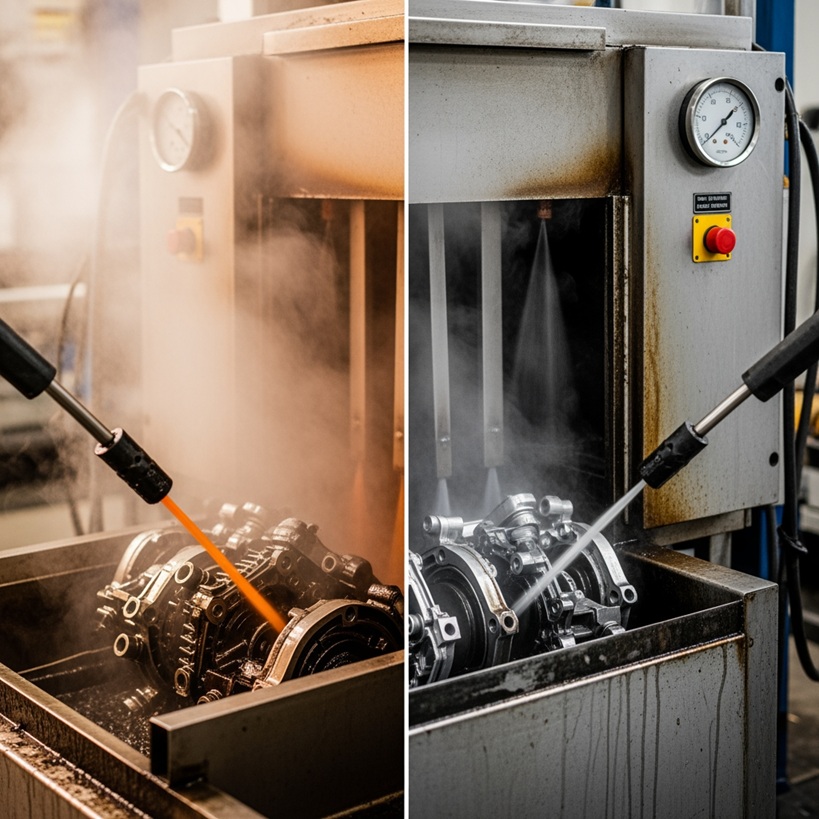
Oil-saturated components create one of the most persistent challenges in industrial maintenance operations. Mining workshops processing drill bits coated in hydraulic fluid, automotive facilities handling engine blocks drenched in motor oil, and manufacturing plants cleaning fabrication components covered in cutting oils all face the same fundamental question: does water temperature actually matter when removing heavy petroleum contamination?
The answer directly impacts cleaning cycle times, labour costs, chemical consumption, and operational efficiency. A mining operation running three shifts might process 200 contaminated components daily. If each part requires an additional 15 minutes of manual scrubbing due to inadequate cleaning temperature, that operation loses 50 labour hours weekly to a problem that proper equipment selection could eliminate. For maintenance supervisors and operations managers evaluating hot water parts washer options, understanding the science behind temperature-based cleaning determines whether an investment delivers genuine ROI or simply replaces one inefficiency with another.
The Chemistry Behind Temperature-Based Oil Removal
Petroleum-based contamination adheres to metal surfaces through molecular attraction and surface tension. Cold water cleaning attempts to overcome these forces through mechanical action alone – pressure, agitation, and chemical surfactants that break surface tension. This approach works adequately for light contamination like dust or water-soluble residues, but struggles against the molecular bonds that secure heavy oils, greases, and hydraulic fluids to component surfaces.
Hot water fundamentally changes this equation. Heating water to 60-80°C reduces oil viscosity by 60-70%, transforming thick, adhesive contamination into fluid material that flows away from surfaces rather than clinging stubbornly. The elevated temperature accelerates chemical reaction rates, allowing alkaline cleaning solutions to saponify oils – converting them into water-soluble soaps – three to four times faster than the same chemistry at ambient temperature.
This isn’t theoretical chemistry. A workshop cleaning excavator hydraulic components with cold water might achieve 70% contamination removal after a 20-minute cycle. The same components in a heavy duty parts washer operating at 75°C reach 95% removal in 8-12 minutes. The difference between these outcomes isn’t marginal – it’s the distinction between components that require additional manual cleaning and parts that emerge genuinely ready for inspection and reassembly.
Measurable Performance Differences Across Contamination Types
Different petroleum products respond differently to temperature-based cleaning, and understanding these variations helps operations managers match equipment specifications to actual contamination challenges.
Light Machine Oils (Spindle Oils, Hydraulic Fluids)
These low-viscosity oils present the easiest cleaning challenge. Cold water systems with adequate pressure (1000-1500 PSI) and appropriate detergents remove 80-85% of light oil contamination. Hot water parts washer systems improve this to 95-98% removal while reducing cycle time by 40-50%. For workshops primarily handling light contamination, the productivity gain matters more than the cleaning quality improvement – both approaches eventually get parts clean, but hot water does it in half the time.
Medium-Viscosity Lubricants (Motor Oils, Gear Oils)
This category represents the majority of automotive and light industrial contamination. Cold water cleaning struggles here, typically achieving 60-70% removal even with extended cycles and aggressive detergents. Operators often resort to pre-soaking or manual scrubbing to supplement mechanical cleaning. Heated parts cleaning systems operating at 70-80°C consistently deliver 90-95% removal without pre-treatment, eliminating the labour waste that makes cold water cleaning deceptively expensive despite lower equipment costs.
Heavy Greases and Thick Lubricants
Mining operations, heavy equipment maintenance, and industrial gearbox servicing encounter contamination that cold water simply cannot remove effectively. Thick bearing greases, assembly lubricants, and cold-weather hydraulics require thermal energy to become fluid enough for mechanical removal. A super heavy duty parts washer with 80-85°C operating temperature and high-pressure spray arms removes 85-90% of heavy grease contamination in a single cycle. Cold water alternatives might achieve 40-50% removal, leaving components that still require extensive manual cleaning.
Carbonised Oils and Baked-On Residues
Engine components, exhaust system parts, and manufacturing equipment exposed to high temperatures develop carbonised oil deposits that bond chemically to metal surfaces. These deposits require either aggressive solvents (with associated safety and environmental concerns) or thermal cleaning combined with alkaline chemistry. Hot tank systems operating at 80-95°C with extended immersion times break down carbonised deposits that cold water cannot touch. For operations dealing with baked-on contamination, cold water isn’t simply less efficient – it’s functionally inadequate regardless of cycle time or chemical concentration.
Operational Efficiency and Labour Cost Analysis
The true cost difference between hot and cold water cleaning emerges in labour requirements rather than equipment purchase price. A cold water spray washer might cost 30-40% less than a heated equivalent, creating apparent savings that disappear when operational costs are properly analysed.
Consider a mid-sized mining workshop cleaning 40 components daily – drill bits, bucket teeth, hydraulic cylinders, and drive components. Using cold water equipment, operators load parts, run a 15-minute cycle, and discover that 60-70% of components require additional manual attention. Two workers spend 3-4 hours daily scrubbing parts that the washer couldn’t fully clean, representing 6-8 labour hours at $35-45/hour, including overhead – roughly $250-360 in daily labour waste.
The same operation using heated parts cleaning systems runs 10-minute cycles that deliver 90-95% cleaning effectiveness. Post-wash manual intervention drops to 10-15 minutes daily for particularly stubborn contamination. Labour waste decreases from 6-8 hours to 0.25 hours, saving $220-340 daily. At $1,100-1,700 weekly savings, the equipment cost premium recovers in 8-16 weeks, depending on system capacity.
This analysis assumes consistent contamination levels. Operations facing variable contamination – light oils some days, heavy greases others – see even greater benefits from hot water systems because the equipment handles the full contamination spectrum without process changes. Cold water systems that work adequately for light contamination fail completely when heavy grease appears, forcing workers to develop workarounds that waste time and compromise cleaning quality.
Energy Consumption and Operating Cost Reality
The most common objection to hot water parts washing centres on energy costs. Heating water requires energy, and operations managers reasonably question whether cleaning efficiency gains justify the ongoing expense.
Modern hot blaster systems with insulated tanks and efficient heating elements typically consume 15-25 kWh daily in continuous-use environments. At $0.25-0.30/kWh (typical Australian industrial rates), this represents $3.75-7.50 in daily energy costs. However, this calculation ignores offsetting factors that reduce net operating costs.
Hot water parts washer systems require 40-60% less cleaning chemistry per component because elevated temperature improves detergent effectiveness. A workshop using 200L of cleaning solution weekly in a cold water system might use 80-120L in a hot water equivalent, saving $30-50 weekly on chemical costs. Water consumption also decreases because shorter cycle times mean less total spray time per component.
The labour savings dwarf these considerations. Even conservative estimates show hot water cleaning reducing manual scrubbing by 4-6 hours daily in a busy workshop. The $140-270 daily labour savings make the $4-8 energy cost essentially irrelevant – operations achieve 20:1 to 40:1 return on the incremental energy expense.
For operations running single-shift schedules with moderate throughput, the calculation becomes tighter. A small automotive workshop cleaning 10-15 components daily might save only 45-60 minutes of manual labour, worth $25-40. Energy costs of $3-5 daily reduce net savings to $20-35, extending payback periods but still delivering positive ROI over equipment lifespan.
Application-Specific Temperature Requirements
Not all oil-contaminated components require maximum temperature cleaning. Understanding application-specific requirements prevents over-specification while ensuring adequate performance.
Automotive and Light Equipment (60-70°C)
Standard motor oils, transmission fluids, and differential lubricants respond well to moderate temperatures. Manual parts washers operating at 65-70°C provide excellent results for automotive service centres, light equipment maintenance, and general mechanical workshops. These systems balance cleaning effectiveness with moderate energy consumption, making them cost-effective for operations handling primarily light-to-medium contamination.
Mining and Heavy Equipment (70-80°C)
Drill bits, bucket teeth, track components, and heavy equipment parts encounter extreme contamination – combinations of hydraulic fluid, gear oil, heavy grease, and abrasive material like coal dust or ore. This environment demands 75-80°C operating temperature to ensure single-cycle cleaning of the full contamination spectrum. Operations attempting to economise with lower-temperature equipment discover that apparent savings evaporate in manual cleaning labour.
Oil and Gas Industry (80-90°C)
Valves, wellhead components, and drilling equipment face crude oil, drilling mud, and specialised lubricants that require maximum thermal energy for effective removal. Extra heavy duty systems operating at 80-85°C provide the thermal power necessary for this contamination level. The combination of high temperature, aggressive alkaline chemistry, and high-pressure spray (1500-2000 PSI) removes contamination that defeats lower-specification equipment.
Food Processing and Commercial Kitchens (75-85°C)
Animal fats, vegetable oils, and food processing lubricants require both high temperature for oil removal and sanitation-level heating for bacterial control. Stainless steel parts washers operating at 80-85°C meet both requirements, providing thermal cleaning that removes oil-based contamination while achieving temperature-time combinations that satisfy food safety standards.
Cold Water Applications That Actually Work
Despite hot water’s clear advantages for oil removal, certain applications legitimately favour cold water cleaning. Understanding these scenarios prevents unnecessary equipment costs while ensuring appropriate specifications for actual operational needs.
Water-Soluble Contamination
Components contaminated with water-based coolants, salt spray, or dust don’t benefit from elevated temperature. Cold water with appropriate pressure and detergents removes these materials effectively. Workshops primarily handling this contamination type shouldn’t pay for heating capacity they don’t need.
Aluminium and Soft Metal Components
Some aluminium alloys and soft metals develop surface discolouration or oxidation when exposed to hot alkaline solutions. These materials require cold water cleaning with neutral pH detergents to prevent cosmetic damage. Operations cleaning aerospace components, electronics housings, or precision aluminium parts often specify cold water systems despite the oil removal limitations.
Temperature-Sensitive Assemblies
Components containing rubber seals, plastic bushings, or adhesive-bonded assemblies may suffer damage from hot water exposure. These parts require cold water cleaning regardless of contamination type. However, operations dealing with both temperature-sensitive assemblies and heavy oil contamination often maintain separate cleaning systems – cold water for sensitive components, heated parts cleaning systems for heavy-duty applications.
Budget-Constrained Operations
Small workshops with minimal throughput and tight capital budgets sometimes choose cold water operation, accepting longer cleaning times and manual scrubbing requirements to minimise initial investment. This represents a conscious trade-off between capital cost and operational efficiency rather than a technically optimal solution.
Long-Term Reliability and Maintenance Considerations
Hot water parts washer systems face harsher operating conditions than cold water equivalents, raising legitimate questions about maintenance requirements and equipment longevity. Heating elements, insulated tanks, and elevated temperatures create additional maintenance considerations that operations managers must factor into the total cost of ownership.
Quality systems built to Australian standards with heavy-gauge stainless steel or powder-coated construction typically require minimal maintenance beyond routine tasks. Annual heating element inspection, quarterly pump seal checks, and regular cleaning solution monitoring represent standard maintenance protocols. Well-maintained heated parts cleaning systems routinely deliver 15-20 years of service in demanding industrial environments.
The critical factor isn’t whether hot water systems require more maintenance than cold water alternatives – they do – but whether the incremental maintenance burden justifies the operational benefits. A system saving 5-6 labour hours daily justifies annual heating element replacement costing $400-600. The labour savings in a single week exceed the annual maintenance premium.
Component quality matters significantly in hot water applications. Heating elements rated for continuous industrial use, corrosion-resistant pump housings, and properly insulated tanks prevent the premature failures that plague under-specified equipment. Operations managers evaluating systems should prioritise construction quality and component ratings over purchase price alone – a system that fails after three years delivers worse total cost of ownership than a properly specified unit that runs for 15 years despite higher initial cost.
Making the Specification Decision
Operations managers evaluating cleaning equipment face a straightforward decision framework based on contamination type, throughput requirements, and labour costs.
Choose hot water cleaning when:
- Processing 15+ oil-contaminated components daily
- Handling medium-to-heavy petroleum contamination (gear oils, greases, hydraulics)
- Labour costs exceed $30/hour, including overhead
- Single-cycle cleaning eliminates bottlenecks in the maintenance workflow
- Components require consistent cleaning quality for inspection or reassembly
Cold water remains appropriate when:
- Processing primarily water-soluble contamination
- Handling fewer than 10 components daily with light oil contamination
- Cleaning temperature-sensitive materials (certain aluminium alloys, assemblies with rubber components)
- Capital budget constraints outweigh operational efficiency considerations
- Manual cleaning labour is readily available and inexpensive
Heavy-duty specifications become essential when:
- Operating in mining, oil and gas, or heavy industrial environments
- Processing components with baked-on or carbonised oil deposits
- Requiring sanitation-level cleaning for food processing applications
- Handling variable contamination that includes heavy greases and thick lubricants
The decision rarely hinges on marginal factors. Most operations face contamination that clearly demands hot water cleaning, or alternatively, handle contamination types that don’t justify the capability. Operations falling in the middle – moderate contamination, modest throughput, cost-sensitive environments – benefit from calculating actual labour waste under current processes before making specification decisions.
Conclusion
Hot water cleaning delivers measurably superior performance, removing oil-saturated contamination from industrial components. The 60-70% improvement in cleaning effectiveness and 40-50% reduction in cycle time translate directly to labour savings that dwarf incremental equipment and operating costs. For mining operations, heavy equipment maintenance facilities, and industrial workshops processing medium-to-heavy petroleum contamination, hot water parts washer systems represent the only specification that eliminates manual cleaning labour while delivering consistent results.
The temperature advantage isn’t subtle or marginal – it’s the difference between components that emerge ready for inspection and parts that still require manual scrubbing. Operations attempting to economise with cold water equipment discover that apparent savings disappear in labour waste, extended cycle times, and cleaning quality inconsistency. Hotwash Australia manufactures heated parts cleaning systems engineered for Australian industrial conditions, with heavy-duty construction that delivers 15-20 years of reliable service in demanding mining and manufacturing environments.
Maintenance supervisors and operations managers evaluating cleaning equipment should calculate current labour waste from manual scrubbing and inadequate cleaning cycles. The resulting figures typically justify hot water specification within 8-16 weeks of operation. For operations ready to eliminate manual cleaning labour and achieve consistent single-cycle results, contact us to discuss system specifications matched to actual contamination challenges and throughput requirements.

Leave A Comment