
Gearbox failures cost Australian mining operations an average of $15,000 per hour in lost production, yet 70% of premature gearbox failures stem from a single preventable cause – contamination introduced during the rebuild process itself. A microscopic metal particle smaller than a grain of salt can cascade into catastrophic bearing failure within weeks of reassembly.
The paradox facing maintenance teams is stark: the rebuild intended to extend equipment life often introduces the very contaminants that guarantee premature failure. Traditional cleaning methods – solvent tanks, pressure washers, manual scrubbing – leave behind the invisible particles that destroy precision components. A gearbox housing that appears spotless to the human eye can harbour thousands of abrasive particles in blind holes, threaded passages, and surface irregularities.
Industrial operations across mining, oil and gas, and heavy manufacturing sectors are discovering that Hotwash Australia gearbox rebuild cleaning protocols eliminate contamination at the microscopic level. The difference between a rebuild lasting 18 months and one achieving its full 10-year service life often comes down to cleanliness standards measured in microns, not visible dirt.
Why Standard Cleaning Methods Fail Gearbox Rebuild Standards
Manual cleaning approaches introduce three critical failure modes that undermine rebuild quality. First, solvent cleaning dissolves oils and greases but lacks the mechanical action to dislodge embedded particles from machined surfaces. Metal fragments from bearing races, gear tooth wear, and assembly operations remain pressed into surface irregularities where solvents cannot reach them.
Pressure Washing and Manual Scrubbing Limitations
Second, pressure washing with cold water moves contamination around rather than removing it. Particles dislodge from one area only to settle in blind holes, threaded ports, and internal passages. The high-pressure stream forces contaminants deeper into areas that become impossible to access once the gearbox is partially assembled.
Third, manual scrubbing introduces its own contamination. Rags and brushes shed fibres that embed in oil films. Workshop dust settles on components between cleaning and assembly. Human handling transfers skin oils that attract airborne particles. Each well-intentioned cleaning step adds new contamination sources.
Industry Cleanliness Standards
The automotive industry established decades ago that gearbox components require cleanliness levels comparable to hydraulic systems – typically ISO 16/14/11 or cleaner. Achieving this standard demands controlled processes that remove particles down to 5 microns whilst preventing recontamination. Workshop cleaning methods rarely achieve better than ISO 20/18/15, leaving thousands of failure-inducing particles per millilitre of residual fluid.
Contamination Sources Throughout the Rebuild Process
Gearbox contamination control must address contamination at every stage, starting with disassembly itself. Bearing removal generates metal particles as races are pressed from shafts. Gear pullers score surfaces. Impact tools create microscopic metal fragments. Even careful disassembly produces contamination that immediately begins settling on exposed surfaces.
Inspection and Measurement Issues
Inspection and measurement compound the problem. Micrometres, dial indicators, and measuring tools transfer particles between components. Inspection benches accumulate metal dust from multiple rebuilds. Handling components with shop gloves introduces fibres and abrasive particles embedded in the glove material itself.
Machining and Repair Operations
Machining operations for repair work – resurfacing bearing seats, drilling for helicoil inserts, grinding high spots – generate swarf that penetrates every exposed surface. Cutting fluids carry these particles into threaded holes and internal passages. Standard post-machining cleaning removes visible chips but leaves the microscopic particles that cause bearing failure.
Assembly Environment Contributions
The assembly environment itself contributes contamination. Workshop air contains metal dust from grinding operations, welding fume particles, and general industrial airborne contamination. Components cleaned Monday morning accumulate measurable particle contamination by Tuesday afternoon simply from atmospheric exposure in a typical workshop environment.
Temperature and Agitation: The Science Behind Effective Cleaning
Hot water dissolves and removes contaminants through three mechanisms that cold cleaning cannot replicate. First, elevated temperatures reduce oil viscosity by 50% at 60°C compared to 20°C, allowing contaminated lubricants to drain freely from internal passages. Residual oils that cling stubbornly to surfaces at room temperature flow away readily at proper cleaning temperatures.
Thermal Energy and Surface Tension Benefits
Second, hot water increases the solubility of many contaminants whilst reducing surface tension. This combination allows cleaning solutions to penetrate threaded holes, seal grooves, and bearing pockets that remain contaminated with cold cleaning methods. The thermal energy helps break the molecular bonds between contaminants and metal surfaces.
Third, heated cleaning solutions maintain their effectiveness throughout the cleaning cycle. Cold water rapidly cools when it contacts large metal masses like gearbox housings, reducing cleaning effectiveness within seconds. Hot systems maintain consistent temperature, delivering uniform cleaning across all surfaces.
Mechanical Agitation Through Parts Washers
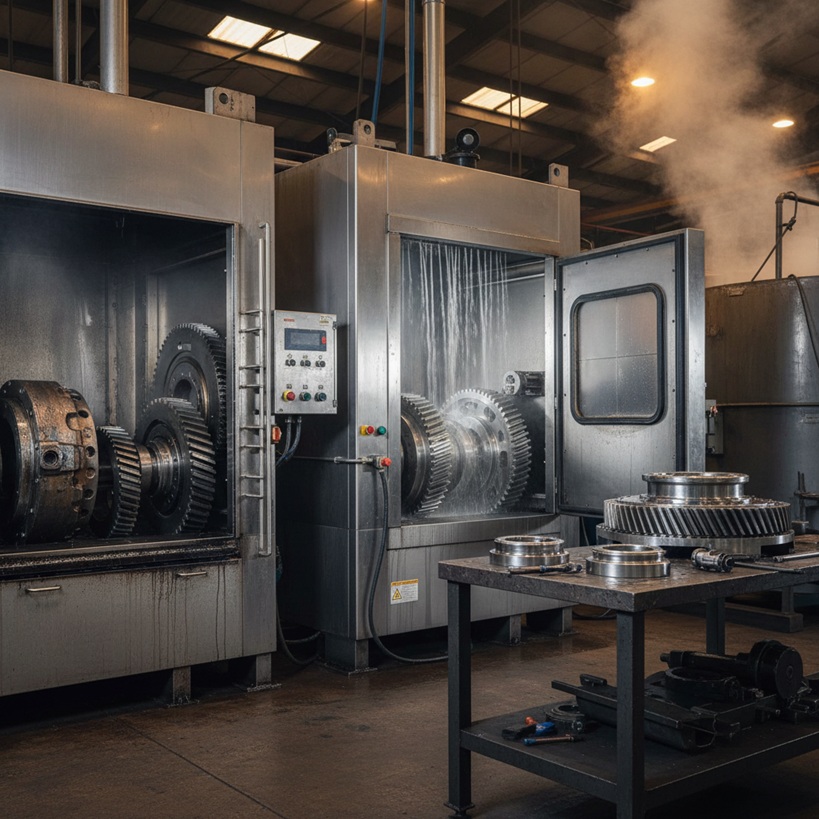
Mechanical agitation through heavy-duty parts washers provides the physical force necessary to dislodge embedded particles. Rotating spray arms deliver high-pressure jets from multiple angles, reaching surfaces that manual cleaning misses. The combination of temperature, pressure, and multi-directional spray creates cleaning forces that manual methods cannot approach.
The spray pattern design determines cleaning effectiveness in complex geometries. Properly engineered systems direct high-pressure streams into blind holes, threaded passages, and internal cavities. The turbulent flow created by spray impact physically lifts particles from surface irregularities where they’ve become embedded through operational wear and handling.
Critical Cleaning Stages for Gearbox Components
Housing preparation requires the most intensive gearbox rebuild cleaning because these large castings contain the most contamination hiding places. Blind holes drilled for dowel pins trap metal particles and machining fluids. Threaded holes for cap screws accumulate swarf from assembly and disassembly. Internal galleries and oil passages harbour sludge and wear particles from the previous service life.
Hot Tank Immersion for Housings
Industrial hot tanks excel at housing cleaning because immersion ensures complete coverage of complex internal geometries. The heated solution penetrates all passages whilst the extended soak time allows chemistry to work on stubborn deposits. Housings emerge with internal passages as clean as external surfaces – a condition impossible to achieve with spray cleaning alone.
Bearing Component Requirements
Bearing components demand absolute cleanliness because even a single abrasive particle can initiate rolling element failure. Bearing races, cages, and rolling elements require cleaning that removes every trace of old lubricant, wear particles, and handling contamination. The cleaning process must avoid introducing new contamination – no rag fibres, no brush bristles, no airborne particles settling during drying.
Gear Cleaning Challenges
Gear cleaning presents unique challenges because tooth profiles contain microscopic surface irregularities that trap contaminants. The root radius between teeth accumulates wear particles and sludge that standard cleaning misses. Gear faces require cleaning that removes all traces of pitting corrosion products without damaging the surface finish that affects contact patterns and noise levels.
Shaft and Critical Surface Cleaning
Shaft cleaning focuses on bearing seats, seal surfaces, and keyways – the critical areas where contamination causes immediate problems. Bearing seats must be completely free of corrosion, old fretting compound, and any particles that would create high spots under the bearing race. Seal surfaces require mirror-smooth cleanliness to prevent leakage that leads to lubricant loss and subsequent failure.
Implementing Contamination Control Protocols
Effective gearbox contamination control starts with segregating rebuild work from general workshop operations. Dedicated cleaning areas prevent cross-contamination from grinding dust, welding fume, and general shop debris. The cleaning zone maintains positive air pressure with filtered air to prevent airborne contamination from settling on cleaned components.
Component Tracking Systems
Component tracking through the cleaning process ensures nothing proceeds to assembly without meeting cleanliness standards. Simple systems – colour-coded bins, dedicated staging areas, physical separation – prevent cleaned components from mixing with uncleaned parts. This seemingly basic control eliminates the common error of assembling one contaminated component into an otherwise clean rebuild.
Extra Heavy-Duty System Capabilities
Extra heavy-duty parts washers handle the largest gearbox housings found in mining and heavy industrial applications. These high-capacity systems process components weighing several hundred kilograms, eliminating the need to clean large housings in sections or resort to manual methods for oversized parts. The ability to clean complete assemblies in one cycle prevents the contamination transfer that occurs when partially cleaned components are handled multiple times.
Drying and Storage Procedures
Drying procedures prevent water spots and flash rusting that compromise cleanliness. Heated air drying at controlled temperatures removes water from all surfaces including internal passages. Components proceed directly from drying to assembly or protective storage, minimising the exposure time during which atmospheric contamination can settle on cleaned surfaces.
Assembly Area Standards
Assembly area cleanliness standards match the component cleanliness achieved through washing. Clean benches with laminar airflow, lint-free gloves, dedicated tools that never leave the clean assembly area – these controls maintain the contamination-free condition through final assembly. The investment in cleaning becomes worthless if assembly reintroduces the contamination that was removed.
Measuring Cleanliness and Validating Results
Visual inspection provides only the crudest assessment of cleanliness. Components that appear spotless to the naked eye often fail particle counting analysis, revealing thousands of contaminants in the critical size ranges that cause bearing failure. Proper validation requires quantitative measurement methods that detect particles down to 5 microns.
Patch Testing Methods
Patch testing offers a practical field method for validating gearbox rebuild cleaning effectiveness. A measured volume of solvent rinses the cleaned component, then filters through a membrane with known pore size. Microscopic examination of the membrane reveals particle count and size distribution. This simple test quantifies cleanliness in ways that visual inspection cannot approach.
Fluid Sampling Validation
Fluid sampling from the first oil fill provides another validation method. Drawing samples after initial fill but before operation allows particle analysis of any contamination remaining in the assembled gearbox. Clean rebuilds show particle counts consistent with new oil from sealed containers. Contaminated rebuilds show elevated counts even before the gearbox runs.
Bearing Inspection at Service Intervals
Bearing inspection at first service interval validates long-term cleanliness standards. Bearings from properly cleaned rebuilds show no unusual wear patterns, no particle indentations in races, no premature fatigue. Contaminated rebuilds reveal characteristic damage – linear scratches from abrasive particles, indentations where particles were overrolled, accelerated fatigue from stress concentrations around embedded contaminants.
ROI Analysis: Cleaning Investment Versus Failure Costs
The economics of proper gearbox contamination control become clear when comparing equipment costs against failure consequences. Super heavy-duty parts washers suitable for large mining gearboxes represent a capital investment of $50,000-$80,000. A single premature gearbox failure in a critical production system costs $200,000-$500,000 when combining replacement parts, emergency labour, and lost production.
Labour Efficiency Improvements
Labour efficiency improvements justify cleaning system investment independent of failure prevention. Manual cleaning of a large gearbox housing requires 6-8 hours of technician time. Automated washing completes the same task in 90 minutes with superior results, freeing skilled technicians for assembly and diagnostic work. The labour savings alone recover equipment costs within 18-24 months for operations maintaining multiple large gearboxes.
Rebuild Consistency Benefits
Rebuild consistency improves when cleaning processes remove human variability. Manual cleaning quality depends on technician skill, fatigue level, time pressure, and individual standards. Automated systems deliver identical cleaning every cycle regardless of external factors. This consistency translates to predictable rebuild life and simplified maintenance planning.
Service Interval Extension
Extended service intervals reduce total maintenance burden when rebuilds achieve their design life. A gearbox properly cleaned during rebuild and reaching 10 years service requires one rebuild per decade. The same gearbox contaminated during rebuild and failing after 18 months requires six rebuilds in the same period – six times the parts cost, six times the labour, six times the production interruption.
Industry-Specific Applications and Requirements
Mining operations face the most demanding gearbox rebuild cleaning challenges due to component size and contamination severity. Haul truck final drives, crusher gearboxes, and conveyor reducers operate in extremely contaminated environments where external contamination adds to internal wear particles. These large components require hot blaster systems that combine high temperature with maximum spray pressure to remove baked-on contamination.
Oil and Gas Applications
Oil and gas applications demand absolute cleanliness because gearbox failures in remote locations create extraordinary costs. Offshore platform gearboxes, pipeline compressor drives, and drilling rig systems cannot tolerate premature failures. The cleaning standards for these rebuilds match aerospace requirements, with particle counts verified through laboratory analysis before components return to service.
Food Processing Facilities
Food processing facilities require stainless steel parts washers for gearbox components in sanitary areas. Mixer drives, conveyor gearboxes, and packaging equipment operate in environments where gearbox contamination control prevents product contamination as well as equipment failure. The cleaning systems themselves must meet sanitation standards whilst delivering the particle removal necessary for reliable gearbox operation.
Heavy Manufacturing Operations
Heavy manufacturing operations benefit from cleaning systems that integrate with production schedules. Automotive plants, steel mills, and fabrication facilities maintain gearbox inventories that rotate through rebuild cycles. Cleaning capacity that matches rebuild throughput prevents bottlenecks whilst maintaining consistent quality standards across all units.
Conclusion: Achieving Rebuild Success Through Contamination Control
Gearbox rebuild cleaning success depends more on contamination control than any other single factor. The microscopic particles that traditional cleaning methods leave behind initiate the wear cascades that lead to premature failure, wasted rebuild investment, and unexpected downtime. Australian operations maintaining critical gearboxes cannot afford the false economy of inadequate cleaning equipment.
The transition from manual cleaning to automated hot washing systems represents a fundamental shift in rebuild quality standards. Operations that implement proper gearbox contamination control protocols achieve rebuild life spans that approach new equipment expectations, eliminate the repeat failures that plague inadequately cleaned rebuilds, and reduce total maintenance burden through extended service intervals.
Hotwash manufactures industrial parts washing systems engineered specifically for the contamination control standards that gearbox rebuilding demands. Australian-built equipment delivers the temperature control, spray pressure, and cleaning capacity necessary for components ranging from small workshop gearboxes to mining equipment weighing hundreds of kilograms.
Contact us to discuss contamination control requirements for gearbox rebuild operations. The engineering team provides application-specific recommendations based on component sizes, contamination types, and throughput requirements. Proper cleaning system selection prevents the premature failures that turn rebuild investments into recurring maintenance burdens.

Leave A Comment