
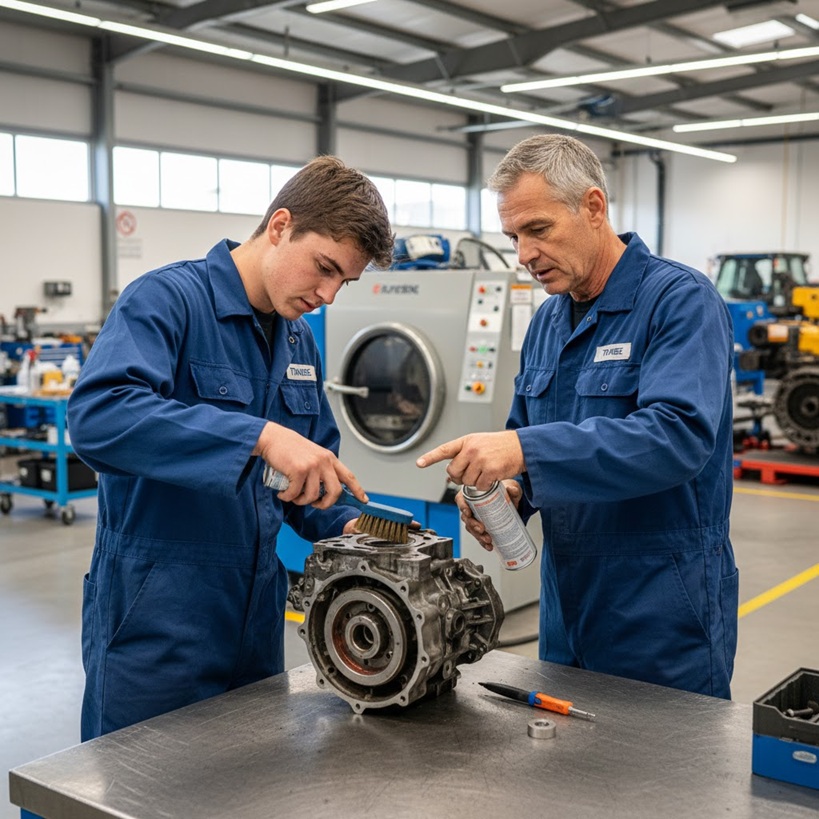
Every apprentice mechanic in an Australian workshop learns the same hard lesson on day one. If you cannot clean parts properly, you cannot work on them properly. This is not about keeping the workshop tidy. It is about teaching fundamental mechanical discipline. This discipline determines whether someone becomes a reliable tradesperson or remains a liability.
We have watched thousands of apprentices transition from school leavers to skilled tradespeople. We see them across mining operations, transport workshops, and manufacturing facilities. The ones who master professional cleaning standards in their first six months consistently outperform those who treat it as grunt work. The difference shows up in diagnostic accuracy. It appears in assembly quality. It is evident in workplace safety records. Proper apprentice workshop training must start with the bucket and brush before it moves to the diagnostic laptop.
Why Cleaning Standards Matter More Than Technical Skills
Workshop managers often make the mistake of rushing apprentices toward technical tasks. They do this before the apprentice understands why cleanliness matters. An apprentice who cannot properly clean a cylinder head will not spot the hairline crack that causes a comeback. One who leaves assembly surfaces contaminated with oil creates warranty failures. These failures cost thousands of dollars.
Professional cleaning teaches observation. An apprentice spends time removing carbon deposits from intake ports. During this process, they learn what normal wear looks like versus abnormal damage. They develop the patience required for precision work. They understand that shortcuts create problems. These problems take ten times longer to fix than doing it right the first time.
Mining operations learned this lesson the expensive way. FIFO maintenance teams found that apprentices who skipped proper parts cleaning missed critical wear indicators. One major Pilbara operation tracked comeback rates. They found apprentices with poor cleaning discipline had 3.2 times more repeat failures in their first two years.
The financial impact extends beyond rework costs. An apprentice might damage a $15,000 turbocharger because they assembled it with contaminated bearings. This does not just cost parts. It costs workshop credibility. It damages customer relationships. Effective skills development programs prioritise these foundational habits over speed.
The Manual Cleaning Foundation Every Apprentice Needs
Before introducing apprentices to automated systems, they need hands-on experience. Manual cleaning builds understanding. They learn what different contaminants are. They see how they behave. They understand what removal actually requires.
Start with basic manual parts washers that use solvent or aqueous cleaning solutions. Parts washers teach apprentices that engine oil behaves differently than gear oil. They learn that carbon deposits require mechanical action. They discover that aluminium needs gentler treatment than cast iron.
The Progression of Cleaning Skills
The typical progression works effectively over eight weeks.
Weeks 1-2: Focus on small components. Have them clean fasteners, brackets, and sensors using a brush and solvent. Focus on complete contaminant removal. Teach proper handling to avoid recontamination.
Weeks 3-4: Move to medium components. Cylinder heads, housings, and covers require disassembly knowledge. Teach them to clean in sequence. Start with external surfaces. Move to internal passages. Finish with threaded holes.
Weeks 5-8: Advance to large assemblies. Engine blocks, transmission cases, and diff housings require effort. Cleaning technique affects inspection quality here. This is where they learn that a clean part reveals its true condition.
Most apprentices resist this phase. They want to start turning spanners. They do not want to scrub parts. Smart workshop managers explain the connection. You cannot torque a head bolt properly if the threads are full of old gasket material. You cannot diagnose a bearing failure if the housing is covered in sludge.
One Perth transport workshop tracks this with photos. Apprentices photograph parts before and after cleaning. After three months, they review the photos together. Apprentices consistently report seeing damage they missed in early attempts.
Transitioning to Automated Systems Without Losing Understanding
Once apprentices understand cleaning, heavy duty parts washers become productivity tools. They are not shortcuts. The key is teaching that automation does not eliminate responsibility. It changes what the apprentice is responsible for.
Loading Technique and Cycle Selection
Parts must be positioned so spray jets reach all surfaces. An apprentice who loads a cylinder head upside down wastes 15 minutes. They get poor results. Teach them to visualise water flow. They must orient parts accordingly.
Different contamination levels need different parameters. Light oil film needs 10 minutes at 60°C. Heavy carbon buildup needs 20 minutes at 80°C. Apprentices must assess contamination severity. They match it to system capability. Using parts washers effectively requires this judgment call.
Quality Verification
The machine does the work. But the apprentice confirms results. Teach them to check internal passages. They must inspect threaded holes and complex geometries. Contamination often hides in these spots. If it is not clean, it goes back in.
This progression prevents a common problem. Apprentices treat automated washers as magic boxes. They load dirty parts and press start. They assume everything comes out perfect. Then they assemble contaminated components. This creates failures.
A Kalgoorlie mining workshop addressed this creatively. They required apprentices to manually clean one identical part whilst the washer cleaned another. They compared results. They discussed why the machine achieved better consistency. This built respect for automation whilst maintaining cleaning knowledge.
Industry-Specific Cleaning Standards Apprentices Must Learn
Different industries have different contamination challenges. Cleanliness requirements vary. Apprentices need to understand these distinctions early in their apprentice workshop training.
Mining and Earthmoving Challenges
Mining involves heavy contamination. Mud, coal dust, and extreme grease buildup are common. Parts often require pre-cleaning. Teach apprentices to remove bulk contamination first. Then use extra heavy duty parts washers for final cleaning.
Transport and Automotive Precision
Automotive work deals with oil, carbon, and coolant. The emphasis is on cleaning internal passages. Cylinder heads, blocks, and fuel system components are critical. Apprentices learn that invisible contamination in oil galleries causes bearing failures.
Food Processing Hygiene
Food processing requires strict hygiene. Stainless steel parts washers are the standard. Apprentices must understand that “clean enough for mechanical work” is not clean enough for food safety. They must learn about bacterial control and surface residues.
Manufacturing and Fabrication
Manufacturing deals with metal fines and cutting fluids. Parts must be clean enough for precision measurement. Teach apprentices that machining debris left in tapped holes strips threads during assembly. Advanced surface preparation using wet abrasive blasters helps prepare fabricated components for coating or welding.
The mistake many workshops make is teaching generic cleaning. An apprentice who learns automotive standards then moves to food processing faces a gap. Better to teach the principles behind different standards. Then they understand why requirements vary.
Common Apprentice Cleaning Mistakes and How to Prevent Them
After training hundreds of apprentices across Australian workshops, certain mistakes appear consistently. Addressing these early prevents bad habits.
Mistake 1: Assuming visual cleanliness equals actual cleanliness. A part can look clean but still have oil film in bearing bores. Solution: Teach the white cloth test. Wipe suspected areas with a clean cloth. Check for contamination transfer.
Mistake 2: Using incorrect cleaning methods. Apprentices often use wire brushes on aluminium. This creates surface damage that looks like corrosion. Solution: Create a materials reference chart. Show appropriate cleaning methods for different alloys.
Mistake 3: Rushing the drying process. Wet parts assembled immediately trap moisture. This causes corrosion. Solution: Establish a drying protocol. Use compressed air for passages. Use clean rags for surfaces. Mandate minimum air-dry time.
Mistake 4: Recontaminating clean parts. Apprentices set clean components on dirty benches. They handle them with contaminated gloves. Solution: Designate clean zones. Require glove changes between dirty and clean work.
Mistake 5: Ignoring safety procedures. Young workers often skip PPE when using solvents. Solution: Make PPE non-negotiable. Explain the long-term health impacts of chemical exposure.
One effective training method involves deliberate failure analysis. Have apprentices incorrectly clean a part. Then assemble and disassemble it. Let them see what contamination does. The lesson sticks when they see bearing damage caused by their own poor cleaning.
Creating Measurable Cleaning Standards for Apprentice Assessment
Vague expectations create inconsistent results. Apprentices need specific standards. They need measurable goals they can achieve and be assessed against.
Cylinder Head Standards
Develop a checklist. All carbon must be removed from combustion chambers. Valve guides and seats must be clean and undamaged. Water passages must be free of scale. Threaded holes must be clean. Gasket surfaces must be flat and free of old material.
Engine Block and Transmission Criteria
For engine blocks, oil passages must be blown clear. Main bearing bores must be clean. Cylinder walls should show visible crosshatch. Hot tanks are often essential for getting blocks to this standard.
For transmission components, all old fluid must be removed. Bearing surfaces must be clean. Valve body passages must be clear. Case machined surfaces must be undamaged.
These standards give apprentices clear targets. They give supervisors objective assessment criteria. This is better than subjective “good enough” judgments. A Welshpool workshop implemented a pass/fail system. Leading hands inspect and rate the cleaning. Failures get documented with photos. After six months, apprentices reduced their failure rate from 40% to under 5%.
The Safety Discipline That Starts with Cleaning Training
Professional cleaning standards connect to workplace safety. Apprentices who learn this connection early develop better awareness.
Chemical exposure represents the most obvious risk. Solvents and caustic cleaners pose health hazards. Teaching proper PPE use during cleaning establishes habits. These transfer to all workshop tasks. An apprentice who wears gloves while cleaning will do the same during welding.
Manual handling injuries often occur during parts cleaning. Heavy components cause back strains. Training apprentices to use hoists and proper lifting technique prevents injuries. Using super heavy duty parts washers with roll-in baskets reduces manual handling risks significantly.
Slip hazards injure more workers than most people realise. Cleaning creates temporary hazards. Apprentices learn they are responsible for managing these risks. This awareness extends to all their work. Environmental responsibility also begins here. Proper disposal of solvents teaches compliance with regulations.
Building Long-Term Professional Habits Through Early Cleaning Discipline
The real value of cleaning training is the professional mindset it develops. Apprentices who learn to clean properly develop habits that define their careers.
Attention to Detail: Cleaning requires noticing small things. The oil film in a bore. The crack in a casting. This observation skill transfers to diagnostics.
Process Discipline: Proper cleaning follows a sequence. Apprentices learn that skipping steps creates problems. This systematic thinking applies to all mechanical work.
Quality Standards: Understanding “properly clean” teaches objective quality. It moves them away from “good enough” judgments.
Problem Prevention: Cleaning teaches that preventing problems is easier than fixing them. This mindset reduces costly mistakes.
Workshop managers report that apprentices with strong cleaning discipline become reliable tradespeople. They handle complex jobs. They train the next generation. Those who never develop it remain stuck on basic tasks.
Integrating Cleaning Standards Into Broader Apprentice Development
Cleaning training should not exist in isolation. Smart workshops integrate it throughout skills development programs.
During disassembly training, teach apprentices to clean components immediately. This reveals wear patterns whilst the assembly sequence is fresh. It prevents parts from sitting dirty for days.
When teaching measurement, emphasise clean surfaces. A micrometer reading on an oily shaft is meaningless. A dial indicator on a contaminated surface gives false readings.
During assembly training, connect cleanliness to torque accuracy. Contaminated threads change friction coefficients. This affects clamping loads. Dirty gasket surfaces leak. Clean assembly prevents comebacks. Surface preparation is key here, often requiring tools like hot blasters to ensure perfect adhesion surfaces. For metal surface preparation, wet abrasive blasters provide excellent results without creating dust hazards that apprentices must learn to manage safely.
As apprentices progress to diagnostic work, remind them of the basics. You cannot identify an oil leak on a dirty engine. You cannot trace coolant contamination without clean samples.
At Hotwash Australia, we understand the importance of building professional cleaning standards from day one. Our equipment is designed to support apprentice development and long-term workshop success.
Conclusion
Teaching apprentices professional cleaning standards is not about grunt work. It is about building the foundation for every skill they will develop. The discipline they learn determines their future reliability.
Australian workshops that invest time in cleaning training see returns. They see lower comeback rates. They see fewer warranty failures. They see better diagnostic accuracy. Apprentices progress faster through their training. Those that rush past it create tradespeople with gaps in understanding.
The transition from manual cleaning to automated systems should enhance capability. It should not replace understanding. When young workers know why proper cleaning matters, they use automated equipment effectively.
Start every apprentice with hands-on cleaning. Establish measurable standards. Connect cleaning discipline to safety. Integrate it throughout their technical training. This approach builds tradespeople who understand professional standards. Cleaning is the most fundamental skill of all.
For more information on implementing professional parts cleaning systems for training environments, contact our apprentice training support team or email us on sales@hotwash.com.au to discuss your workshop requirements.

Leave A Comment