
When a police car breaks down during a pursuit, the consequences are severe. When a fire truck fails to start during a structure fire, property and lives are at risk. When an ambulance cannot reach a cardiac arrest patient, seconds determine survival. Maintenance failures in these sectors cost lives.
Emergency services fleets operate under conditions that destroy civilian vehicles within months. Twenty-four-hour operations, aggressive driving, and extreme loads create immense stress on mechanical components. Zero-tolerance reliability requirements demand maintenance standards that go far beyond standard workshop practices.
Western Australia’s emergency services cover 2.6 million square kilometres. This is the largest operational area of any emergency services network in Australia. Police vehicles accumulate 40,000 to 60,000 kilometres annually compared to 15,000 for civilian vehicles. Fire trucks carry 4,000 litres of water plus equipment weighing up to 15 tonnes.
Standard maintenance schedules do not apply here. Standard parts washers do not cut it either.
The Hidden Cost of Emergency Vehicle Downtime
Every emergency vehicle removed from service creates operational gaps. These gaps ripple through entire regions. When a police vehicle requires unscheduled maintenance, officers must share vehicles. This reduces patrol coverage. Alternatively, overtime costs escalate as replacement vehicles are sourced from other stations.
Fire and Rescue agencies report that unscheduled maintenance events cost significantly more than planned maintenance. The multiplier is often more than triple the standard cost. This factors in overtime, vehicle transfers, and operational disruption.
Operational Disruption and Coverage Gaps
The financial impact extends beyond direct repair bills. A single ambulance out of service in regional Western Australia can increase response times by 15 to 30 minutes. This delay is critical for communities relying on that specific vehicle.
Police pursuits abandoned due to mechanical failure allow offenders to escape. They often reoffend, creating further community risk. Fire trucks that cannot respond force mutual aid requests from neighbouring brigades. This leaves their primary areas under-protected.
Financial Impact of Unscheduled Repairs
Maintenance reliability directly impacts community safety. Emergency services fleet managers face a challenge civilian workshop managers never encounter. Their maintenance failures make news headlines.
This reality drives strict standards. Managers must prioritise critical equipment reliability over simple cost minimisation. Investing in the right maintenance infrastructure prevents these expensive failures.
Contamination Challenges Unique to Emergency Fleets
Emergency vehicles accumulate contamination that civilian vehicles never encounter. Police vehicles transport arrestees who may have vomited, bled, or urinated in rear compartments. Steering wheels, door handles, and communication equipment become contaminated with bodily fluids.
Fire trucks return from structure fires coated in soot. This soot is carcinogenic and contains benzene, formaldehyde, and polycyclic aromatic hydrocarbons. Surface contamination on external components often requires specialised removal methods. Wet abrasive blasters effectively remove toxic residues from chassis components and external surfaces without spreading contamination through the workshop.
Ambulances carry infectious disease risks ranging from tuberculosis to hepatitis C. The diversity of contamination types demands multiple cleaning approaches.
Biohazard Risks in Police and Ambulance Vehicles
Standard workshop cleaning methods do not address these contamination levels. Mechanics working on emergency vehicles face occupational health risks. They require proper decontamination protocols.
Parts removed from emergency vehicles carry contamination. Manual scrubbing often spreads this rather than removing it. Workshop safety depends on cleaning systems that eliminate biological and chemical contamination before mechanics handle components.
Stainless steel parts washers are essential here. They allow for the use of aggressive detergents and high temperatures to ensure hygiene. This is vital for maintaining infection control standards in ambulance workshops.
Carcinogenic Exposure in Fire Trucks
Fire truck maintenance involves handling components coated in toxic residues. Manual cleaning exposes mechanics to these carcinogens through skin contact and inhalation.
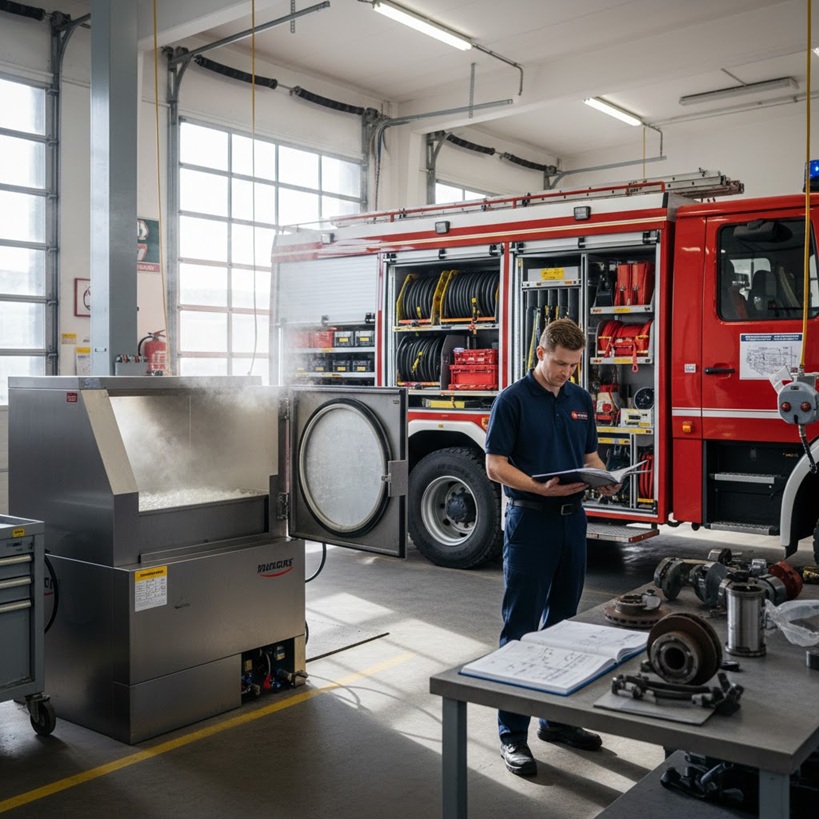
Hotwash Australia provides equipment designed to address this challenge. High-temperature water combined with biodegradable detergent kills pathogens. It also removes carbon deposits and toxic soot. The enclosed cleaning process prevents cross-contamination.
For external chassis components heavily contaminated with carcinogenic soot, wet abrasive blasters provide a safer alternative to manual scraping. The water containment system prevents airborne particles that manual methods create. For workshops maintaining vehicles with health risks, automated washing is a compliance necessity.
Accelerated Wear Patterns in Emergency Service Vehicles
Police vehicles experience brake system wear rates 300% to 400% higher than civilian vehicles. This is due to aggressive driving during pursuits and rapid response calls. Fire trucks operate braking systems while carrying maximum loads. This generates intense heat that degrades components rapidly.
Brake System Degradation
Suspension components also wear at accelerated rates. Police vehicles regularly mount kerbs during operations. Fire trucks navigate unpaved access roads to reach rural properties. Ambulances access construction sites and farm properties where roads do not exist.
Standard suspension service intervals do not account for these conditions. Components typically serviced at 40,000 kilometres require inspection every 10,000 to 15,000 kilometres in emergency fleets. This frequency generates parts volumes that overwhelm manual cleaning capacity.
Engine Idle Time and Oil Contamination
Engine oil contamination occurs faster in emergency vehicles due to extended idling. Police vehicles idle for hours during surveillance. Fire trucks run pumps while stationary. Ambulances idle with climate control running for patient comfort.
This operating pattern creates carbon buildup in intake systems and exhaust gas recirculation (EGR) valves. Civilian vehicles rarely experience this level of accumulation. Emergency fleet maintenance requires cleaning systems that can remove heavy carbon deposits efficiently.
Temperature and Pressure Requirements for Critical Components
Brake callipers removed from police vehicles after pursuit driving contain baked-on carbon deposits. Temperatures can exceed 400°C during operation. Manual scrubbing does not remove these deposits effectively.
Restoring Brake Callipers and Components
Heavy duty cleaning is required. Heavy duty parts washers use high-pressure spray and heated water. This combination removes deposits that manual methods cannot touch.
The machine does the scrubbing while the mechanic stays productive. This ensures brake components are perfectly clean for inspection. Visual inspection is critical to identify heat cracks or fatigue in these high-stress parts.
Maintaining Fire Truck Pump Performance
Fire truck pump components require absolute cleanliness. Debris or contamination in pump housings reduces performance. When lives depend on water delivery, flow rates and pressure capacity must be maintained.
Standard cold-water washing does not remove mineral deposits or carbon contamination effectively. Temperature matters. Hot water dissolves grease and oil that cold water just moves around. Hot blasters can also be effective for surface restoration on external pump housings and valves.
Wet abrasive blasters excel at removing scale buildup and corrosion from pump components without damaging precision surfaces. This combination of cleaning technologies ensures fire truck reliability.
Compliance Standards for Emergency Vehicle Maintenance
Australian Standard AS 2896 covers Emergency Warning Lights. It requires maintenance documentation proving electrical systems meet specifications. This requires clean electrical connections and components.
Electrical System Documentation (AS 2896)
Corrosion or contamination that obscures inspection points creates compliance failures. Parts washing ensures components meet the visual inspection requirements that compliance demands.
Fire truck maintenance follows National Fire Protection Association (NFPA) standards. This requires annual pump testing and component inspection. Pump housings must be disassembled and inspected for wear. Clean components allow for accurate wear measurement and torque specification adherence.
Infection Control Protocols
Ambulance infection control protocols are strict. Stretcher mounting hardware and interior panels require decontamination. Standard workshop cleaning does not meet these standards.
Automated parts washing provides the decontamination level healthcare standards require. It removes infectious disease risks from mounting points and mechanical components. This protects both the patient and the paramedic.
Workflow Efficiency in High-Volume Emergency Workshops
Emergency services workshops maintain hundreds of vehicles on compressed schedules. Western Australia Police Force operates more than 1,500 vehicles. Fire and Emergency Services WA maintains over 500 trucks. St John Ambulance WA operates hundreds of ambulances.
These fleets generate parts cleaning volumes that manual methods cannot handle. Workshop productivity depends on eliminating bottlenecks.
Managing Compressed Maintenance Schedules
When brake service requires 90 minutes of manual cleaning, it becomes a constraint. Mechanics cannot inspect and reassemble components until they are clean. This limits workshop throughput.
Extra heavy duty parts washers process multiple brake assemblies simultaneously. This eliminates the cleaning bottleneck. It ensures vehicles return to service within defined timeframes.
Labour Cost Savings Through Automation
The labour cost equation changes in emergency services workshops. Mechanics are highly skilled and costly. Spending hours manually cleaning pump components is a waste of resources.
An automated parts washer completes the same cleaning in 20 minutes. The cost is a fraction of manual labour. The savings compound across hundreds of maintenance events annually. More importantly, it ensures critical equipment reliability by adhering to consistent cleaning standards.
Occupational Health Standards in Emergency Vehicle Workshops
Mechanics working on emergency vehicles face exposure risks. Fire truck contamination includes carcinogenic compounds. Studies link firefighter cancer rates to contamination exposure, including vehicle maintenance activities.
Reducing Chemical and Toxin Exposure
Manual parts cleaning creates exposure pathways. Scrubbing contaminated components by hand creates aerosols. This spreads contamination throughout the workshop.
Enclosed hot tanks contain contamination during cleaning. They prevent the exposure that manual methods create. This protects the respiratory health of workshop staff.
Preventing Repetitive Strain Injuries
Repetitive strain injuries from manual scrubbing affect mechanics. Brush scrubbing creates hand and wrist strain that accumulates over years.
Automated parts washing eliminates this repetitive motion exposure. It reduces workplace injury rates while improving cleaning consistency. The mechanic loads parts, starts the cycle, and returns to find cleaned components ready for inspection.
Selecting the Right Equipment for Emergency Fleets
Emergency services workshops cannot afford equipment that breaks down. When the parts washer fails, productivity collapses. Australian-built equipment backed by local service support is essential.
Heavy Duty Capabilities for Fire Trucks
Fire trucks require large-capacity machines. Components are heavy and bulky. Super heavy duty parts washers handle the parts volumes major metropolitan workshops generate. They are built to withstand the weight of large pump housings and transmission parts.
Stainless Steel for Hygiene and Durability
Stainless steel models meet hygiene requirements for ambulance workshops. They resist corrosion from aggressive cleaning chemicals. This ensures the machine remains hygienic over its lifespan.
Rugged construction handles continuous operation. Australian manufacturers understand the conditions emergency services face. Same-day parts dispatch keeps equipment running. Local technicians understand the urgency of emergency services requirements.
For smaller components or specific detailed cleaning, manual parts washers can still play a role, provided they are used safely and for appropriate tasks.
Case Study: Perth Fire Station Workshop Efficiency
A Perth metropolitan fire station workshop maintained 45 fire trucks. Mechanics spent hours weekly manually scrubbing pump components and chassis parts. This represented weeks of productive time lost annually per mechanic.
The workshop installed a heavy-duty parts washer. Pump housings that required 90 minutes of manual scrubbing were cleaned in 18 minutes. Brake callipers took 12 minutes instead of 45.
The productivity impact was immediate. Mechanics spent time diagnosing and repairing rather than scrubbing. Annual labour savings were significant. Vehicle turnaround times improved, and fleet availability increased. The safety impact was equally important, with reduced contact with carcinogenic soot.
Conclusion
Emergency services exist to respond when communities need help. Every vehicle in the workshop is a vehicle that cannot respond to emergencies. Maintenance efficiency directly impacts community protection.
Parts cleaning represents a significant portion of maintenance time. Eliminating cleaning bottlenecks reduces overall maintenance time. This returns vehicles to service faster.
Emergency vehicle maintenance demands standards that protect both mechanics and communities. Cleaning systems must eliminate contamination exposure and ensure critical equipment reliability. Manual cleaning methods worked when fleets were smaller. Modern operations require cleaning technology that matches operational intensity.
Workshop managers responsible for emergency services fleets face unique challenges. Reach out to our emergency fleet equipment experts or email us on sales@hotwash.com.au to explore systems designed for workshops where downtime is not an option.

Leave A Comment