
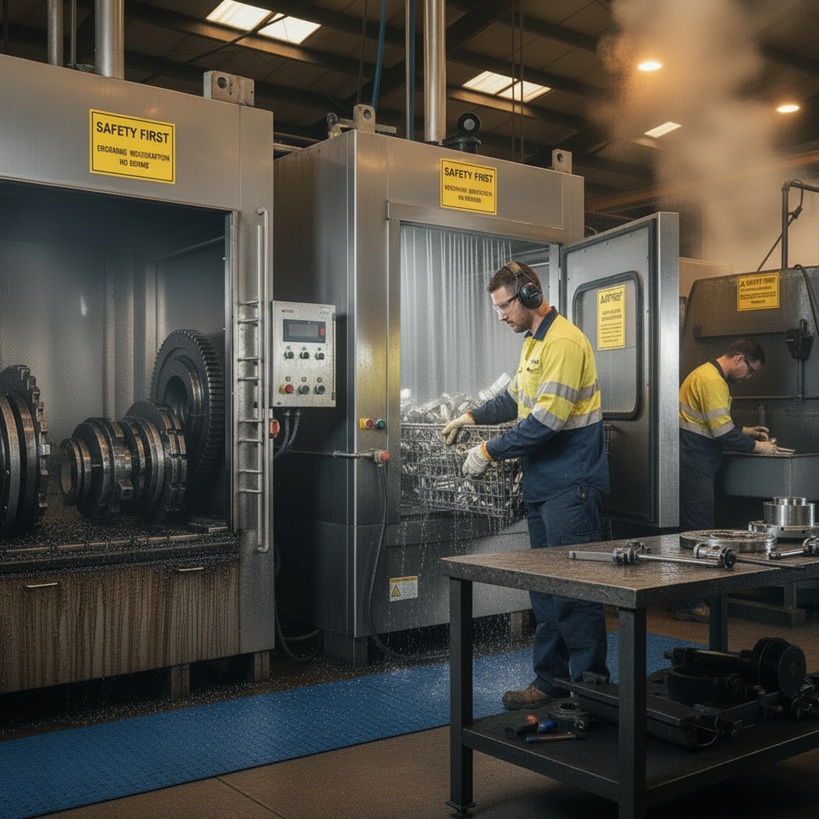
Manual scrubbing of industrial parts creates a silent epidemic in Australian workshops – musculoskeletal disorders that develop gradually, often going unnoticed until workers face chronic pain, reduced mobility, and long-term disability. Workshop managers across mining, manufacturing, and automotive sectors report rising workers’ compensation claims linked to repetitive manual cleaning tasks, with the financial and human costs mounting each year.
The physical demands of manual parts washing – sustained awkward postures, repetitive scrubbing motions, forceful gripping, and prolonged standing – create the perfect conditions for musculoskeletal injuries. A maintenance worker manually cleaning heavy equipment components might spend 3-4 hours daily in bent positions, applying significant force to remove hardened grease and contaminants. These cumulative exposures don’t cause immediate injury, but over months and years, they damage soft tissues, joints, and spinal structures.
Workshop injury prevention strategies increasingly focus on eliminating high-risk manual tasks rather than simply training workers to perform them “correctly.” This approach recognises a fundamental truth – no amount of training can make repetitive forceful scrubbing safe when performed daily for years. The solution lies in automated industrial cleaning systems that remove workers from hazardous manual cleaning tasks entirely.
The Biomechanical Reality of Manual Parts Washing
Manual scrubbing of industrial components creates multiple biomechanical risk factors simultaneously. Workers typically adopt forward-bent postures at wash stations, creating sustained loading on the lumbar spine.
Postural Stresses
Research from Safe Work Australia indicates that forward flexion of just 20 degrees increases disc pressure by 30%, and workshop cleaning tasks often require 45-60 degrees of forward bending sustained for extended periods.
Repetitive Motion Risks
The repetitive nature of scrubbing motions compounds these postural stresses. A worker might perform 2,000-3,000 scrubbing strokes per hour when manually cleaning parts, with each stroke requiring forceful grip and shoulder movement. This repetition rate far exceeds ergonomic guidelines for upper limb tasks, particularly when combined with the force requirements for removing baked-on contaminants.
Force application presents another critical risk factor. Removing heavy grease, carbon deposits, or hardened mud requires significant manual force – often 50-80 Newtons of grip force sustained repeatedly. Workers frequently report hand and forearm fatigue, early warning signs of developing musculoskeletal disorders. When fatigue sets in, workers compensate by adjusting postures and movement patterns, often adopting even more hazardous positions to maintain cleaning effectiveness.
Static Standing and Fatigue
The static standing required at manual wash stations creates additional lower limb and back stress. Workers often stand in fixed positions for 1-2 hours continuously, reducing blood flow to lower limbs and increasing spinal loading. Concrete workshop floors compound this issue, offering no shock absorption and increasing fatigue rates.
Common Musculoskeletal Injuries from Manual Cleaning Tasks
Lower Back Disorders
Lower back disorders represent the most prevalent injury category from manual parts washing. The combination of forward bending, twisting to reach different parts, and lifting heavy components creates classic conditions for lumbar disc injury and chronic back pain. Workers’ compensation data shows back injuries account for 35-40% of claims related to manual cleaning tasks, with average time loss exceeding 8 weeks per incident.
Upper Limb Injuries
Shoulder Injuries: Rotator cuff tendinitis and impingement syndrome commonly affect workers who manually clean parts for several years. These conditions typically develop gradually, with workers initially experiencing minor discomfort that progressively worsens until movement becomes severely limited and painful.
Hand and Wrist Disorders: Carpal tunnel syndrome, trigger finger, and tendinitis of the wrist and forearm affect workers who perform intensive manual cleaning daily. These conditions often require surgical intervention and extended recovery periods, with some workers never regaining full hand function.
Neck and Knee Problems
Neck and upper back pain results from the sustained forward head posture adopted during detailed cleaning work. Workers lean forward to inspect parts and apply cleaning force, creating sustained loading on cervical and thoracic spinal structures. Chronic neck pain and headaches frequently develop, impacting both work performance and quality of life.
Knee disorders affect workers who kneel or squat to access lower wash station areas or clean large floor-mounted components. Repetitive kneeling creates pressure on knee structures, leading to bursitis and cartilage damage. These injuries prove particularly problematic as they limit mobility both at work and in daily activities.
The Financial Impact of Musculoskeletal Injuries
Direct Workers’ Compensation Costs
Workers’ compensation costs for musculoskeletal disorders significantly impact workshop operations. The average claim for back injury exceeds $45,000 when accounting for medical treatment, wage replacement, and rehabilitation costs. Shoulder injuries average $38,000 per claim, while hand and wrist disorders typically cost $25,000-$30,000. A workshop with 10 manual cleaning staff might face 2-3 musculoskeletal injury claims annually, creating direct costs of $100,000-$150,000.
Indirect Costs
Indirect costs multiply these figures substantially. When an experienced maintenance worker takes medical leave, productivity drops as replacement workers lack the same efficiency and knowledge. Training temporary staff creates additional costs, and work quality often suffers during transition periods. Research suggests indirect costs typically equal 2-4 times the direct workers’ compensation expenses, meaning a $100,000 direct cost actually impacts operations by $300,000-$500,000.
Lost productivity from presenteeism – workers continuing to work while injured or in pain – creates hidden costs that many operations overlook. An injured worker might remain on the job but operate at 60-70% efficiency, taking longer to complete cleaning tasks and potentially making errors in judgment about part cleanliness. This reduced productivity affects downstream operations, potentially causing equipment failures or production delays.
Insurance Premium Increases
Insurance premium increases follow poor injury records. Operations with high musculoskeletal injury rates face workers’ compensation premium increases of 20-40%, creating ongoing financial burdens that persist for years after implementing improvements. These increased premiums represent permanent cost increases until injury rates demonstrate sustained reduction.
Regulatory Requirements and Duty of Care
Hierarchy of Controls
Australian workplace health and safety legislation places clear obligations on employers to eliminate or minimise musculoskeletal injury risks. The hierarchy of controls mandates that elimination of hazards takes priority over all other control measures. This legal framework means that if automated cleaning systems can eliminate manual scrubbing tasks, employers must seriously consider this option rather than relying on training or personal protective equipment.
Legal Obligations
Safe Work Australia’s hazardous manual tasks regulations specifically address repetitive movements, sustained awkward postures, and forceful exertions – the exact risk factors present in manual parts washing. Operations that continue manual cleaning methods face increasing scrutiny during workplace inspections, particularly if workers have reported musculoskeletal symptoms or filed injury claims.
The duty of care extends beyond simply providing equipment – employers must ensure workers aren’t exposed to foreseeable risks. Given the well-documented connection between manual scrubbing and musculoskeletal disorders, operations that fail to implement engineering controls face potential legal liability if workers develop chronic conditions. Recent case law demonstrates courts increasingly expect employers to invest in technology that removes workers from hazardous tasks.
Worker Consultation Requirements
Consultation requirements mean employers must involve workers in identifying musculoskeletal risks and evaluating control measures. Workers performing manual cleaning tasks often provide valuable insights into specific risk factors and can help identify which components create the greatest physical demands. This consultation process frequently reveals that workers have been managing pain and discomfort for extended periods, highlighting the need for intervention.
Automated Parts Washing as Engineering Control
Heavy-duty parts washers eliminate the biomechanical risk factors that cause musculoskeletal injuries in manual cleaning operations. Workers simply load contaminated components into the wash chamber, close the door, and activate the automated cleaning cycle. The system handles all scrubbing action through high-pressure spray arms and heated cleaning solution, removing workers from forceful repetitive tasks entirely.
Biomechanical Risk Elimination
The ergonomic benefits extend beyond eliminating scrubbing motions. Automated systems position wash chambers at appropriate heights, allowing workers to load and unload parts without excessive bending or reaching. Chamber designs accommodate various part sizes and configurations, eliminating the awkward postures required to access all surfaces during manual cleaning. Workers spend minutes loading systems rather than hours manually scrubbing, dramatically reducing cumulative exposure to physical stresses.
Temperature and Safety Advantages
Temperature control in automated systems removes another injury risk – thermal burns from hot cleaning solutions. Manual cleaning often involves heated chemical solutions that create burn risks, particularly when workers rush to meet production schedules. Hotwash Australia manufactures systems that contain all heated solution within sealed chambers, eliminating contact with hot liquids and steam.
Consistency Benefits
The consistency of automated cleaning also prevents the compensatory movements that occur during manual work. When manual cleaning proves ineffective, workers apply more force, adopt more extreme postures, or extend cleaning duration – all responses that increase injury risk. Automated systems deliver consistent results regardless of contamination levels, removing the need for workers to compensate through increased physical effort.
Selecting Appropriate Systems for Workshop Applications
Capacity-Based Selection
Workshop size and parts volume determine appropriate system capacity. Small automotive workshops cleaning 20-30 components daily benefit from manual parts washers that reduce physical demands while fitting space-constrained environments. These systems still eliminate repetitive scrubbing while allowing manual loading and solution agitation, representing practical manual scrubbing alternatives for operations transitioning from purely manual methods.
Medium-sized manufacturing and maintenance operations processing 50-100 components daily require fully automated spray washers with programmable cycles. These systems handle varied part types and contamination levels without worker intervention during cleaning cycles. The time savings prove substantial – a worker might manually clean 8-10 parts per hour, while an automated system processes 15-20 parts hourly while the worker performs other tasks.
Large mining operations and heavy equipment maintenance facilities need extra heavy-duty parts washers designed for intensive continuous use. These systems feature robust construction, high-capacity heating elements, and large wash chambers accommodating substantial components. The investment proves justified through eliminated injury costs and dramatically improved cleaning efficiency.
Contamination-Specific Solutions
Contamination type influences system selection. Operations dealing with heavy grease and oil benefit from hot tank systems that use immersion cleaning for thorough degreasing without physical scrubbing. Components soak in heated solution, allowing chemistry and temperature to dissolve contaminants rather than relying on mechanical action. This approach proves particularly effective for complex geometries where manual scrubbing cannot reach all surfaces.
Operations requiring surface preparation or rust removal consider wet abrasive blasters that combine cleaning with surface treatment. These systems eliminate the manual scraping and wire brushing that create significant hand and arm strain, instead using controlled abrasive media to remove coatings and corrosion.
Implementation Strategy for Injury Prevention
Documentation and Analysis
Successful implementation begins with documenting current injury patterns and identifying high-risk manual tasks. Review workers’ compensation claims, incident reports, and worker-reported discomfort to understand which cleaning tasks create the greatest musculoskeletal stress. This data provides baseline metrics for measuring improvement and justifies equipment investment through documented injury costs.
Staged Implementation
Task analysis identifies which components and cleaning requirements best suit automated processing. Start by automating the highest-volume, most physically demanding tasks – typically cleaning of heavy components requiring sustained forceful scrubbing. This approach delivers immediate workshop injury prevention while allowing workers to adapt to new processes gradually.
Worker training ensures effective system utilisation and reinforces ergonomic benefits. Demonstrate proper loading techniques, explain how automation eliminates injury risks, and encourage workers to report any remaining manual tasks that create physical strain. Workers who understand the injury prevention rationale typically embrace automated systems enthusiastically, having personally experienced the physical demands of manual cleaning.
Monitoring and Continuous Improvement
Monitoring both injury metrics and system utilisation confirms effectiveness. Track musculoskeletal injury reports, workers’ compensation claims, and worker-reported discomfort levels quarterly. Compare these metrics to pre-implementation baselines to quantify injury reduction. Additionally, monitor system usage rates to ensure workers consistently use automated equipment rather than reverting to manual methods for convenience.
Continuous improvement identifies opportunities for further automation. As operations gain experience with initial systems, additional manual tasks become candidates for automation. This staged approach allows operations to build expertise and demonstrate ROI before expanding automated cleaning capacity.
Beyond Injury Prevention – Operational Benefits
Quality and Consistency
Cleaning consistency improves dramatically with automated systems. Manual cleaning quality varies based on worker fatigue, experience, and time pressure. An exhausted worker at the end of a shift delivers inconsistent results compared to fresh morning performance. Automated systems deliver identical cleaning results regardless of time, eliminating quality variation that can cause downstream equipment failures or production issues.
Labour Redeployment
Labour redeployment creates additional value beyond workshop injury prevention. Workers freed from manual scrubbing can focus on skilled maintenance tasks, equipment inspections, or preventive maintenance activities that require human judgment and expertise. This shift from manual labour to skilled work improves job satisfaction while enhancing overall maintenance effectiveness.
Throughput and Efficiency
Cleaning speed increases substantially with automated processing. While a worker manually cleans components, an automated system processes parts continuously. This throughput improvement reduces equipment downtime, allowing faster return to service and supporting production schedules more effectively.
Chemical efficiency improves through controlled solution use and temperature management. Manual washing often involves excessive chemical use as workers add more solution attempting to improve cleaning effectiveness. Automated systems use precise solution volumes at optimal temperatures, reducing chemical costs while improving environmental performance.
Measuring Return on Investment
Capital vs Injury Cost Comparison
Equipment investment costs typically range from $15,000-$80,000 depending on system capacity and features. Compare this capital cost against annual injury expenses – operations spending $100,000-$150,000 annually on musculoskeletal injury claims achieve payback within 12-18 months purely through injury cost reduction.
Combined Savings Analysis
Labour savings accelerate ROI substantially. If automated cleaning frees 2-3 hours daily of worker time previously spent manually scrubbing, this represents $25,000-$40,000 annually in redeployed labour value. Combined with injury cost reduction, total ROI often reaches 6-12 months for operations with significant manual cleaning volumes.
Insurance premium reductions provide ongoing savings after injury rates decline. Operations demonstrating sustained injury reduction through automated systems typically see workers’ compensation premiums decrease 15-25%, creating permanent cost reductions that continue indefinitely.
Productivity improvements from reduced equipment downtime deliver additional value difficult to quantify precisely but significant in impact. Faster parts cleaning supports quicker equipment repairs and maintenance, reducing production delays and improving asset utilisation.
Australian Manufacturing and Support Advantages
Local Design Benefits
Australian-designed and manufactured systems offer advantages for local operations. Equipment built to Australian standards ensures compliance with local electrical and safety requirements without modification. Local engineering means systems suit Australian industrial conditions, including power supply characteristics, water quality, and ambient temperature ranges.
Support and Customisation
Support availability proves critical for maintaining uptime. Locally manufactured equipment ensures parts availability and technical support access without international shipping delays or time zone complications. When a production-critical parts washer requires service, same-day response from Australian support teams minimises downtime impact.
System customisation accommodates specific workshop requirements more readily with local manufacturers. Operations with unique part geometries, contamination types, or space constraints work directly with Australian engineering teams to develop optimal solutions. This collaboration ensures equipment truly fits operational needs rather than forcing operations to adapt to standard imported designs.
Conclusion
Musculoskeletal injuries from manual parts scrubbing create substantial human and financial costs that manual scrubbing alternatives effectively eliminate. The biomechanical stresses inherent in manual cleaning – sustained awkward postures, repetitive forceful movements, and prolonged static standing – cause chronic disorders that develop gradually but impact workers permanently.
Workshop injury prevention strategies that prioritise engineering controls align with both regulatory requirements and sound business practice. Automated parts washing systems remove workers from hazardous tasks entirely, delivering superior results compared to training or administrative controls that attempt to make inherently hazardous tasks safer.
The financial case for automation extends beyond injury cost reduction to include labour redeployment, improved cleaning consistency, increased throughput, and reduced chemical consumption. Operations typically achieve ROI within 6-18 months while creating safer, more efficient maintenance processes.
Australian-manufactured systems deliver the durability, performance, and support required for demanding industrial applications. Purpose-built for mining, manufacturing, and heavy equipment maintenance environments, these systems eliminate the manual scrubbing tasks that cause chronic musculoskeletal disorders while improving operational efficiency.
Workshop managers and operations directors evaluating workshop injury prevention strategies should assess current musculoskeletal injury patterns, quantify associated costs, and compare these expenses against automated cleaning system. The evidence consistently demonstrates that eliminating manual scrubbing through automation delivers both immediate and long-term value while protecting worker health.
Contact us to discuss how automated parts washing systems can eliminate musculoskeletal injury risks while improving cleaning efficiency and operational performance. The team provides detailed application analysis, system recommendations, and ROI projections based on specific parts cleaning requirements and injury prevention objectives.

Leave A Comment