
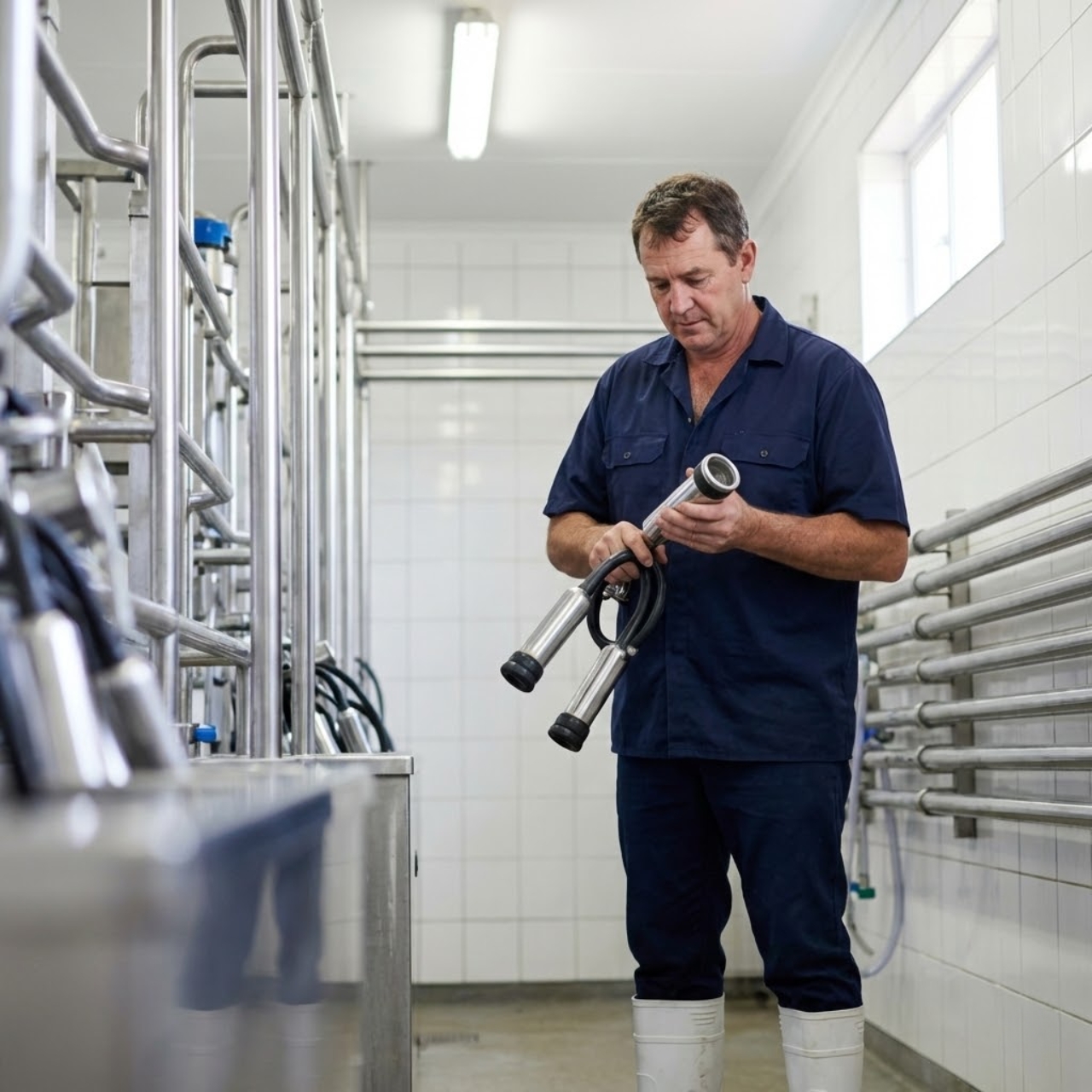
Dairy operations face a unique industrial challenge that few other sectors encounter – equipment must meet stringent food safety standards while enduring the mechanical demands of continuous production cycles. A single milking machine processes hundreds of litres daily, accumulating milk residue, bacterial growth, and mechanical wear simultaneously. The Australian dairy industry’s reputation depends on maintaining both hygiene compliance and operational reliability, yet many farms struggle to achieve both without compromising efficiency.
Traditional cleaning methods force dairy operators to choose between thorough sanitisation and equipment longevity. Manual scrubbing with harsh chemicals achieves hygiene standards but accelerates component degradation. Light cleaning preserves mechanical parts but risks bacterial contamination and regulatory violations. This false choice costs the industry millions annually through equipment replacement, downtime, and potential food safety incidents.
Modern dairy farm equipment cleaning systems eliminate this compromise. Automated stainless steel parts washers deliver pharmaceutical-grade cleanliness whilst protecting precision mechanical components from chemical damage and physical wear. The result transforms dairy operations – consistent food safety compliance cleaning, extended equipment life, and labour reallocation from scrubbing to production management.
Why Dairy Equipment Demands Specialised Cleaning Approaches
Dairy processing equipment presents contamination profiles unlike standard industrial machinery. Milk proteins bond aggressively to stainless steel surfaces, creating biofilm matrices that harbour Listeria monocytogenes, Salmonella, and Staphylococcus aureus. These pathogens multiply rapidly in milk residue, doubling populations every 20 minutes at ambient temperatures. A milking claw inadequately cleaned after morning operations becomes a contamination vector by afternoon milking.
Mechanical complexity compounds the hygiene challenge. Modern milking machines contain precision pulsators, vacuum regulators, and electronic sensors that malfunction when exposed to aggressive cleaning chemicals. Caustic solutions required for protein removal corrode aluminium housings and degrade rubber seals. High-pressure spray that removes stubborn biofilm also forces contaminated water into bearing assemblies and electrical connections.
Temperature sensitivity further complicates cleaning protocols for effective milking system hygiene. Cold water fails to dissolve milk fats, leaving residues that support bacterial growth. Excessive heat denatures proteins into cement-like deposits that require mechanical removal. The optimal cleaning temperature window – 60-70°C for most dairy residues – must be maintained consistently throughout the wash cycle to achieve effective sanitisation without thermal damage to components.
Australian dairy regulations compound these technical challenges. Food Standards Australia New Zealand (FSANZ) mandates specific cleaning validation protocols, requiring farms to demonstrate consistent pathogen elimination. Dairy Food Safety Victoria audits cleaning effectiveness through ATP testing and microbial swabs. Non-compliance triggers production holds, product recalls, and licence suspensions that devastate farm economics, making food safety compliance cleaning essential.
Contamination Risks Specific to Dairy Farm Operations
Milking equipment accumulates contamination layers that manual cleaning rarely fully removes, creating significant challenges for dairy component sanitisation. Milk fat deposits build in pipeline elbows and valve seats, creating anaerobic pockets where Clostridium species proliferate. Protein films on teat cup liners harbour mastitis pathogens that transfer between animals. Mineral scale from hard water reduces flow rates and creates surface irregularities that trap bacteria.
Cream separators present particularly challenging cleaning scenarios. The disc stack assembly contains hundreds of conical plates separated by millimetre gaps. Milk residue trapped between discs requires complete disassembly and individual plate cleaning to prevent rancid fat accumulation. Manual cleaning of a separator stack consumes 90 minutes per cycle – time that delays afternoon milking and extends labour shifts.
Bulk milk tanks combine hygiene and mechanical maintenance challenges in a single critical asset. Internal surfaces must achieve surgical cleanliness to prevent milk spoilage during refrigerated storage. Simultaneously, agitator bearings, temperature sensors, and refrigeration coils require protection from cleaning solution damage. Tank contamination incidents cost farms $5,000-$15,000 per occurrence through milk rejection and regulatory response.
Plate heat exchangers used for milk cooling accumulate biofilm in narrow flow channels that visual inspection cannot detect. These exchangers operate at precise pressure differentials – biofilm accumulation increases backpressure, reducing cooling efficiency and forcing refrigeration systems to work harder. A 2mm biofilm layer reduces heat transfer efficiency by 40%, increasing energy costs whilst creating pathogen reservoirs that compromise agricultural hygiene systems.
How Automated Cleaning Systems Address Dual Requirements
Hotwash systems designed for dairy applications combine food-grade hygiene with mechanical component protection through precision-controlled washing parameters. Programmable temperature profiles maintain optimal cleaning conditions throughout the cycle – initial 65°C rinse removes bulk milk residue, followed by 70°C detergent wash for protein dissolution, then 82°C sanitising rinse for pathogen elimination. Temperature accuracy within ±2°C ensures consistent results without thermal shock to sensitive components.
Spray pressure modulation protects delicate parts whilst achieving thorough dairy farm equipment cleaning. Rotating spray arms deliver 40-60 PSI for general surface cleaning, sufficient to remove milk films without forcing water into sealed bearings. Targeted high-pressure jets at 80-100 PSI direct intense cleaning action at contamination-prone areas – valve seats, pipeline connections, and pump housings – where biofilm typically accumulates.
Stainless steel construction throughout the wash chamber prevents cross-contamination between cleaning cycles. Unlike powder-coated systems where coating chips can harbour bacteria, food-grade 304 stainless steel provides non-porous surfaces that resist bacterial adhesion and withstand repeated sanitiser exposure. Sloped chamber floors and strategically positioned drain points prevent water pooling that could support microbial growth between uses.
Chemical injection systems deliver precise detergent concentrations matched to contamination levels for effective dairy component sanitisation. Dairy-specific alkaline cleaners at 2-3% concentration dissolve milk proteins and fats without excessive caustic strength that damages aluminium and rubber components. Acid descaling cycles at programmed intervals remove mineral deposits before scale buildup affects equipment performance. Rinse cycles between chemical applications prevent residue carryover that could contaminate subsequent milk production.
Protecting Sensitive Dairy Equipment Components During Cleaning
Milking machine pulsators contain precision rubber diaphragms that regulate vacuum cycling for gentle milk extraction. These diaphragms degrade rapidly when exposed to petroleum-based solvents or excessive alkalinity. Automated parts washing systems use pH-neutral surfactants for initial cleaning, reserving alkaline detergents for final sanitisation cycles. This staged approach removes contamination whilst preserving rubber elasticity and diaphragm lifespan, supporting milking system hygiene without component damage.
Electronic milk meters and conductivity sensors require cleaning protocols that prevent water ingress into sealed housings. Heavy-duty parts washers accommodate these components through adjustable spray patterns that direct cleaning action at external surfaces whilst avoiding direct spray on electrical connections. Controlled spray angles and pressure settings clean sensor housings thoroughly without compromising waterproof seals.
Vacuum pump components present particular cleaning challenges – oil contamination from pump lubricants combines with milk residue to create stubborn deposits. Hot water alone proves ineffective; petroleum solvents clean thoroughly but leave residues that contaminate subsequent milk contact. Automated systems resolve this through heated alkaline detergent cycles that emulsify both milk fats and petroleum oils, followed by multiple rinse stages that eliminate all chemical residues.
Stainless steel pipeline sections require internal and external cleaning to maintain both hygiene and appearance. External surfaces accumulate dust and environmental contamination that harbours mould spores. Internal surfaces develop milk stone deposits that narrow flow passages and create bacterial refuges. Immersion-style hot tank systems clean both surfaces simultaneously, with heated detergent solution penetrating internal passages whilst spray action addresses external contamination.
Balancing Chemical Effectiveness With Equipment Longevity
Alkaline cleaners essential for protein removal attack aluminium components commonly used in dairy equipment housings and fittings. Sodium hydroxide solutions above 4% concentration cause visible pitting on aluminium surfaces within minutes. Automated dairy farm equipment cleaning systems prevent this damage through precise chemical metering that maintains effective protein removal at the minimum alkalinity necessary – typically 2-3% for routine cleaning.
Chlorinated sanitisers provide excellent pathogen elimination but accelerate stress corrosion cracking in stainless steel welds. Dairy operations using chlorine-based sanitisers experience premature failure of welded pipeline joints and tank fittings. Alternative sanitising approaches using peracetic acid or hot water at 82°C+ achieve equivalent pathogen reduction without corrosion acceleration. Programmable wash cycles accommodate either approach based on farm preferences and equipment metallurgy.
Acid descaling treatments necessary for mineral deposit removal can damage rubber seals and gaskets if contact time exceeds recommended limits. Manual descaling often involves extended soaking that overdoses components with acid exposure. Automated agricultural hygiene systems deliver controlled acid contact – typically 10-15 minutes at 1-2% acid concentration – sufficient to dissolve calcium carbonate deposits without degrading elastomers.
Rinse water quality significantly impacts equipment longevity independent of detergent chemistry. Hard water used for final rinsing deposits mineral films that accelerate subsequent contamination and corrosion. Farms using automated parts washers with integrated water softening systems report 40% longer component life compared to manual washing with untreated water. The investment in water treatment returns value through reduced replacement costs and fewer contamination incidents.
Achieving Regulatory Compliance Through Consistent Cleaning
FSANZ Code 4.2.4 requires dairy operations to implement cleaning validation protocols demonstrating effective pathogen elimination through food safety compliance cleaning. Manual cleaning produces variable results – operator technique, fatigue, and time pressure create inconsistencies that auditors identify through microbial testing. A single failed swab test triggers intensive investigation and potential production suspension.
Automated dairy farm equipment cleaning systems deliver documented consistency that satisfies regulatory validation requirements. Programmable cycles execute identical wash parameters every cycle – same temperature profile, pressure pattern, chemical concentration, and duration. Digital controls log each cycle’s performance, creating audit trails that demonstrate cleaning consistency across months of operation.
ATP testing protocols used by dairy safety auditors measure organic residue remaining after cleaning. Manual washing typically achieves 200-500 relative light units (RLU) on equipment surfaces – acceptable but inconsistent. Automated systems consistently deliver sub-100 RLU readings, demonstrating superior organic residue removal that correlates with reduced microbial contamination risk and effective dairy component sanitisation.
Temperature validation requirements present particular challenges for manual cleaning. Regulations specify minimum sanitising temperatures (typically 77-82°C) maintained for prescribed durations (10+ minutes). Manual methods struggle to achieve and maintain these temperatures on large equipment masses. Automated systems with integral heating and temperature monitoring guarantee compliance through programmable cycle parameters that auditors can verify through system logs.
Labour Efficiency and Operational Cost Reduction
Manual cleaning of a complete milking system requires 2-3 hours per cycle with two operators – one disassembling components, another scrubbing and sanitising. At typical dairy labour rates ($28-35/hour), each cleaning cycle costs $112-210 in direct labour. Farms conducting two milkings daily spend $820-1,470 weekly on cleaning labour alone.
Automated parts washing reduces this labour requirement to 30 minutes for equipment loading, cycle initiation, and unloading. A single operator handles the entire process while the automated system executes the cleaning cycle. Labour cost per cleaning drops to $14-18, generating weekly savings of $740-1,316. Annual labour savings of $38,000-68,000 justify equipment investment within 18-24 months for typical dairy operations.
Equipment longevity improvements contribute additional cost reductions beyond direct labour savings. Milking machine components manually cleaned with aggressive scrubbing and harsh chemicals require replacement every 18-24 months. Automated cleaning with controlled parameters extends component life to 36-48 months, halving replacement costs. A milking claw assembly costing $850 lasts twice as long, saving $425 annually per unit.
Downtime reduction delivers operational value difficult to quantify but significant to farm economics. Manual cleaning delays between milking shifts extend working hours and compress maintenance windows. Automated agricultural hygiene systems complete cleaning cycles during natural production pauses, eliminating delays. Farms report 45-60 minutes recovered daily – time redirected to herd management, equipment maintenance, or quality improvement activities.
Selecting Appropriate Systems for Dairy Applications
Small dairy operations (50-150 cows) generate manageable equipment cleaning volumes suited to manual parts washers with heated tanks and circulation pumps. These systems accommodate milking claws, pipeline sections, and small separator components whilst requiring minimal floor space. Heated detergent circulation provides consistent cleaning without automation complexity.
Medium-scale farms (150-400 cows) benefit from automated spray cabinet systems that handle increased component volumes and cleaning frequency. These systems accommodate complete milking machine assemblies, bulk tank agitators, and plate heat exchanger components. Programmable cycles eliminate operator variability whilst maintaining throughput necessary for twice-daily milking schedules.
Large commercial dairies (400+ cows) operating multiple milking stations require extra heavy-duty parts washers with substantial chamber capacity and robust construction. These operations generate continuous equipment cleaning demands – one milking system disassembles for cleaning whilst another operates. High-capacity systems with rapid cycle times prevent cleaning backlogs that delay milking schedules.
Specialist equipment like cream separators and homogenisers benefit from immersion-style hot tank systems that accommodate complex assemblies with internal passages requiring thorough milking system hygiene. Heated detergent solution surrounds components completely, penetrating narrow gaps between separator discs and valve internal passages that spray washing cannot effectively reach. Temperature-controlled immersion ensures consistent results on equipment geometries challenging for spray systems.
Conclusion
Dairy operations no longer face the false choice between hygiene compliance and equipment longevity. Modern automated dairy farm equipment cleaning systems deliver both outcomes simultaneously through precision-controlled washing parameters that eliminate pathogens whilst protecting mechanical components. The Australian dairy industry’s reputation for quality depends on maintaining this dual standard – food safety compliance cleaning without compromise, operational reliability without exception.
The economic case for automation proves compelling across all farm scales. Labour savings of $38,000-68,000 annually, combined with doubled equipment lifespan and eliminated contamination incidents, generate returns that justify system investment within two years. Beyond immediate cost reduction, automated cleaning delivers operational consistency that satisfies increasingly stringent regulatory requirements whilst freeing skilled labour for higher-value activities.
Dairy farms considering equipment cleaning improvements benefit from consulting specialists who understand both food safety requirements and mechanical component protection. Systems designed specifically for dairy applications balance these requirements through food-grade stainless steel construction, programmable temperature profiles, and adjustable spray patterns that accommodate everything from delicate sensors to heavily contaminated separator components.
The transition from manual to automated cleaning represents more than equipment acquisition – it fundamentally improves dairy operation efficiency, safety, and profitability. Farms implementing these agricultural hygiene systems report not only cleaner equipment and lower costs, but reduced stress on staff who previously spent hours scrubbing equipment between milking shifts. Contact us to discuss how automated cleaning systems can transform dairy equipment maintenance whilst ensuring the hygiene standards Australia’s dairy industry demands.

Leave A Comment