
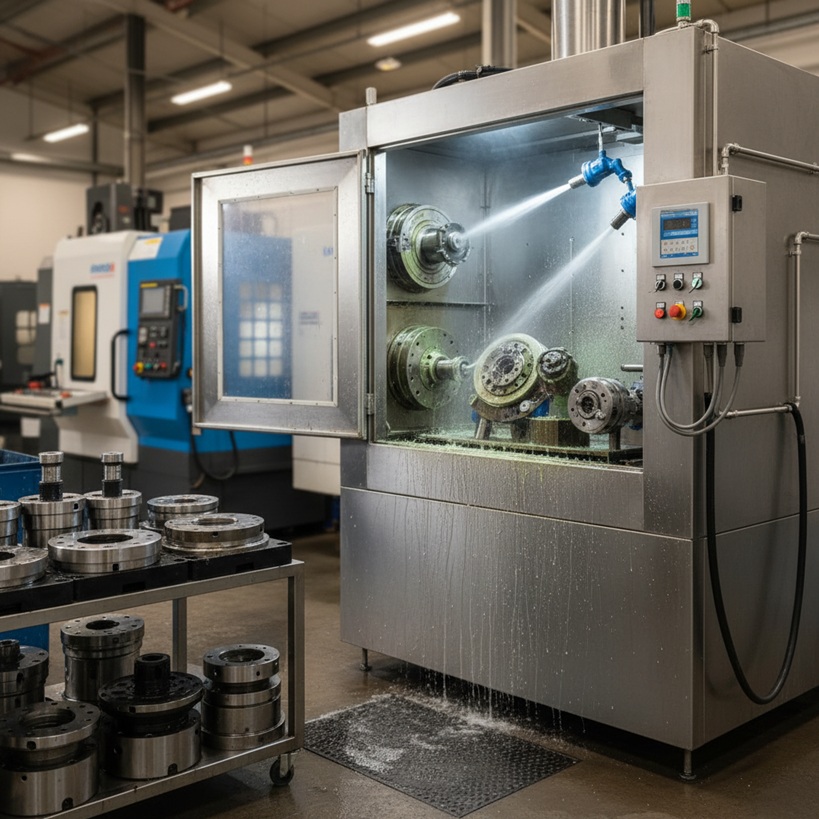
CNC machining generates substantial contamination – cutting fluids, metal chips, and grinding swarf accumulate on precision components with every production cycle. A single micron of residue on a bearing surface can compromise tolerances measured in thousandths of a millimetre. Yet the same aggressive cleaning methods that remove stubborn contamination can damage the precision surfaces they’re meant to protect.
Manufacturing facilities face a persistent challenge: how to thoroughly clean CNC machine components without introducing scratches, corrosion, or dimensional changes that affect performance. The solution requires understanding both the contamination types specific to CNC operations and the cleaning technologies that remove them without compromising precision.
The Contamination Challenge in CNC Operations
CNC machine component cleaning addresses distinct contamination patterns that differ significantly from general workshop dirt. Cutting fluids – whether water-based coolants or straight cutting oils – bond with metal fines to create stubborn residues that resist simple solvent wiping.
Water-Based Cutting Fluid Issues
Water-based cutting fluids emulsify with metal particles to form paste-like deposits. These residues trap bacteria that accelerate corrosion on precision surfaces. Left for 24 hours, these deposits begin etching into ground surfaces, creating permanent damage that affects component performance.
Straight Cutting Oil Problems
Straight cutting oils create thick, tenacious films that attract additional contamination. These oils penetrate into bearing surfaces, slideways, and threaded connections. Manual cleaning with rags simply spreads the contamination rather than removing it – a time-consuming process that rarely achieves the cleanliness standards required for precision equipment.
Metal Chips and Swarf Impact
Metal chips and swarf embed in cutting fluid residues, creating abrasive particles that cause accelerated wear when components return to service. A single embedded chip dragged across a precision guideway can create a scratch that requires expensive regrinding to repair.
Manufacturing facilities running three-shift operations face additional complications. Components requiring cleaning arrive continuously throughout production cycles, creating workflow bottlenecks when manual cleaning methods can’t keep pace with machine output.
Why Manual Cleaning Methods Fail Precision Requirements
Workshop mechanics traditionally clean CNC components using solvent tanks, wire brushes, and manual scrubbing. This approach introduces multiple risks to precision components.
Abrasive Contact Risks
Abrasive contact from brushes and scrapers creates microscopic scratches on ground surfaces. These scratches become stress concentration points that accelerate fatigue failure in rotating components. A bearing race with surface scratches from aggressive cleaning may fail at 60% of its expected service life.
Solvent Treatment Limitations
Solvent limitations mean that cold solvent soaking dissolves surface oils but fails to remove emulsified cutting fluid residues. Mechanics compensate by scrubbing harder, introducing the abrasive contact damage that precision components cannot tolerate.
Inconsistent Results and Quality Control
Inconsistent results occur because manual cleaning effectiveness depends on individual technique and effort. One mechanic achieves acceptable cleanliness while another leaves residues that cause premature component failure. This variability creates quality control problems in facilities where multiple staff perform maintenance tasks.
Time consumption becomes significant when cleaning complex components like rotary tables or multi-axis spindle assemblies. A mechanic might spend 45 minutes manually cleaning a single component – time that could be spent on skilled maintenance tasks rather than repetitive cleaning work.
The labour cost alone justifies investigating automated alternatives. At $45 per hour for a qualified mechanic, manual cleaning of components costs $33.75 per unit before considering the quality risks and workflow delays.
Hot Spray Washing Technology for Precision Components
Automated hot blaster systems address the precision cleaning challenge through controlled application of heated cleaning solution at optimised pressure levels. This technology removes cutting fluid removal methods that work without physical contact that could damage precision surfaces.
Temperature Control Benefits
Temperature control enhances cleaning chemistry effectiveness. Heated cleaning solution at 60-80°C breaks down cutting fluid emulsions and dissolves stubborn oil films that resist cold solvent treatment. The thermal energy accelerates chemical reactions, allowing shorter cycle times while achieving superior cleaning results.
Pressure Optimization
Pressure optimisation delivers cleaning solution at levels sufficient to dislodge contamination without impacting precision surfaces. Typical spray pressures of 300-600 PSI provide mechanical energy that removes embedded chips and swarf while remaining well below the threshold that could damage ground finishes or bearing surfaces.
Rotating Spray Coverage
Rotating spray arms ensure complete coverage of complex component geometries. Multiple spray nozzles positioned at strategic angles deliver cleaning solution to internal passages, threaded holes, and recessed surfaces that manual methods struggle to reach. This comprehensive coverage eliminates the hidden contamination pockets that cause premature component failure.
Programmable Cycle Standardization
Programmable cycles standardise cleaning processes across all shifts and operators. A programmed cycle delivers identical temperature, pressure, and duration for every component cleaned, eliminating the variability inherent in manual methods. Quality control becomes predictable rather than dependent on individual technique.
Manufacturing facilities processing CNC components benefit from cycle times of 8-15 minutes depending on contamination levels and component complexity. This represents a 65-75% time reduction compared to manual cleaning methods, directly improving maintenance workflow efficiency.
Selecting Appropriate Cleaning Systems for CNC Applications
CNC machine component cleaning requirements vary based on production scale, component sizes, and contamination severity. Hotwash Australia manufactures systems across capacity ranges to match specific operational needs.
Chamber Sizing Considerations
Chamber sizing determines component capacity and workflow integration. Small workshops maintaining 2-3 CNC machines require different capacity than production facilities running 15+ machines across multiple shifts. A 600mm x 600mm chamber accommodates most individual CNC components including rotary tables, tool holders, and spindle assemblies. Larger facilities benefit from 900mm x 900mm or 1200mm x 1200mm chambers that clean multiple components simultaneously.
Construction Material Options
Construction materials affect both durability and hygiene standards. Powder-coated steel construction provides robust performance for general manufacturing applications where appearance isn’t critical. Stainless steel parts washers deliver superior corrosion resistance and maintain clean appearance in facilities where equipment presentation matters or where food-grade compliance is required.
Heating Capacity Requirements
Heating capacity influences both cycle time and cleaning effectiveness. Systems with 12kW heating elements reach operating temperature in 25-30 minutes and maintain consistent heat during continuous operation. Facilities running multiple cleaning cycles per shift require adequate heating capacity to prevent temperature drop between cycles that would compromise cleaning performance.
Automation Features
Automation features determine operational convenience and consistency. Manual door systems require operator presence throughout the cycle. Automated sliding doors with programmable cycles allow operators to load components, start the cycle, and return to other tasks while cleaning proceeds unattended. This operational flexibility becomes significant in facilities where skilled mechanics should focus on complex maintenance rather than supervising cleaning equipment.
CNC Machine Component Cleaning Applications
Different CNC component types present distinct cleaning challenges that influence system selection and cycle programming.
Spindle Assembly Cleaning
Spindle assemblies accumulate cutting fluid in bearing areas and internal passages. Complete cleaning requires heated solution penetration into these recessed areas to dissolve oil films and flush out contamination. Heavy duty parts washers with rotating spray arms deliver the multi-angle coverage these complex assemblies require. Typical cycle times of 12-15 minutes achieve cleanliness levels that manual methods cannot match.
Rotary Tables and Indexers
Rotary tables and indexers contain precision worm gears and bearing surfaces that trap metal fines mixed with cutting fluid. These components require thorough CNC machine component cleaning before lubrication to prevent abrasive contamination from accelerating wear. Spray washing removes embedded particles without the brushing contact that risks damaging precision surfaces.
Tool Holders and Collets
Tool holders and collets accumulate taper contamination that affects tool runout and cutting performance. Even microscopic residues on taper surfaces create runout that degrades machined part quality. Heated spray washing dissolves these residues completely, restoring the precision contact required for accurate machining.
Linear Guideways and Ball Screws
Linear guideways and ball screws demand contamination-free surfaces to achieve their design life. Cutting fluid residues that harden on these components create abrasive particles that cause accelerated wear and premature failure. Regular cleaning using automated industrial cleaning equipment prevents this contamination accumulation, extending component life and reducing unexpected downtime.
Coolant System Components
Coolant system components including pumps, filters, and distribution manifolds benefit from periodic cleaning that removes bacterial growth and sludge accumulation. Clean coolant systems maintain cutting fluid effectiveness and prevent the biological contamination that causes odour problems and accelerates cutting fluid degradation.
Protecting Precision During the Cleaning Process
Effective CNC machine component cleaning requires careful attention to factors that could compromise precision even while removing contamination.
Chemical Selection Guidelines
Chemical selection influences both cleaning effectiveness and material compatibility. Alkaline cleaners at pH 10-11 provide excellent cutting fluid removal methods without the aggressive attack of stronger caustic solutions. These balanced formulations clean thoroughly while protecting aluminium components, painted surfaces, and bearing seals from chemical damage.
Rinse Procedure Importance
Rinse procedures prevent residue formation that could affect precision surfaces. A final rinse with clean heated water removes all cleaning chemistry, leaving surfaces completely residue-free. This step becomes critical for components that will be immediately reassembled and returned to service.
Drying Method Requirements
Drying methods prevent water spotting and flash corrosion on precision surfaces. Heated cabinet drying at 60-70°C following the wash cycle evaporates residual moisture before corrosion can initiate. This controlled drying protects ground surfaces, bearing races, and other precision features that manual drying with compressed air often misses.
Corrosion Prevention Measures
Corrosion prevention through rust inhibitor application provides short-term protection for cleaned components awaiting reassembly. Water-displacing rust preventives applied immediately after cleaning create a protective film that prevents oxidation during storage periods.
Operational Efficiency and ROI Considerations
Manufacturing facilities evaluating automated CNC machine component cleaning systems should quantify both direct cost savings and operational improvements.
Labour Cost Reduction
Labour cost reduction delivers immediate measurable savings. A mechanic earning $45 per hour spending 45 minutes manually cleaning a component costs $33.75 in direct labour. Automated cleaning reduces hands-on time to 2-3 minutes for loading and unloading, cutting labour cost to $2.25-3.38 per component. Facilities cleaning 15 components weekly save $473 weekly or $24,600 annually in direct labour costs alone.
Consistency Improvements
Consistency improvements reduce component failures caused by inadequate cleaning. When contamination causes premature bearing failure or guideway wear, the resulting downtime and replacement costs far exceed cleaning equipment investment. A single CNC machine producing $180 per hour in value loses $1,440 during an 8-hour unplanned downtime event for component replacement.
Maintenance Workflow Optimization
Maintenance workflow improves when cleaning no longer creates bottlenecks in component refurbishment. Mechanics load components into automated washers and proceed to other tasks rather than spending 45 minutes per component on manual cleaning. This workflow improvement allows maintenance teams to complete more work during scheduled downtime windows.
Component Life Extension
Component life extension occurs when thorough, consistent cleaning removes all abrasive contamination before components return to service. Linear guideways cleaned properly between services achieve their design life of 15,000-20,000 hours rather than failing prematurely at 8,000-10,000 hours due to contamination damage.
Production Quality Benefits
Production quality benefits from properly cleaned tool holders and spindle tapers that maintain runout specifications. When taper contamination causes excessive runout, machined part quality degrades, increasing scrap rates and requiring additional quality inspection. Consistent component cleaning maintains the precision contact required for quality production.
Integration with Preventive Maintenance Programs
CNC machine component cleaning becomes most effective when integrated into structured preventive maintenance schedules rather than performed reactively when problems occur.
Scheduled Cleaning Intervals
Scheduled cleaning intervals based on machine operating hours prevent contamination accumulation that causes accelerated wear. A CNC machine running 120 hours weekly benefits from spindle cleaning every 500 operating hours – approximately monthly for continuous operations. This proactive approach prevents the contamination buildup that causes unexpected failures.
Component Tracking Systems
Component tracking systems document cleaning history and identify components requiring more frequent attention. When a particular rotary table requires cleaning twice as often as similar units, this pattern indicates potential seal wear or coolant system problems requiring investigation. The cleaning schedule becomes a diagnostic tool revealing developing problems before they cause failures.
Workflow Planning
Workflow planning schedules component cleaning during machine downtime to minimise production impact. When a machining centre undergoes scheduled maintenance, simultaneous cleaning of removed components ensures everything returns to service in optimal condition. This coordinated approach maximises the value of planned downtime.
Australian Manufacturing Standards and Compliance
Manufacturing facilities operating across Australia must consider local requirements when specifying industrial cleaning equipment.
Electrical Safety Requirements
Electrical safety compliance with AS/NZS 3760 ensures equipment meets Australian standards for electrical safety in industrial environments. Hotwash Australia equipment manufactured locally incorporates compliant electrical systems designed for Australian power supply standards.
Pressure Vessel Regulations
Pressure vessel requirements apply to heated cleaning systems operating above atmospheric pressure. Equipment manufactured to Australian standards includes appropriate pressure relief systems and construction methods that meet local regulatory requirements.
Workplace Health and Safety
Workplace health and safety considerations under WHS regulations favour automated cleaning systems that reduce manual handling, chemical exposure, and repetitive strain injuries. Automated parts washers eliminate the prolonged standing, repetitive scrubbing motions, and solvent exposure associated with manual cleaning methods.
Environmental Compliance
Environmental compliance regarding wastewater disposal and chemical usage aligns with state environmental regulations. Modern parts washers incorporate filtration systems that extend cleaning solution life, reducing both chemical consumption and wastewater volume requiring disposal.
Conclusion
CNC machine component cleaning demands technology that removes stubborn cutting fluid contamination without compromising the precision surfaces that determine component performance. Manual cleaning methods introduce risks – abrasive contact damage, inconsistent results, and excessive labour time – that automated hot spray washing eliminates.
Manufacturing facilities benefit from measurable improvements: 65-75% reduction in cleaning time, elimination of quality variability, and extended component life through thorough contamination removal. The labour cost savings alone – $24,600 annually for facilities cleaning 15 components weekly – justify automated system investment while delivering operational improvements that manual methods cannot achieve.
Australian-manufactured industrial parts washers provide the robust construction, precise temperature control, and programmable automation that CNC machine component cleaning requires. These systems protect precision while removing contamination, supporting the preventive maintenance programs that maximise CNC machine reliability and production quality.
Manufacturing facilities ready to eliminate manual cleaning bottlenecks and improve component cleaning consistency should contact us to discuss system specifications matched to specific CNC maintenance requirements and production scale.

Leave A Comment