
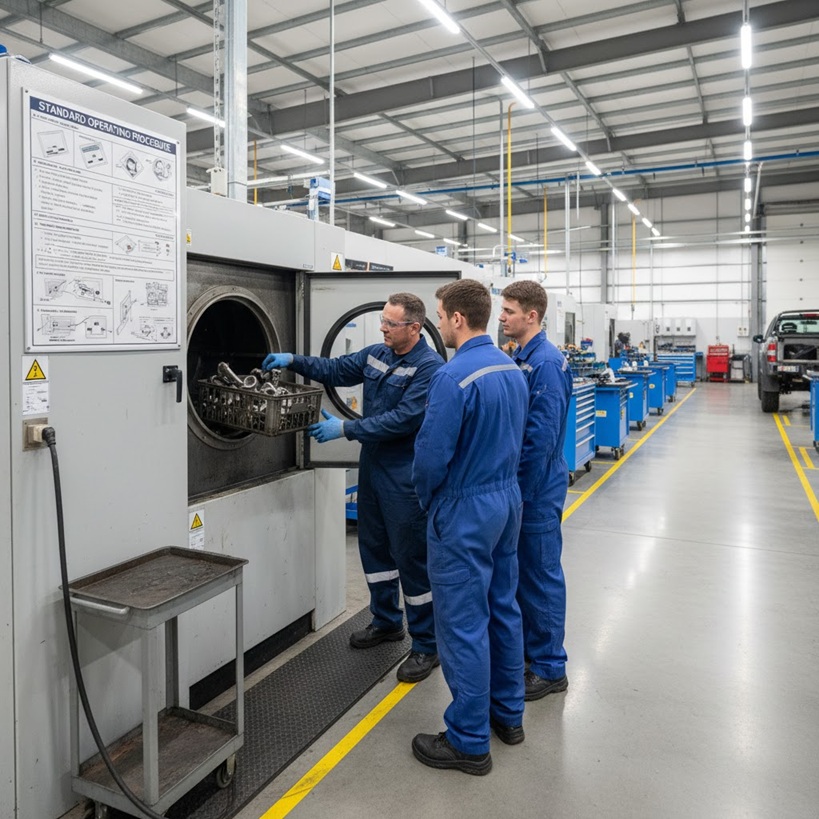
Workshop managers face a persistent problem. Inconsistent parts cleaning results slow production. They waste labour hours and create safety hazards. A diesel injector cleaned properly on Monday comes back filthy on Wednesday. One operator’s “clean” is another’s “needs rework.” Without documented workshop quality procedures, workshops burn hours re-cleaning parts. They also risk equipment failures from contaminated components.
The solution is not just better equipment. You must build quality procedures directly into cleaning operations. Facilities that document their cleaning procedures achieve faster throughput. They receive fewer quality complaints compared to those running equipment without standardised processes.
Quality procedures transform parts washing. It changes from a variable manual task into a consistent operation. This guide shows workshop managers how to build quality controls into cleaning operations. You will learn to reduce rework and create cleaning consistency. This protects equipment and speeds up production.
Why Workshop Cleaning Needs Quality Procedures
Most workshops treat parts cleaning as a basic task. Operators spray some degreaser and scrub with a brush. This approach works until it fails. The cost always shows up downstream.
A mining maintenance workshop tracked rework costs over six months. They operated without documented cleaning procedures. They found that 23% of engine rebuilds required additional cleaning after assembly started. Technicians found oil residue in cylinder head ports. They found carbon buildup in valve seats. Each instance meant disassembly and re-cleaning. This added hours to every job.
After implementing quality procedures, rework dropped to 3%. The difference was simple. Every operator followed the same cleaning cycle. They used the same detergent concentration. They verified results against the same cleanliness standard.
Quality procedures deliver three measurable benefits. First is consistency. You get the same result regardless of which operator runs the equipment. Second is speed. No rework means parts move straight from washing to assembly. Third is documentation. Cleaning records prove compliance for warranty claims and safety investigations.
Core Elements of Workshop Cleaning Quality Procedures
Effective quality procedures do not require complex documentation. They do not need expensive software. They need five core elements that any workshop can implement immediately.
Documented Cleaning Specifications
Start by defining what “clean” means. A cylinder head requires spotless ports. A chassis component needs visible dirt removed but does not require surgical cleanliness.
Create simple specification sheets. List the component type, such as engine blocks or hydraulic cylinders. Define the contamination level. Is it light oil or heavy grease? State the required cleanliness standard. This could be visual inspection or a white glove test. Finally, specify the cleaning method. Some parts need parts washers for pre-cleaning, while others go straight to the tank. Castings with heavy rust might require wet abrasive blasters before final washing.
A Perth automotive workshop uses three cleanliness levels. Standard means visible dirt is removed. Precision means all oil residue is removed. Critical means surgical cleanliness for bearings and seals. Operators know exactly what result each component requires.
Standardised Operating Procedures (SOPs)
Document the exact steps operators follow. Standard operating procedures ensure consistent results. For automated systems, this includes removing loose debris first. It involves positioning parts for maximum spray coverage. Operators must select the appropriate basket.
Define the parameters clearly. Detergent concentration typically sits between 2-5% for biodegradable solutions. Water temperature should range from 60-85°C depending on contamination. Cycle times vary based on the component. Documenting these settings removes guesswork.
A mining equipment workshop reduced cleaning cycle time by 30%. They simply standardised their procedure. Previously, operators guessed at cycle times. Some ran 60-minute cycles “to be safe.” Testing showed 35 minutes achieved complete cleaning. Standardising eliminated unnecessary machine time.
Quality Verification Points
Build inspection checkpoints into the cleaning process. Do not wait until assembly to discover failures.
Implement immediate verification. The operator inspects parts immediately after cleaning. This catches 90% of issues when re-cleaning is quick. Use sampling inspection for quality control. A supervisor randomly inspects 10% of components. This identifies procedure drift before it becomes systemic.
For safety-critical parts, require documented inspection. Brake components and engine bearings need this level of scrutiny. A food processing facility added UV light inspection. Under UV, oil residue fluoresces. This makes contamination visible that standard lighting misses. When surface preparation is critical, wet abrasive blasters provide verifiable cleanliness that visual inspection can confirm.
Operator Training and Competency
Quality procedures only work when operators understand them. They must know why procedures matter. Training should not be “watch the experienced guy for an hour.”
Teach why cleaning quality matters. Show examples of failures from inadequate cleaning. Explain how the equipment works. Operators should understand spray patterns and detergent chemistry. Teach them to recognise different contamination types. They must know how to verify cleaning completeness.
Test operator competency before they work independently. Have trainees clean test components. Inspect their work against standards. A trainee who can explain why a cylinder head needs high heat understands the process. This is better than someone who just memorizes a button sequence.
Documentation and Records
Track what gets cleaned. Note when it happens and who did it. Simple cleaning logs prevent disputes. They identify patterns early.
Record the date and time. Note the component identification. Record the cleaning cycle used and the operator’s name. Finally, record the pass/fail inspection result.
Digital systems help, but a clipboard works fine. The goal is accountability. You want traceability, not paperwork for its own sake. A transport workshop used logs to track detergent usage. When cleaning quality declined, logs showed the issue started after a supplier change. They switched back and restored results. Without logs, they would have wasted weeks guessing.
Implementing Procedures with Automated Parts Washers
Automated systems make workshop quality procedures easier to maintain. Manual cleaning methods introduce too many variables. Modern systems include features designed to support consistent operations.
Programmable Cleaning Cycles
Modern equipment stores multiple cleaning programmes. Each is optimised for specific component types. Operators select “Engine Block” or “Hydraulic Cylinder” instead of guessing.
This eliminates procedure variation. Every operator runs identical parameters for identical parts. Quality becomes a function of the machine, not operator judgment. Heavy duty parts washers often come with these programmable features standard.
Consistent Temperature and Pressure
Manual cleaning varies with operator fatigue. Automated washers maintain precise temperature and pressure. Temperature consistency matters because chemistry depends on heat. Biodegradable detergents work optimally at 70-80°C. Below 60°C, grease does not emulsify properly. Automated systems maintain target temperature within a few degrees.
Rotating Spray Arms for Coverage
Manual washing misses hidden surfaces. Operators cannot see inside blind holes. Industrial spray washers use rotating spray arms. They bombard parts from multiple angles. This reaches surfaces hand washing misses.
Complete coverage means quality does not depend on thoroughness. The machine reaches every surface every cycle. It eliminates the variable of operator attention to detail. Hot tanks provide similar consistency for immersion cleaning needs.
Built-In Quality Features
Purpose-built equipment includes design features that support quality. Mesh baskets prevent parts from blocking spray patterns. They ensure complete exposure to the cleaning solution. Sliding doors contain spray during operation. This prevents operator exposure to hot water.
Filtration systems remove contamination from wash water. This prevents dirt from redepositing onto cleaned parts. Sight windows allow visual monitoring. Operators can check progress without opening the chamber.
For sensitive industries, these features are critical. Stainless steel parts washers include food-grade construction. A commercial kitchen might require visual inspection through the window. If contamination remains, operators extend the cycle. This prevents inadequately cleaned equipment from returning to production.
Measuring Quality Procedure Effectiveness
Quality procedures only matter if they improve outcomes. Track specific metrics to verify your procedures deliver value. At Hotwash Australia, we help workshops establish these baselines before installing new equipment.
Tracking Rework Rates
Count how many cleaned components require re-cleaning. Set a target of less than 5%. Before procedures, 15-25% of parts might need rework. After implementation, this should drop significantly. Increasing rework indicates procedure drift.
Monitoring Cleaning Cycle Time
Measure the average time from dirty part to clean part. Quality procedures should reduce total time. You eliminate rework and operator guesswork. A mining workshop tracked total cleaning time. They used extra heavy duty parts washers for large components. Before procedures, cleaning took 85 minutes. After procedures, it dropped to 35 minutes.
Assessing Operator Consistency
Track cleaning results by operator. High variation indicates training gaps. Low variation proves procedures work. Test consistency by having different operators clean identical components. Inspect results against cleanliness standards.
Tracking Equipment Downtime
The ultimate measure is equipment failure. Do inadequately cleaned components cause breakdowns? Track warranty claims traced to cleaning quality. A diesel engine rebuilder tracked warranty returns. After implementing standard operating procedures, returns dropped from 8% to 1.5%.
Common Quality Procedure Failures and Solutions
Even well-designed procedures fail without proper implementation. Common problems undermine workshop cleaning quality.
Managing Procedure Drift
Operators gradually deviate from documented procedures. They introduce variation. An operator might discover a “shortcut.” Soon everyone uses it. Regular audits solve this. Supervisors observe operators and verify compliance.
Addressing Inadequate Training
New operators often receive brief instructions. They miss critical steps. Implement a documented training program. Do not let new operators work independently until they demonstrate competency.
Equipment Maintenance Neglect
Cleaning quality degrades as equipment performance declines. Operators compensate by extending cycle times. This undermines the automated procedure. Stick to a preventive maintenance schedule. Replace filters and inspect spray nozzles regularly. For specialized tasks like paint removal, wet abrasive blasters require specific maintenance checks to ensure pressure remains high.
Inadequate Lighting for Inspection
Operators cannot verify quality in the dark. Contamination remains invisible until assembly. Install proper inspection lighting near the washer. LED work lights reveal contamination that overhead lighting misses. This catches failures immediately. For components cleaned with wet abrasive blasters, proper lighting helps verify that all rust and scale have been removed to bare metal.
Building Quality Into Your Workshop
Quality procedures transform workshop cleaning. It becomes a controlled process delivering measurable results. The investment is simple. You need documented procedures, training, and consistent equipment.
Workshops that implement quality procedures achieve faster throughput. They eliminate rework costs. Components move from washing directly to assembly. Australian workshops need cleaning operations that match their workmanship.
For the largest operations, super heavy duty parts washers provide the capacity needed to maintain these standards at scale. When a technician rebuilds a massive engine, cleaning must be perfect. Quality procedures prevent failures and reduce labour costs.
Conclusion
Quality procedures are essential for modern workshops. They protect your reputation and your bottom line. By documenting your process and training your team, you ensure every part meets the standard. You stop relying on luck and start relying on process.
If you are ready to build quality procedures into your operations, contact our cleaning procedure specialists or email us on sales@hotwash.com.au to discuss systems that deliver consistent results.

Leave A Comment