
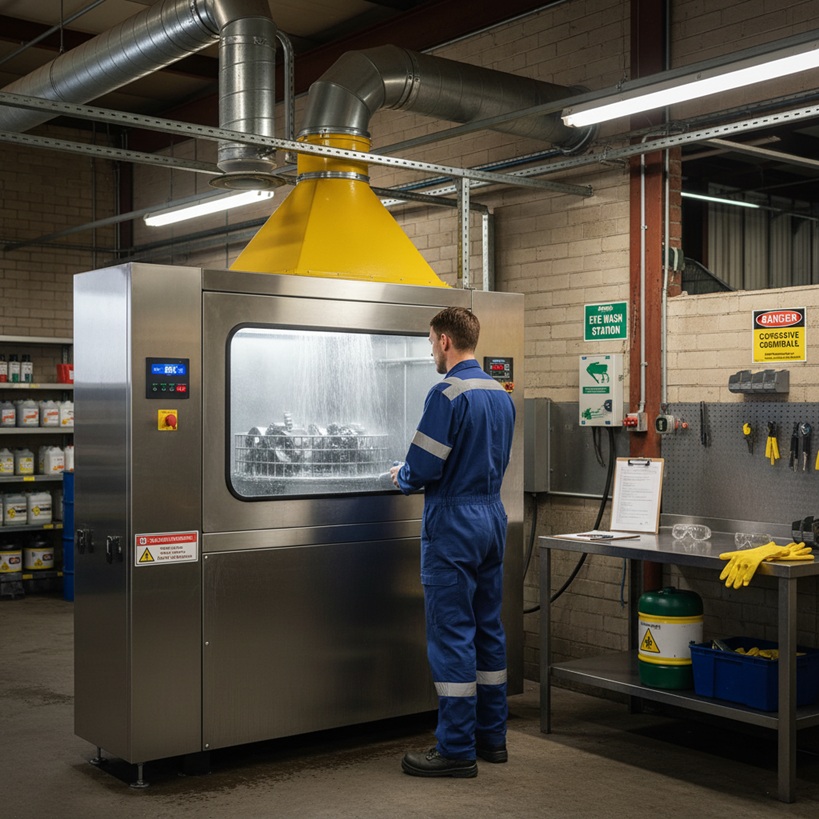
Material Safety Data Sheets sit in filing cabinets across Australian workshops, mining sites, and manufacturing facilities. Yet when maintenance supervisors face actual cleaning challenges – removing baked-on carbon, cutting through heavy grease, or managing chemical exposure risks – the gap between documentation and operational reality becomes apparent. Understanding parts cleaning chemical safety requires more than regulatory compliance paperwork. It demands practical knowledge of how cleaning agents behave in real industrial environments, how workers actually interact with these chemicals, and what safety measures function effectively under production pressures.
The disconnect between MSDS chemical handling workshop practices and documentation creates genuine risks. A chemical rated “low hazard” on paper can still cause respiratory issues when heated to 80°C in an enclosed wash bay. A “biodegradable” degreaser might meet environmental standards yet strip protective coatings from sensitive components. This article examines the practical realities of parts cleaning chemical safety that MSDS sheets rarely address.
How Industrial Cleaning Chemicals Actually Behave Under Pressure
Temperature Effects on Chemical Volatility
Laboratory testing conditions for MSDS documentation rarely replicate the high-temperature, high-pressure environments inside heavy-duty parts washers. When alkaline degreasers reach 70-90°C under spray pressure, their chemical behaviour changes significantly from room-temperature handling.
Heated cleaning solutions release vapours differently than cold applications. A mild alkaline cleaner at 25°C produces minimal fumes. That same solution at 85°C in an industrial parts washer generates substantial vapour that can overwhelm inadequate ventilation systems. Mining operations running continuous cleaning cycles face cumulative exposure that standard MSDS testing doesn’t capture.
Petroleum-based solvents present even greater volatility challenges. Flash points listed on MSDS sheets assume atmospheric pressure and standard temperatures. Inside a heated spray cabinet operating at 2,000 PSI, solvent behaviour changes. The practical implication: operators need ventilation systems designed for actual operating temperatures, not just the chemical’s room-temperature properties.
Pressure-Induced Aerosolisation
High-pressure spray systems atomise cleaning solutions into fine mists that behave differently than bulk liquids. MSDS documentation typically addresses liquid contact and vapour inhalation as separate concerns. In reality, pressurised spray creates an aerosol state where both risks occur simultaneously.
A maintenance technician opening a super heavy-duty parts washer mid-cycle encounters aerosolised chemicals suspended in heated air. The MSDS might list dermal contact precautions and separate inhalation warnings, but doesn’t address this combined exposure scenario. Practical safety measures must account for this reality – sealed systems with proper cycle completion protocols, not just gloves and respirators.
The Chemical Mixing Problem Nobody Documents
Contamination Reactions
MSDS sheets describe individual chemicals in isolation. Industrial parts cleaning rarely works that way. Contaminated components bring oil, grease, coolant, fuel, and metalworking fluids into the wash system. These substances interact with cleaning agents in ways no single MSDS sheet predicts.
When alkaline degreasers contact petroleum products, they create emulsions that change the solution’s cleaning properties and safety profile. Heavy mining equipment arrives at the wash bay carrying diesel fuel, hydraulic oil, coal dust, and drilling mud simultaneously. As these contaminants mix with heated cleaning solution, chemical reactions occur that aren’t documented on any MSDS.
Oil and gas operations face similar challenges. Pipeline components cleaned in hot tank systems might carry crude oil, natural gas condensate, corrosion inhibitors, and scale preventers. Each substance reacts differently with the cleaning solution, potentially creating unexpected hazards.
Solution Degradation Over Time
Fresh cleaning solution behaves according to MSDS specifications. After 40 hours of continuous use processing contaminated parts, that solution’s chemistry has changed substantially. Contamination buildup, pH drift, and chemical breakdown create a working solution quite different from the original product.
Most MSDS sheets don’t address how safety properties change as solutions age and become contaminated. Yet workshop supervisors must decide when solution replacement becomes a safety issue, not just a cleaning performance concern. Practical MSDS chemical handling workshop protocols require monitoring actual solution conditions, not just referencing original product documentation.
Temperature Thresholds Where Safety Rules Change
The 60°C Threshold
Industrial parts cleaning effectiveness increases dramatically with temperature. So do chemical hazards. The relationship isn’t linear – specific temperature thresholds trigger significant changes in chemical behaviour and safety requirements.
Many alkaline cleaners show modest vapour generation below 60°C. Above this temperature, vapour production accelerates substantially. For enclosed wash systems without proper ventilation, this threshold represents a practical safety boundary. Operations running at 65-70°C need significantly different ventilation than those at 55°C, even using identical chemicals.
Food processing facilities using stainless steel parts washers often operate in this temperature range to meet sanitation requirements. The MSDS might clear the chemical for food industry use, but doesn’t specify the ventilation requirements at elevated temperatures necessary for proper sanitation.
High-Temperature Operation Above 80°C
Hot blaster systems operating at 85-95°C deliver maximum cleaning power for heavy contamination. At these temperatures, even low-volatility chemicals generate substantial vapours. Skin contact risks increase – heated solutions cause thermal burns independent of chemical hazards.
The practical safety consideration: high-temperature systems require sealed operation with automated cycles. Manual intervention during heated operation creates unacceptable exposure risks that MSDS documentation doesn’t adequately address. Mining operations running intensive cleaning cycles need equipment designed for sealed, automated operation, not just chemical selection based on MSDS ratings.
What MSDS Sheets Miss About Dermal Exposure
Breakthrough Time Reality
Glove selection based on MSDS chemical resistance charts seems straightforward. Real-world dermal protection proves more complex. Duration of exposure, solution temperature, mechanical stress on gloves, and contamination transfer all affect actual protection levels.
MSDS sheets list chemical breakthrough times for glove materials under laboratory conditions – typically room-temperature immersion testing. A maintenance worker wearing nitrile gloves while manually loading parts into heated cleaning solution faces different conditions. The combination of heat, mechanical flexing, and abrasion from parts handling reduces effective breakthrough time significantly.
Workshop operations using manual parts washers involve repeated hand immersion in heated solutions. Gloves rated for 4-hour breakthrough protection might provide only 60-90 minutes under actual working conditions. Practical parts cleaning chemical safety protocols require glove change schedules based on real working conditions, not just MSDS data.
The Secondary Contamination Problem
Chemical-resistant gloves protect hands from cleaning solution. They also transfer contamination to everything the worker touches – tools, door handles, control panels, mobile phones. This secondary contamination pathway rarely appears in MSDS safety recommendations.
Automated systems reduce this risk substantially by eliminating manual parts handling during the cleaning cycle. Operations managers evaluating extra heavy-duty parts washers should consider contamination control as a safety factor, not just cleaning efficiency. Sealed, automated systems prevent the secondary contamination that manual operations create regardless of PPE compliance.
Ventilation Requirements for Actual Workshop Conditions
Capture Velocity vs. General Ventilation
MSDS sheets specify ventilation in air changes per hour or general mechanical ventilation recommendations. These guidelines assume ideal airflow patterns and proper system design. Workshop reality involves complex spaces with multiple contamination sources, variable airflow patterns, and practical limitations on exhaust placement.
Effective chemical safety requires capturing vapours at the source before they disperse into the workspace. General ventilation moves air through the entire space – an approach that works for low-level contamination but fails with concentrated chemical sources.
Parts washing equipment generates a concentrated vapour source. The difference between a properly vented system and an inadequate one isn’t just air volume – it’s vapour capture design. A wash system exhausting 500 CFM directly from the wash chamber provides better protection than 2,000 CFM of general room ventilation.
Mining operations running multiple cleaning systems simultaneously need integrated ventilation design, not just individual equipment exhaust. The cumulative vapour load from several heavy-duty parts washers operating concurrently requires engineering analysis beyond individual MSDS recommendations.
Seasonal and Environmental Variables
Workshop ventilation performance changes with outside temperature, humidity, and wind conditions. A ventilation system adequate in winter might prove insufficient during summer when elevated ambient temperatures increase chemical volatility.
Australian mining sites face extreme temperature variations between seasons. A wash bay ventilation system designed for 15°C ambient conditions operates differently when outside temperatures reach 40°C. Practical MSDS chemical handling workshop systems require ventilation designed for worst-case environmental conditions, not average temperatures.
The Biological Reality of Cumulative Exposure
Peak Exposure Events
MSDS exposure limits specify safe concentrations for 8-hour work shifts. This approach assumes uniform exposure throughout the shift and complete recovery between shifts. Industrial cleaning operations rarely follow this pattern.
Maintenance workers don’t experience steady chemical exposure throughout their shifts. They face high-concentration exposure when loading contaminated parts, opening wash chambers, and draining used solution. Between these peak events, exposure drops to near-zero levels.
MSDS time-weighted average (TWA) exposure limits don’t adequately address this peak-and-valley pattern. A worker might stay below 8-hour TWA limits while experiencing multiple short-duration exposures that exceed short-term exposure limits (STEL). Practical safety monitoring requires tracking peak exposures, not just shift averages.
The Sensitisation Risk
Some cleaning chemicals cause allergic sensitisation after repeated exposure. Once sensitised, workers experience reactions at exposure levels well below MSDS safety limits. The MSDS documents this risk, but rarely explains the practical implications.
A sensitised worker can’t safely continue in roles involving that chemical, regardless of exposure controls. For small maintenance teams, losing an experienced technician to chemical sensitisation creates significant operational impact. This risk factor should influence chemical selection and automation decisions, not just PPE requirements.
Why Automated Systems Deliver Superior Chemical Safety
Exposure Elimination vs. Exposure Control
The most effective chemical safety measure doesn’t appear on any MSDS sheet: eliminating human exposure through automation. Sealed, automated parts washing systems fundamentally change the safety equation by removing workers from the chemical environment during the cleaning cycle.
Traditional chemical safety follows the hierarchy of controls: elimination, substitution, engineering controls, administrative controls, PPE. Most MSDS recommendations focus on the bottom tiers – respirators, gloves, ventilation. Automated washing systems move up the hierarchy to near-elimination.
A fully automated system loads parts, executes the wash cycle, and completes drying without operator intervention. Chemical exposure occurs only during initial solution filling and periodic maintenance – perhaps 30 minutes weekly instead of 8 hours daily. This represents a 95% reduction in exposure opportunity that no PPE or ventilation improvement can match.
Consistency and Compliance
Manual safety procedures depend on consistent worker compliance. Fatigue, production pressure, and simple human error create gaps in protection. Automated systems maintain consistent safety performance regardless of production demands or workforce variables.
Mining operations running 24/7 schedules face particular challenges with manual safety compliance across multiple shifts. An automated extra heavy-duty parts washer delivers identical safety performance at 3:00 AM as at 9:00 AM, with tired workers or fresh ones. This consistency reduces safety incidents and simplifies compliance documentation.
Building a Practical Chemical Safety Program
Start with Equipment Selection
Effective parts cleaning chemical safety begins with equipment design. Sealed systems with automated cycles eliminate most exposure risks. Proper ventilation integration removes vapours at the source. Temperature controls prevent thermal hazards. These engineering controls provide baseline safety that administrative procedures and PPE can’t match.
When evaluating parts washing systems, assess safety features alongside cleaning performance. Does the system seal completely during operation? Can operators load and unload parts without exposure to heated solution? Does the design prevent aerosol escape during the cycle? These questions determine baseline safety levels that chemical selection alone can’t achieve.
Match Chemicals to Actual Operating Conditions
Select cleaning chemicals based on how they’ll actually be used, not just MSDS ratings. Consider operating temperature, pressure, cycle duration, and contamination types. A chemical with excellent safety ratings at room-temperature might prove hazardous at 85°C in a high-pressure spray system.
Oil and gas operations cleaning heavily contaminated pipeline components need different chemical considerations than food processing facilities cleaning kitchen equipment. The MSDS provides baseline data, but application-specific safety assessment requires understanding actual operating conditions.
Monitor Solution Conditions
Track cleaning solution pH, contamination levels, and age. Fresh solution behaves according to MSDS specifications. Degraded, contaminated solution presents different hazards. Establish solution replacement schedules based on safety considerations, not just cleaning performance.
Train for Real Scenarios
Worker training should address actual exposure scenarios, not just MSDS content review. Practice emergency response for solution spills during transfer operations. Demonstrate proper techniques for opening wash chambers after heated cycles. Explain why automated cycle completion matters for safety, not just cleaning results.
Conclusion
Material Safety Data Sheets provide essential baseline information for parts cleaning chemical safety, but they don’t tell the complete story. Real-world chemical behaviour under high temperature and pressure, contamination interactions, cumulative exposure patterns, and equipment design factors all influence actual safety outcomes in ways standard documentation doesn’t capture.
Operations managers, maintenance supervisors, and procurement teams evaluating industrial cleaning systems should assess chemical safety through a practical lens. How does the equipment design minimise exposure? What happens when chemicals reach operating temperature? How do contamination loads affect solution safety over time? These questions lead to better safety outcomes than MSDS compliance checklists alone.
Hotwash Australia manufactures industrial parts washing systems engineered for real-world MSDS chemical handling workshop applications. Sealed automated operation, integrated ventilation design, and temperature control systems address the practical safety challenges that standard equipment overlooks. Australian mining operations, oil and gas facilities, and heavy manufacturing plants rely on these systems to deliver both cleaning performance and genuine worker protection.
For operations seeking to move beyond basic MSDS compliance toward comprehensive chemical safety, contact us to discuss equipment solutions designed for Australian industrial conditions. Proper equipment selection represents the most effective chemical safety investment – eliminating exposure rather than merely controlling it.

Leave A Comment