
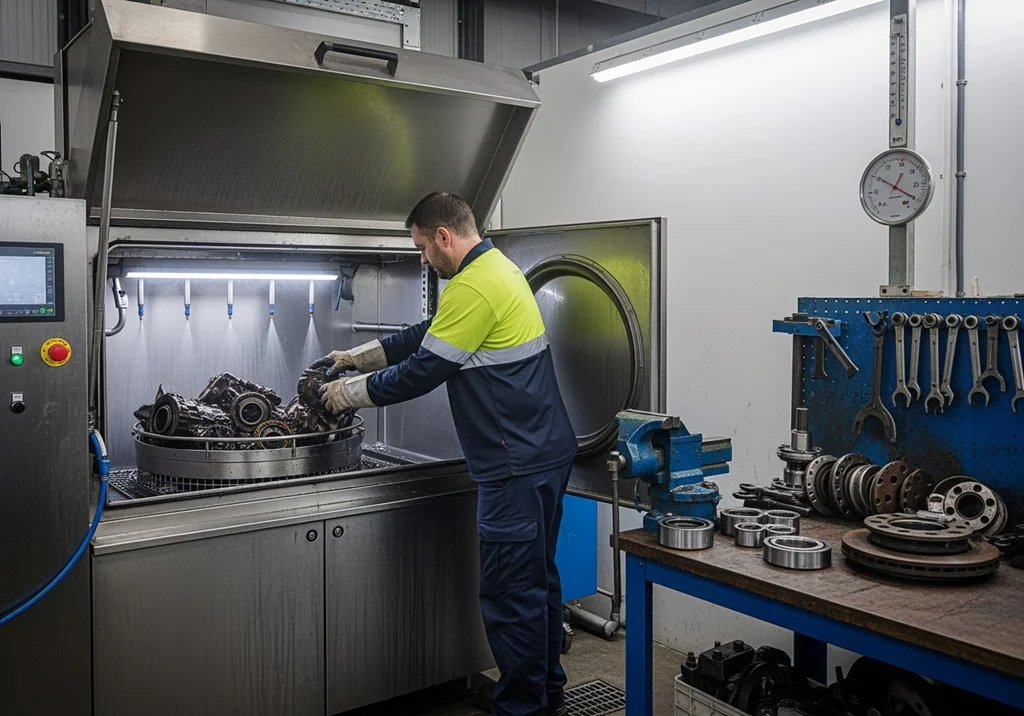
Every winter morning, workshops across Australia face the same problem. The temperature has dropped overnight, and the parts washer is cold. Water takes longer to heat. Cleaning cycles stretch out. Mechanics stand around waiting instead of working.
This is not a minor inconvenience. Parts washers that slow down in cold weather cost your workshop real money. This guide explains how industrial hot wash systems are engineered to maintain full cleaning speed regardless of ambient temperature. It covers what to look for when choosing cold-weather-ready equipment for your workshop.
Why Cold Weather Slows Down Parts Washing
Cold ambient temperatures create three specific problems for parts washing equipment. Understanding each one explains why some machines perform consistently through winter. Others struggle from the first cold morning.
Three Problems Cold Air Creates
The first problem is longer heat-up times. Water entering the system at low ambient temperature needs significantly more energy to reach 80-85°C operating temperature. A poorly insulated tank can take over an hour to heat from cold in winter. That is far longer than on a warm day.
The second problem is faster heat loss during operation. Once the washer reaches temperature, cold air pulls heat away from the tank surfaces. The heating element works harder just to maintain temperature. This increases power consumption and extends cycle times across every wash.
The third problem is reduced cleaning effectiveness. If water temperature drops significantly during a wash cycle, grease and oil do not break down as efficiently. Parts come out partially clean and require a second cycle. That is exactly what the machine was meant to eliminate.
The Real Cost of Slower Cycles
These are not theoretical problems. A mining workshop running multiple wash cycles per day loses meaningful productive time if each cycle runs longer in winter. That is a mechanic standing around waiting instead of turning spanners.
Parts washer cold weather performance directly affects labour costs. The gap between summer and winter cycle times translates to real money on your wage bill. Understanding parts washer cold weather performance gaps is the first step to eliminating them. The solution starts with how the machine is built – not how it is operated.
Choosing the right parts washers for your operation starts with understanding how cold weather affects machine performance. Effective parts cleaning depends on consistent water temperature. A machine that cannot hold temperature costs you time with every cycle.
Tank Insulation: Your First Line of Defence
The most important factor in cold-weather parts washing performance is tank insulation. This is not complicated engineering. It is basic thermal management. It separates professional industrial hot wash equipment from cheaper alternatives.
Insulation Thickness and Heat Retention
Quality heavy duty parts washers use high-density insulation around the entire tank. Cheaper systems use thinner insulation or skip it on certain panels to reduce manufacturing cost. The result shows up immediately when ambient temperature drops.
A well-insulated tank loses far less temperature per hour in cold ambient conditions. A poorly insulated tank of the same size loses significantly more. Over a standard wash cycle, that difference can mean the gap between holding optimal cleaning temperature and dropping to where grease no longer breaks down effectively.
Hot tank insulation quality is the single most important specification to verify before purchasing winter workshop gear. It determines how well the machine performs from the first cycle of the day to the last.
How Insulation Affects Heat-Up Time
Better insulation also means faster heat-up from cold. Less energy escapes into the surrounding workshop air. More energy goes directly into heating the water.
A well-insulated system reaches operating temperature significantly faster than an equivalent uninsulated system. For workshops where early morning temperatures regularly hit 5-10°C, this difference matters most. It determines whether the first cleaning cycle starts at shift begin or well into the morning.
Heating Element Capacity and Recovery Speed
Insulation keeps heat in. The heating element puts heat in fast enough to matter. Both need to work together.
Kilowatt Ratings Explained
Heating capacity is measured in kilowatts. Standard industrial spray washers for workshop use run heating elements sized for their tank volume. Larger systems for mining operations use significantly higher-capacity elements.
Higher kilowatt capacity means faster heat-up from cold and faster recovery between cycles. A higher-capacity element heating the same water volume reaches operating temperature noticeably faster. Heating element capacity is directly linked to how quickly your workshop cleaning speed returns to full productivity on cold mornings.
Recovery Speed Between Cycles
Capacity matters beyond initial heat-up. It determines recovery speed – how fast the system returns to operating temperature between cycles.
When you load dirty parts, hot air escapes. When you drain the tank to remove settled debris, you lose heated water. When a full wash cycle runs, the pump circulates water through spray arms exposed to cooler air. All of this pulls temperature down.
A properly sized heating element recovers that lost temperature during the wash cycle or between cycles. An undersized element cannot keep pace. Water temperature gradually drops throughout the day and cleaning performance suffers.
Hotwash Australia designs industrial hot wash systems for continuous mining operations with appropriately sized heating elements for exactly this reason. The extra capacity is not needed on warm days. It is essential when ambient temperature drops and the washer runs back-to-back cycles all shift.
Thermostat Accuracy and Temperature Stability
Maintaining consistent water temperature requires accurate thermostat control. Cheap thermostats create real problems in cold weather. The results show up in cleaning quality, not just energy bills.
Digital vs Mechanical Thermostats
A quality digital thermostat maintains water temperature within a tight band of the setpoint. It monitors temperature constantly and adjusts heating element operation to compensate for heat loss. When ambient temperature drops, the thermostat runs the heating element more frequently to hold the target temperature.
Basic mechanical thermostats allow wider temperature swings. In cold weather, water temperature cycles across a broader range instead of holding steady. The lower end of that range does not clean as effectively as consistent high temperature.
Why Consistent Temperature Matters
The difference shows up in results. Parts washed at a consistent high temperature come out spotless. Parts washed in a system that fluctuates may have residual grease in recessed areas. Carbon build-up that did not fully dissolve may also remain.
For workshops running super heavy duty washers on mining equipment, temperature stability is not negotiable. Excavator bucket pins covered in wet clay and grease need sustained high temperature to clean properly. Temperature fluctuations mean inconsistent results and repeat cycles.
Pump Pressure and Spray Arm Performance
Water temperature breaks down grease and oil. Pump pressure and spray arm design deliver that hot water where it needs to go. In cold weather, getting this combination right matters more than ever.
Pressure Requirements in Cold Conditions
Industrial hot wash systems run pump pressure designed to drive hot water through spray arms with multiple nozzles. Those nozzles are angled to hit all surfaces of loaded parts.
In cold weather, maintaining pressure matters more because the contamination is thicker. Cold grease is harder than warm grease. Cold oil is more viscous. Higher pressure helps compensate for contamination that has hardened overnight.
Stainless steel washers built for food industry and general workshop use employ high-pressure pumps with engineered spray arm geometry. The result is thorough parts cleaning even when parts carry heavier winter contamination loads.
Spray Coverage for Winter Contamination
Spray arm design determines coverage. A well-designed system uses rotating spray arms with nozzles positioned to reach all areas of the wash chamber. Parts get hit from multiple angles with overlapping spray patterns.
This matters because cold weather often means dirtier parts. Equipment operating in cold, wet conditions picks up more mud, more moisture, and more contamination overall. A spray pattern adequate in summer may not cut through winter build-up without proper pressure behind it.
Correctly specified parts washers maintain consistent spray pressure and coverage throughout cold-weather operation. That consistency is what separates purpose-built industrial equipment from standard machines.
Detergent Performance and Cold Weather Operation
Hot water does most of the cleaning work. Biodegradable detergent helps by breaking surface tension and emulsifying oils. But detergent performance changes with temperature. Poorly performing machines lose significant ground here in winter.
Temperature Thresholds for Cleaning Chemicals
Most industrial parts washing detergents are formulated to work best within a specific temperature range. Below the effective threshold, cleaning effectiveness drops noticeably. The detergent still works, but needs more time or higher concentration to achieve the same results.
If temperature drops during a wash cycle, detergent performance drops with it. Poor hot tank insulation or an undersized heating element are the usual causes. Parts take longer to clean, or they do not come out as clean.
Maintaining Detergent Efficiency Year-Round
The solution is not more detergent. It is maintaining proper operating temperature so the detergent works as designed. A system that holds temperature tightly uses detergent more efficiently. The chemistry works best at consistent high temperature.
For food industry applications, this is particularly important. Food-safe detergents must work effectively without harsh chemicals. Temperature control is critical for proper cleaning and sanitation outcomes. Consistent parts cleaning across food-grade applications depends entirely on maintaining operating temperature within the correct range.
Workshops handling both food-grade components and surface preparation work can complement their setup with a wet abrasive blaster machine. Wet abrasive blasters are purpose-built for rust and residue removal between cleaning cycles.
Cold Start Procedures for Mining Sites
Mining operations in remote areas face the harshest cold-weather conditions. FIFO sites can see overnight temperatures near freezing during winter. Equipment sitting idle overnight is stone cold when the first shift starts.
Pre-Heating Strategies
Smart operators do not wait for the washer to heat from cold when they need it. They start the heating cycle well before the first wash is needed. By the time parts come in from the workshop, the washer is at operating temperature.
Starting the heat cycle early means the machine is ready when workers arrive. This simple, no-cost change eliminates the biggest cold-weather delay in most workshops.
Timer Systems for Remote Operations
Some larger mining operations run washers on timer systems that automatically begin heating at a set time each morning. The washer reaches temperature before workers arrive. Cold-start delays disappear entirely.
For operations running multiple shifts, keeping the washer at temperature during heavy use periods is often the better approach. The power cost of maintaining temperature is lower than the labour cost of waiting for heat-up between shifts.
Extra heavy duty washers designed for continuous mining use include insulation and heating systems built specifically for round-the-clock operation.
ROI: Insulated vs Non-Insulated Systems
Real-world performance differences between insulated and non-insulated systems become obvious in cold weather. The case for investing in properly engineered parts washers is built on consistent, daily performance gaps. Choosing the right winter workshop gear means prioritising insulation, element capacity, and thermostat quality over purchase price alone.
What the Performance Gap Looks Like
An insulated system heats faster from cold, maintains temperature better across cycles, and uses less energy doing it. In cold weather, these differences compound throughout the day. By the third or fourth wash cycle, a poorly insulated system struggles to maintain cleaning temperature. A well-insulated one runs consistently from start to finish.
The performance gap shows most clearly on winter mornings – exactly when your operation can least afford delays. Tracking parts washer cold weather performance across seasons is the most reliable way to identify whether your current equipment is costing you time.
The Case for Investing in Proper Equipment
The upfront cost difference between basic and well-insulated systems is real. But consistent workshop cleaning speed across winter saves labour hours that quickly offset the premium. A machine that performs well in summer but struggles in cold conditions is not built for Australian conditions.
For workshops and mining operations, the right question is not the upfront equipment cost. It is what slower cycle times and repeat washing cost every winter.
Maintenance for Cold Weather Readiness
Cold weather creates specific maintenance requirements for hot wash equipment. A well-maintained washer maintains cleaning speed in 5°C mornings. A neglected one struggles from the first cycle.
Monthly Checks
Check heating element function regularly. Elements with scale build-up lose efficiency and struggle to maintain temperature. Descaling or element replacement restores full heating element capacity.
Monitor thermostat accuracy monthly. Use a separate thermometer to verify actual water temperature matches the thermostat reading. A thermostat showing the correct setpoint whilst actual water temperature is significantly lower means parts are not getting properly cleaned.
Verify pump pressure monthly. Cold, thick grease requires full pump pressure to remove. Worn pump components reduce pressure and cleaning effectiveness. Test and replace worn components promptly.
Seasonal Preparation
Before winter begins, run a full pre-season check. Inspect insulation condition – look for wet spots, compressed areas, or gaps in coverage. These create cold spots where heat escapes faster than designed.
Clean spray arms and nozzles. Mineral deposits partially block nozzles and reduce spray coverage. This matters more in cold weather when maximum spray force is needed to cut through contamination.
Hot blasters used for targeted component cleaning require the same seasonal attention. Clear nozzles and full pressure are essential when ambient temperature is working against cleaning performance. A wet abrasive blaster machine used for surface preparation also needs nozzle and pressure checks before winter begins.
Conclusion
Cold weather does not have to slow down parts washing. Systems engineered with proper insulation, adequate heating element capacity, and accurate temperature control maintain full workshop cleaning speed. That performance holds regardless of ambient temperature.
The difference between a washer that performs consistently through winter and one that struggles comes down to design choices. Insulation quality, element capacity, thermostat accuracy, and construction standards are what matter. These features cost more upfront but deliver better performance and lower operating costs across the machine’s full working life.
For Australian workshops and mining operations facing 5°C mornings, properly engineered equipment eliminates cold-weather delays. Consistent productivity year-round is the result.
For expert advice on the right parts washer for your operation, contact our industrial cleaning specialists or email us at sales@hotwash.com.au.

Leave A Comment