
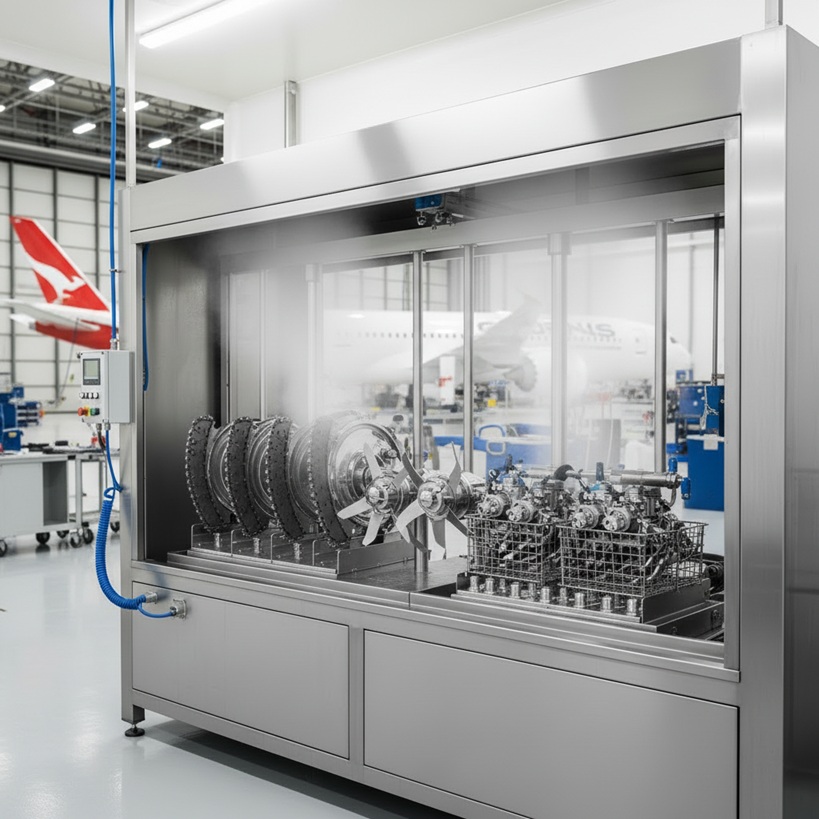
Aircraft maintenance facilities across Australia face a critical challenge: cleaning components to standards that satisfy both Civil Aviation Safety Authority (CASA) regulations and original equipment manufacturer (OEM) specifications. A single contaminated part can compromise flight safety, trigger costly rework, or ground an aircraft indefinitely. For maintenance organisations holding CASA Part 145 approvals, the stakes extend beyond operational efficiency – they encompass regulatory compliance, airworthiness certification, and the fundamental safety of every aircraft returning to service.
The complexity intensifies when maintenance teams must reconcile CASA’s regulatory framework with manufacturer-specific cleaning protocols that vary between Boeing, Airbus, Pratt & Whitney, and Rolls-Royce components. Traditional manual cleaning methods struggle to deliver the consistency and traceability these dual requirements demand. A hydraulic valve cleaned to visual standards may still harbour microscopic contamination that exceeds OEM particle count limits. An engine component washed with an incompatible solvent may suffer material degradation that manifests thousands of flight hours later.
Hotwash Australia systems address these challenges through controlled, repeatable cleaning processes that generate the documentation CASA inspectors and quality assurance teams require. Rather than relying on technician judgement and manual scrubbing, automated parts washers deliver consistent results across shifts, facilities, and component types.
Understanding CASA’s Component Cleaning Requirements
CASA regulations don’t prescribe specific cleaning methods for every component type. Instead, Civil Aviation Safety Regulation (CASR) Part 145 establishes a framework requiring maintenance organisations to follow procedures that ensure airworthiness. This regulatory approach places responsibility on approved maintenance organisations (AMOs) to develop and implement aviation parts cleaning regulations that meet both CASA standards and manufacturer specifications.
Regulatory Framework and Compliance Standards
The critical regulatory touchpoint appears in CASR 145.A.45, which requires maintenance organisations to establish procedures covering all aspects of maintenance work. For aircraft component cleaning CASA compliance, this translates to documented procedures that specify:
Cleaning agent compatibility – Chemicals must not degrade component materials or leave residues that affect performance. Using an alkaline cleaner on aluminium alloy components, for example, can cause surface etching that creates stress concentration points.
Contamination removal standards – Procedures must define acceptable cleanliness levels for different component types. A fuel system component requires particle counts measured in microns, while structural components may permit visual cleanliness standards.
Process verification methods – Quality assurance procedures must confirm cleaning effectiveness through inspection, testing, or measurement. This documentation becomes essential during CASA audits and component release certification.
Traceability requirements – Maintenance records must demonstrate which cleaning procedure was applied to each component, including cleaning agent batch numbers, process parameters, and inspection results.
Practical Application Across Component Types
The regulatory framework intersects with practical reality when maintenance technicians discover that “clean” means different things for different components. A landing gear assembly requires removal of hydraulic fluid, dirt, and corrosion products without damaging protective coatings. An engine compressor blade demands removal of carbon deposits and salt contamination to tolerances measured in thousandths of an inch. A fuel control unit needs cleaning that eliminates particles down to 5 microns while preserving calibration seals and sensitive internal components.
Heavy-duty parts washers provide the controlled environment necessary to meet these varying standards through programmable wash cycles, filtration systems, and temperature control that manual methods cannot replicate consistently.
Reconciling OEM Specifications with Regulatory Standards
Original equipment manufacturers issue component maintenance manuals (CMMs) and structural repair manuals (SRMs) that specify cleaning requirements with precision that often exceeds CASA’s regulatory framework. Boeing’s CMM for CFM56 engine components, for instance, specifies cleaning agents by military specification number, maximum cleaning solution temperature ranges within 5-degree tolerances, and particle count limits verified through laboratory analysis.
Documentation Challenges for Maintenance Organisations
This creates a documentation challenge for maintenance organisations: CASA requires compliance with manufacturer specifications as part of the airworthiness approval process, but verifying that compliance demands measurement capabilities and process control that manual cleaning cannot provide.
Consider the cleaning requirements for a typical turbine engine fuel nozzle. The OEM specification might require:
- Complete removal of carbon deposits and varnish from internal passages
- Final cleanliness verified to NAS 1638 Class 6 or better (fewer than 1,000 particles per 100ml larger than 5 microns)
- No residual cleaning agent that could affect fuel atomisation
- Inspection of internal surfaces using a borescope after cleaning
- Documentation of cleaning solution concentration, temperature, and exposure time
Manual vs Automated Cleaning Approaches
Achieving these standards manually requires technicians to disassemble components, hand-clean internal passages with brushes and solvent, verify cleanliness through multiple rinse cycles, and document every step. The process consumes hours per component, introduces variability between technicians, and generates quality escapes when microscopic contamination survives visual inspection.
Industrial parts washers eliminate this variability through programmable cleaning cycles that maintain consistent solution temperature, spray pressure, and exposure time. The system documents process parameters automatically, creating the traceability records CASA inspectors require without manual data entry prone to transcription errors.
Critical Cleaning Applications in Aircraft Maintenance
Different aircraft systems present distinct cleaning challenges that demand specific approaches to satisfy both regulatory and OEM requirements for aircraft component cleaning CASA compliance.
Fuel System Components
Fuel system components including pumps, valves, filters, and control units require cleaning that removes contamination without introducing particles or residues that could affect engine performance. Jet fuel contamination standards (ASTM D1655) specify maximum particle counts and water content that fuel system components must not exceed after maintenance.
Material Compatibility Considerations
The cleaning challenge intensifies because many fuel system components contain elastomeric seals, electronic sensors, and calibrated mechanical assemblies that cannot withstand aggressive cleaning methods. Using high-temperature cleaning solutions or incompatible solvents can swell seals, damage sensor coatings, or alter calibration settings.
Hot tank systems provide the controlled immersion cleaning necessary for complex fuel system components. The heated solution penetrates internal passages and complex geometries while maintaining temperatures below the threshold that damages sensitive components. Filtration systems remove contamination from the cleaning solution, preventing redeposition on cleaned parts.
Hydraulic System Components
Aircraft hydraulic components operate at pressures exceeding 3,000 PSI, where microscopic contamination can cause servo valve failures, actuator malfunctions, or complete system shutdown. Boeing and Airbus specifications typically require hydraulic component cleaning to ISO 4406 cleanliness codes of 15/13/10 or better – meaning fewer than 160 particles per millilitre larger than 4 microns.
Particle Count Verification Challenges
Achieving these cleanliness levels requires not just removing visible contamination, but eliminating particles invisible to the naked eye. Manual cleaning with solvent and rags cannot verify particle counts at this level. Even ultrasonic cleaning tanks, while effective at removing bonded contamination, require controlled solution filtration and final rinse procedures to meet aerospace cleanliness standards.
Automated spray washing systems address this challenge through multi-stage cleaning cycles: an initial high-pressure wash removes bulk contamination, a heated detergent stage dissolves oils and greases, and multiple filtered rinse stages reduce particle counts to specification levels. The closed-loop filtration system prevents contamination removed from one component from depositing on another.
Engine Components
Turbine engine maintenance generates engine components requiring cleaning that range from light degreasing to aggressive carbon deposit removal. Compressor blades need cleaning to preserve aerodynamic profiles measured in thousandths of an inch. Combustion chamber components require the removal of carbon deposits millimetres thick without damaging thermal barrier coatings. Turbine disks demand cleaning that reveals cracks and defects for non-destructive testing.
Manufacturer-Specific Protocols
Pratt & Whitney and Rolls-Royce engine manuals specify cleaning procedures by component type and contamination level. Light contamination might permit aqueous cleaning with alkaline solutions at controlled concentrations. Heavy carbon buildup might require chemical stripping with hazardous materials that demand specialised handling and disposal procedures.
The regulatory compliance challenge emerges when maintenance organisations must document that each component received the manufacturer-specified cleaning method and achieved the required cleanliness level. Manual processes generate documentation through handwritten logbook entries and inspection sign-offs that introduce opportunities for errors and omissions.
Super heavy-duty parts washers designed for aerospace applications incorporate automated cycle documentation that records cleaning procedures, solution concentrations, and process completion times. This automated record-keeping satisfies CASA traceability requirements while eliminating manual documentation errors.
Material Compatibility and Corrosion Prevention
Aircraft components incorporate materials selected for specific performance characteristics: aluminium alloys for weight reduction, titanium for high-temperature applications, composite materials for structural efficiency, and specialised coatings for corrosion protection. Each material presents cleaning compatibility requirements that maintenance organisations must address to prevent damage.
CASA Continuing Airworthiness Requirements
CASA’s continuing airworthiness requirements prohibit maintenance practices that degrade component materials or protective finishes. Using an incompatible cleaning agent constitutes improper maintenance that can void component airworthiness certification and expose the maintenance organisation to regulatory enforcement action.
The material compatibility challenge manifests in several common scenarios:
Aluminium Alloy Corrosion
Alkaline cleaning solutions with pH above 10 can cause surface etching and intergranular corrosion in aluminium alloys. Boeing specifications typically restrict cleaning solutions for aluminium components to pH ranges between 9 and 10.5, with exposure time limits and mandatory corrosion inhibitor additives.
Cadmium Plating Degradation
Many steel components receive cadmium plating for corrosion protection. Acidic cleaning solutions or excessive mechanical scrubbing can damage this plating, exposing the underlying steel to corrosion. OEM specifications often require visual inspection of cadmium-plated components after cleaning to verify plating integrity.
Composite Material Delamination
Carbon fibre and fibreglass composite structures require cleaning procedures that don’t introduce moisture into the laminate structure or degrade the resin matrix. High-temperature cleaning or aggressive solvents can cause delamination that compromises structural integrity.
Coating Preservation
Thermal barrier coatings on turbine components, anodised finishes on aluminium parts, and protective primers on steel structures all require cleaning procedures that preserve coating adhesion and thickness. Abrasive cleaning methods or incompatible chemicals can remove these protective layers.
Stainless steel parts washers eliminate cross-contamination risks that manual cleaning introduces. A component cleaned in a stainless steel wash cabinet won’t pick up rust particles from a corroded steel sink or absorb incompatible chemicals from previous cleaning operations. The controlled environment ensures material compatibility through every cleaning cycle.
Documentation and Traceability for CASA Compliance
CASA auditors reviewing maintenance organisation procedures focus heavily on documentation systems that demonstrate airworthiness compliance. For aircraft component cleaning CASA operations, this means maintenance records must prove that each component received cleaning appropriate to its type, contamination level, and manufacturer specifications.
Required Documentation Elements
The documentation requirements extend beyond simple work order entries. CASA expects maintenance organisations to maintain records showing:
Procedure identification – Which approved cleaning procedure was applied to each component, including procedure revision level and approval date.
Process parameters – Cleaning solution type and concentration, temperature ranges, cycle duration, and any deviations from standard procedures.
Inspection results – Visual inspection findings, particle count measurements, or other verification methods confirming cleaning effectiveness.
Material traceability – Cleaning agent batch numbers, solution change dates, and filter replacement records that demonstrate proper maintenance of the cleaning system itself.
Personnel qualifications – Records showing that technicians performing cleaning and inspection hold appropriate licences, ratings, and training for the work performed.
Automated Documentation Systems
Manual cleaning processes generate this documentation through paper forms, logbook entries, and inspection stamps that require technician diligence and supervisor verification. The system works until production pressure, personnel turnover, or simple human error creates documentation gaps that CASA auditors identify during facility inspections.
Automated parts washers transform documentation from a manual burden into an automated byproduct of the cleaning process. When a technician loads components and initiates a programmed wash cycle, the system automatically records cycle start time, solution temperature throughout the cycle, spray pressure readings, and cycle completion confirmation. This data feeds directly into maintenance tracking systems without manual transcription.
Quality Assurance Integration
The documentation advantage extends to quality assurance verification. Rather than relying on a supervisor to spot-check cleaning results and sign inspection forms, automated systems can require inspection confirmation before releasing components from the wash chamber. The system timestamps the inspection completion and links it to the specific cleaning cycle, creating an unbroken documentation chain from dirty component receipt to clean component release.
Implementing Compliant Cleaning Systems in Maintenance Facilities
Transitioning from manual cleaning methods to automated systems that satisfy both CASA requirements and OEM specifications demands more than equipment purchase. Maintenance organisations must integrate new cleaning capabilities into existing quality systems, train personnel on proper operation, and validate that the new process meets all applicable standards for aviation parts cleaning regulations.
Implementation Process Steps:
The implementation process typically follows this sequence:
Requirements Analysis
Review component types, contamination levels, and manufacturer cleaning specifications to determine system capacity, cleaning methods, and automation features required.
Procedure Development
Write cleaning procedures that reference specific equipment settings, cleaning agents, and verification methods. These procedures must receive quality assurance approval and CASA acceptance as part of the maintenance organisation’s procedures manual.
Personnel Training
Train maintenance technicians and inspectors on equipment operation, safety procedures, and documentation requirements. Training records become part of the personnel qualification documentation CASA reviews during audits.
Process Validation
Clean representative components using the new system and verify results meet OEM cleanliness specifications through laboratory testing, particle count analysis, or other measurement methods. Validation data demonstrates to CASA that the procedure achieves its intended results.
Ongoing Verification
Establish periodic checks that confirm continued cleaning effectiveness, such as monthly particle count testing of hydraulic components or quarterly verification of cleaning solution concentration and pH.
Regulatory Approval Framework
The regulatory approval process doesn’t require CASA to individually approve each cleaning procedure or equipment installation. Instead, CASA approves the maintenance organisation’s quality system, including procedures for developing, validating, and controlling maintenance procedures. The cleaning system implementation becomes an internal quality assurance activity that CASA auditors review during periodic facility inspections.
This regulatory framework allows maintenance organisations to continuously improve their capabilities without waiting for individual approvals. When a facility installs extra heavy-duty parts washers capable of handling larger components or achieving better cleanliness levels, the organisation updates its procedures manual, validates the new process, and implements the change under its existing quality system.
Balancing Efficiency with Compliance Requirements
Aircraft maintenance facilities operate under constant pressure to reduce turnaround times while maintaining perfect quality and regulatory compliance. Component cleaning represents a bottleneck in many maintenance operations – technicians wait for parts to be cleaned before reassembly can proceed, extending aircraft downtime and delaying return to service.
Operational Efficiency Challenges
The efficiency challenge intensifies when cleaning requirements demand multiple process steps: initial degreasing, detailed cleaning, rinse cycles, drying, and inspection. Manual methods require technicians to move components between cleaning stations, monitor process timing, and verify completion of each step. The labour intensity drives maintenance costs while introducing opportunities for process shortcuts that compromise cleanliness.
Labour Savings Through Automation
Automated cleaning systems collapse these multiple steps into single-cycle operations that free technicians for higher-value work. A component that required two hours of manual cleaning, rinsing, and drying is completed in a 45-minute automated cycle that requires only loading and unloading labour. The system handles process timing, temperature control, and cycle sequencing without technician monitoring.
The labour savings translate directly to reduced maintenance costs and shorter aircraft downtime. An engine shop processing 20 fuel nozzles per week saves 30 technician hours by eliminating manual cleaning labour. Those hours are redirected to inspection, assembly, and testing activities that directly advance aircraft return to service. The aircraft operator gains additional revenue days as maintenance turnaround time decreases.
Quality Cost Reduction
Beyond direct labour savings, automated systems reduce quality escapes that trigger costly rework. A fuel control unit that passes visual inspection but retains microscopic contamination may fail functional testing after reassembly, requiring disassembly, recleaning, and repeated testing. The rework consumes additional labour hours and extends aircraft downtime. Automated cleaning that achieves specified cleanliness levels in the first cycle eliminates this rework loop.
Conclusion
Aircraft component cleaning CASA compliance sits at the intersection of regulatory requirements, manufacturer specifications, and operational efficiency. CASA’s airworthiness requirements demand documented procedures and verifiable results, while OEM specifications define cleanliness standards that manual methods struggle to achieve consistently. Maintenance organisations navigating these dual requirements face documentation burdens, material compatibility challenges, and efficiency pressures that traditional cleaning approaches cannot adequately address.
Automated parts washers resolve these challenges through controlled, repeatable processes that generate the documentation CASA requires while achieving the cleanliness levels manufacturers specify. The investment in proper cleaning equipment delivers returns through reduced labour costs, shorter turnaround times, and elimination of quality escapes that trigger expensive rework.
For maintenance organisations holding CASA Part 145 approvals, the question isn’t whether to implement automated cleaning systems, but when to make the transition that transforms component cleaning from a compliance burden into a competitive advantage. The facilities that make this transition gain operational efficiency while strengthening their aviation parts cleaning regulations compliance posture – a combination that benefits aircraft operators, maintenance teams, and ultimately the safety of every flight.
Contact us to discuss how Australian-engineered parts washing systems can help maintenance facilities meet CASA requirements while improving operational efficiency and reducing component turnaround times.

Leave A Comment