
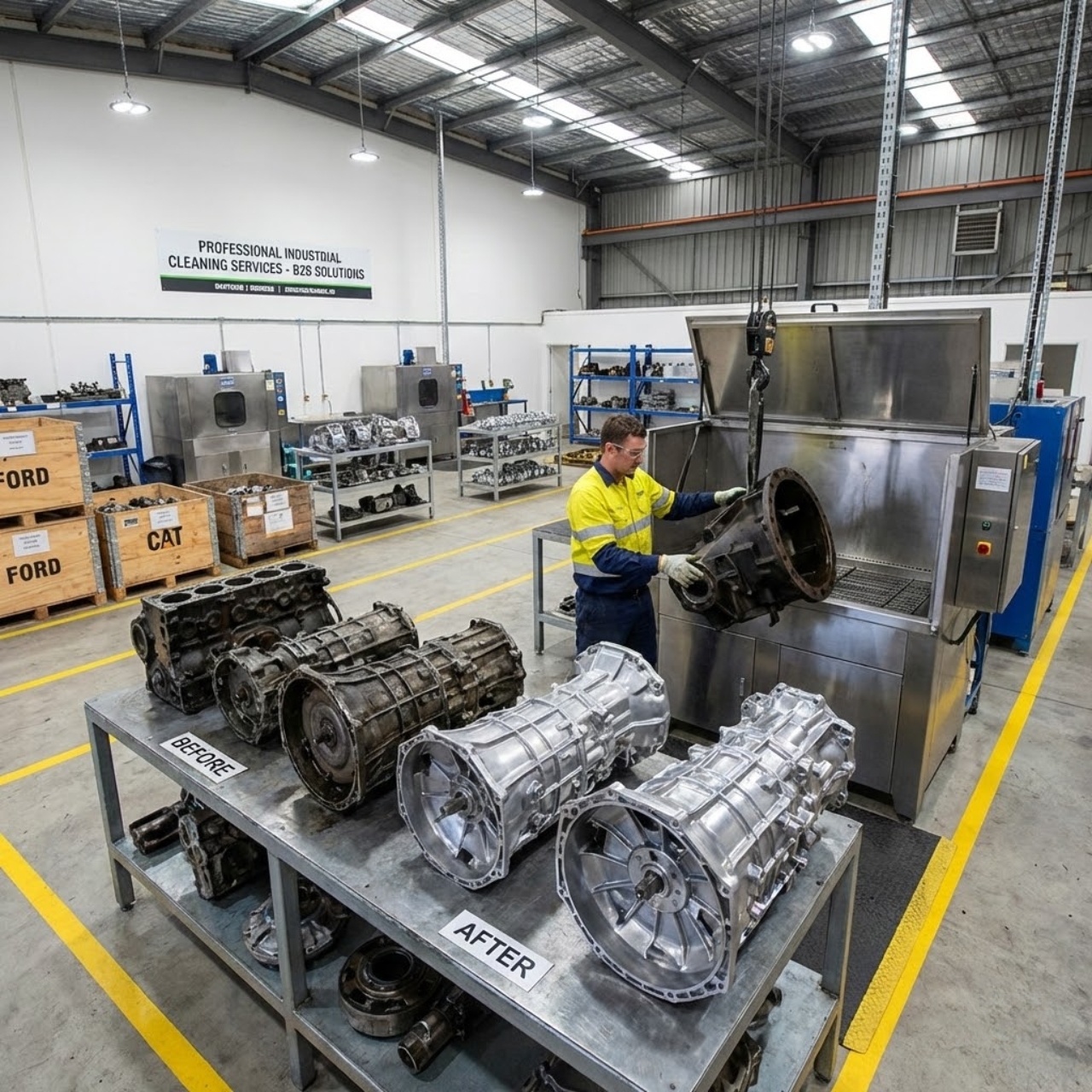
Workshop owners and service centre operators face constant pressure to increase revenue per square metre. While most focus on their core services, a significant opportunity sits overlooked – industrial parts cleaning represents a high-margin service line that complements existing operations without requiring complete business restructuring.
Parts cleaning service revenue potential stems from a simple reality: every workshop, maintenance facility, and industrial operation generates dirty components that need professional cleaning. Mining operations remove drill bits caked with mud and drilling fluids. Automotive workshops deal with oil-covered engine blocks. Manufacturing facilities need fabrication components cleaned before quality inspection. These cleaning needs exist whether businesses address them efficiently or not.
The difference between manual scrubbing and professional parts cleaning systems determines whether this task becomes a profit centre or a cost drain. Operations that treat parts cleaning as a revenue-generating service rather than a necessary evil create competitive advantages while improving their bottom line.
Why Parts Cleaning Creates Service Revenue Opportunities
Traditional workshop services – repairs, maintenance, fabrication – require skilled labour that commands high wages. Parts cleaning, when properly automated, delivers consistent results with minimal labour input. This creates an unusual profit dynamic: high service value to customers, low operational cost to providers.
Consider a mining service contractor currently sending contaminated drill bits to external cleaning specialists. Each shipment involves transport costs, turnaround delays, and coordination headaches. If that contractor installed industrial cleaning equipment, they could offer same-day cleaning services to other mining operations in their region. The equipment pays for itself through internal use while generating additional parts cleaning service revenue from external customers.
The same principle applies across industries. Automotive workshops that install heavy-duty parts washers can offer engine cleaning services to other mechanics, mobile service providers, and equipment rental companies. Food processing facilities with stainless steel cleaning systems can clean equipment for neighbouring food manufacturers during off-peak hours.
Service Models That Generate Parts Cleaning Revenue
Per-Item Cleaning Services
The simplest revenue model charges customers per component cleaned. A workshop sets pricing based on part size, contamination level, and cleaning complexity. Small automotive components might cost $15-30 per piece, while large mining equipment parts command $200-500 depending on dimensions and contamination severity.
Per-item cleaning services work particularly well for operations with excess cleaning throughput capacity. If internal parts cleaning equipment runs at 40% capacity, the remaining 60% represents pure revenue opportunity. The fixed costs – equipment depreciation, facility space, utilities – exist whether the system runs at 40% or 100% capacity. Additional cleaning jobs contribute almost entirely to industrial cleaning margins.
Contract Cleaning Agreements
Regular customers benefit from predictable pricing through monthly or quarterly contract cleaning agreements. A mining service contractor might agree to clean 200 drill bits monthly at a fixed rate, guaranteeing the cleaning provider consistent revenue while giving the customer budget certainty and priority service.
Contract cleaning agreements often include pickup and delivery, creating additional service touchpoints and relationship depth. These ongoing relationships frequently expand into other services as trust builds and customers discover additional capabilities.
Emergency and Expedited Services
Industrial operations occasionally face urgent cleaning needs – equipment failures requiring immediate component cleaning, quality control issues demanding rapid turnaround, production delays where every hour matters. Operations that can deliver same-day or next-day cleaning services command premium pricing for this responsiveness.
Emergency cleaning services typically charge 50-100% premiums over standard rates. A component that normally costs $80 to clean might command $120-160 for same-day service. For operations with automated cleaning equipment, delivering this premium service requires no additional labour – just prioritising one job over others.
Industries With Unmet Parts Cleaning Demand
Mining and Resources Sector
Mining operations generate enormous parts cleaning demand. Drill bits, excavator components, conveyor parts, and processing equipment require regular cleaning to maintain performance and enable inspection. Many mining sites lack adequate cleaning infrastructure, relying on manual methods or sending components off-site.
Service providers near mining regions can establish cleaning operations specifically targeting this sector. Extra heavy-duty systems handle the extreme contamination levels – mud, coal dust, drilling fluids, heavy grease – that characterise mining equipment. A single service centre can support multiple mining operations within a 100-kilometre radius.
The key advantage: mining companies pay for results, not hours. A component that takes workers four hours to manually clean might justify a $300 cleaning fee. If automated equipment cleans that same component in 45 minutes with minimal labour input, the service provider captures significant industrial cleaning margins while delivering faster turnaround than manual methods.
Automotive and Heavy Vehicle Maintenance
Automotive workshops face parts cleaning needs daily but rarely invest in professional equipment. Engine rebuilds require spotless components. Transmission repairs demand contamination-free parts. Brake and suspension work benefits from cleaned components that allow proper inspection.
Most workshops either skip thorough cleaning – compromising quality – or waste technician time on manual scrubbing. A specialised cleaning service that offers same-day turnaround for engine blocks, cylinder heads, transmission cases, and other components fills a genuine market gap.
Mobile mechanics and equipment rental companies represent particularly attractive customers. These operations lack facilities for parts cleaning but need the service regularly. A workshop with industrial spray washers can become their go-to cleaning provider, creating recurring parts cleaning service revenue from customers who have no alternative.
Manufacturing and Fabrication Operations
Manufacturing facilities clean components at multiple production stages – after machining, before assembly, during quality control, and for rework processes. Many manufacturers use inadequate cleaning methods because investing in proper equipment seems outside their core competency.
A service provider near manufacturing clusters can offer cleaning services that integrate into production workflows. Morning pickup, same-day cleaning, afternoon return becomes a seamless extension of the manufacturer’s operations. For the service provider, this creates predictable daily revenue with minimal sales effort once relationships establish.
Food Processing and Commercial Kitchens
Food industry operations require frequent, thorough cleaning of processing equipment, commercial kitchen components, and food contact surfaces. Hygiene standards demand professional-grade cleaning that manual methods struggle to achieve consistently.
Operations with food-grade stainless steel systems can offer cleaning services to restaurants, commercial kitchens, food processing plants, and catering operations. The service model often includes regular scheduled cleaning – weekly or monthly – creating subscription-like revenue stability.
Equipment Investment vs Revenue Potential
Parts cleaning service revenue depends on matching equipment capacity to market demand. A manual parts washer suitable for small workshop needs costs $8,000-15,000 and handles limited cleaning throughput capacity. This equipment suits operations testing the service concept with existing customers before major investment.
Heavy-duty automated systems represent $40,000-80,000 investments but deliver dramatically higher throughput and consistency. An operation running two cleaning cycles daily generates $400-800 in service revenue. Over 250 working days annually, that produces $100,000-200,000 in gross revenue from a single system.
The calculation becomes compelling when considering that much of this revenue comes from excess capacity. If a workshop invests in cleaning equipment primarily for internal use, any external cleaning services represent almost pure profit contribution after covering marginal costs like detergent and utilities.
Return on investment timelines vary by business model. An operation with immediate access to regular customers might recover equipment costs within 12-18 months. Businesses building customer bases from scratch typically see 24-36 month payback periods. Either timeline compares favourably to many capital equipment investments.
Operational Requirements for Service Success
Consistent Quality Standards
Service businesses succeed or fail on consistency. Customers paying for parts cleaning expect the same spotless results every time, regardless of which staff member operates equipment or how busy the facility runs that day.
Automated cleaning equipment delivers this consistency naturally. The same cycle parameters – temperature, pressure, duration, detergent concentration – produce identical results. This eliminates the quality variation inherent in manual cleaning, where results depend on worker skill, fatigue, and attention to detail.
Turnaround Time Commitments
Industrial customers value speed. A mining operation with equipment down loses thousands of dollars hourly. A manufacturer with components awaiting cleaning delays production. Service providers that deliver predictable, fast turnaround times capture premium pricing and customer loyalty.
Hot tank systems and high-temperature spray washers reduce cleaning time from hours to minutes for many applications. This speed advantage becomes a core service differentiator – customers choose providers who return cleaned components fastest, not necessarily cheapest.
Pickup and Delivery Logistics
Many potential customers would use parts cleaning services but lack time or vehicles to transport components. Service providers that offer pickup and delivery remove this friction, expanding their addressable market significantly.
A dedicated pickup route visiting 10-15 regular customers takes 3-4 hours but can collect $2,000-4,000 worth of cleaning work. The logistics cost – vehicle, fuel, driver time – represents perhaps 20-25% of revenue, leaving substantial industrial cleaning margins while providing customer convenience that justifies premium pricing.
Capacity Planning
Parts cleaning service revenue depends on available cleaning throughput capacity. An operation running cleaning equipment at maximum capacity cannot accept additional customers without investment in additional systems or extended operating hours.
Smart service providers plan capacity in stages. Initial investment handles internal needs plus 30-40% excess capacity for external customers. As that capacity fills, a second system installation doubles capacity before turning away customers. This staged approach matches capital investment to proven demand rather than speculating on future growth.
Marketing Parts Cleaning Services to Industrial Customers
Direct Outreach to Target Industries
Parts cleaning services sell through direct relationship building, not advertising. Service providers identify potential customers – mining contractors, automotive workshops, manufacturing facilities – and approach them with specific value propositions.
The pitch focuses on pain points: “Technicians currently spend 6 hours weekly manually cleaning components. This service handles that work for $400 monthly, freeing skilled staff for billable work.” This positions cleaning services as profit improvements, not costs.
Demonstration and Trial Services
Industrial customers resist new service providers until they verify quality and reliability. Offering discounted trial services – “Send five of the dirtiest components at 50% off standard pricing” – overcomes initial resistance and demonstrates capabilities.
Once customers experience professional parts cleaning results and fast turnaround, most become regular clients. The trial investment pays back quickly through ongoing revenue from converted customers.
Referral Networks
Industrial service businesses cluster in networks where reputation travels quickly. A mining service contractor satisfied with cleaning services mentions the provider to other contractors. An automotive workshop recommends the service to other mechanics in their professional network.
Service providers who deliver exceptional results and reliability benefit from organic referral growth that requires no marketing investment. This word-of-mouth growth typically accelerates after the first 12-18 months as reputation establishes.
Integrating Cleaning Services Into Existing Operations
Workflow Integration
Successful service additions complement rather than disrupt existing operations. Parts cleaning services integrate naturally into workshop workflows – components arrive dirty, get cleaned during normal production cycles, and return to customers without requiring dedicated staff or facility reorganisation.
Operations with super heavy-duty systems for internal needs often discover they can process external customer work during off-peak hours or between internal jobs. This utilises existing equipment investment without operational disruption.
Staff Training Requirements
Modern automated cleaning equipment requires minimal training – typically 2-4 hours for basic operation. Staff learn to load components, select appropriate cycles, and safely unload cleaned parts. This simplicity means existing workshop staff can handle cleaning services without hiring specialised operators.
The training investment pays immediate returns. Staff who previously spent hours manually scrubbing components now load automated equipment, start cycles, and return to higher-value work while cleaning proceeds unattended.
Quality Control Processes
Service businesses need consistent quality verification. Simple inspection protocols – visual checks, spot testing, customer feedback tracking – ensure every component meets standards before return to customers.
These quality processes take minutes per batch but prevent the reputation damage and rework costs that come from returning inadequately cleaned components. Operations that implement basic quality controls from day one avoid problems that plague service providers who prioritise speed over consistency.
Financial Performance Metrics
Revenue Per System Hour
Service providers should track revenue generated per hour of equipment operation. A system producing $60-80 per operating hour indicates healthy pricing and utilisation. Lower figures suggest either inadequate pricing or insufficient customer volume to justify the investment.
This metric helps operators decide when additional capacity investment makes sense. When revenue per hour consistently exceeds $80-100 and the system runs near capacity, adding equipment becomes clearly justified.
Customer Acquisition Cost vs Lifetime Value
Industrial service customers typically remain loyal for years once relationships establish. A customer generating $300 monthly in cleaning revenue produces $3,600 annually and potentially $18,000-36,000 over a 5-10 year relationship.
This high lifetime value justifies significant acquisition investment. Spending $500-1,000 to acquire a customer through trials, demonstrations, or relationship building delivers strong returns when that customer provides years of recurring parts cleaning service revenue.
Margin Analysis by Service Type
Different cleaning services produce different industrial cleaning margins. Small, simple components might generate 60-70% gross margins – minimal processing time, standard cycles, low handling complexity. Large, heavily contaminated components might produce 40-50% margins despite higher absolute pricing due to longer cycle times and more careful handling.
Understanding these margin differences helps service providers optimise their customer mix and pricing strategies. Some operations focus on high-volume, simpler work that maximises cleaning throughput capacity. Others target complex, high-value jobs that command premium pricing despite lower volumes.
Conclusion
Parts cleaning service revenue represents one of the most accessible expansion opportunities for workshop operators, service centres, and industrial maintenance facilities. The service complements existing operations, requires moderate capital investment, and addresses genuine market demand that many potential customers currently meet inadequately or not at all.
Success depends on matching equipment capacity to market opportunity, delivering consistent quality and fast turnaround, and building relationships with industrial customers who value professional results over manual cleaning methods. Operations that approach parts cleaning as a strategic service line rather than an equipment purchase create sustainable competitive advantages while improving facility profitability.
The Australian industrial sector continues growing, with mining, manufacturing, and heavy industry operations requiring ever-higher equipment performance and reliability. Professional parts cleaning services support these requirements while generating attractive returns for service providers who invest in proper equipment and operational processes.
For workshops and service centres evaluating expansion opportunities, parts cleaning offers lower risk and faster payback than many alternatives. The service leverages existing customer relationships, requires no specialised technical expertise, and generates revenue from equipment that also serves internal operational needs.
Contact us to discuss how industrial parts cleaning equipment can create new revenue streams for operations while improving internal cleaning efficiency and component quality.

Leave A Comment