
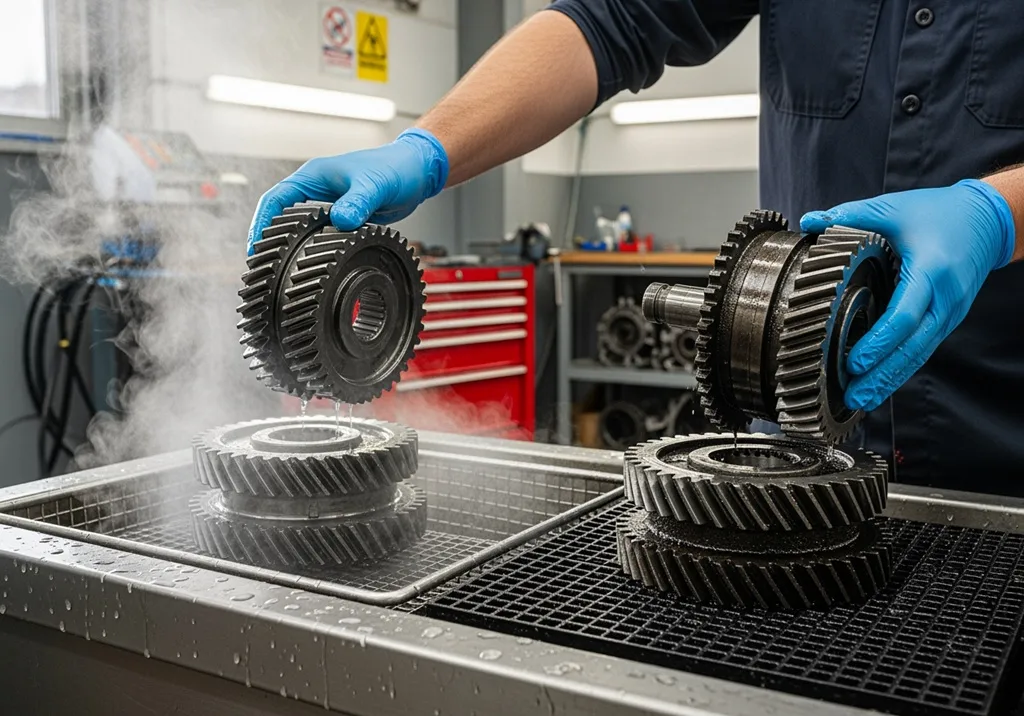
When Australian workshops and mining sites cool down overnight, the contamination on parts hardens. Oils thicken. Grease solidifies. Carbon deposits set like concrete. By the time the first shift arrives, components that need cleaning are carrying winter sludge that resists manual scrubbing and cold-water methods alike.
Understanding why hot water cleans this contamination faster comes down to basic physics. Thermal shock is the rapid temperature change when hot water hits cold, hardened deposits. This reaction breaks contamination bonds quickly. What manual scrubbing takes hours to remove, a heated spray washer lifts in minutes. This guide explains the science behind that difference and how to apply it in your operation.
What Makes Winter Sludge So Stubborn
Winter sludge is not just dirty. It is chemically and physically different from the same contamination at 25°C. Cold temperature transforms soft, manageable deposits into hard, adherent layers that resist standard parts cleaning approaches. Effective sludge removal in winter requires a method that accounts for this physical change – not simply more effort with the same tools.
How Cold Changes Contamination
The molecular structure of oils and greases changes as they lose heat. Oils become viscous – cold temperature turns fluid contamination into semi-solid deposits that cling to surfaces. Grease thickens dramatically, often requiring mechanical force to dislodge when cold.
Carbon deposits add a separate layer of difficulty. Engine components, exhaust parts, and combustion chambers accumulate carbon that bakes on at high temperatures, then hardens further when cooled. These deposits resist standard parts washers – unless aqueous cleaning heat creates the thermal shock needed to fracture them.
A loader bucket caked in mud and hydraulic oil at 5°C presents a completely different cleaning challenge than the same bucket at 25°C. That temperature difference changes the entire approach required to achieve clean results.
Why Traditional Methods Struggle
The traditional response to winter sludge involves harsh chemical solvents, extended soaking in caustic tanks, or hours of manual scrubbing. Each approach has serious drawbacks.
Solvents expose workers to toxic fumes and skin contact risks. These problems get worse in winter when workshops close up to retain heat. Overnight soaking requires parts to sit idle for hours. Manual scrubbing consumes productive labour time and delivers inconsistent results that often need a second pass. For operations that rely on consistent winter grease removal, none of these parts cleaning methods delivers reliable results at scale.
Thermal shock parts cleaning is a faster, safer, and more consistent alternative.
The Physics of Thermal Shock Cleaning
Thermal shock occurs when materials experience rapid temperature change. In parts washing, this means hitting cold, hardened contamination with water heated to 60-85°C. The sudden temperature differential creates multiple simultaneous cleaning effects that work together to lift deposits fast. Thermal shock cleaning is not a brute-force approach – it is a precise physical reaction that breaks contamination bonds at the molecular level.
How Aqueous Cleaning Heat Fractures Hardened Deposits
When hot water contacts cold contamination, it causes immediate thermal expansion. Contaminants expand at a different rate than the metal substrate beneath them. This differential expansion breaks the physical bond between grime and surface. It creates microscopic cracks and separation points in deposits that were previously locked in place.
What was a solid layer becomes a fractured coating ready to lift away. Aqueous cleaning heat does this in seconds. No mechanical force, no harsh chemistry – just the physics of rapid temperature change working against the bond holding sludge to metal.
The Four Cleaning Effects of Hot Water
Heat delivers four simultaneous cleaning effects that cold water cannot replicate.
First, thermal expansion fractures deposits as described above. Second, heat reduces viscosity dramatically. Oil that was thick and sticky at low temperature becomes fluid and mobile at 70°C. Grease melts. Both flow off surfaces rather than cling to them.
Third, hot water parts washing increases the kinetic energy of water molecules. Faster-moving water molecules penetrate contamination layers more effectively, reach the metal surface beneath, and physically displace what remains.
Fourth, heat improves biodegradable detergent performance. Surfactants in heavy duty parts washers work by reducing surface tension between water and oil. At elevated temperatures, these surfactants become more active, creating better emulsification of oils and grease. The combination of hot water and active detergent produces cleaning power far beyond either element working alone.
Temperature Thresholds for Effective Sludge Removal
Not all hot water delivers the same thermal shock results. Selecting the right parts washer temperature is one of the most important decisions a workshop manager can make. Match it to your contamination level for best results.
Below 60°C: Marginal Results
Below 40°C, water provides minimal thermal shock benefit. In the 40-60°C range, cleaning effectiveness improves – oil viscosity drops and thermal expansion begins breaking surface bonds. But this range still requires extended cycle times for complete sludge removal from winter-hardened contamination.
60-75°C: The Effective Cleaning Range
This is where thermal shock cleaning becomes highly effective. Oil and grease become fully fluid. Carbon deposits begin lifting from surfaces. Biodegradable detergents reach peak activity. Industrial spray washers operating in this range clean most components efficiently – the standard that heated spray consistently achieves.
Hotwash Australia supplies heated industrial cleaning equipment across every temperature tier – from light workshop applications to the most demanding mining contamination. Most mining equipment with heavy mud, grease, and oil responds well to the upper end of this range.
Above 75°C: Maximum Power for Heavy Contamination
Above 75°C, cleaning power continues increasing. Water at 80-85°C requires more energy to maintain and increases evaporation rates. For extreme contamination on robust parts, this range delivers maximum results.
These machines operate safely in this range. They are trusted by major Australian mining operations for cleaning the most severely contaminated components. Engine components with baked carbon benefit from higher temperatures. Food processing equipment typically uses a lower range to maintain hygiene standards and protect seals and surfaces.
How Pressure Amplifies Thermal Shock
Temperature alone does not tell the complete story. High-pressure spray delivery multiplies the effectiveness of thermal shock by adding mechanical force to the cleaning process.
Spray Pressure and Mechanical Force
When heated water exits spray nozzles at high pressure, it creates focused impact zones on contaminated surfaces. This pressure drives hot water and detergent into crevices, blind holes, and complex geometries that soaking cannot reach. The mechanical impact helps dislodge deposits that the heat has already weakened.
Pressure also creates turbulence at the surface boundary layer. As spray jets sweep across contaminated parts, they create flow patterns that prevent contaminants from redepositing. This carries loosened sludge away from the part and into the wash tank, where filtration removes it from the cleaning solution.
Why Combined Heat and Pressure Outperforms Either Alone
The combination of high temperature and high pressure creates a synergistic effect greater than either factor alone. Hot water weakens bonds and reduces viscosity. Pressure provides mechanical force to remove what the heat has loosened.
Hot blasters deliver water at high temperature through high-pressure spray manifolds. These units remove winter sludge from large mining components efficiently. Thermal shock cleaning fractures hardened deposits whilst pressure blasts them away – leaving surfaces clean without manual intervention.
Why Cold Water Cleaning Fails in Winter
Understanding thermal shock also explains why cold water cleaning breaks down as temperatures drop. Without heat to reduce viscosity and create thermal expansion, cold water cannot effectively tackle hardened winter sludge.
Viscosity Problems at Low Temperatures
Cold water cannot significantly reduce the viscosity of thickened oils and greases. These contaminants remain sticky and adherent. They resist spray pressure and detergent action.
Manual scrubbing becomes necessary, adding hours to parts cleaning cycles that an automated hot water system completes in minutes. Winter grease removal by hand is one of the most labour-intensive tasks in any workshop – and one of the most easily avoided with the right equipment.
Chemical degreasers also work more slowly in cold water. Surfactant activity decreases at lower temperatures, reducing the detergent’s ability to emulsify oils and penetrate contamination layers. Workshops are forced to use stronger chemical concentrations – increasing costs and safety risks simultaneously.
The Labour Cost of Cold-Water Methods
The productivity difference between cold water and thermal shock cleaning is significant and measurable. A heavily contaminated component cleans in minutes with hot water spray. The same component may require several hours of scrubbing with cold water and solvents.
That time difference is direct labour cost, every cycle, every shift, across every winter season. Manual parts washers using aqueous solutions offer an improvement over harsh chemical solvents. For high-volume cleaning requirements, automated heated systems deliver the greatest efficiency gains.
Real-World Applications Across Australian Industries
Mining operations, automotive workshops, food processing facilities, and transport yards all deal with winter sludge differently. Hot water parts washing delivers measurable results across each of these sectors.
Mining Operations
Hotwash Australia has deployed over 1,200 automatic parts washers across Australia. When excavator components arrive covered in cold, hardened mud and grease, heated spray washers complete the same cleaning in a fraction of the time manual methods require.
Thermal shock parts cleaning keeps maintenance schedules on track when winter conditions would otherwise slow every cleaning cycle down.
Automotive and Transport Workshops
Engine blocks with baked-on carbon deposits and cold oil residue clean thoroughly in heated spray washers. The thermal shock fractures carbon layers whilst hot detergent solution emulsifies oil – leaving cylinder bores and oil galleries clean. Manual cleaning of the same components takes considerably longer and exposes mechanics to harsh solvents.
Transport workshops cleaning truck components benefit from thermal shock. It removes road grime mixed with diesel fuel and gear oil effectively. These complex contamination mixes resist cold water cleaning but lift away rapidly with hot water parts washing at the right temperature.
Food Processing Facilities
Stainless steel cleaning machines operating at appropriate temperatures remove animal fats, vegetable oils, and protein deposits from food processing equipment. The heat melts fats and oils whilst maintaining temperatures safe for food-grade seals and surfaces. This delivers hygiene standards that manual parts cleaning cannot match consistently.
Energy Efficiency of Heated Aqueous Systems
Workshop managers often question the energy cost of heating cleaning water. The actual numbers are more favourable than most operations expect.
The True Cost Comparison
A modern insulated wash tank maintained throughout the day consumes energy efficiently per cleaning cycle. A mechanic spending several hours cleaning one parts batch incurs full labour time and facility running costs. Automated hot water systems consistently cost less in total – in energy, labour, and chemical use – than manual cleaning methods in almost every realistic comparison.
Environmental Advantages
Replacing solvent-based cold cleaning with hot water and biodegradable detergent eliminates toxic chemical disposal costs. Aqueous cleaning systems also eliminate the flammable storage requirements and hazard controls that solvent-based methods demand.
Hot tanks incorporate water recirculation systems that minimise consumption despite the heating requirement – reducing chemical waste across every cleaning cycle.
Matching Temperature to Your Application
Selecting the right cleaning temperature requires matching contamination type, substrate material, and required cycle time. Getting this right maximises thermal shock effectiveness without wasting energy or risking component damage.
Light, Medium, and Heavy Contamination
Light contamination – fresh oils, water-soluble coolants, light dust – responds to lower temperatures. This delivers adequate thermal shock for recent deposits with minimum energy use.
Medium contamination – thickened grease, mixed oils, dried mud, carbon deposits – requires mid-range temperatures. Most Australian industrial applications fall here. Mining components, fabrication parts, and heavy equipment benefit from this range.
Heavy contamination – baked carbon, cold-hardened grease, thick winter sludge, extreme deposits – demands the upper temperature range. Large mining operations, oil and gas facilities, and heavy manufacturing rely on super heavy duty parts washers running at these temperatures for thorough results on severely contaminated components.
Material Considerations
Aluminium, steel, and stainless steel each have appropriate cleaning temperature ranges. Parts with rubber seals or plastic components require temperature monitoring to prevent damage. Setting the correct parts washer temperature for the substrate matters as much as setting it for the contamination type. Getting both right protects components and maximises cleaning results.
Cycle time also affects temperature selection. Operations needing fast turnaround benefit from higher temperatures. Facilities with longer acceptable cycle times can use moderate temperatures and extended wash periods. This achieves the same outcome with lower energy input.
Conclusion
Thermal shock cleaning transforms winter sludge removal from a labour-intensive struggle into a fast, automated process. Rapid temperature change fractures hardened deposits, aqueous cleaning heat reduces viscosity, and pressure removes what the heat has loosened. Together, these effects deliver cleaning results that cold water and manual methods cannot match.
For Australian workshops and mining operations facing winter conditions, heated parts washer systems overcome the contamination challenges that slow every other cleaning method down. The productivity gains are real – minutes instead of hours, per cycle, per component, across every winter shift.
To find the right heated parts washer for your contamination challenges, contact our aqueous cleaning specialists or email us at sales@hotwash.com.au.

Leave A Comment