
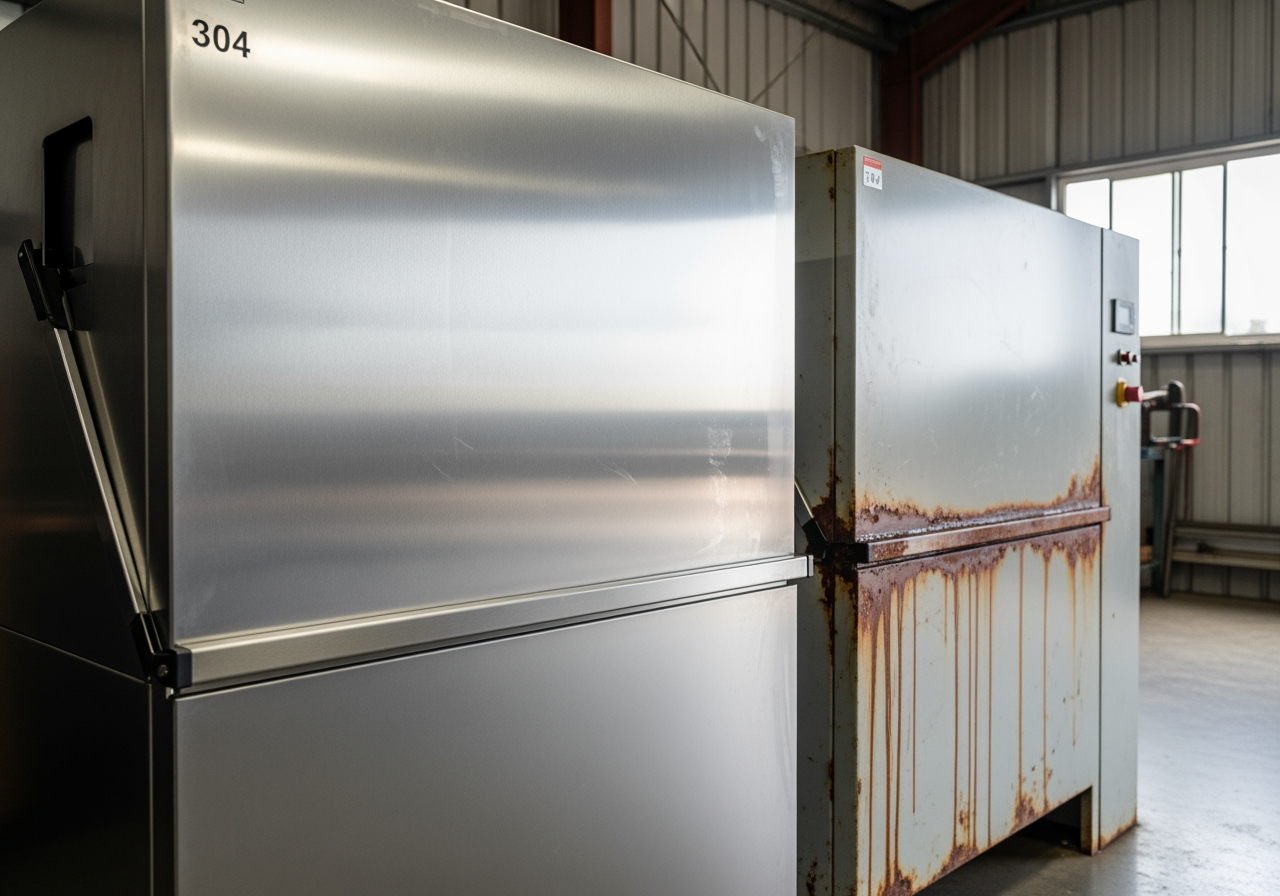
Workshop equipment takes a beating in Australian industrial environments. Salt spray in coastal workshops, caustic chemicals in mining operations, and extreme temperature swings test every material to its limits. Equipment that fails under these conditions costs workshops thousands in downtime and replacement costs.
Understanding what drives equipment lifespan helps maintenance managers make better capital equipment decisions. The gap in longevity between stainless steel and powder-coated mild steel is measurable – and in aggressive Australian environments, it is substantial.
Material Properties That Determine Workshop Equipment Longevity
How Stainless Steel Resists Corrosion
Stainless steel contains a minimum of 10.5% chromium. This creates a passive chromium oxide layer on the surface. This microscopic layer self-heals when scratched. It provides continuous corrosion protection throughout the equipment’s service life.
Grade 304 stainless – the standard for industrial equipment – contains 18% chromium and 8% nickel. Grade 316 adds molybdenum for enhanced chemical resistance. It is specified for marine and caustic environments where standard Grade 304 would eventually fail.
The passive layer withstands water, oils, greases, and most industrial cleaning detergents. Mild steel lacks this protection. Even with powder coating, moisture eventually penetrates through scratches, weld points, or coating imperfections. Once water reaches the base metal, oxidation begins. In humid coastal workshops or facilities using hot water cleaning systems, this process accelerates rapidly.
Corrosion resistant materials like Grade 304 and 316 stainless are among the strongest equipment longevity factors for workshops in aggressive environments. The material choice at purchase determines whether a machine lasts 8 years or 20.
Stainless steel parts washers are built to withstand these conditions across their full service life – something powder-coated alternatives simply cannot match in coastal or high-humidity Australian workshops.
How Thermal Cycling Affects Equipment Longevity Factors
Industrial parts washers heat water to 60-85 degrees Celsius during operation. They then cool to ambient temperature between cycles. This expansion and contraction occurs hundreds of times annually. Over ten years, that amounts to thousands of expansion-contraction events.
Stainless steel handles this cycling without fatigue. Welds maintain integrity. The tank structure does not deform. Equipment maintains original performance specifications throughout its service life.
Powder-coated mild steel faces greater challenges. The coating and base metal expand at different rates. Over thousands of cycles, this differential movement causes coating delamination – particularly at weld seams and corners. Once coating separates, moisture infiltrates and corrosion begins beneath the surface.
Temperature extremes in Australian workshops compound this problem. Non-climate-controlled facilities experience ambient swings from 5 degrees Celsius winter mornings to 45 degrees summer afternoons. Combined with operational heating cycles, these conditions accelerate equipment degradation in mild steel construction.
Corrosion Resistance in Australian Workshop Conditions
Coastal and High-Humidity Environment Performance
Australian coastal workshops face accelerated corrosion from salt-laden air. Facilities within 10 kilometres of coastline experience atmospheric salt deposition that attacks unprotected metal surfaces year-round.
The performance gap is clear. Mild steel with industrial powder coating shows visible corrosion within 500-1,000 hours of salt fog exposure. Grade 304 stainless steel shows no corrosion after 3,000 or more hours. In practical terms, powder-coated equipment requires refinishing or replacement within 5-7 years in coastal workshops. A stainless steel parts washer in the same environment reaches 15-20 years without structural degradation.
The 20-year cost comparison makes this case directly. A powder-coated parts washer needs refinishing at year six and replacement at year ten. A stainless steel unit operates the full 20 years without refinishing. That difference represents significant savings – and that calculation does not include the productivity cost of refinishing shutdowns.
Coastal workshop equipment durability depends heavily on this material decision. Humidity alone accelerates corrosion without salt exposure. Workshops in tropical regions and humid coastal areas maintain elevated moisture year-round. Water vapour condenses on cooler surfaces overnight. This daily wetting and drying cycle promotes oxidation on mild steel, even with intact powder coating.
Heavy duty parts washers built in stainless steel are particularly valuable in these coastal environments – the combination of heavy cleaning demands and corrosive conditions makes material selection a critical decision.
Mining, Food Processing, and High-Contamination Sites
Mining operations face 45 degrees Celsius heat with fine dust contamination year-round. Wet season humidity in Northern Territory and Queensland mining operations creates condensation that promotes corrosion. Coastal workshop equipment durability in these remote industrial environments depends entirely on corrosion resistant materials. Powder coating degrades under the combination of heat, humidity, and chemical exposure.
Food processing plants maintain 80-90% relative humidity from cooking, washing, and steam processes. Australian food safety standards mandate materials that resist cleaning chemicals and maintain sanitary conditions. The smooth, non-porous stainless steel surface prevents bacterial colonisation. Daily alkaline detergent cleaning does not degrade the material.
Oil and gas operations present extreme chemical challenges. Components contaminated with crude oil, drilling fluids, and industrial lubricants require aggressive cleaning chemistry. Cleaning equipment used in these applications benefits directly from stainless steel construction that withstands both harsh contaminants and powerful cleaning agents.
Chemical Compatibility and Contamination Resistance
Chemical Inertness Across Industrial Cleaning Applications
The stainless steel chromium oxide layer provides broad chemical resistance. Alkaline degreasers used in food industry washers do not degrade the surface. Petroleum products from automotive parts rinse away without absorption. Acidic contamination from mining operations does not etch the material.
Cleaning equipment operating with biodegradable detergents at pH 8-11 performs reliably in stainless steel construction across its full service life. More aggressive chemistry at pH 12-13 requires stainless construction. Powder-coated mild steel fails rapidly under high-pH exposure.
Powder-coated equipment offers limited chemical resistance. Any coating breach – from loading impacts, operational scratches, or manufacturing defects – exposes vulnerable base metal. Once chemicals contact the steel substrate, corrosion spreads beneath the surface where it cannot be seen until structural damage has already occurred.
Limits of Stainless Steel Chemical Resistance
Even stainless steel has limits. Concentrated hydrochloric acid, strong chloride solutions, and certain industrial solvents cause stress corrosion cracking. Grade 316 becomes necessary for marine facilities, caustic cleaning applications, and environments with chloride exposure exceeding 200 ppm.
Extra heavy duty parts washers in marine or highly caustic environments should always be specified in Grade 316. The premium over Grade 304 is modest at purchase and eliminates the risk of stress corrosion failure in demanding chemical environments.
Always verify compatibility before introducing any new chemical into your parts washer – regardless of tank material. Material grade determines the range of compatible chemicals, not immunity to every cleaning compound.
Maintenance Requirements and Lifecycle Cost Analysis
Maintenance Demands for Each Construction Type
A stainless steel parts washer requires minimal maintenance to preserve function. Regular cleaning removes surface contamination. Occasional passivation treatments restore the protective layer if compromised. No refinishing, no coating repairs, no rust remediation. Maintenance focuses entirely on operational components – pumps, heating elements, controls – not structural preservation.
Powder-coated mild steel demands progressive maintenance as equipment ages. Touch-up painting addresses scratches and chips. Rust spots require grinding, priming, and refinishing. Eventually, complete recoating becomes necessary. These interventions cost significantly depending on equipment size and coating damage extent.
The labour cost of maintaining powder-coated equipment accumulates quickly. Maintenance staff spending two to three hours quarterly on coating touch-ups invest 8-12 hours annually. Over ten years, that is substantial maintenance labour that stainless steel equipment does not require.
Stainless steel lifecycle cost also benefits from longer replacement intervals. Workshops replacing powder-coated equipment every 7-10 years incur purchasing costs, installation expenses, and disposal fees twice as often as facilities using stainless steel equipment lasting 15-20 years.
Total Cost of Ownership Over 20 Years
Initial purchase price shows a 40-50% premium for stainless steel construction. This deters buyers focused on upfront cost rather than stainless steel lifecycle cost outcomes over the full equipment life. However, a stainless steel parts washer lasting 15-20 years compared to 7-10 years for powder-coated alternatives changes the economics entirely.
Over ten years, maintenance costs strongly favour stainless steel. Powder-coated equipment requires annual maintenance labour plus refinishing at year six or seven. Stainless steel equipment requires minimal maintenance over the same period. The savings are significant.
Resale value remains higher for stainless steel equipment. Used industrial equipment markets value corrosion-free stainless steel units well after ten years. Powder-coated equipment at the same age commands far less due to visible wear and coating degradation.
Super heavy duty spray washers built in stainless steel demonstrate this lifecycle cost advantage most clearly. Mining and oil and gas operations that invest in stainless construction at purchase typically avoid two full replacement cycles over a 20-year period.
Specification Considerations for Long-Term Performance
Material Grade, Wall Thickness, and Weld Quality
Grade 304 stainless suits most workshop environments with standard cleaning chemistry and moderate contamination. Grade 316 becomes necessary for marine facilities, caustic cleaning applications, and environments with chloride exposure above 200 ppm.
Tank wall thickness affects durability under mechanical stress. Standard 2mm stainless provides adequate strength for light and medium-duty applications. Hot tanks for mining operations use heavier material to withstand impacts from loading heavy components and resist deformation from thermal stress. This is one of the key equipment longevity factors to verify when specifying equipment for high-demand sites.
Weld quality determines long-term structural integrity. Continuous welds with full penetration create leak-proof joints that maintain strength throughout equipment life. Spot welds or incomplete penetration create stress concentration points where cracks initiate under thermal cycling. Australian-made equipment typically features superior weld quality compared to imported units built to minimum specifications.
These specification details make a real difference when evaluating industrial cleaning equipment for long-term deployment in aggressive environments.
Surface Finish and Component Material Consistency
Standard 2B mill finish provides smooth, easy-to-clean surfaces suitable for most industrial applications. Electropolished finishes offer enhanced corrosion resistance and simplified cleaning for food industry environments where surface texture matters for hygiene compliance.
Component material consistency matters for equipment longevity. Mixing stainless steel tanks with mild steel frames creates galvanic corrosion at contact points. Fully stainless construction eliminates this risk. Facilities investing in stainless steel tanks should specify stainless steel frames, doors, and structural components for maximum equipment longevity factors across the full machine.
For surface preparation requirements alongside parts washing, wet abrasive blasters offer a complementary solution for rust removal, carbon stripping, and surface conditioning before or after the cleaning cycle.
Conclusion
Stainless steel construction delivers measurable longevity advantages in Australian workshop environments. Corrosion resistant materials, thermal stability, and chemical compatibility extend parts washer service life to 15-20 years compared to 7-10 years for powder-coated mild steel. This performance gap becomes more pronounced in coastal facilities, high-humidity environments, and operations using aggressive cleaning chemistry.
Stainless steel lifecycle cost analysis demonstrates that the higher purchase price is recovered through reduced maintenance, eliminated refinishing, and extended service life. For Australian workshops making long-term capital equipment decisions, material selection is the single most important factor in total cost of ownership.
Hotwash Australia has 40+ years of experience supplying industrial cleaning equipment across Australia, with over 1,200 automatic parts washers deployed nationally.
To discuss stainless steel parts washer specifications for your workshop environment, speak with our equipment specialists or email us at sales@hotwash.com.au.

Leave A Comment