
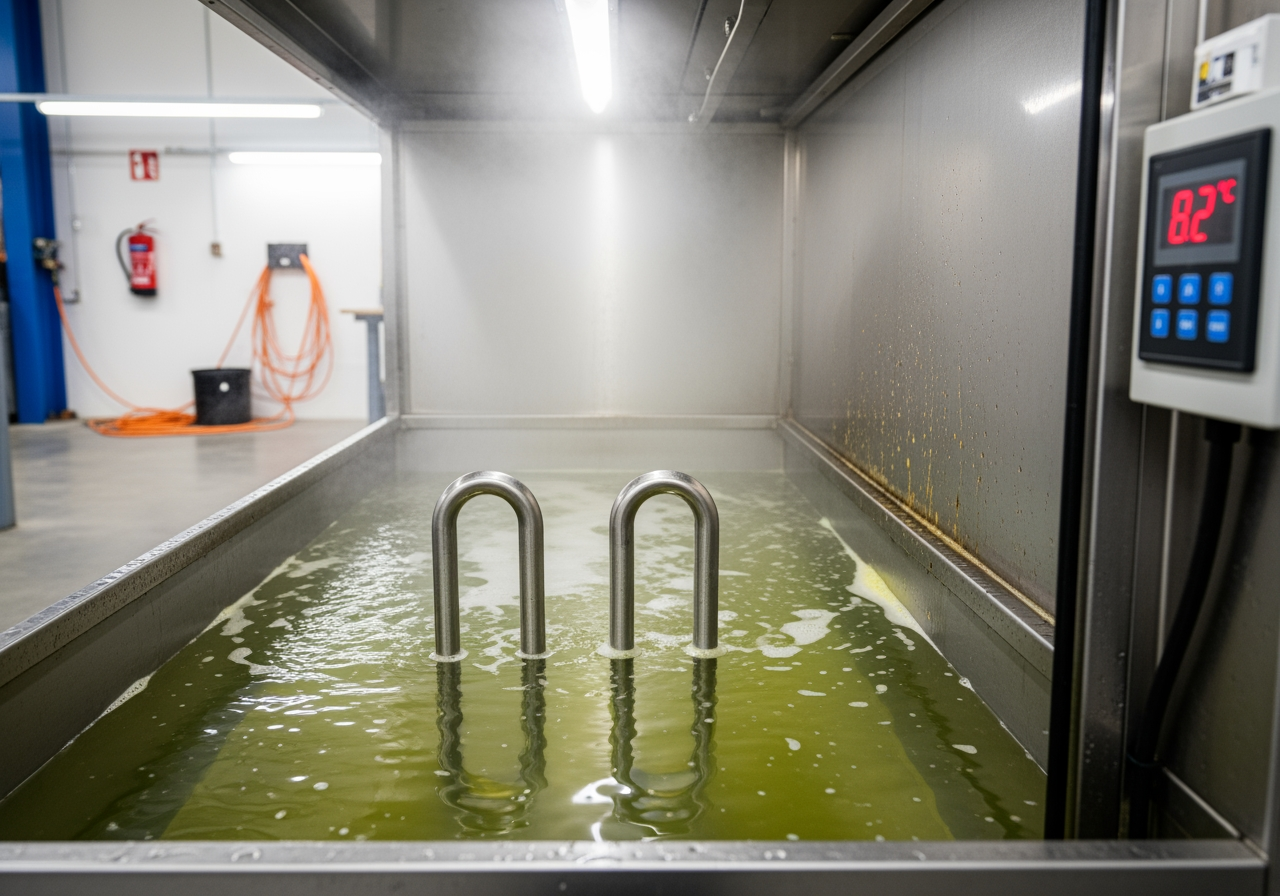
A parts washer that cannot reach the right temperature costs your workshop time and money. Grease stays on parts. Mechanics wait for the machine instead of completing repairs. The problem is usually a heating element that does not match the tank size or cleaning demand.
Heating element specifications determine how quickly your machine heats up, how well it holds temperature during long shifts, and how consistently it cleans across back-to-back cycles. Get this right and your workshop runs efficiently. Get it wrong and you pay for electricity that delivers disappointing results.
This guide explains how heating element capacity works, what operating temperatures different contamination types require, and how to calculate the right specifications for your operation.
How Heating Element Capacity Affects Cleaning Performance
Kilowatt Ratings and Heat-Up Time
Heating element capacity is measured in kilowatts (kW). A higher kW rating heats water faster. A 6kW element in a 400-litre tank takes roughly 90 minutes to reach 80°C from cold. A 12kW element in the same tank reaches temperature in about 45 minutes.
That 45-minute difference adds up quickly. Across three or four daily cycles, faster heat-up means more throughput and less waiting. Workshop productivity depends on equipment that is ready when your team is.
Parts washer machines for light to moderate workshop use typically run 6-9kW heating elements. High-volume operations need 15kW or more to maintain productivity across multiple cleaning cycles per shift.
What Undersized Heating Elements Cost Your Workshop
An undersized heating element creates three problems.
First, long heat-up times delay production. No one can start cleaning until water reaches operating temperature. Second, the element runs constantly trying to maintain heat. This increases electricity costs without improving cleaning results. Third, every time you open the lid to load parts, water temperature drops. A weak element struggles to recover before the next cycle.
Heavy duty parts washers match parts washer heating capacity to tank volume and usage intensity. A 200-litre workshop washer running two to three cycles daily works fine with a 6kW element. A 600-litre mining washer running 10 or more cycles needs 18kW or more to keep pace with demand.
Operating Temperature Requirements by Contamination Type
Different contaminants need different water temperatures to break down effectively. Understanding the aqueous cleaning temperature range prevents wasting energy overheating water – or failing to clean parts because temperatures fall short of what the job needs.
Grease and Oil Removal (60-75°C)
Standard workshop grease and oil dissolve at 60-75°C combined with biodegradable detergent. This range handles automotive engine components, transmission parts, and general workshop equipment effectively.
Most workshop parts washers operate in this range for daily cleaning. It is the most energy-efficient range for aqueous cleaning and covers the majority of contamination types found in automotive and light industrial settings. Running at the lower end of this range saves electricity without sacrificing cleaning results.
Heavy Carbon Deposits (75-85°C)
Carbon buildup from combustion chambers and diesel engine parts requires higher temperatures. At 75-85°C, water softens carbon deposits so spray pressure can dislodge them from surfaces and ports.
Mining equipment exposed to coal dust and diesel emissions accumulates baked-on carbon that defeats lower temperature settings. Cycle times at this range run 20-30% longer than standard grease cleaning, but results are consistently thorough.
Stainless steel parts washers maintain precise operating temperature control for food processing facilities. Temperatures of 70-80°C dissolve fats and oils whilst meeting hygiene standards – suitable for cleaning mixers, slicers, and conveyor components between production runs.
Extreme Contamination Applications (85-95°C)
Oil and gas industry components require maximum heat. Drill bits caked with drilling mud and parts with multiple contamination layers need 85-95°C to break down what lower temperatures leave behind.
Super heavy duty parts washers reach these extreme temperatures for the most demanding industrial applications. Mining operations dealing with hydraulic oil, heavy grease, and rock residue also benefit from this upper temperature range. At these settings, cleaning times drop significantly compared to lower temperature attempts on the same contamination.
Calculating the Right Heating Capacity
Tank Volume and Heat-Up Time Formula
Start with tank capacity. A basic guide: 1kW raises roughly 1 litre of water by 1°C per minute. To heat 400 litres from 20°C to 80°C (a 60°C rise), you need approximately 24,000 watts of energy. A 6kW element takes about 67 minutes. A 12kW element cuts that to 33 minutes.
Heating element kW selection should always account for real-world conditions. Industrial washer heat-up time runs 20-30% longer than these theoretical calculations. Heat loss through tank walls and spray circulation adds time. Quality insulation reduces this significantly. If your calculation points to 9kW, specify 12kW to cover heat loss and allow headroom for fast recovery between cycles.
Cycle Frequency and Temperature Recovery
Every time you load dirty parts and close the lid, water temperature drops 5-15°C. The amount varies based on part mass and how long the lid stays open. The element must recover this temperature loss before the next cycle begins effectively.
A workshop running four cycles daily can tolerate slower recovery. A mining parts room running 12 cycles needs fast recovery to maintain throughput. Parts washer heating capacity must account for total daily heating demand – not just the initial heat-up from cold. Add up all recovery cycles when selecting element capacity.
Ambient Conditions and Site Location
Workshop location affects heating requirements. Cold ambient temperatures increase heat loss through tank walls and demand more energy to maintain operating temperature consistently across shifts.
Sites in cold regions or outdoor locations benefit from higher-capacity elements and well-insulated tanks. Heating element kW selection for remote or cold-climate sites should include a 20-30% buffer above calculated requirements. Sites with strong prevailing winds around equipment also lose more heat than sheltered indoor workshops.
Single-Phase vs Three-Phase Heating Elements
Single-Phase Supply (240V) Limitations
Standard workshop power outlets provide single-phase 240V electricity. Single-phase circuits typically limit heating elements to 2.4-3.6kW on standard outlets. This suits manual parts washers and small workshop systems with 100-200 litre tanks running light-duty cleaning tasks.
Larger single-phase elements (up to 9kW on dedicated circuits) exist but require electrician installation and dedicated circuit breakers. Most workshops with single-phase power stick to smaller washers or accept longer heat-up times as a trade-off.
Three-Phase Supply (415V) Advantages
Three-phase 415V power allows heating elements from 12kW to 36kW. This enables fast heat-up and quick temperature recovery between back-to-back cycles.
Manufacturing facilities, mining sites, and larger workshops typically have three-phase power available. If you are buying a washer with a tank over 400 litres, expect three-phase power requirements. Confirm your electrical supply before ordering. Retrofitting three-phase power to a site costs thousands and adds weeks to project timelines.
Hot tanks for deep soak cleaning and heavy carbon removal also require three-phase supply when running at maximum heating capacity for industrial soak applications.
Temperature Control, Safety, and Element Maintenance
Thermostat Accuracy and Safety Cutouts
Quality parts washers use adjustable thermostats that maintain operating temperature control within 3°C of setpoint. Cheap thermostats swing up to 10°C, causing elements to overheat then let water cool too far. This cycling wastes electricity and produces inconsistent cleaning across cycles.
Digital thermostats allow programming of different temperature setpoints for different tasks. Set 65°C for light grease and 85°C for heavy carbon deposits. Precise operating temperature control is especially important when cleaning food processing equipment or precision engineered components.
Safety cutouts prevent heating elements from running if water levels drop too low. Running an element dry destroys it within minutes and creates fire risk. Quality systems include water level monitoring and high-temperature cutoffs as standard. Do not accept a washer without both protection systems in place.
Scale Buildup and Element Lifespan
Hard water deposits mineral scale on heating elements over time. Scale insulates the element from the water it is trying to heat. A scaled element draws full electrical power but transfers less heat – you pay for electricity that does not clean parts.
Descaling every 6-12 months removes mineral buildup before it causes problems. Sites with very hard water benefit from water softeners or regular acid descaling treatments. A heavily scaled 12kW element can drop to delivering only 8kW of effective heating – a 33% loss in capacity.
Heating element specifications also cover detergent compatibility. Some chemicals accelerate element corrosion. Using the manufacturer’s recommended detergent protects a $500-2,000 element from premature failure. Warning signs of a failing element include longer heat-up times and inability to reach maximum temperature. Most elements last 5-8 years with proper maintenance.
Matching Heating Capacity to Industry Requirements
Automotive and Light Industrial Workshops
Small to medium automotive workshops typically run 200-400 litre washers with 6-12kW heating elements. Cleaning engine blocks, cylinder heads, and transmission components at 70-80°C handles most daily jobs. Two to four cycles daily means heat-up time matters, but temperature stability during operation matters more.
Hotwash Australia has supplied industrial parts washers to automotive workshops, engineering facilities, and mining operations across Australia for over 40 years. Heating element specifications are matched to tank volume, cycle frequency, and site conditions – not estimated from generic capacity tables.
Mining, Oil and Gas Operations
Mining sites need maximum heating capacity for large components and heavy contamination. A 600-litre washer serving excavator parts requires 18-24kW to maintain productivity across shifts. Cold ambient temperatures at remote sites demand even higher capacity margins.
Oil and gas industry components arrive with drilling mud, crude oil, and heavy grease. Large-capacity washers with 24-36kW heating elements reach 90°C to dissolve extreme contamination that defeats lower temperatures. These systems often run continuously, so heating capacity must maintain temperature despite constant lid opening and part loading throughout the shift.
Conclusion
Heating element specifications determine whether your parts washer cleans efficiently or creates costly bottlenecks. Match parts washer heating capacity to tank volume, cycle frequency, and contamination severity.
Automotive workshops succeed with 6-12kW elements and aqueous cleaning temperature ranges of 60-80°C. Mining, oil and gas, and heavy industrial operations need 18-36kW with operating temperature control reaching up to 95°C. Regular descaling, compatible detergents, and calibrated thermostats extend element lifespan and protect your equipment investment.
For advice on heating element specifications suited to your operation, contact our parts washer specialists or email us at sales@hotwash.com.au.

Leave A Comment