
Automated parts washers clean engine blocks in 15 minutes compared to four hours of manual scrubbing. The difference is not just automation – it is how spray nozzles are positioned, angled, and configured inside the cabinet. Buying a parts washer without understanding spray nozzle design means risking disappointing results on the workshop floor.
Poorly configured spray systems leave blind spots. Oil pools in cylinder head ports. Carbon clings to valve stems. Grease remains in threaded holes. Your mechanic opens the cabinet expecting clean parts and finds another hour of hand finishing. That is not automation – it is an expensive disappointment.
This guide explains how spray nozzle placement determines cleaning performance, what multi-level spray arrays achieve, and what to look for when evaluating automated cabinet design.
Why Nozzle Configuration Determines Cleaning Results
The Problem With Poorly Configured Spray Systems
A parts washer cabinet is not just a box with spray jets. It is a carefully designed system where water must reach every surface – top, bottom, inside, outside, threaded holes, blind cavities, and complex geometries. Parts washing equipment must direct spray at contaminated surfaces. Pressure spraying in the wrong direction achieves nothing.
A well-configured system with 60 PSI and properly positioned nozzles outperforms a poorly designed 100 PSI machine consistently. Workshop managers often focus on pump pressure specifications when comparing machines. Spray nozzle design is at least as important – and often more so.
Understanding the Cabinet as a Cleaning Envelope
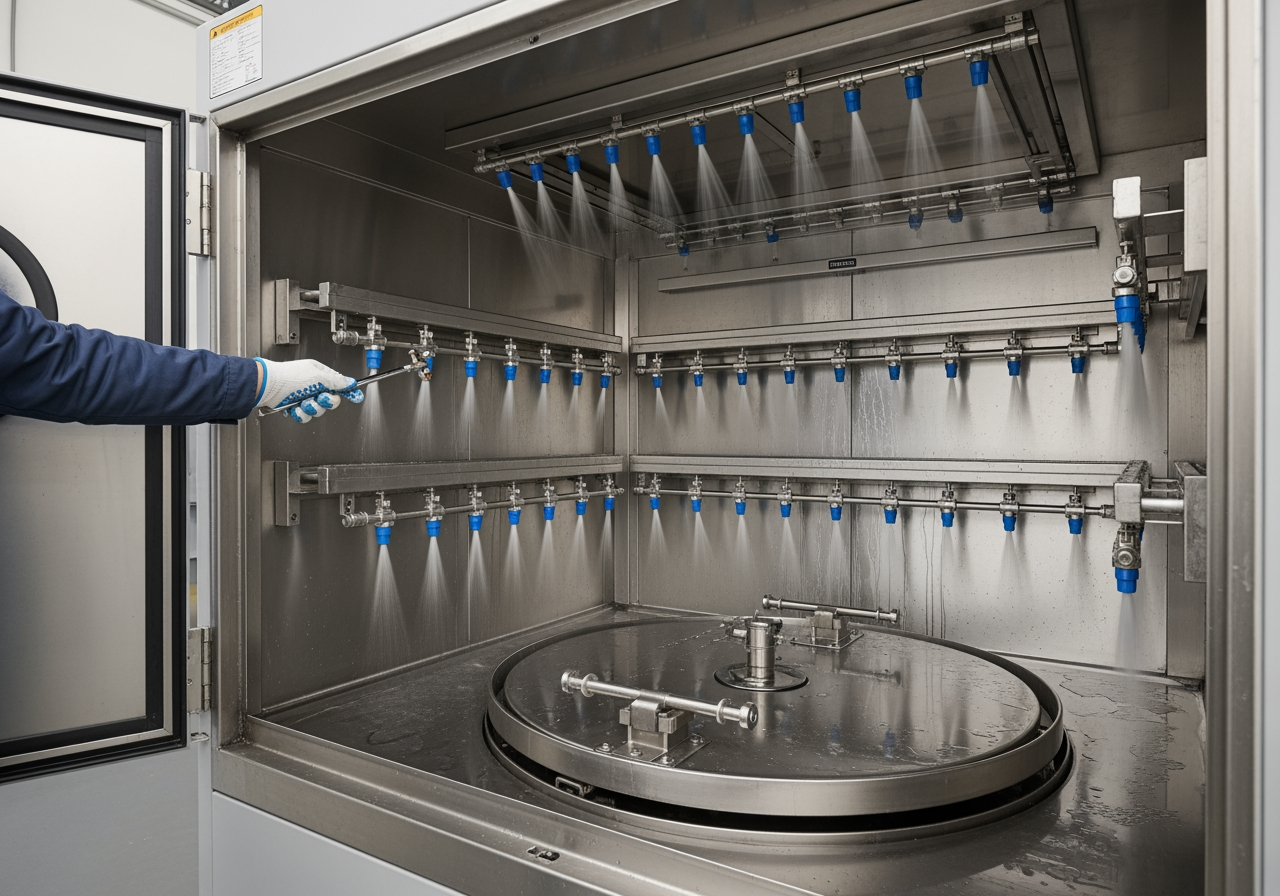
Effective nozzle configuration creates overlapping spray coverage zones inside the cabinet. Where one nozzle’s effective range ends, another begins. Parts rotating on the turntable pass through these zones and receive spray impact from multiple angles during every cycle.
This creates what engineers describe as a cleaning envelope – a three-dimensional space where no surface escapes spray contact. Getting this right requires understanding fluid dynamics, part geometry, and contamination patterns. Getting it wrong means cleaning failures that repeat every cycle regardless of pump pressure or chemical choice.
Multi-Level Spray Arrays for Complete Coverage
Professional industrial spray washers use multi-level nozzle arrays. Spray jets are positioned at different heights inside the cabinet. This creates vertical coverage zones that clean parts from multiple elevations simultaneously.
Bottom-Level Nozzles and Underside Cleaning
Bottom-level nozzles spray upward from beneath the turntable. These target the underside of parts, where oil drains and pools during use. A transmission housing sitting on the turntable has oil clinging to its bottom surface. Bottom spray jets hit this contamination directly. Gravity assists drainage as loosened contamination falls away from the part.
Heavy duty spray washers use multiple bottom jets positioned across the full turntable width. This ensures underside coverage regardless of where parts sit on the basket. Gaps in bottom spray coverage create consistent cleaning failures on the underside of complex components like differential housings and gearbox casings.
Mid-Level Horizontal Nozzles
Mid-level nozzles spray horizontally across the cabinet width. These jets target vertical surfaces – the sides of engine blocks, the walls of differential housings, the exterior of cylinder heads. Horizontal spray provides the direct impact needed to remove baked-on carbon and thick grease layers from vertical faces.
A three-level array without mid-level jets leaves vertical surfaces receiving only glancing spray from top and bottom nozzles. This creates the most common cleaning failure in basic cabinet designs – side surfaces that look clean but retain a thin grease film detectable under inspection lighting.
Top-Level Nozzles and Cavity Cleaning
Top-level nozzles spray downward from the cabinet roof. These jets clean the top surfaces of parts and provide downward force that helps flush contaminants toward the drain. They also reach into open cavities – cylinder bores, valve ports, intake manifolds – where contamination accumulates.
Maximum-capacity cleaning equipment for mining and heavy industrial applications often uses four or five spray levels. Mining components have multiple cavities and internal passages that require comprehensive coverage from above, below, and all sides. The additional nozzle levels add design cost but eliminate the need for manual finishing work after automated cleaning.
Nozzle Angle Optimisation for Complex Geometries
Perpendicular Impact vs Glancing Spray
Spray nozzle angle matters as much as position. A nozzle pointed perpendicular to a surface delivers maximum cleaning force. The same nozzle angled at 10 degrees to that surface creates glancing spray that loses most of its impact effectiveness.
Parts washers handle components with complex three-dimensional geometries. Engine blocks have vertical cylinder bores, horizontal oil galleries, angled coolant passages, and threaded bolt holes at various orientations. Effective nozzle configuration angles jets to strike surfaces as close to perpendicular as possible. Hotwash Australia designs spray nozzle systems around common industrial component geometries, positioning jets to target typical contamination zones for each machine’s intended application.
Adjustable Nozzle Mounts for Varied Applications
Some systems use adjustable nozzle mounts. Workshop staff can reposition jets to optimise spray patterns for their specific parts mix. A facility cleaning both small automotive components and large mining parts benefits from this flexibility.
The turntable rotation adds a fourth dimension to spray coverage. A nozzle angled at 45 degrees sweeps across the entire part surface as rotation brings different areas into the spray path. Rotation compensates for nozzle positions that might otherwise create coverage gaps on components with complex external shapes.
Rotating Spray Arms vs Fixed Nozzle Arrays
How Rotating Spray Arms Work
Rotating spray arms mount on a central manifold that spins during the wash cycle. Jets positioned along the arms sweep across the cabinet interior, creating moving spray patterns. As arms rotate, nozzles pass close to parts from constantly changing angles, providing dynamic coverage.
The rotation creates centrifugal force that extends spray reach. Water exits nozzles with additional velocity from the arm’s rotational speed. This extended reach helps in larger cabinets where fixed nozzles might not project spray far enough to cover the full interior.
Rotating arms excel at cleaning irregular parts that do not fit standard geometries. A fabricated bracket with multiple angles and protrusions receives spray impact from constantly changing directions. The moving pattern finds contamination that fixed jets might miss on irregular shapes.
Fixed Nozzle Array Advantages
Fixed nozzle arrays mount spray jets at specific positions throughout the cabinet interior. These jets remain stationary whilst the turntable rotates parts through the spray zones. Stainless steel cleaning equipment uses fixed arrays because food processing workshops need reliability and precise hygiene outcomes from every cycle.
The advantage of fixed arrays lies in targeted spray positioning. Designers place nozzles precisely where contamination accumulates on specific part types. Fixed arrays also eliminate mechanical complexity – no rotating seals, no spinning manifolds, no additional moving parts to maintain. Mining operations running parts washers 24 hours per day appreciate this reliability and simpler maintenance scheduling.
Nozzle Type Selection for Spray Pattern Control
Fan, Cone, and Solid Stream Nozzles
The physical nozzle design controls spray pattern characteristics – fan width, spray cone angle, droplet size, and impact force. Different nozzle types suit different cleaning challenges and part geometries.
Fan spray nozzles produce a flat, wide spray pattern. These clean large flat surfaces efficiently in a single pass. Cone spray nozzles produce circular patterns with varying cone angles. A 15-degree narrow cone concentrates force for aggressive cleaning on stubborn contamination. A 45-degree wide cone covers larger areas with less concentrated impact. Solid stream nozzles deliver maximum impact force to a small area – positioned where parts have the worst contamination buildup.
A typical hot blasters cabinet might use 15-20 nozzles with mixed types – fan sprays for side coverage, wide cone sprays for top and bottom, and several solid stream jets for high-impact cleaning zones. This mixed approach optimises spray patterns for varied part geometries.
Nozzle Material and Orifice Size Selection
Nozzle material selection affects longevity and chemical compatibility. Stainless steel nozzles resist corrosion from hot detergent solutions. Brass nozzles offer good performance at lower cost but corrode faster in aggressive chemical environments. Carbide-lined nozzles provide maximum abrasion resistance for systems washing heavily contaminated mining parts – lasting 300-500 hours compared to 50-80 hours for standard steel nozzles.
Orifice size determines flow rate and spray velocity. Larger orifices flow more water but reduce pressure. Smaller orifices increase velocity but limit volume. Cabinet designers balance orifice sizes across all nozzles to achieve target coverage whilst maintaining adequate pressure at each jet.
Spray Zone Overlap, Coverage Mapping, and Pump Distribution
Coverage Mapping and the 20-30% Overlap Target
Effective nozzle configuration requires mapping spray coverage zones and confirming adequate overlap. Gaps in coverage leave contamination zones that repeat every cycle. Excessive overlap wastes pump capacity without improving cleaning results.
Cabinet designers create coverage maps showing each nozzle’s effective spray zone. These maps account for spray pattern geometry, cabinet dimensions, and turntable rotation. The target is complete coverage with 20-30% overlap between adjacent spray zones. This overlap ensures no surface escapes spray impact as parts rotate through the cleaning envelope during each cycle.
Pump Capacity and Flow Distribution Across Nozzles
The spray pump must provide adequate flow to supply all nozzles simultaneously. Insufficient pump capacity means nozzles compete for flow, reducing spray velocity and cleaning effectiveness across the cabinet.
Manifold design controls flow distribution. A ring manifold with nozzles tapped around the perimeter provides even flow. Poor manifold design creates pressure variations that compromise spray patterns – some nozzles spray forcefully whilst others deliver weak flow. Confirming manifold design quality is as important as checking pump specifications when evaluating workshop manual washers or automated cabinet systems.
Turntable Speed, Maintenance Access, and Water Quality
Turntable Speed and Spray Dwell Time
Turntable rotation speed affects how long parts remain in each spray zone. Too fast and parts pass through spray patterns before contamination loosens. Too slow and cycle times increase without improving cleaning.
Typical turntable speeds run 2-6 RPM. At 4 RPM, a part completes one full rotation in 15 seconds. During a 15-minute wash cycle, parts rotate 60 times – passing through each spray zone 60 times. Heavy contamination benefits from slower rotation (2-3 RPM) for increased dwell time. Light contamination cleans faster at 5-6 RPM, reducing cycle time without sacrificing results.
Variable speed turntables allow operators to adjust rotation for different part types. This flexibility optimises productivity across varied applications without changing nozzle configuration between jobs.
Nozzle Maintenance and Water Quality Considerations
Spray nozzles clog over time from mineral deposits, detergent residue, and contamination particles. Clogged nozzles reduce flow, alter spray patterns, and compromise cleaning performance. Cabinet design must provide maintenance access for nozzle inspection and cleaning.
Hard water deposits calcium and magnesium scale inside nozzles, gradually reducing orifice size. Sites with hard bore water should consider water softeners to extend nozzle life. A 100-micron filter in the pump discharge line captures particles before they reach nozzles. Monthly visual inspection catches problems early. Quarterly nozzle removal and cleaning maintains optimal spray patterns across the full cabinet.
Conclusion
Spray nozzle design determines whether your automated parts washer delivers spotless results or disappointing performance. Multi-level nozzle arrays with optimised angles create overlapping coverage zones that clean complex part geometries from all directions. A well-configured spray system at 60 PSI consistently outperforms a poorly designed cabinet running 100 PSI.
Evaluate parts washer cabinet washer configuration as closely as pump specifications. Ask how many spray levels the system uses. Confirm nozzle positioning and spray pattern coverage. Request demonstrations on parts similar to your application. A properly configured spray system cleans thoroughly the first time – eliminating re-wash cycles and freeing your mechanics for productive work.
For advice on spray nozzle configuration for your specific parts and contamination challenges, consult our cleaning equipment specialists or email us at sales@hotwash.com.au.

Leave A Comment