
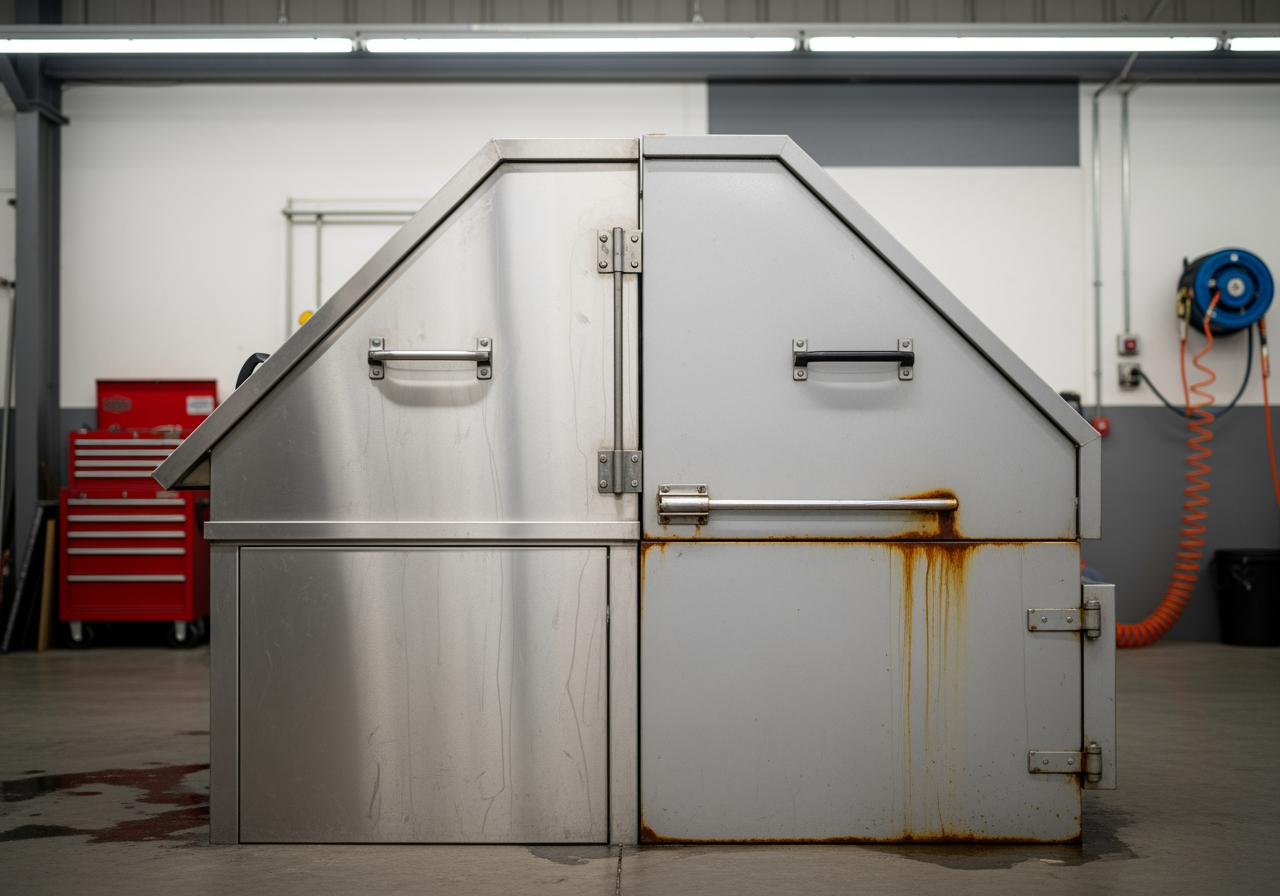
The material your parts washer is built from affects far more than its appearance. It determines how long the equipment lasts, what it costs to maintain, and whether it survives your workshop’s chemical environment. For many workshop managers, the choice between stainless steel and mild steel comes down to purchase price. But that’s only part of the picture.
Hotwash Australia manufactures both stainless steel and mild steel parts washers to Australian industrial standards. This guide walks you through the key differences so you can match industrial washer construction to your real workshop conditions – not just your initial budget.
Understanding Material Properties in Parts Washing
Knowing how each material behaves under workshop conditions helps you predict long-term performance. The differences come down to chemistry and how each material responds to heat and moisture.
How Stainless Steel Resists Corrosion
Stainless steel contains a minimum of 10.5% chromium. This chromium creates a passive oxide layer on the surface that self-repairs when scratched. Everyday handling and parts contact don’t start the corrosion process. That’s what makes stainless steel parts washer construction so durable in harsh environments.
Grade 304 stainless steel – the standard specification used in quality stainless steel parts washers – contains 18% chromium and 8% nickel. This combination resists most industrial cleaning chemicals effectively. Alkaline detergents, acidic rust removers, and sanitising solutions all leave Grade 304 unaffected under normal operating conditions.
Why Mild Steel Needs Constant Protection
Mild steel contains less than 0.3% carbon with minimal alloying elements. Without a protective barrier, it rusts within hours when exposed to water and oxygen. Powder coating provides that barrier – but it’s the only line of defence between your workshop environment and bare steel.
Parts washers cycle between ambient temperature and 85°C many times each day. Steel and powder coating expand at different rates during these thermal cycles. After thousands of heating and cooling cycles, the coating develops stress cracks. Any chip, scratch, or weld point becomes a rust initiation site. Rust spreads beneath the coating and works toward weld seams and tank walls. Once structural corrosion takes hold, no surface repair can reverse it.
Purchase Price vs Total Cost of Ownership
Upfront price and true cost over the equipment’s life are two different numbers. Understanding both is essential before making a construction material decision.
Comparing Upfront Investment
A heavy duty parts washer in mild steel with powder coating typically costs $15,000-$22,000. The equivalent stainless steel model costs $20,000-$30,000 – roughly 35% more upfront. That price difference leads many workshops to select mild steel without calculating what replacement and maintenance costs add over time.
20-Year Cost Comparison
Mild steel parts washers in typical workshop environments last 8-12 years before rust damage forces replacement. Stainless steel systems run 20-25 years in the same conditions with no structural degradation. Here’s what that means over 20 years:
Mild steel over 20 years:
- Initial purchase: $18,000
- Replacement at year 10: $18,000
- Maintenance (coating repairs, rust treatment): $4,000
- Total: $40,000
Stainless steel over 20 years:
- Initial purchase: $25,000
- No replacement required
- Maintenance (wear parts only): $1,500
- Total: $26,500
Stainless steel saves $13,500 over 20 years. For workshops running two shifts daily, downtime during equipment replacement adds further costs that don’t appear in these figures.
Industry-Specific Construction Requirements
Some industries have no real choice between materials. Regulations, hygiene standards, and operating conditions make stainless steel the only viable option in certain applications.
Food Processing and Hygiene Compliance
Australian Food Safety Standards require food-grade materials for equipment used in food processing environments. Grade 304 stainless steel meets these requirements. Mild steel with food-safe powder coating cannot achieve the same hygiene standard.
Any coating damage on mild steel creates a contamination risk. Bacteria harbour in rust pits and coating crevices, making reliable sanitation impossible. Commercial bakeries, meat processing plants, and dairy operations rely on stainless steel parts washing equipment as a non-negotiable compliance requirement. For these facilities, the industrial washer construction choice isn’t optional – it’s a regulatory obligation.
Mining and Heavy Industry Applications
Mining workshops face some of the harshest conditions parts washing equipment encounters. Coal mining exposes equipment to acidic water and sulphur compounds that accelerate mild steel corrosion. Underground environments with high humidity create constant moisture exposure. Extra heavy duty parts washers in these settings benefit significantly from stainless construction in tanks, spray systems, and pump housings.
Not all mining environments demand stainless steel, however. Hard rock operations with dry conditions and minimal chemical exposure can use powder-coated mild steel successfully. The tipping point is salt exposure. Coastal mining regions face accelerated corrosion from salt in air and process water, making stainless steel the more cost-effective long-term choice.
Automotive and General Manufacturing Workshops
Automotive and general manufacturing workshops have a genuine choice between both construction types. A transmission repair shop cleaning gearboxes, differential housings, and engine blocks operates in a controlled environment with moderate chemical exposure. A well-maintained mild steel system delivers adequate service life at lower cost.
The key variable is chemical concentration – not industry type. A general workshop using pH 13 alkaline degreaser at 80°C will corrode mild steel faster than a food plant using a milder pH 11 detergent. Know your cleaning chemicals before committing to a construction material.
Maintenance Requirements by Construction Type
Maintenance costs differ significantly between construction types. These differences accumulate across the equipment’s working life and affect your total cost of ownership in ways the purchase price doesn’t show.
Maintaining Powder-Coated Mild Steel Equipment
Mild steel systems require active and consistent corrosion management. Your team needs to inspect tanks, doors, and spray arms monthly for any coating damage. Every chip, scratch, or impact point needs immediate touch-up with epoxy paint. Weld seams need special attention because coating thickness varies at these stress points.
Annual mild steel maintenance typically costs $800-$1,200 in labour and materials. This covers routine inspection and touch-up work, rust treatment when corrosion is found, and structural assessment of affected areas. Skip this maintenance and corrosion accelerates quickly.
Minimal Upkeep for Stainless Steel Systems
Hot tanks and spray washers built from stainless steel require maintenance focused on functional components only. Quarterly checks cover pump seals, heating elements, and spray nozzles – the same wear items found in both construction types. The tank, frame, and plumbing need no protective maintenance at all.
Annual stainless steel maintenance typically costs $200-$400 in labour and materials. Over 15 years, the difference in maintenance costs between the two materials exceeds $12,000. This further closes the real cost gap between stainless steel and mild steel construction.
Choosing the Right Construction for Your Workshop
A straightforward scoring system helps you assess your workshop’s corrosion risk before making a decision. Rate each factor as low (1 point), moderate (2 points), or high (3 points):
- Chemical exposure – pH below 7 or above 11 significantly increases corrosion risk
- Operating temperature – sustained temperatures above 70°C break down powder coating faster
- Humidity – coastal locations and high-humidity workshops promote rust formation
- Contamination type – salt, acids, or chlorides demand stainless steel construction
A total score above 8 points indicates stainless steel provides better value despite the higher purchase price.
Using a Corrosion Risk Score
Apply this scoring system to your specific chemicals, not just your industry category. The chemicals you use daily determine your actual corrosion risk level. An automotive workshop using aggressive alkaline cleaners may score higher than a food plant using mild, pH-controlled detergents.
Matching Material to Equipment Size and Location
Manual parts washers under 100 litres in low-corrosion environments perform well in powder-coated mild steel. These smaller systems suit workshops with limited budgets and controlled chemical exposure. Large automated systems processing hundreds of parts daily justify stainless steel investment through extended service life and reduced maintenance requirements.
Location also plays a role in industrial washer construction decisions. Remote workshops face freight costs of $2,000-$4,000 to ship replacement equipment. For remote operations, buying stainless steel once proves far more cost-effective than replacing a mild steel system part-way through its working life.
Conclusion
Stainless steel parts washer construction delivers superior corrosion resistance, longer equipment lifespan, and lower maintenance requirements compared to powder-coated mild steel. The 35% higher purchase price becomes cost-effective over 10-15 years through eliminated replacement cycles and reduced maintenance labour. Food processing facilities must use stainless construction by regulation, whilst mining and coastal operations achieve better long-term value with stainless steel.
Mild steel systems with quality powder coating suit general workshops with controlled environments and moderate chemical exposure. They deliver 8-12 years of reliable service with proper maintenance. The right industrial washer construction decision depends on your chemical exposure levels, operating environment, regulatory requirements, and long-term cost analysis – not purchase price alone.
For expert advice on choosing the right construction material for your workshop, contact our stainless steel equipment specialists or email us on sales@hotwash.com.au.

Leave A Comment