
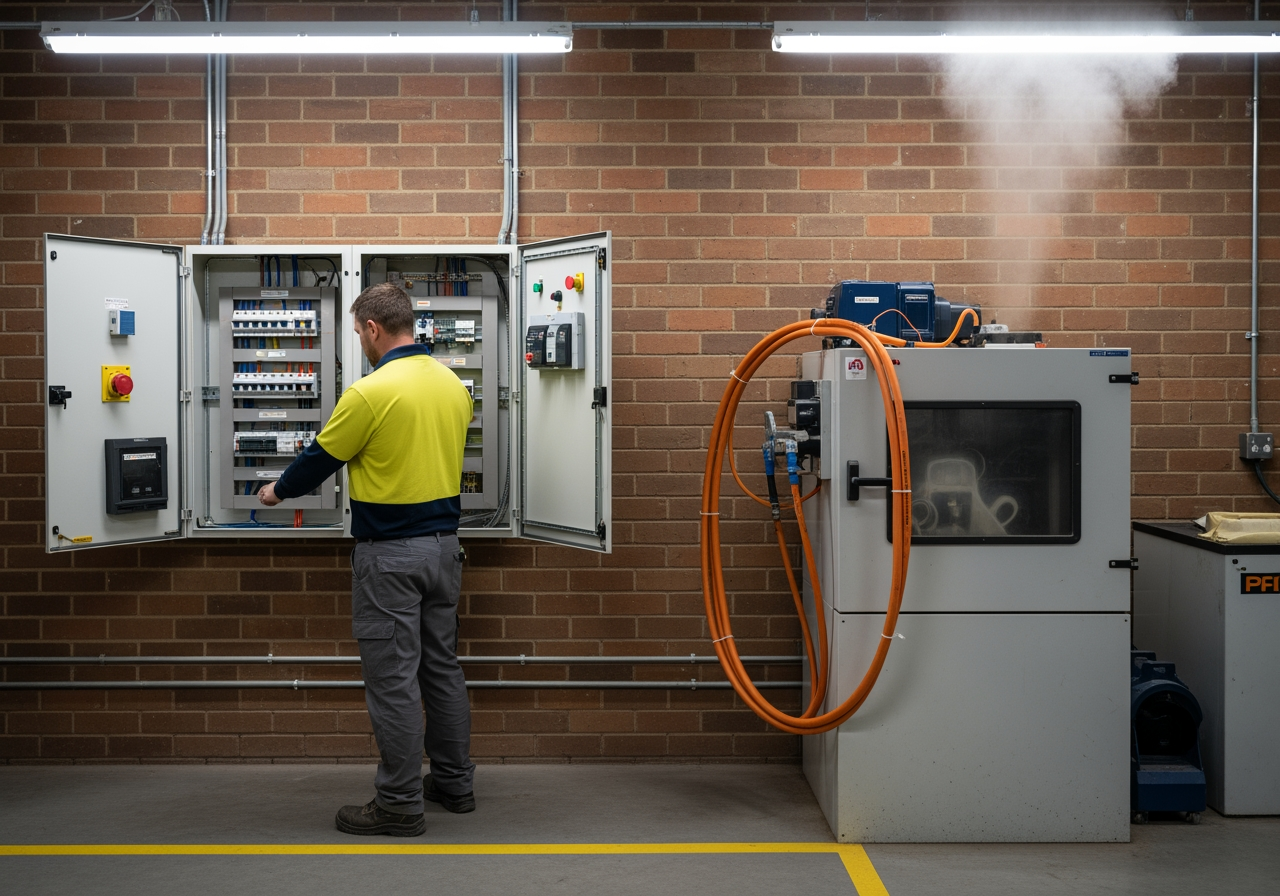
Choosing the right power supply for your parts washer isn’t about electrical theory. It’s about matching your workshop’s existing infrastructure to equipment that performs reliably without tripping breakers or requiring expensive upgrades. Single phase and three phase power each suit different operations, and choosing wrong costs time and money from day one.
Most workshops already have one type of power available. The question isn’t which is “better” – it’s which matches your facility, your cleaning requirements, and your budget.
Understanding Single Phase and Three Phase Power
Understanding how each power type works helps you assess which suits your workshop before you speak to an electrician or equipment supplier.
How Single Phase Power Works
Single phase power runs on two wires – one active, one neutral. It’s standard in homes and small commercial buildings across Australia. The voltage alternates in a single wave pattern, delivering power in pulses rather than a constant flow.
For parts washer power applications, this pulsing delivery affects heating speed and motor performance. Single phase supply provides 240V in Australian installations, with a practical maximum load of around 10kW. Manual parts washers and smaller automated units work well within this supply range.
How Three Phase Power Works
Three phase power uses three active wires, each carrying voltage waves offset by one-third of a cycle. This creates constant, smooth power delivery without the peaks and valleys of single phase supply.
Three phase supply delivers 415V in Australian industrial installations and handles loads from 10kW to 100kW and beyond. It’s common in factories, mining sites, and large workshops. The smooth power delivery benefits both heating elements and pump motors in industrial parts washers.
How Power Type Affects Parts Washer Performance
Parts washer power requirements centre on two main functions: heating water and driving pumps. The supply type directly impacts how quickly these systems work and what they cost to run.
Heating Speed and Water Temperature
Single phase washers typically use 2.4kW to 7.5kW heating elements. A 7.5kW element heats 200 litres of water from cold to 60°C in approximately 45 minutes. That’s acceptable for workshops running one or two wash cycles daily.
Three phase washers commonly use 12kW to 36kW heating capacity. A 15kW three phase system heats the same 200 litres to 60°C in roughly 15 minutes. For operations running continuous cycles, that 30-minute heating advantage compounds quickly across a full shift.
A workshop cleaning engine blocks twice daily works fine with single phase heating times. A mining parts room processing excavator components every hour needs the faster heating that three phase equipment provides.
Pump Performance and Spray Pressure
Single phase motors deliver adequate spray pressure for most automotive and light industrial parts washing – typically 80-120 PSI. The pulsing power delivery doesn’t noticeably affect cleaning results at this pressure range.
Heavy duty parts washers running three phase motors provide higher pressures of 120-200+ PSI with smoother operation. The constant power delivery reduces mechanical stress and extends motor life. Under sustained high-duty-cycle operation, three phase motors outperform their single phase equivalents in longevity.
Energy Efficiency Differences
Three phase systems convert electrical energy to mechanical work more efficiently – typically 10-15% better than equivalent single phase equipment. For a washer running eight hours daily, this translates to a noticeable reduction in power bills over the year.
Single phase washers cost less upfront but use slightly more electricity per wash cycle. Three phase equipment costs more initially but runs cheaper long-term. The break-even point depends on usage intensity – light use favours single phase, continuous operation favours three phase.
Matching Power Requirements to Workshop Size
The right parts washer power specification depends on your workshop size, existing infrastructure, and cleaning volume. These three factors together determine the correct choice.
Small Workshops With Single Phase Supply
Small workshops with one to five staff typically run single phase power. These operations clean parts intermittently – a few batches daily rather than continuous processing.
A suburban mechanic’s workshop might clean cylinder heads, transmission components, and engine parts twice daily. A 7.5kW single phase washer heats overnight, maintains temperature during business hours, and handles the workload without any electrical upgrades. Installation cost is minimal – a dedicated 32-amp circuit from an existing switchboard typically costs $400-$800 to install.
Medium Workshops With Three Phase Available
Medium workshops with five to fifteen staff often have three phase infrastructure available, particularly in established industrial estates. If three phase already exists at your facility, specify three phase washers. The performance advantage costs nothing extra when the infrastructure is already there.
If only single phase is available, calculate whether your cleaning volume justifies the $3,000-$8,000 cost of installing three phase supply. For workshops running more than four cycles daily, the performance and efficiency gains typically justify the upgrade cost over a three-to-five-year horizon.
Large Operations and Industrial Facilities
Large operations – mining maintenance, manufacturing, heavy transport – run three phase infrastructure as standard. These facilities process high volumes of heavily contaminated parts continuously throughout each shift.
Extra heavy duty parts washers require three phase power for their heating and pumping capacity. Super heavy duty models for continuous industrial operation also run on three phase as standard. The 15-20 minute heat-up time and sustained high-pressure spray capability keeps pace with demanding maintenance schedules. Single phase equipment cannot maintain the required throughput in these environments.
Installation Costs and Infrastructure
Installation costs vary dramatically based on your existing electrical infrastructure. Understanding the scenarios helps you budget accurately.
Single Phase Installation Requirements
Single phase parts washers plug into standard 15-amp or 20-amp outlets for smaller units, or require dedicated 32-amp circuits for larger models. Most workshops already have appropriate circuits available. If not, an electrician installs a dedicated circuit for $400-$800 typically. No special switchboard upgrades and no power company involvement are required. Installation happens in hours, not weeks.
Three Phase Installation Scenarios
Three phase installation costs depend on what infrastructure already exists:
- Three phase already at the building: An electrician runs a dedicated circuit from the switchboard to the washer location. Cost: $600-$1,500 depending on distance and switchboard capacity. Timeline: one to two days.
- Three phase at the street but not the building: The power company installs a three phase meter and supply. An electrician upgrades the switchboard and runs circuits. Cost: $3,000-$8,000. Timeline: two to six weeks including approvals.
- No three phase in the area: Rare in established industrial areas but common in rural locations. Infrastructure upgrade costs can reach $15,000-$40,000+.
For workshops in established industrial areas, three phase typically exists at the building or nearby. For rural operations or suburban workshops, single phase may be the only practical option without major investment.
Running Costs Comparison
Operating costs include electricity, water, and detergent. Power supply type primarily affects electricity consumption – the most significant ongoing variable cost.
Single Phase Operating Costs
A typical 7.5kW single phase washer running four hours daily consumes approximately 30kWh. At the current average Australian industrial electricity rate of around $0.28/kWh, that’s $8.40 daily or roughly $2,100 annually. Per-cycle costs including water and detergent run approximately $10-$12 for most light-to-medium applications.
For workshops running one or two cycles daily, single phase parts washer power costs remain manageable. This profile suits most small automotive and light industrial operations.
Three Phase Operating Costs
A 15kW three phase washer running four hours daily consumes approximately 55kWh – higher total consumption than single phase. At the same $0.28/kWh rate, that’s $15.40 daily or $3,850 annually. However, three phase systems process more parts per cycle and complete cycles faster.
Hot tanks and high-capacity spray washers running six or more cycles daily achieve lower cost per part cleaned with three phase supply than equivalent single phase systems. At high duty cycles, the efficiency advantage of three phase equipment outweighs the higher total consumption figure.
Three phase motors under heavy use also demonstrate 20-30% greater longevity than equivalent single phase motors. Pump and motor replacement costs factor into the total ownership calculation, particularly for workshops running continuous operations.
Making the Right Decision for Your Workshop
The right choice becomes clear when you assess your facility, usage intensity, and timeline together.
Choosing Single Phase Equipment
Single phase suits your operation when:
- Your facility only has single phase supply available
- Three phase installation would cost $5,000+ and usage doesn’t justify the investment
- You run one to three cleaning cycles daily
- Your components are automotive or light industrial
- You need equipment operating within one to two days
- Budget favours lower initial investment
Choosing Three Phase Equipment
Three phase equipment makes sense when:
- Three phase infrastructure already exists at your facility
- You run more than four cleaning cycles daily
- Your components include heavy mining, oil field, or large industrial parts
- Heating time under 20 minutes is operationally important
- Equipment will run high duty cycles of six or more hours daily
- Long-term operating cost efficiency matters more than purchase price
Super heavy duty parts washers running continuous operations across multiple shifts represent the clearest case for three phase. These systems simply can’t deliver required throughput on single phase supply.
Stainless steel parts washers for food processing facilities require particular attention to power planning. Large food plants running continuous production need three phase for rapid heating and sustained operation. Smaller commercial kitchens cleaning equipment twice daily in scheduled batches typically manage well with single phase supply.
Conclusion
Parts washer power supply type fundamentally affects performance, installation cost, and operating efficiency – but “better” depends entirely on your workshop’s infrastructure and requirements. Single phase equipment suits small-to-medium workshops with standard electrical supply and moderate cleaning volumes. Three phase systems deliver the speed and capacity that large operations and heavy industry demand.
The decision isn’t about electrical specifications. It’s about matching equipment to existing infrastructure and operational reality. A small workshop shouldn’t invest in three phase infrastructure for equipment running twice daily. An industrial maintenance facility can’t operate efficiently on single phase equipment that can’t maintain continuous throughput.
Hotwash Australia manufactures both single and three phase industrial parts washers for Australian industrial conditions. Both power configurations are available across all capacity ranges – the right power specification simply depends on your facility’s capabilities and cleaning demands.
For help assessing power requirements for your specific application, reach out to our industrial parts washer specialists or email us on sales@hotwash.com.au.

Leave A Comment