
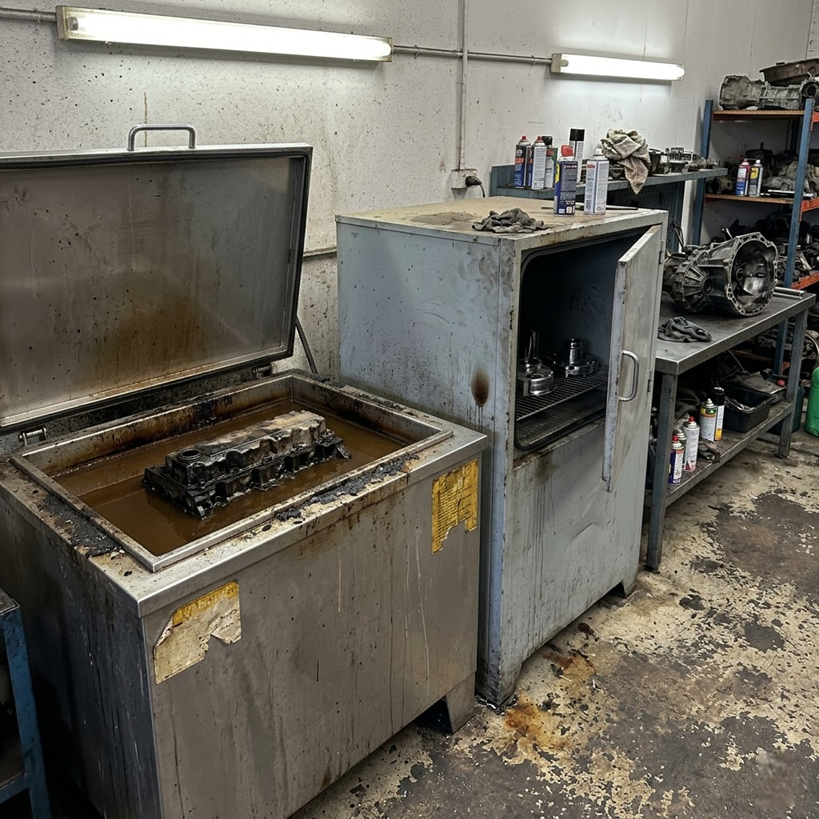
Choosing between hot tank immersion systems and spray washers affects your workshop’s productivity for years. The wrong choice leads to wasted labour hours. It results in incomplete cleaning and frustrated mechanics. The right choice cuts cleaning time by 75%. It pays for itself in saved labour within 12 months.
Both technologies clean parts faster than manual scrubbing. However, they work differently. Hot tanks submerge parts in heated cleaning solution for deep penetration. Spray washers blast parts with high-pressure jets for mechanical cleaning action. Each excels in different applications.
This guide helps you decide which technology fits your workshop size, parts types, and contamination levels. The decision comes down to three factors. You must consider what you clean, how dirty it is, and how fast you need it done.
How Hot Tank Immersion Systems Work
Hot tank systems submerge parts in heated cleaning solution. The machine maintains this fluid at 60-85°C. Parts soak for 15-60 minutes whilst the heated chemistry breaks down grease, oil, carbon, and paint. The immersion process reaches every surface, cavity, and internal passage without mechanical action.
The cleaning chemistry does the heavy lifting in hot tanks. Biodegradable detergent formulations penetrate carbon deposits. They emulsify oils that spray washing might struggle to remove. Temperature accelerates the chemical reaction. Solution at 80°C cleans three times faster than solution at room temperature.
Hot tanks excel at cleaning complex geometries. Cylinder heads with intricate port work benefit from this method. Engine blocks with oil galleries and transmission housings with internal passages also require complete immersion. The solution reaches areas spray jets cannot access.
Tank capacity determines throughput. A 400-litre tank handles multiple cylinder heads simultaneously. You can load parts in the morning and retrieve them spotless after lunch. That represents 3-4 hours of productive work whilst the tank does the cleaning.
The trade-off is cycle time. Hot tanks require longer dwell times than spray washers. This works perfectly for workshops cleaning 2-3 large parts daily. However, spray washers move faster for operations cleaning 20+ small parts per shift.
How Spray Washer Technology Operates
Spray washers attack contamination with mechanical force. High-pressure pumps push heated water and detergent through rotating spray arms. These operate at 80-120 PSI. The spray jets physically dislodge grease, oil, and carbon whilst the chemistry emulsifies it.
Cleaning happens in enclosed cabinets. You load dirty parts, close the door, and select the cycle. Rotating spray arms ensure coverage from all angles. A 15-minute cycle usually delivers parts ready for inspection or assembly.
The mechanical action makes heavy duty parts washers faster than hot tanks for most applications. Where a hot tank requires 30-45 minutes, a spray washer completes the job in 10-15 minutes. That speed advantage adds up across multiple parts per day.
Heavy-duty spray washers handle everything from small automotive components to large equipment parts. Chamber sizes range from 600mm for workshop applications to much larger sizes for industrial operations.
The limitation is accessibility. Spray washers clean external surfaces brilliantly. However, they can struggle with deeply recessed areas. Parts with blind holes or complex cavities may need hot tank immersion for complete cleaning.
Contamination Type Determines Best Technology
Grease and oil respond well to both technologies. Spray washers remove fresh contamination faster. Hot tanks excel at baked-on oils and carbonised deposits that resist mechanical cleaning.
Carbon buildup from combustion requires chemical penetration. Cylinder heads, exhaust manifolds, and diesel injectors benefit from hot tank immersion. The heated chemistry dissolves carbon that spray washing only partially removes.
Paint stripping needs hot tank chemistry. Automotive parts and equipment housings stripped for refinishing require the chemical action only immersion provides. Spray washers will not strip paint effectively. For complete surface preparation that removes both contamination and old coatings, wet abrasive blasters offer the best solution.
Heavy mining contamination responds to mechanical spray action. Mud, coal dust, and drilling fluids mix with grease to form thick layers. The high-pressure jets physically blast away this contamination. This is where mechanical force outweighs chemical soaking.
Parts Size and Geometry Considerations
Small to medium automotive parts suit spray washers perfectly. Alternators, starters, brake callipers, and suspension components clean thoroughly in 10-15 minutes. You load a batch, run the cycle, and unload clean parts.
Large engine blocks present challenges for standard spray washers. A V8 block fits in larger spray cabinets but may not receive adequate spray coverage in all areas. Hot tanks accommodate oversized parts more easily. If it fits in the tank, it gets cleaned.
Complex geometries favour hot tanks. Parts with internal oil galleries or coolant passages benefit from complete immersion. The solution penetrates everywhere without relying on spray jet angles.
Flat fabricated parts clean faster in spray washers. Steel plates, brackets, and frames present large external surfaces. Spray jets clean these efficiently. There is no need for the longer immersion times hot tanks require.
Mining equipment components exceed most hot tank capacities. Excavator buckets and haul truck parts need massive chambers. Super heavy duty parts washers with chambers up to 2400mm handle these components. Hot tanks large enough for this work become impractical due to heating costs.
Workshop Space and Installation Requirements
Hot tanks require less floor space than equivalent-capacity spray washers. A 400-litre hot tank occupies roughly 1200mm × 900mm. A spray washer handling similar part sizes needs more space for the cabinet plus door clearance.
Spray washers need three-phase power for pumps and heating elements. A typical heavy-duty spray washer draws 15-20kW. Hot tanks use less power for heating elements only. However, they take longer to heat the solution volume from cold.
Both technologies require drainage. Spray washers recirculate solution during cycles. They drain periodically for filter cleaning. Hot tanks hold solution for days or weeks. They require periodic draining for solution changeout. You must budget for trade waste disposal or oil-water separator systems.
Ventilation matters for hot tanks. Heated solution releases vapour that needs extraction. You should install exhaust hoods or ensure adequate workshop ventilation. Spray washers operate in enclosed cabinets with less vapour release.
Operating Costs and Labour Savings
Solution consumption differs significantly. Spray washers recirculate heated solution through filters. They use small amounts of detergent per day in typical workshop applications. Hot tanks hold large volumes of solution changed every 2-4 weeks.
Heating costs favour spray washers for intermittent use. You heat the solution for each cycle, then shut down. Hot tanks maintain temperature continuously. For workshops running multiple cleaning cycles daily, spray washers often use energy more efficiently.
Labour savings determine ROI. At Hotwash Australia, we help workshops calculate their true cleaning costs. A mechanic earning $45/hour spends 3-4 hours hand-cleaning an engine block. A spray washer completes it in 15 minutes. This costs about $11.25 in labour plus detergent. A hot tank takes 45 minutes of machine time but only 5 minutes of labour. Either option beats manual cleaning by huge margins.
This cleaning method comparison shows that throughput affects labour costs differently. Spray washers tie up labour for 15 minutes per cycle for loading and unloading. Hot tanks require less interaction. For single-part cleaning, spray washers are faster. For batch processing multiple parts, hot tanks maximise mechanic productivity.
Maintenance costs run similar for both technologies. Spray washers need pump seals and filters replaced annually. Hot tanks need heating element inspection. You should budget $500-800 annually for either system in typical use.
Industry-Specific Applications
Automotive workshops favour spray washers for speed and versatility. Cleaning brake components and transmission housings fits the 15-minute cycle time perfectly. Parts move through the workshop faster. This keeps bays productive.
Diesel engine rebuilders need both technologies. Spray washers handle external components. Hot tanks tackle cylinder heads and blocks requiring carbon removal. Many diesel specialists run both systems to cover all bases.
Mining maintenance operations choose spray washers for volume. Professional systems are built specifically for this sector. Cleaning excavator components requires the mechanical power of spray technology. The faster cycle times suit high-volume maintenance schedules.
Marine workshops face corrosion challenges. Salt contamination and marine growth require aggressive cleaning. Hot tanks excel at removing corrosion from aluminium marine components. Spray washers handle routine maintenance cleaning of outboard parts.
Hygiene and Specialised Materials
Food processing facilities require stainless steel construction. They need enclosed cleaning to prevent contamination. Spray washers meet hygiene standards while cleaning mixers and conveyor components.
Stainless steel parts washers resist corrosion and chemical attack. The enclosed cabinet contains splash and maintains sanitation standards better than open hot tanks.
Manufacturing and fabrication shops also benefit. They clean welded assemblies and machined parts. Spray washers remove cutting fluids and metal fines efficiently. The mechanical spray action reaches into welded corners.
Entry-Level Options for Smaller Workshops
Small workshops with limited space often cannot justify large systems. Manual parts washers serve as entry-level automation. These combine spray technology with manual loading in compact footprints.
They bridge the gap between hand scrubbing and fully automated systems. They offer professional cleaning results without the large footprint or power requirements of industrial units.
Surface Preparation Differences
Sometimes cleaning is not enough. You need to prepare the surface for painting or coating. Standard washers remove grease but not rust or old paint.
Wet abrasive blasters combine water with abrasive media. This is different from washing. It strips the surface down to bare metal. If your workshop does restoration or repainting, wet abrasive blasters might be a better choice than a standard washer. These systems provide the surface profile needed for coatings whilst eliminating the dust hazards of dry blasting.
For workshops requiring both cleaning and surface preparation, wet abrasive blasters can handle rust removal and paint stripping that neither hot tanks nor spray washers can accomplish. This makes them essential for restoration work and pre-coating preparation.
Making the Right Choice for Your Operation
You should choose hot tanks when you clean complex internal geometries. They are best for removing heavy carbon deposits or stripping paint. The immersion technology reaches areas spray jets cannot access.
You should choose spray washers when you need fast cycle times. They are ideal for cleaning multiple parts daily or handling primarily external surfaces. The mechanical spray action maximizes workshop productivity.
Mining operations need capacity. Extra heavy duty parts washers handle massive components that would overwhelm a hot tank. The mechanical force is necessary for thick mud and grease.
Many operations eventually run both technologies. Start with the system that matches your highest-volume cleaning tasks. Add the complementary technology as your operation grows.
Conclusion
Hot tanks and spray washers both eliminate manual parts scrubbing. They suit different applications. Hot tanks excel at complex geometries and carbon removal. Spray washers deliver faster cycles and mechanical cleaning power.
Your contamination type, parts geometry, and cleaning volume determine the right choice. Heavy carbon and internal passages favour hot tanks. External surfaces and high-volume operations favour spray washers. Modern parts washing technology offers solutions for every workshop.
Either technology pays for itself in saved labour within 12-18 months. A mechanic spending four hours daily on manual cleaning costs the business $45,000 annually. A $25,000 washer recovers that investment quickly. It also improves safety and consistency.
We manufacture both technologies in Perth with Australian-made quality. Our systems are built for local conditions. Contact our technical team to discuss which technology suits your workshop. Email us on sales@hotwash.com.au for a detailed quote based on your specific needs.

Leave A Comment