
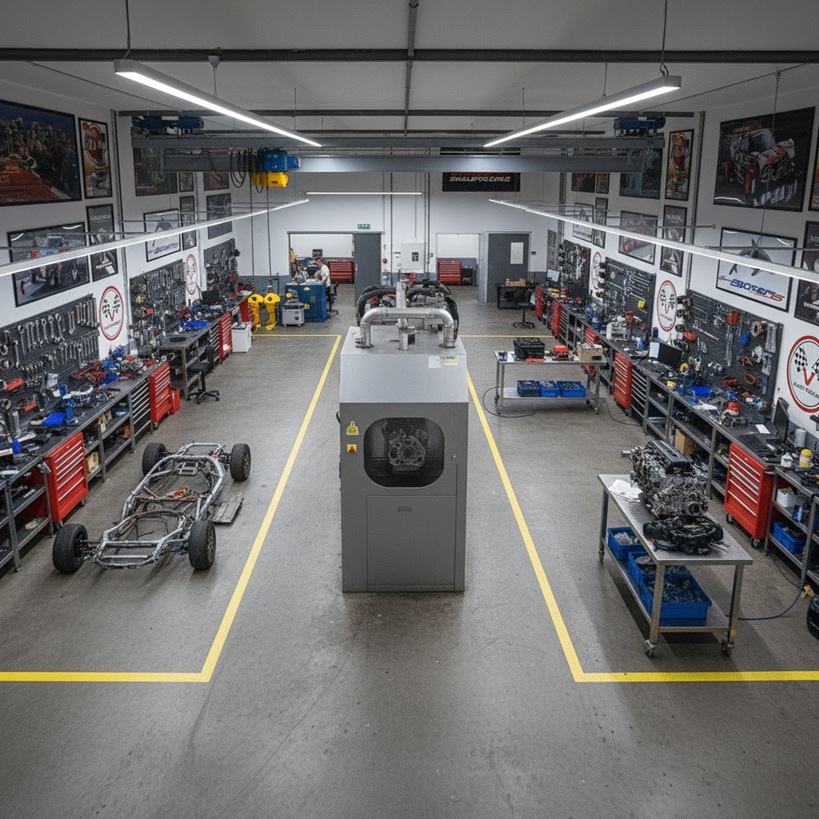
Cramped workshops waste money. When mechanics trip over parts washers or cannot access equipment properly, productivity drops. Safety risks also climb when space is tight. Workshops that plan their layout around automated cleaning equipment save space. They can cut cleaning time by 75% and keep workers safer.
The difference between a well-planned workshop and a cluttered one is measurable. It shows in labour hours, injury rates, and equipment lifespan. A 200-square-metre automotive workshop in Perth saved 12 hours per week. They did this simply by relocating their parts washers next to their main work bays. That is 624 hours per year. It is equivalent to one full-time position saved through better organisation.
This guide shows workshop managers how to plan layouts that maximise efficiency. Whether you are setting up a new facility or reorganising an old one, these rules apply. They work for small mechanics and large mining maintenance facilities alike. Proper workshop layout planning ensures every square metre of your floor contributes to profit.
Assessing Your Workshop’s Cleaning Workflow
Before moving a single piece of equipment, map your current process. Track how far workers carry dirty parts. Look for bottlenecks where people have to wait. Measure which cleaning tasks consume the most time each day.
Start with a simple exercise. Follow one dirty engine component from removal to cleaning to reinstallation. Count the steps and measure the distances. Most workshops find their mechanics walk 50-100 metres just to clean one part. Multiply that by 30 parts per day. You are looking at serious wasted movement.
Mining operations face even bigger challenges. Excavator components often weigh hundreds of kilograms. Every metre of transport adds handling time and injury risk. A Pilbara maintenance facility reduced forklift movements by 40%. They positioned their extra heavy duty parts washers between their parts storage and main service bays.
Document your current cleaning methods too. If workers spend 4 hours scrubbing parts by hand, they are not doing mechanical work. Automated systems clean the same parts in 15-20 minutes. Mechanics stay on the tools earning revenue whilst the machine does the dirty work. This is the first step in equipment placement optimization.
Calculating Space Requirements for Automated Systems
Parts washers need more than just their footprint dimensions. You must account for door swing and loading access. You also need room for service clearance and drainage connections. A typical spray washer needs approximately 3 square metres of operational space.
Operational Footprint and Access Zones
You must maintain clear access zones around the machine. Front loading access needs at least 1.5 metres for safe handling. Side service access needs 800mm for maintenance and filter changes. Rear clearance of 600mm is usually enough for plumbing and power.
Food processing facilities using stainless steel parts washers need extra space. They must maintain hygiene zones to separate dirty and clean areas. Commercial kitchens often allocate 5 square metres total for these systems. This ensures no cross-contamination occurs during the cleaning cycle.
Vertical Space and Ventilation Needs
Do not forget vertical space. Hot water systems generate steam and heat. You need proper ventilation to prevent moisture buildup in the roof. High moisture levels can lead to rust on other workshop tools.
Workshops with low ceilings should consider spray washers over hot tanks, which generate more steam. If you use immersion cleaning (soaking parts in heated solution), you may need a dedicated extraction hood. This keeps the air clear and the floor dry for your team.
Positioning Equipment for Maximum Workflow Efficiency
The best location for your parts washer is where work flows naturally. It should sit at the intersection of work bays, utilities, and logical progression. Think of it as the hub of your maintenance operation. At Hotwash Australia, we help managers design these hubs for maximum speed.
The Dirty-to-Clean Progression
Optimal positioning follows a straight line or a logical loop:
- Parts removal zone – Where parts come off the machine.
- Pre-cleaning staging – Brief inspection and debris removal.
- Automated washing – The central washer location.
- Drying and inspection – Quality check before assembly.
- Clean parts storage – Ready for reinstallation.
Automotive workshops get the best results by positioning washers centrally. This cuts average walking distance from 30 metres to under 10 metres. Over a full day, this saves mechanics 45 minutes of unproductive movement. Effective workshop layout planning always considers the natural flow of work.
Material Handling and Lifting Access
Heavy parts require mechanical help. You should align super heavy duty parts washers with crane travel routes. This eliminates the need for double-handling with forklifts.
One Kalgoorlie workshop cut parts handling time by 60%. They simply moved their washer so the overhead crane could drop parts directly into the basket. This reduced the risk of dropped loads and saved precious time during shift changes. Effective equipment placement optimization always considers the weight of the components.
Agricultural workshops face seasonal pressure. During harvest, they process massive volumes of parts covered in soil and grease. Smart facilities position their washers near large roller doors. This allows easy access for tractor components whilst keeping the rest of the workshop clear.
Utility Infrastructure and Layout Integration
Automated parts washers need three things: power, water, and drainage. Planning these connections during layout design prevents expensive costs later. Moving a machine 5 metres can cost thousands if you have to move the plumbing.
Electrical and Power Connectivity
Electrical needs vary by the size of the system:
- Manual parts washers: Standard 10-amp power.
- Heavy duty parts washers: 15-20kW three-phase.
- Wet abrasive blasters: 25-30kW three-phase.
Three-phase power runs can be expensive. Position washers near existing electrical boards when you can. If your workshop has power at the rear wall, do not plan the washer for the front corner unless you have the budget. Short runs save money and reduce the risk of cable damage.
Water Supply and Drainage Planning
Drainage is often forgotten until installation day. Parts washers discharge oily water. This must be treated before it enters the sewer system. Most councils require oil-water separators for workshop drains.
Check your local trade waste rules in Perth, Sydney, or Melbourne. You might need to budget for a compliant drainage pit. Recirculating washers save water because they use the same fluid for many cycles. This reduces the load on your drainage system and keeps your bills lower.
Safety Considerations and Regulatory Compliance
Workshop layout affects safety as much as speed. Poorly positioned equipment creates slip hazards and chemical exposure risks. You must follow Australian WHS rules to protect your team.
Ergonomic Loading and Manual Handling
Layout must support safe loading and unloading. Set the washer deck height between 850mm and 950mm. This prevents technicians from bending too much. Excessive reaching or bending leads to back injuries over time.
Never expect workers to manually lift parts heavier than 20kg into a washer. Use overhead hoists or hydraulic loading platforms. A Bunbury mining workshop stopped three manual handling injuries per year by adding a simple hoist above their parts washer. This is a key part of smart workshop layout planning.
Lighting and Slip Resistance
Cleaning zones are often wet. Use non-slip flooring around the washer to prevent falls. You also need good lighting. Aim for at least 300 lux at the cleaning station. This helps workers see contamination and ensures the part is truly clean before it goes back on the engine.
Automated systems are much safer than manual scrubbing. Workers no longer spend hours with their hands in hot chemicals. However, the layout must still provide clear walkways. Keep paths at least 1.2 metres wide so people can move safely even when carrying tools.
Space-Saving Solutions for Compact Workshops
Small workshops have the hardest time with layout. Every square metre counts when you only have 150 square metres total. The good news is that automation saves space compared to manual sinks.
Manual cleaning needs a sink, brush storage, chemical tubs, and drying areas. This takes up about 8 square metres. A compact automated washer does everything in 3 square metres. It is faster and delivers better results.
Compact workshop tips:
- Wall-mounting: Keep the floor clear for vehicle movement.
- Corner placement: Use underused corners for cleaning stations.
- Mobile units: Use wheeled washers that can move when not in use.
- Vertical storage: Put shelves above the washer for cleaning supplies.
Planning for Future Expansion
Your business will grow. The layout that works for three bays today might be too small for five bays next year. Smart planning looks ahead to these changes.
When you install your first system, think about where the second one will go. Leave utility points ready for expansion. This might cost an extra $500 now, but it saves $5,000 later. Growing shops should choose modular equipment. You can start with a basic spray washer and add wet abrasive blasters later for surface preparation.
Mining facilities often add capacity as their fleet grows. Design your layout with “expansion zones.” These are areas with pre-installed utility access. They can accommodate new machines without stopping your current work.
Calculating Return on Investment (ROI)
Layout improvements cost money upfront. However, they deliver measurable returns through efficiency and safety. You can calculate the payback period by looking at labour savings.
An automotive workshop spent $12,000 reorganising their floor around a new system. They saved 15 hours per week in parts handling. At $45 per hour, that is $675 in weekly savings. The changes paid for themselves in just 18 weeks.
Mining operations see even faster returns. A Karratha facility invested in equipment placement optimization and a centralised cleaning unit. They reduced cleaning time from 6 hours daily to 90 minutes. Saving 4.5 hours of labour per day at mining rates ($65/hour) equals $292 in daily savings. The investment was fully recovered in 96 days.
Conclusion
Effective workshop layout planning is a productivity multiplier. When parts washers sit in the right spot with the right connections, workshops thrive. You will see the results in saved hours, better safety, and increased capacity.
The difference shows in your team. Mechanics are less tired because they walk less. The floors stay cleaner because washing is contained. Most importantly, you can track your efficiency through real metrics. The investment in planning usually pays back within 6 months.
Whether you run a small garage or a massive mining maintenance hub, the principles are the same. Match your layout to your workflow and your utilities to your machines. This creates a professional, high-output environment that stands the test of time.
To improve your facility’s efficiency, reach out to our equipment specialists or email our team at sales@hotwash.com.au today. Our technical experts can help you find the best equipment and placement for your specific needs.

Leave A Comment