
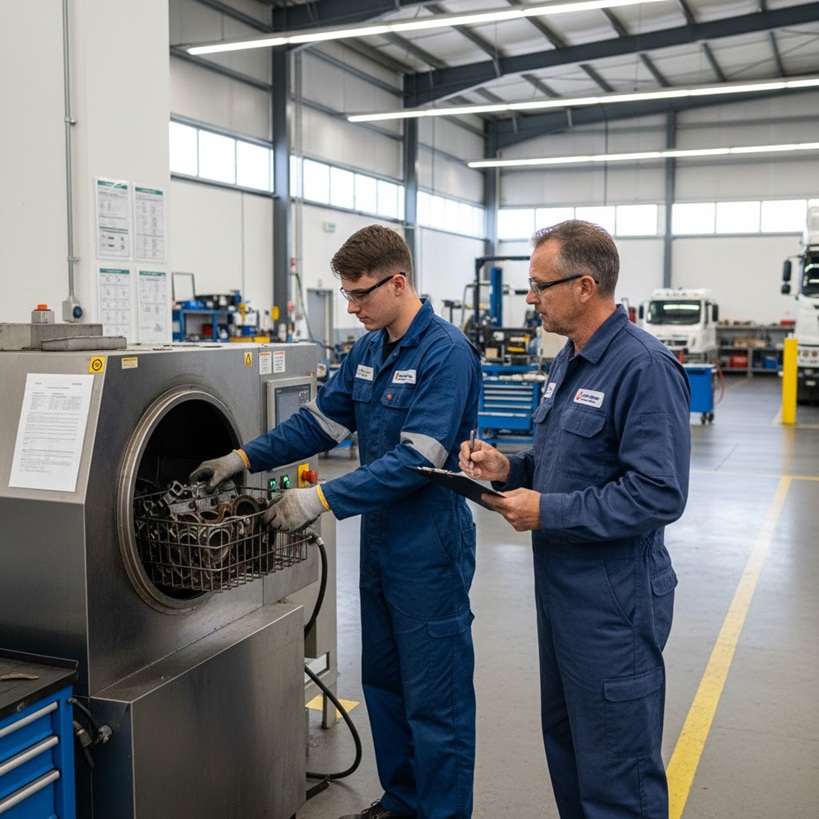
Workshop apprentices who learn proper equipment operation from day one avoid costly mistakes. They develop faster into productive team members. Training young workers on parts washers and cleaning equipment is not just about safety compliance. It is about building competency that saves time and money for decades.
Australian workshops face a practical challenge. Experienced tradies retire whilst apprentices arrive with limited hands-on knowledge. This skills gap hits hardest with specialised equipment. An apprentice who does not understand proper operation wastes chemicals. They damage parts. They tie up equipment when it should be cleaning components efficiently.
Structured training solves this problem. Apprentices learn correct operation procedures, cleaning cycles, and maintenance routines. They become competent operators within weeks instead of months. This guide breaks down how to build that competency systematically through effective equipment operation training.
Why Parts Washer Training Matters for Workshop Productivity
A parts washer can clean engine blocks in 15 minutes. This work takes four hours by hand. But this speed only applies if the operator knows what they are doing.
Untrained apprentices make predictable mistakes. They overload the chamber. They use incorrect detergent ratios. They run inadequate cycles. They fail to position parts for proper spray coverage. Each mistake costs time. An engine block that emerges still coated in carbon needs another cleaning cycle. This delays the job and wastes energy.
The productivity impact compounds across a workshop. If three apprentices each waste 30 minutes daily through improper operation, that is 7.5 hours lost weekly. That is nearly a full working day. Over a year, poor training costs roughly 390 hours of productive time.
Training delivers measurable returns. Apprentices who complete structured training operate equipment correctly 95% of the time within their first month. They clean parts right the first time. They maintain equipment properly. They spot problems before they cause breakdowns.
Building a Structured Training Programme
Effective training follows a clear progression. It moves from demonstration to supervised practice. It ends with independent operation and ongoing competency checks.
Week One: Equipment Fundamentals
Start with the basics. Apprentices need to understand what the equipment does. For parts washers, this means explaining the cleaning cycle. Discuss hot water circulation, detergent injection, and spray pressure.
Walk through the control panel. Show apprentices how to select cleaning programmes. Explain temperature settings. Monitor cycle progress together. Explain what each button and indicator means. Do not assume they will figure it out. Spell it out clearly.
Demonstrate proper loading techniques. Parts must be positioned so spray jets reach all surfaces. Heavy components go on the bottom. Lighter parts go on top. Items with blind holes need positioning that allows water drainage. Show examples of correct and incorrect loading.
Week Two: Supervised Operation
Apprentices learn by doing. Assign real cleaning tasks under supervision. Have them load a batch of components. Watch them select the appropriate cycle and start the machine.
Correct mistakes immediately. If they overload the chamber, explain why that reduces effectiveness. If they select a short cycle for heavy contamination, correct them. Show them how to assess contamination levels.
Run through common scenarios. Discuss cleaning aluminium components. These need lower temperatures to prevent etching. Discuss washing painted parts. These need gentle cycles. Discuss extremely greasy items. These often need a pre-rinse using manual parts washers before the main wash.
Week Three: Independent Operation with Checks
Let apprentices operate equipment independently. Verify results after they finish. Inspect the parts together. Point out any areas that did not clean properly. Discuss what adjustment would improve results.
This inspection process teaches quality standards. Apprentices learn what “properly clean” looks like. They learn how to achieve it consistently. They start recognising when parts need a second cycle.
Introduce basic troubleshooting. What should they do if the washer does not heat properly? How do they check detergent levels? When should they call for maintenance help? Clear guidelines prevent confusion.
Essential Skills for Parts Washer Operation
Competent operators master five core skill areas. These are loading techniques, cycle selection, chemical handling, maintenance procedures, and safety practices.
Loading and Positioning
Proper loading maximises cleaning effectiveness. It also prevents damage. Apprentices need to understand weight distribution. They must consider spray pattern coverage and drainage.
Heavy items like engine blocks go on the bottom rack. Lighter components like cylinder heads sit on top. Parts must be stable. Nothing should shift during the wash cycle. Unstable loads can damage parts and spray arms.
Positioning matters as much as placement. Hollow parts need orientation that allows water to drain. Parts with threaded holes should be angled. This lets spray jets reach the threads. Components with blind passages need careful positioning.
Cycle Selection and Programming
Different contamination levels require different cleaning cycles. Apprentices must learn to assess parts.
Light contamination: Use a short cycle with moderate temperature. This suits road dust and light oil film. Typical duration is 10-15 minutes.
Medium contamination: Use a standard cycle with high temperature. This suits grease and workshop grime. Typical duration is 20-30 minutes.
Heavy contamination: Use an extended cycle with maximum temperature. This suits caked grease and thick carbon. Typical duration is 40-60 minutes. Hot tanks are often best for this level of immersion cleaning.
Selecting the wrong cycle wastes resources. Too short, and parts emerge dirty. Too long, and you waste energy without improving results.
Chemical Handling and Dosing
Industrial parts washers use biodegradable detergents. Apprentices need training on proper handling and dosing.
Most automated washers inject detergent automatically. Apprentices must know how to check reservoir levels. They must refill correctly. Low detergent levels reduce cleaning effectiveness. Overfilling wastes chemicals.
Routine Maintenance Procedures
Operators who understand basic maintenance keep equipment running reliably. Training should cover daily, weekly, and monthly tasks.
Daily: Check water levels. Inspect spray arms for blockages. Verify detergent supply. Clean door seals.
Weekly: Drain and refill the wash tank if needed. Clean filters. Check pump operation.
Monthly: Deep clean spray nozzles. Check electrical connections. Verify temperature calibration.
Apprentices do not need to perform all maintenance. But they should recognise when equipment needs attention. An apprentice who reports reduced spray pressure prevents a breakdown.
At Hotwash Australia, we provide maintenance schedules with every machine. Teaching apprentices to follow these schedules is a vital part of their development.
Safety Protocols
Safety training prevents injuries and equipment damage. Key protocols include:
Never open the washer during a cycle. Hot water and steam can cause burns. Wait for the cycle to complete.
Do not overload the chamber. Excessive weight damages racks. Follow load capacity specifications.
Wear appropriate PPE. Gloves prevent skin contact with hot oils and detergents. This applies to parts washers and other cleaning equipment like wet abrasive blasters.
Keep the area clear. Wet floors create slip hazards. Obstructions prevent emergency access.
Know emergency shutdown procedures. Apprentices must understand how to stop the machine immediately.
Hands-On Training Techniques That Work
Effective training combines demonstration, practice, and feedback. These techniques accelerate competency.
Side-by-Side Demonstration
Do not just tell apprentices what to do. Show them. Load parts whilst explaining your decisions. Narrate your thought process. Explain why you angle a cylinder head a certain way. Explain why you choose a specific cycle. Physical demonstration builds understanding fast.
Supervised Practice with Immediate Feedback
Learning requires doing. Assign cleaning tasks and supervise closely. Watch apprentices load parts. Provide immediate feedback. If they position parts incorrectly, stop them. Explain the problem right then. Immediate correction prevents bad habits.
Mistake Analysis
When parts do not clean properly, use it as a teaching moment. Do not just re-run the cycle. Analyse what went wrong with the apprentice. Ask them why the spray did not reach certain areas. Analysing mistakes develops problem-solving skills.
Measuring Training Effectiveness
Competency training requires verification. You need to know apprentices have genuinely learned proper operation.
Practical Competency Tests
Schedule formal competency assessments. Present specific scenarios. Ask them to clean a batch of heavily contaminated engine components. Observe the entire process. Score performance against established criteria.
Quality Metrics
Track objective performance indicators. Look at the first-time cleaning success rate. Target 95% success after 60 days. Monitor equipment uptime. Operator-caused issues should drop to zero after 90 days.
Compliance with operator certification requirements is also key for some industries. Ensure your training records meet these standards.
Workplace Integration
Ultimate measurement comes from workplace integration. Can the apprentice handle tasks independently? After 90 days, they should assess incoming parts correctly. They should operate washers without supervision. They should achieve consistent quality.
Common Training Mistakes to Avoid
Even well-intentioned training programmes fail when workshops make common errors.
Assuming Knowledge: Never assume apprentices understand basics. Explain everything explicitly.
Inconsistent Standards: Ensure all trainers teach the same methods. Inconsistency confuses learners.
Skipping Documentation: Verbal training does not stick. Provide written procedures and checklists.
Neglecting Follow-Up: Training does not end after week one. Schedule regular check-ins.
Building Long-Term Competency
Structured training creates competent operators quickly. But true expertise develops over years. Support long-term skill development.
Introduce advanced techniques later. Teach them to optimise cycles for specific materials. Involve experienced apprentices in training newer workers. Teaching reinforces knowledge. Encourage problem-solving. When apprentices suggest improvements, listen to them.
For mining applications, operating extra heavy duty parts washers requires understanding massive payloads. Training here focuses heavily on safety and rigging as well as cleaning. Advanced surface preparation using wet abrasive blasters may also be part of the apprentice skill set in mining operations.
Conclusion
Apprentice competency does not happen by accident. It requires structured equipment operation training. Workshops that invest time in training build capable teams. They work efficiently and maintain equipment reliably.
Parts washer training delivers measurable returns. You get fewer mistakes and better cleaning results. You reduce equipment downtime. An apprentice who masters operation within three months contributes productively for their entire career.
Australian workshops need skilled operators. Structured programmes create that competency systematically. They turn inexperienced apprentices into confident operators.
Ready to implement effective equipment training? Contact our training support team or email us on sales@hotwash.com.au to discuss operator resources. Our Australian-made heavy duty parts washers come with comprehensive training materials to build competency from day one.

Leave A Comment