
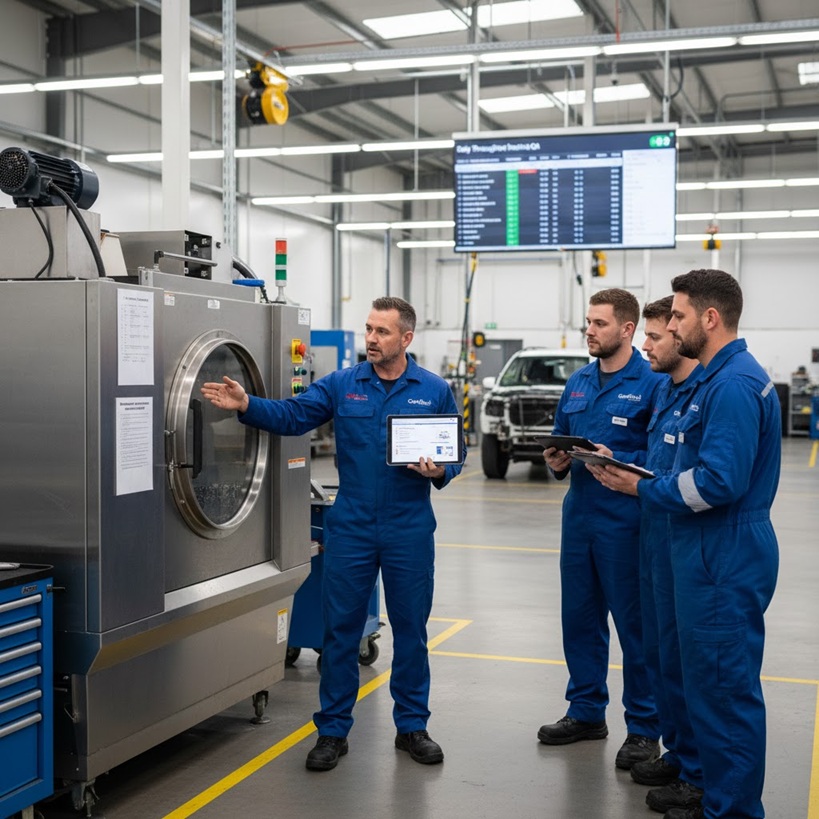
A parts washer sits idle in a Welshpool workshop. It is not broken. It sits idle simply because no one knows how to use it properly. The business paid $15,000 for automated cleaning, yet workers still scrub parts by hand in the sink. This scenario plays out across Australian workshops every week. Equipment gets purchased, productivity gains are promised, but results are never delivered.
The gap between buying industrial equipment and actually improving workshop productivity comes down to one factor: training. This does not mean a quick five-minute demonstration during installation. It means establishing proper protocols that turn expensive machinery into measurable time savings. Without structured training, even the best equipment becomes an underutilised asset that takes up floor space.
Workshop Productivity Methods Start with Training
Workshop productivity is not about working harder. It is about eliminating wasted time. A mechanic might spend four hours cleaning engine components by hand. That same mechanic could do the job in 15 minutes using a parts washer. That represents 3 hours and 45 minutes of lost productivity for a single task. Multiply that across a team of five mechanics over a month, and the business loses 375 hours of billable work.
Proper training converts equipment investment into operational efficiency. A workshop manager at a Perth mining contractor tracked their workshop productivity methods before and after implementing structured training. Before training, workers used their machine for small components only. They defaulted to manual cleaning for larger parts because they were unsure how to load them.
After the manager implemented efficiency improvement training, the team changed their habits. They began cleaning excavator bucket teeth, hydraulic cylinders, and gearbox housings in the washer. This reduced average cleaning time by 68%.
The productivity equation is straightforward. Equipment capability minus operator knowledge equals actual output. Most workshops operate at 40-60% of their equipment’s potential. This happens because training usually stops after installation day.
The Real Cost of Inadequate Training
Poor training creates hidden costs that do not appear immediately on maintenance invoices. These costs bleed profit from the business slowly over time. A food processing facility in Melbourne provides a clear example. They purchased cleaning equipment for mixer components and conveyor parts. The installation team demonstrated basic operation. Staff learned to load parts, add detergent, and press start.
Within six months, the facility faced three significant problems. First, workers overloaded chambers. This reduced cleaning effectiveness and required re-washing. It doubled cycle times and water usage. The business calculated they ran the washers 40% more than necessary. This added $3,200 annually in electricity and water costs.
Second, incorrect detergent ratios damaged seals and pumps. The maintenance team replaced pump seals twice in eight months. These repairs should not occur within the first two years of operation. Each repair cost $850 in parts and labour, plus expensive downtime.
Third, staff avoided using the equipment for complex cleaning tasks. They reverted to manual methods because they lacked confidence. The washers sat unused during peak production periods whilst workers scrubbed parts in sinks. The production manager estimated they lost 15-20 hours of labour weekly.
The total cost of inadequate training over 12 months was substantial. They lost $8,400 in excess running costs and $1,700 in premature repairs. They also lost approximately $31,200 in labour (20 hours weekly at $30/hour). The business spent $41,300 because they skipped comprehensive efficiency improvement training.
Building Effective Training Protocols: A Three-Tier System
Effective training protocols follow a structured approach. You cannot teach everything in one session. A three-tier system builds competency progressively and ensures information sticks.
Tier One: Fundamental Operation Skills
This covers daily use. It involves starting the machine, loading parts correctly, selecting appropriate cycles, and basic troubleshooting. Training should be hands-on, not just verbal instruction. Workers need to load parts themselves. They must adjust spray arms and understand why chamber arrangement affects cleaning results.
Fundamental training is critical for smaller units like manual parts washers. Workers often assume these machines are simple. However, knowing which brush to use or how to regulate fluid flow changes the speed of cleaning. For a standard spray washer, fundamental training takes about 90 minutes. This includes loading different part types, such as small fasteners versus large housings. It also covers understanding weight distribution and recognising when parts need pre-cleaning.
Tier Two: Optimisation and Efficiency
This tier teaches workers how to maximise equipment capability. Topics include detergent concentration for different contamination levels and cycle customisation. It focuses on getting the most out of the machine.
At Hotwash Australia, we have seen workshops implement optimisation training for their hot tanks. Workers learned to group parts by contamination level rather than size. This reduced total cleaning time by 35%. Heavy grease components soaked first. Meanwhile, workers loaded the spray washer with lighter contamination parts. This sequential approach eliminated bottlenecks.
Optimisation training typically requires 2-3 hours. It should include practical exercises. Workers should solve real cleaning challenges they face daily. This is where you introduce advanced workshop productivity methods.
Tier Three: Preventative Maintenance
This tier covers routine maintenance tasks. These tasks prevent breakdowns and extend equipment life. Workers learn to check pump pressure and inspect spray nozzles for blockages. They learn to monitor temperature accuracy and identify early warning signs of component wear.
A mining operation in the Pilbara trained their maintenance team on checks for parts washers. The team performed weekly inspections. This 15-minute task caught problems before they caused failures. Over 18 months, they reduced unplanned downtime by 80%. They avoided three major repairs that would have cost $12,000 combined. Maintenance training requires 3-4 hours initially, plus quarterly refreshers.
The Link Between Safety and Productivity
Safety and productivity are often treated as separate goals. In reality, they are linked. An unsafe worker is a slow worker. An injured worker stops production entirely. Proper training protocols must include safety procedures specific to industrial cleaning.
This is particularly important for equipment like hot blasters. These machines use water and abrasive media to clean metal. If a worker uses the wrong pressure setting or fails to secure the viewing window, accidents happen. Training ensures workers respect the power of the machinery. Wet abrasive blasters require similar safety protocols and operator awareness.
Chemical safety is another critical component. Workers need to know how to handle detergents and solvents safely. They must understand the risks of mixing incompatible chemicals. A clear protocol prevents chemical burns and respiratory issues. This keeps your workforce healthy and on the job.
Creating Documentation That Workers Actually Use
Training manuals that sit on shelves do not improve productivity. Effective documentation needs to be accessible, visual, and task-specific.
Quick Reference Guides
Single-page laminated guides work better than 50-page manuals. You should mount these directly near the equipment. These guides show common tasks in a step-by-step format with photos.
A quick reference guide might include:
- Proper brush selection for different materials.
- Detergent mixing ratios.
- A troubleshooting flowchart for common issues.
- Emergency stop procedures.
Visual Aids
Photos of correctly loaded chambers help workers replicate best practices. A workshop in Sydney took photos of optimal part arrangements. They labelled each image with part type and cycle selection. Workers referenced these images daily for the first month. The visual guides reduced loading errors by 90%.
Digital Access Solutions
Workshop staff carry phones. You should put documentation where they already look. A Perth fabrication shop created a shared folder with equipment videos. They included troubleshooting guides and maintenance checklists. Workers accessed information immediately when questions arose. They did not have to wait for a supervisor or guess the solution.
Measuring Training Effectiveness
Training protocols need measurable outcomes. You need to justify the time investment. Track these metrics before and after implementing structured efficiency improvement training:
Cycle Time per Part Type
Measure how long it takes to clean specific components. A hydraulic cylinder might take 45 minutes to clean manually. It should take 12-15 minutes in a properly used parts washer. If it still takes 30 minutes, training has not translated to practice.
Equipment Utilisation Rate
Calculate what percentage of available time equipment actually operates. A washer that runs three hours daily in an eight-hour shift has a 37.5% utilisation rate. After effective training, that should increase to 60-75%. This is especially true for high-capacity machines like extra heavy duty parts washers. Workers need to understand the full range of parts they can clean to keep the machine busy.
Maintenance Frequency
Track unplanned repairs and premature component failures. Proper training should reduce maintenance calls by 50-70% in the first year. It prevents operator-caused damage and helps staff catch issues early.
Labour Reallocation
Measure how many labour hours shift from manual cleaning to productive work. This is the real productivity gain. Mechanics should spend time on repairs and diagnostics rather than scrubbing parts.
A transport workshop in Melbourne tracked these metrics for six months. Average cleaning cycle time decreased by 40%. Equipment utilisation increased from 35% to 68%. Unplanned maintenance dropped by 65%. Most importantly, the workshop reallocated 22 hours weekly from cleaning to billable repair work. At a $45/hour labour rate, that equals $990 additional revenue weekly. That is $51,480 annually.
Ongoing Training and Skill Development
Training is not a one-time event. It is an ongoing process. Equipment ages and staff changes. You need to establish consistent practices to maintain high standards.
Monthly Refresher Sessions
Hold fifteen-minute team meetings. Review equipment best practices and discuss challenges. Share efficiency improvements. These sessions keep training front-of-mind. They give workers a forum to ask questions about workshop productivity methods.
New Employee Onboarding
Standardise training for new hires. A mining contractor in Kalgoorlie requires all new maintenance staff to complete equipment certification. This happens within their first two weeks. This prevents experienced workers from teaching shortcuts to newcomers. It ensures everyone uses super heavy duty parts washers correctly from day one. Training on wet abrasive blasters and surface preparation equipment follows similar protocols.
Seasonal Reviews
Equipment performance changes with workload variations. A workshop might clean diesel components in winter and petrol components in summer. You need to adjust detergent types and cycle times seasonally. Annual reviews ensure training stays current with operational reality.
The ROI of Proper Training Protocols
Training requires time investment upfront. It typically takes 6-8 hours per worker for comprehensive protocols. For a five-person team, that is 30-40 hours of training time. At a $35/hour average wage, the direct cost is $1,050-$1,400.
Compare that to the productivity gains. Using the Melbourne transport workshop example, the business saw a $51,480 annual revenue increase. The training investment paid for itself in the first week.
Even conservative improvements deliver strong returns. A small automotive workshop with two mechanics implemented basic training. They focused on their equipment. They gained eight hours weekly of productive time. At a $40/hour labour rate, that is $320 weekly or $16,640 annually. Their training investment was six hours total time. That cost approximately $420 in wages. The ROI was 3,857%.
You also need to consider the longevity of the machine itself. Equipment built from high-quality materials, such as stainless steel parts washers, lasts for decades when treated right. Training ensures the operator treats the machine as a valuable asset rather than just a utility.
Conclusion
Workshop productivity improvements do not come from simply buying better equipment. They come from using existing equipment properly. A $15,000 parts washer delivers zero productivity gain if workers do not understand it. They must know how to load it correctly, select appropriate cycles, and maintain it preventatively.
Proper training protocols convert equipment capability into measurable output. The three-tier approach builds competency. It translates to reduced cycle times, higher equipment utilisation, and fewer breakdowns. Documentation that is visual and accessible ensures training sticks.
The ROI is undeniable. Workshops that implement structured efficiency improvement training protocols see results. They typically see 40-70% reductions in cleaning time. They see 50-75% increases in equipment utilisation. They also see 60-80% decreases in operator-caused maintenance issues. These improvements convert directly to labour hours reallocated to revenue-generating work.
Training requires upfront time investment. However, the payback period is measured in days, not months. Even modest productivity gains deliver returns of 1,000% or more in the first year. Australian workshops face labour shortages and rising wage costs. The solution is eliminating wasted time through proper equipment use.
You can maximise the return on your cleaning equipment investment. Contact our equipment training specialists to discuss protocols tailored to your workshop. Email us on sales@hotwash.com.au for a consultation on improving your operational efficiency.

Leave A Comment