
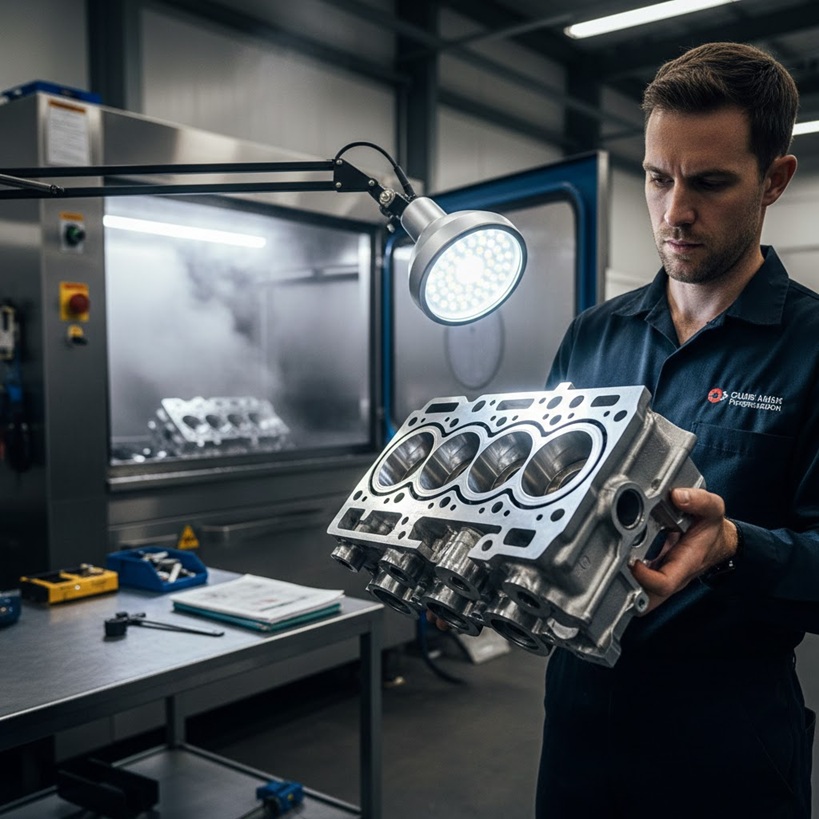
A cracked bearing housing that looks clean can still fail within hours. A cylinder head with invisible carbon deposits will leak compression. In workshops across Perth and regional WA, parts that pass visual inspection after cleaning go straight back into service. The quality of that cleaning determines whether equipment runs for another 5,000 hours or breaks down next week.
Visual inspection requires more than spotting obvious dirt. You must see what clean parts reveal. Stress fractures hide under grease. Corrosion patterns predict failure. Wear indicators remain obscured by manual scrubbing. When mining operations lose $50,000 per hour to unplanned downtime, the difference between “looks clean” and “properly cleaned” becomes expensive fast.
What Clean Parts Actually Show You
Properly cleaned components reveal their true condition. A differential housing covered in oil and mud hides crack propagation. A fuel injector with carbon buildup conceals worn spray patterns. A food processing mixer blade with baked-on residue masks metal fatigue. Workshop managers who rely on automated cleaning report finding defects they would have missed with manual methods. The difference comes down to consistency. Automated spray systems remove contamination uniformly. They expose surfaces that hand scrubbing leaves partially obscured.
Surface Defects and Stress Fractures
Surface defects become visible when you remove every trace of operating residue. Heat-treated components show discolouration patterns. These indicate stress points. Cast iron reveals porosity that predicts future leaks. Machined surfaces display scoring that manual cleaning cannot fully expose. Workers often focus on removing bulk contamination rather than achieving inspection-grade cleanliness required by rigorous parts inspection standards.
Corrosion Patterns and Material Degradation
Corrosion patterns emerge after thorough degreasing. Salt corrosion on marine diesel components looks like general grime until hot water spray removes the protective oil layer. Galvanic corrosion between dissimilar metals appears as discolouration. Scrubbing alone often fails to reveal this because it sits underneath surface oils. You need to strip the surface to the base metal to make an accurate assessment.
The Inspection Standards Mining Operations Demand
BHP’s Pilbara operations do not accept “clean enough.” They require inspection-ready cleanliness. A failed haul truck component costs more in downtime than the part itself. Their maintenance protocols specify contamination levels measured in milligrams per square metre. They do not rely on subjective assessment.
This drives demand for extra heavy duty parts washers that deliver repeatable results. A maintenance supervisor cannot build inspection protocols around variable cleaning quality. Either every excavator bucket pin comes out inspection-ready, or the system fails operational requirements.
Dimensional Inspection Requirements
Dimensional inspection requires bare metal. Micrometers and dial indicators do not measure through oil films. Coordinate measuring machines cannot assess geometry with residual carbon. Non-destructive testing fails when contamination interferes. Magnetic particle inspection and dye penetrant testing require absolutely clean surfaces to function.
Visual Defect Detection Protocols
Visual defect detection demands uniform cleanliness. Crack detection relies on seeing hairline fractures across entire surfaces. If one section remains film-coated whilst another shows bare metal, inspectors miss defects in contaminated zones. Manual washing creates this variable cleanliness. Workers apply inconsistent pressure and coverage. Automated systems ensure every square millimetre meets the same acceptance criteria standards.
How Temperature and Pressure Affect Inspection Quality
Hot water at 85°C does not just clean faster. It changes what you can see. Heated spray dissolves baked-on carbon that cold water moves around. Oil emulsifies instead of spreading. Grease liquefies rather than smearing.
The wet abrasive blasters manufactured by Hotwash Australia combine temperature with pressure. This achieves inspection-grade results. Spray jets delivering high pressure reach recessed areas that hand tools cannot access. Rotating spray arms ensure uniform coverage. This eliminates the partially-clean zones manual washing creates.
Breaking Down Carbon Deposits
Carbon deposits require heat to break down. Engine components operating at combustion temperatures develop carbon that bonds to metal surfaces. Cold degreaser softens surface layers but leaves base contamination. Hot water at 80-85°C penetrates carbon structure. This allows spray pressure to remove deposits down to bare metal. For extremely heavy carbon buildup on cylinder heads or pistons, wet abrasive blasters can strip deposits that chemical cleaning cannot fully remove.
Emulsifying Oil Films
Oil films need emulsification for complete removal. Wiping with solvent moves oil around. Cold spray rinses surface oil but leaves molecular films. Hot water with biodegradable detergent emulsifies oil completely. This exposes the actual metal surface for inspection.
Thermal Breakdown of Baked Grease
Baked grease demands thermal breakdown. Wheel bearings, differential housings, and gearbox components accumulate grease. This grease work-hardens under heat and pressure. Manual scrubbing removes bulk material but leaves a brown film. This film obscures surface inspection. Thermal cleaning breaks these bonds effectively.
Food Industry Inspection Standards and Cleanliness
Commercial kitchens and food processing facilities face different inspection requirements. Bacterial contamination you cannot see matters more than visible cleanliness. A mixer blade that looks clean under visual inspection can still fail ATP testing for organic residue.
This drives adoption of stainless steel parts washers in food manufacturing. Hygiene inspectors do not accept “looks clean.” They swab surfaces and measure contamination in colony-forming units. Equipment that passes visual inspection but fails laboratory testing shuts down production lines.
Organic Residue and Biofilm Risks
Organic residue hides in surface texture. Stainless steel looks smooth but has microscopic surface roughness. This traps proteins and fats. Visual inspection misses this contamination because it is below visible scale. Hot water spray at food-safe temperatures combined with food-grade detergent reaches these micro-scale hiding spots.
Biofilm formation starts invisibly. The first stage of bacterial colonisation does not show up in visual inspection. By the time you see discolouration, you are dealing with established biofilm. It is difficult to remove. Proper cleaning prevents this initial attachment.
Preventing Cross-Contamination
Cross-contamination risks require total cleanliness. Allergen management in food processing is critical. Parts that contacted peanuts must be completely free of protein residue before touching other products. Visual inspection cannot detect protein at these levels. Only proper cleaning protocols prevent cross-contamination.
What Manual Washing Misses That Inspectors Find
A mechanic spending four hours hand-scrubbing a transmission case focuses on bulk oil removal. They are not achieving inspection-grade cleanliness. They are getting parts clean enough for reassembly. The difference becomes obvious under inspection lighting.
Recessed Areas and Blind Passages
Recessed areas remain contaminated. Bolt holes, internal galleries, and blind passages are difficult to reach. Brushes do not fit. Spray-rinsing by hand is ineffective. Inspectors checking these zones find residual contamination. This contamination escaped visual detection during manual cleaning.
Inconsistency in Surface Preparation
Inconsistent surface preparation creates inspection problems. One side of a component gets thorough scrubbing. Another receives cursory attention. Under inspection lighting, this variation becomes obvious. Automated systems eliminate this inconsistency.
Time Pressure vs. Thoroughness
Time pressure compromises thoroughness. When a mechanic has eight parts to clean before shift end, thoroughness suffers. The last parts get less attention than the first. Inspection quality varies based on workload pressure rather than remaining consistent.
The ROI of Inspection-Ready Cleaning
Rio Tinto’s maintenance operations calculated the cost of defects. Finding defects during cleaning inspection costs roughly $200 per component. Missing defects and discovering them during failure costs between $15,000 and $50,000. This includes emergency repairs and downtime.
This math drives investment in automated systems. Equipment that delivers inspection-ready cleanliness every cycle prevents expensive failures. You avoid reassembling components with hidden defects.
Reducing Catastrophic Failures
Earlier defect detection reduces catastrophic failures. A cracked housing found during inspection gets repaired during scheduled maintenance. The same crack missed during inadequate cleaning causes complete failure during operation. It often damages surrounding components and creates safety hazards.
Improving Workshop Throughput
Reduced inspection time improves workshop throughput. When parts come out of heavy duty parts washers inspection-ready, technicians save time. They spend 15 minutes examining components instead of 45 minutes cleaning then examining. This time saving multiplies across every component serviced.
Supporting Warranty Claims
Better documentation supports warranty claims. Photographic evidence of component condition before and after cleaning strengthens warranty disputes. Parts that are not properly cleaned do not photograph clearly enough. You cannot prove manufacturing defects versus operational damage without clear images.
Surface Finish Indicators That Reveal Operating Conditions
Experienced maintenance technicians read surface conditions like mechanics read oil analysis reports. A properly cleaned component tells the story of its operating environment. It reveals heat exposure, contamination sources, and lubrication adequacy. For components with heavy rust or scale, wet abrasive blasters expose the underlying metal condition that chemical cleaning alone might miss.
Thermal Stress and Heat Tint
Discolouration patterns indicate thermal stress. Steel components show blue, brown, or straw-coloured heat tint. This depends on temperature exposure. These patterns only become visible after complete oil removal. Manual cleaning leaves oil films that obscure thermal indicators.
Fretting Corrosion and Lubrication Issues
Fretting corrosion shows inadequate lubrication. The reddish-brown powder forms where parts move under load without proper lubrication. It looks like general rust until proper cleaning exposes the characteristic pattern. This diagnosis changes maintenance protocols.
Cavitation and Abrasive Wear
Cavitation damage appears as pitted surfaces. Hydraulic components and pump housings develop characteristic erosion patterns. Proper cleaning reveals the extent of this damage. It informs repair-versus-replace decisions. Visual inspection through contamination cannot support these decisions.
Abrasive wear creates directional scratching. Contaminated lubrication systems show characteristic scratch patterns. These align with component motion. These patterns diagnose filtration problems. But this only works when cleaning exposes bare metal for examination.
Training Inspectors to Recognise Properly Cleaned Components
New maintenance technicians often confuse “degreased” with “inspection-ready.” A component can be free of bulk oil whilst retaining surface films. These films obscure defects. Training programs that include automated cleaning demonstrate the difference.
Baseline Standards and Physical Examples
Baseline standards require physical examples. Showing technicians a manually cleaned part beside an automated-clean part establishes visual standards. The difference in surface appearance and defect visibility becomes obvious. This side-by-side comparison sets the acceptance criteria standards for the workshop.
Lighting and Touch Testing
Lighting conditions affect inspection quality. Components that look clean under workshop fluorescent lighting show contamination under inspection lamps. Proper cleaning eliminates this variation. Parts look equally clean under any lighting because they actually are clean.
Touch testing reveals residual contamination. A properly cleaned metal surface feels different. It lacks molecular oil films. Training inspectors to recognise this tactile difference improves quality control. It helps when visual inspection alone seems adequate.
Australian Standards and Cleanliness Requirements
AS 1627 specifies cleanliness requirements for hydraulic systems. It measures contamination levels in particles per millilitre. Meeting these standards requires cleaning that removes particles invisible to visual inspection.
Workshop operations serving mining, oil and gas, and food processing industries must demonstrate compliance. Hot tanks are often used to achieve the deep cleaning required for these rigorous standards. For heavily corroded or scaled components, wet abrasive blasters can prepare surfaces to meet Australian Standards cleanliness requirements.
Hydraulic Component Cleanliness
Hydraulic component cleanliness prevents system failures. A cylinder barrel that looks clean can still contain particles. These particles score seals and cause leakage. Proper cleaning removes these sub-visible contaminants.
Workplace Safety and Flash Fire Risks
Workplace safety regulations require proper degreasing. WHS requirements specify that components entering welding or heat-treating operations must be free of residues. Flammable residues create flash fire risks. Visual inspection does not detect hydrocarbon films. Proper cleaning is the only safeguard. Wet abrasive blasters provide the additional benefit of removing flammable coatings and residues whilst preparing surfaces for hot work.
Conclusion
Visual inspection only works when parts are properly cleaned. “Properly cleaned” means more than removing visible contamination. It means exposing bare metal surfaces. This reveals stress fractures, corrosion patterns, and wear indicators. These factors predict future failures.
Mining operations, food processors, and heavy industry workshops cannot accept variable cleaning results. Reliance on visual inspection for quality control demands consistency. Equipment that delivers inspection-ready cleanliness every cycle prevents expensive failures. It stops you from reassembling components with hidden defects.
Hotwash manufactures automated parts washing systems in Perth. These achieve the uniform cleanliness inspection protocols demand. Built to Australian standards for Australian industrial conditions, these systems remove contamination that manual washing leaves behind. They expose the surface conditions that proper inspection requires.
Workshop managers responsible for equipment reliability need cleaning systems that support rigorous parts inspection standards. Contact our inspection standards specialists or email us on sales@hotwash.com.au to discuss parts washing solutions that deliver inspection-ready results. Finding defects during cleaning costs hundreds, whilst missing them costs thousands.

Leave A Comment