
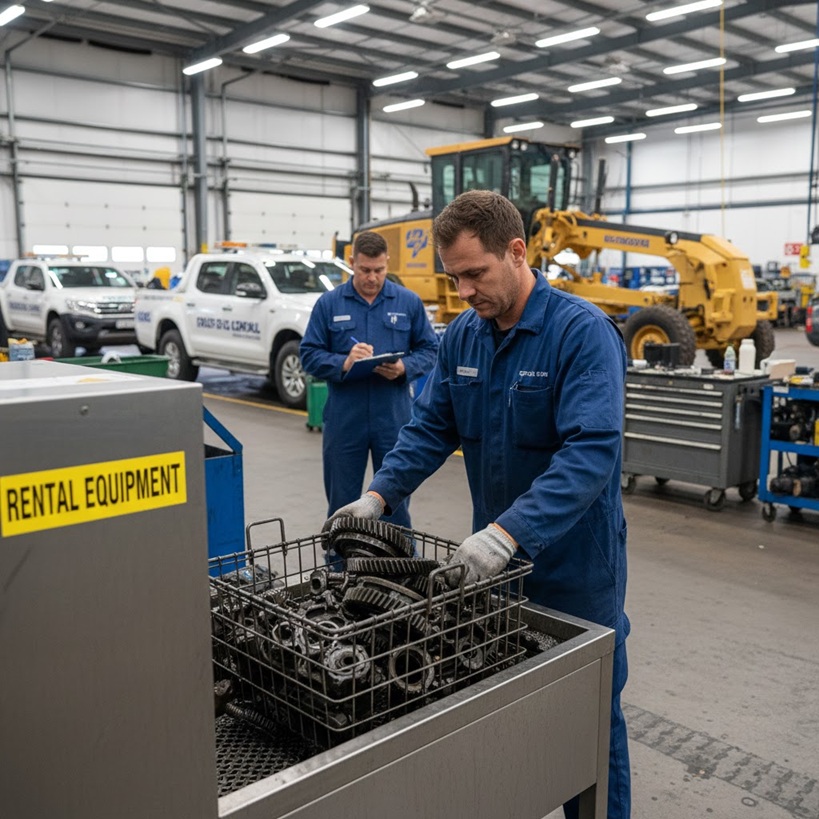
When a parts washer breaks down during peak production, workshop managers face an expensive dilemma. You can rush into buying replacement equipment without proper evaluation. Or, you can lose thousands in downtime whilst researching options. There is a third path that eliminates both risks. Strategic equipment rental solutions transform purchasing decisions from guesswork into data-driven choices.
The hidden costs of rushed equipment purchases are significant. Workshop equipment failures rarely announce themselves with convenient timing. A machine that has cleaned engine components reliably for years might develop issues on a Monday morning. This leaves mechanics scrubbing parts by hand whilst management scrambles for solutions.
The High Cost of Rushed Decisions
The pressure to restore operations quickly often leads to costly mistakes. A mining maintenance facility in the Pilbara recently purchased a $45,000 automated system based solely on specifications. They discovered the chamber could not accommodate their largest excavator components after installation. This detail would have been obvious during a rental trial.
Operational Mismatches
Rushed purchases frequently reveal operational mismatches beyond sizing errors. A “high-efficiency” system that looked perfect on paper might require three-phase power your workshop lacks. Automated features that justified a premium price might prove too complex for your team’s workflow. These discoveries after purchase create buyer’s remorse.
Infrastructure Surprises
You might find that a new machine generates more steam or noise than expected. It might require ventilation upgrades you did not budget for. Equipment rental solutions allow you to identify these infrastructure needs before you commit to a permanent installation. This prevents expensive retrofitting costs later.
How Rentals Transform Decision Making
Rental programs flip the traditional purchasing model. You do not have to commit capital based on brochures and sales presentations. Operations managers test actual equipment performance under their specific conditions. This hands-on evaluation reveals insights no specification sheet captures.
Hotwash Australia offers rental programs where rental payments convert toward the purchase price. This structure provides low-risk financing whilst you evaluate performance under your specific conditions.
Moving Beyond Brochures
A Brisbane food processing plant recently faced this scenario. They needed to upgrade from caustic tanks to automated washing. Rather than gambling on a stainless steel parts washer, they rented the unit for three months. They discovered their cleaning cycles averaged 18 minutes during this period. This was far faster than the 45 minutes their manual process required.
Data-Driven Justification
This data justified the investment with concrete calculations. The rental period serves as an extended demonstration. Every shift provides performance data. Maintenance teams document actual cycle times. They measure detergent consumption rates. They track labour savings. This real-world testing eliminates assumptions. It validates manufacturer claims against your specific applications.
Matching Equipment to Operational Needs
Parts washing requirements vary dramatically between industries. They even vary between workshops in the same sector. A heavy duty parts washer perfect for automotive workshops might prove inadequate for mining operations. Conversely, equipment sized for major mining might waste resources in smaller facilities.
Avoiding Sizing Errors
These mismatches become immediately apparent during rental trials. A Kalgoorlie mining contractor discovered their anticipated need for maximum capacity was actually sporadic. Most days, their parts washers handled smaller components. A mid-range system handled these efficiently. The super heavy duty parts washer they originally specified would have consumed unnecessary power and floor space.
Temperature Requirements
Temperature requirements often surprise first-time automated washing users. Operations accustomed to cold solvent washing often assume they need maximum heat. Rental trials frequently prove that 60°C water with proper detergent outperforms previous methods. This eliminates the expense of high-temperature systems.
Load Capacity Calculations
Real-world testing benefits load capacity calculations enormously. A chamber might accommodate your largest parts physically. However, you need to know if it handles your daily volume efficiently. Rental periods reveal whether you need multiple smaller units or one large system. These insights are impossible to gain from specifications alone.
Financial Benefits of Equipment Rental Solutions
The obvious financial advantage of rentals is avoiding poor purchase decisions. However, smart operations leverage rental programs for other benefits too. They use them for cash flow management, tax advantages, and operational flexibility.
Seasonal Flexibility
Seasonal operations particularly benefit from rental flexibility. A Perth marine service facility processes hundreds of outboard components during summer months. They see minimal volume in winter. Their rental agreement scales with demand. This eliminates idle equipment costs during slow periods. This flexibility freed $50,000 in capital for workshop improvements.
Rent-to-Own Pathways
Rent-to-own programs bridge the gap between testing and ownership. Rental payments convert toward the purchase price. This structure provides low-risk financing. Every payment either secures continued use or builds ownership equity.
A Mackay sugar mill utilised this approach. They converted six months of rental payments into ownership after validating the equipment. This confirmed the machine handled their sticky residue challenges effectively.
Trial Period Arrangements
Structuring deals as trial period arrangements offers tax efficiency. Operating expenses often provide immediate deductions. This compares favourably to depreciating capital equipment over years. Rental expenses offer superior tax efficiency for businesses maximizing current-year deductions. You should consult your accountant about specific advantages for your situation.
Technical Validation During Rentals
Rental periods expose technical details that impact long-term satisfaction. You can assess power consumption during actual use versus specifications. You can also evaluate maintenance requirements under your specific contamination levels.
Assessing Environmental Impact
Noise levels in your specific environment matter more than decibel ratings suggest. A “quiet” 75dB system might echo disruptively in a concrete workshop. Rental trials let you evaluate acoustic impact during actual operations. You might identify needs for placement adjustments or sound dampening.
Maintenance Reality Checks
Maintenance complexity becomes apparent through hands-on experience. Some systems require daily filter cleaning that disrupts workflow. Others run weeks between service. Your team’s comfort with maintenance procedures directly impacts long-term reliability. Rental periods establish these routines before they become permanent obligations.
A Melbourne automotive workshop discovered their rented manual parts washer consumed 30% less detergent than projected. Their parts arrived less contaminated than typical applications. This reduced their operating cost calculations significantly.
Strategic Rental Implementation
Successful rental trials require planning beyond “try it and see.” You must establish clear evaluation criteria before equipment arrives. Document baseline metrics from current processes to measure improvements objectively.
Planning Your Trial
Assign specific team members to track performance data throughout the rental. Keep daily logs of cycle times and parts processed. Note any issues that arise. A Gladstone industrial contractor used detailed rental logs to track hot tanks usage. They found demand peaked Tuesday through Thursday. This informed their eventual purchase of two units rather than one larger system.
Optimising the Test Period
Communication with rental providers throughout the trial improves outcomes. Report any performance issues immediately. Adjustments to spray pressure, temperature settings, or detergent concentration might improve results dramatically. Providers want successful trials leading to purchases. They will willingly optimise settings for your applications.
Consider seasonal timing for trials. Testing during peak production validates performance under maximum stress. Alternatively, slower periods allow thorough evaluation without production pressure. Either approach works, but you must align trial timing with evaluation priorities.
For workshops requiring both cleaning and surface preparation, renting wet abrasive blasters alongside parts washers provides comprehensive evaluation. Wet abrasive blasters handle rust removal and paint stripping that washers cannot. Testing both systems together reveals workflow synergies before purchase commitment.
Common Rental Misconceptions
Some managers hesitate to rent due to outdated beliefs. Understanding the reality of modern rental fleets helps you make better decisions.
The “Worn Out” Myth
“Rental equipment is worn out” is a common misconception. This ignores modern rental fleet management. Reputable providers maintain rental units to identical standards as sold equipment. Rental units often receive more frequent professional maintenance than customer-owned equipment.
The Cost Comparison Fallacy
“Rentals cost more than buying” is a short-sighted calculation. It ignores the value of risk mitigation. One prevented poor purchase decision saves more than years of rental fees. Additionally, rental costs during trial period arrangements often offset labour savings from improved efficiency.
The Expertise Trap
“We know what we need” can be a dangerous assumption. Even experienced operations benefit from hands-on validation. A trusted parts washer model from a previous facility might perform differently now. Your current water quality, parts mix, or production schedule creates new variables. Rental trials eliminate these unknowns.
Making the Rental-to-Purchase Decision
The purchase decision becomes mathematical rather than emotional after accumulating rental data. You can calculate the total cost of ownership accurately. Include purchase price, projected maintenance, operating costs, and labour savings.
Calculating ROI
Compare these figures against continued rental costs and alternative solutions. A Townsville heavy equipment rebuilder analysed three months of rental data. Their hot blasters cleaned transmissions 70% faster than their previous method.
With labour costs of $85 per hour and average time savings of three hours per unit, the system paid for itself in under eight months. This concrete ROI data secured immediate purchase approval.
Similar calculations apply when evaluating wet abrasive blasters. Rental data reveals actual time savings for rust removal and surface preparation. This quantifies the business case for purchase versus continued rental.
Partial Purchase Strategies
Consider partial purchases when rental data shows sporadic high-capacity needs. You might purchase a base unit and rent specialty attachments occasionally. This optimises capital deployment. This hybrid approach provides ownership benefits while maintaining flexibility for peak demands.
Factor in technology advancement rates. Rental trials might reveal current equipment meets 90% of your needs. However, waiting for next-generation models might make sense. Continued rentals bridge this gap without committing capital to soon-obsolete technology.
Long-Term Value Creation
The insights gained from strategic rentals extend beyond individual purchase decisions. Documenting equipment performance under your specific conditions creates valuable operational intelligence.
Operational Intelligence
This data informs maintenance scheduling. It helps with staffing decisions. It guides future equipment specifications. Operations that approach rentals strategically report additional benefits. Staff trained on rental equipment transition seamlessly to purchased units.
Beyond the Machine
Workflow optimisations developed during trials persist regardless of ownership structure. Even unsuccessful trials provide value by preventing poor purchases. The rental experience often reveals opportunities beyond equipment replacement. That parts washer trial might expose inefficiencies in parts flow. It might highlight issues with cleaning chemistry or quality standards.
Conclusion
Smart workshop managers recognise that equipment rental solutions eliminate the expensive gamble of uninformed purchases. By testing actual performance under your specific conditions, rentals transform major capital decisions. They turn risky guesses into calculated investments backed by operational data.
The financial benefits extend beyond risk mitigation. Flexible payment structures and tax advantages create paths to ownership. These options preserve capital and improve cash flow. More importantly, the operational insights gained during rental periods optimise long-term equipment utilisation.
You might be replacing failed equipment, expanding capacity, or upgrading technology. Strategic rentals provide the hands-on validation that specification sheets cannot. The minimal cost of rental trials pales against the potential savings from prevented poor purchases.
Whether evaluating parts washers for cleaning or wet abrasive blasters for surface preparation, rental programs eliminate purchasing risk. Test both systems under your actual conditions before committing capital.
Ready to eliminate equipment purchasing guesswork? Contact our equipment rental specialists to discuss programs that match your operational needs or email us on sales@hotwash.com.au to arrange a trial.

Leave A Comment