
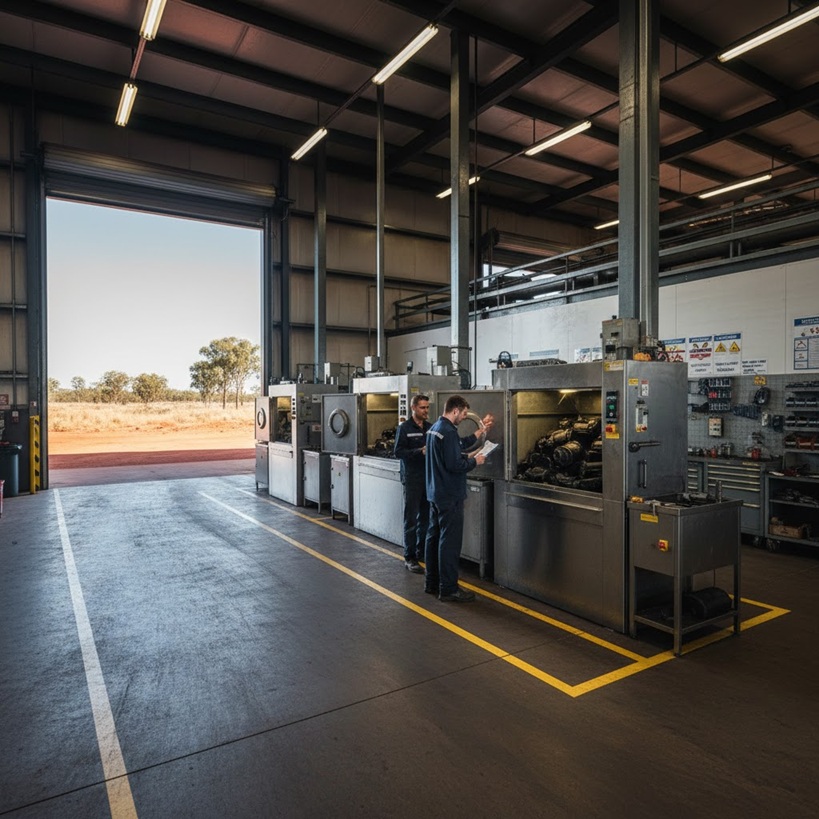
Managing parts cleaning across multiple workshops creates headaches that single-site operators never face. Different equipment at each location means inconsistent results. Training staff at five sites takes five times longer. When a machine breaks down in Kalgoorlie whilst your technician is in Bunbury, productivity stops.
Australian companies operating regional workshop networks waste thousands of hours managing these inconsistencies. Mining contractors, transport fleets, and agricultural machinery dealers all face this issue. A mechanic transferred from your Perth facility to your Geraldton site should not need to relearn how to clean parts.
Your maintenance standards should not vary depending on which depot handles the job. Standardising parts cleaning equipment across your network eliminates these problems. You get the same machines, same processes, and same results. This applies whether the work happens in Welshpool or Karratha.
Why Multi-Site Operations Struggle with Parts Cleaning Consistency
Regional workshop networks face challenges that single-site operations never encounter. Each location often develops its own cleaning methods. This is usually based on whatever equipment was available when the site opened.
One workshop might use a manual parts washer. Another might have an old hot tank. A third might rely on spray bottles and brushes. This inconsistency creates measurable problems for the business.
The Hidden Cost of Inconsistency
Staff training becomes location-specific rather than network-wide. A mechanic who masters the cleaning process at one site starts from scratch when transferred elsewhere. This slows down operations and increases training costs.
Quality control also suffers when cleaning standards vary. A cylinder head cleaned at your metropolitan workshop might meet specifications perfectly. The same component cleaned at a regional site using different equipment might fail inspection. Customers notice when service quality depends on which workshop handled their equipment.
This variance hurts your brand. It also makes it impossible to establish baseline workshop operations standards. You cannot improve what you cannot measure consistently.
Inventory and Management Overheads
Parts inventory multiplies when each site runs different equipment. Your stores need different detergents, spare pumps, heating elements, and filters for each location. A breakdown at one site cannot be fixed with parts from another.
Emergency freight costs add up quickly. You end up shipping specialised components between locations constantly. The hidden cost hits hardest in management time. Operations managers spend hours coordinating between sites. They troubleshoot location-specific problems and explain why results vary. That is time not spent improving overall network efficiency.
Defence Industry Cleaning Standards and Multi-Site Compliance
Defence contractors and suppliers face stricter requirements than most industries. Military specifications demand consistent cleaning results across all facilities handling defence components. A hydraulic valve cleaned at your Darwin workshop must meet identical standards to one processed in your Adelaide facility.
Meeting Strict Audit Requirements
Defence industry cleaning standards require documented processes. They also demand repeatable results. Auditors do not accept “we do our best.” They want proof that every site follows identical procedures.
Different equipment at each location makes this compliance nearly impossible to demonstrate. Standardising on identical heavy duty parts washers across your network makes defence compliance achievable.
Hotwash Australia provides equipment that delivers consistent results for multi-site operations. Same equipment specifications at every location mean the same documented processes. You get the same temperature control and pressure ratings. Auditors see one cleaning procedure applied network-wide. This removes the need for separate validation at every site.
Temperature Control and Contamination Removal
Temperature control matters critically for defence applications. Military specifications often require parts washing at specific temperatures. This is typically 60-85°C to ensure complete contaminant removal.
Manual methods cannot maintain these temperatures consistently. Hot tanks at different sites heat to different temperatures based on age and condition. Contamination removal must be complete and verifiable. Components cannot have residual oils or carbon deposits.
Documentation requirements demand process traceability. You need records showing which system processed which components. This level of multi-site coordination standards requires automated systems with consistent specifications.
Selecting Equipment for Network-Wide Standardisation
Choosing parts washers for multi-site deployment requires different thinking. The “best” machine for one location might not suit your entire network. Standardisation demands equipment that works effectively across your smallest and largest facilities.
Capacity Planning for Different Sites
Capacity planning starts with your busiest site’s requirements. However, you must consider your smallest site’s space constraints. A super heavy duty parts washer perfect for your main workshop might not fit in a regional depot.
The solution is to select equipment sized for your typical high-volume site. You then deploy multiple units at locations with higher throughput needs. This keeps the machine type consistent while scaling for volume.
Infrastructure and Power Constraints
Power requirements vary significantly between metropolitan and regional locations. Three-phase power is standard in industrial areas. It is often scarce in remote sites. Some regional workshops operate on single-phase supply with limited amperage.
Equipment selection must account for the electrical infrastructure at your most limited location. You cannot design your standard based only on your best-equipped facility.
Construction Quality and Durability
Construction quality matters more for multi-site operations. Equipment at a main workshop receives daily maintenance attention. A machine at a remote site might sit neglected for weeks.
Choose stainless steel parts washers or heavy-duty construction. These units tolerate less-than-perfect maintenance without failing. Simplicity in operation also reduces training complexity. Straightforward controls mean a mechanic can operate equipment immediately upon transfer.
Implementing Standardised Cleaning Procedures Across Sites
Equipment standardisation only works when coupled with process standardisation. Identical machines at every location mean nothing if each site uses different detergents. Cycle times and temperatures must also align.
Developing Uniform Processes
Develop network-wide cleaning procedures. Specify exact parameters for each component type. For example, engine blocks run a 15-minute cycle at 75°C. Transmission components run for 20 minutes at 80°C.
Document these procedures with photographs. Show proper part loading and spray arm positioning. A picture of correctly loaded cylinder heads eliminates confusion. Before-and-after photos establish the cleanliness standard expected at every location.
This approach creates robust workshop operations standards. Every technician knows exactly what “clean” looks like.
Synchronised Maintenance Schedules
Establish centralised detergent supply to ensure consistency. Bulk purchasing through a single supplier guarantees the same cleaning chemistry. Different detergents produce different results even in identical equipment.
Schedule simultaneous maintenance across all sites. When your Perth workshop changes pump seals, your regional sites do the same. This synchronised maintenance prevents equipment drift. It ensures one site’s washer does not outperform another’s due to neglect.
Training and Knowledge Transfer for Regional Teams
Multi-site operations face unique training challenges. Bringing all staff to one location is expensive. It disrupts operations significantly. Training at individual sites means travel time for instructors and inconsistent delivery.
Train-the-Trainer Models
Implement train-the-trainer programs. Supervisors from each site receive comprehensive instruction at your main facility. These site champions return to their locations equipped to train local staff.
This ensures consistent training delivery. It also minimises travel costs and operational disruption. Develop quick-reference guides specific to your standardised equipment. Laminated cards mounted near each machine show proper loading techniques.
Remote Support Strategies
Use video conferencing for real-time troubleshooting support. When a regional site encounters a problem, a quick video call provides guidance. Your main workshop’s senior technician can walk the remote staff through the resolution.
Create a shared knowledge base documenting common issues. When one site solves a heating element problem, that solution is shared network-wide. This improves multi-site coordination standards by leveraging collective knowledge.
Measuring Performance and Maintaining Standards
Standardisation only delivers value if you measure results. Without monitoring, equipment and procedures gradually drift. Each site eventually operates differently again.
Key Performance Indicators (KPIs)
Establish key performance indicators to track effectiveness. Measure average cleaning cycle time and detergent consumption per part. Track re-cleaning rates and equipment uptime. These metrics reveal which sites maintain standards.
Implement monthly reporting from each site. Document cleaning volumes and maintenance performed. This reporting creates accountability. It highlights problems before they become serious.
Customer Feedback as a Metric
Conduct quarterly audits comparing results across your network. Clean identical test components at each location and compare outcomes. Differences indicate equipment problems or training gaps.
Use customer feedback to validate quality. If customers report inconsistent cleanliness, your standardisation is not working. Complaints pinpoint specific sites needing improvement.
Cost-Benefit Analysis of Equipment Standardisation
Standardising parts cleaning equipment across multiple sites requires upfront investment. Purchasing five identical extra heavy duty parts washers costs more than buying used machines opportunistically. The question is whether standardisation delivers enough value.
Calculating the Hidden Costs
Calculate current costs of inconsistent equipment. Include obvious expenses like maintaining different spare parts inventories. Add the cost of training staff on multiple systems. Include emergency freight for specialised components.
A mining services contractor operating five workshops calculated these costs at $180,000 annually. Different equipment meant duplicated inventory and excessive training time. Management time spent troubleshooting site-specific problems cost $40,000 alone.
Return on Investment (ROI)
Compare these ongoing costs to the investment in standardised equipment. Replacing mixed systems with identical units often pays for itself in just over a year. The investment delivers ongoing savings after that point.
Factor in productivity improvements. Mechanics transferred between sites work efficiently immediately. Parts cleaning throughput increases when every site uses properly sized equipment. Consistent cleaning also reduces component failures and warranty claims.
Remote Site Considerations and Support Strategies
Regional and remote workshops present unique challenges. Sites in Kalgoorlie, Karratha, or Mount Isa operate far from service centres. Support strategies must account for this isolation.
Equipment Durability in Isolation
Choose robust equipment that tolerates delayed maintenance. Hot tanks and heavy duty washers built for mining operations handle tough conditions. They continue operating even when routine maintenance runs slightly overdue.
Remote sites cannot afford equipment that fails if a service visit gets postponed. Stock critical spare parts at each remote location. Do not rely on emergency freight.
Local Maintenance Capabilities
Each site should maintain pump seals, heating elements, and filters. This local inventory means most breakdowns get fixed within hours. You do not wait days for freight.
Implement remote diagnostics where possible. Modern equipment can report operating parameters to your central team. Temperature deviations or pressure changes signal problems before failure occurs.
For surface restoration needs, wet abrasive blasters offer a robust solution for remote sites. They allow for parts reclamation without complex infrastructure.
Conclusion
Multi-site workshop networks waste substantial resources managing inconsistent equipment. Different machines at each location multiply training requirements and maintenance complexity. They deliver inconsistent results that customers notice.
Standardising on identical equipment eliminates these inefficiencies. You get network-wide training programs and consolidated parts inventory. You achieve consistent cleaning quality regardless of which workshop handles the job.
The upfront investment typically pays for itself within 12 to 18 months. You reduce training costs and decrease premium freight expenses. Improved productivity and quality protect your revenue.
Australian companies need equipment built for local conditions. Choosing robust systems that work reliably ensures your standardisation strategy succeeds.
Ready to standardise parts cleaning across your workshop network? Speak with our multi-site equipment specialists or email us on sales@hotwash.com.au to discuss your network requirements.

Leave A Comment