Concrete Equipment Maintenance: Removing Cement Residue Before It Sets
Concrete sets in 30 minutes. Equipment contaminated with cement residue becomes unusable in less than an hour. For ready-mix operators, concrete pump contractors, and precast manufacturers, this narrow window determines whether equipment stays operational or requires costly downtime for hardened concrete removal.
Australian concrete operations lose an average of 4.2 hours per week to cement buildup cleaning – time that directly impacts job schedules, equipment availability, and labour costs. The difference between preventative washing and reactive chipping comes down to systematic cleaning protocols that address cement residue before the hydration process locks it onto equipment surfaces.
Hotwash manufactures industrial parts washers designed specifically for concrete industry applications, where rapid cleaning cycles and high-pressure spray systems prevent cement from reaching its initial set. Understanding the chemistry of cement curing and the mechanical requirements for effective residue removal determines which cleaning approach keeps concrete equipment operational.
Why Cement Residue Demands Immediate Attention
Cement begins its chemical transformation the moment water activates the calcium silicates. Initial set occurs within 30-45 minutes under typical Australian conditions, with final set completing within 6-10 hours. Once cement reaches initial set, mechanical removal becomes the only option – a process that risks equipment damage and consumes substantial labour hours.
The hydration reaction that hardens cement creates calcium silicate hydrate crystals that bond aggressively to metal, rubber, and plastic surfaces. These crystals form a matrix that increases in strength over 28 days, reaching compressive strengths exceeding 20 MPa in standard concrete mixes. Equipment surfaces contaminated with set cement require grinding, chipping, or chemical dissolution – all methods that damage equipment finishes and reduce component lifespan.
Temperature accelerates the setting process. Concrete equipment operating in Queensland summer conditions may experience initial set in as little as 20 minutes, while Victorian winter operations might extend the working window to 50 minutes. Regardless of climate, the fundamental principle remains constant: cement residue must be removed before the hydration reaction progresses beyond the plastic stage.
Ready-mix truck drums accumulate 2-8 kg of hardened concrete per load when cleaning protocols fail. Over a 250-load annual cycle, this represents 500-2,000 kg of lost capacity and increased fuel consumption from rotating additional weight. Concrete pump lines blocked by hardened cement require complete disassembly and replacement – a process costing $3,000-$8,000 in parts and labour for standard line lengths.
Equipment Categories Most Vulnerable to Cement Buildup
Different concrete equipment types face distinct cement residue challenges based on surface geometry, material contact patterns, and operational cycles.
Concrete Mixer Drums and Transit Mixers
Rotating drum interiors develop cement buildup in the spiral blade recesses and rear discharge areas. The constant tumbling action during transit creates a polishing effect that makes residue harder to detect until significant accumulation occurs. Drum capacities decrease by 3-5% when cement buildup reaches 15-20 mm thickness – a loss that compounds across fleet operations.
Concrete Pumps and Line Systems
Pump hoppers, S-tubes, and pipeline interiors require complete cement removal after each pour. Residue left in pump components creates blockage points that cause pressure spikes and premature wear on seals and pistons. Pipeline sections with hardened cement buildup reduce effective diameter, increasing pump pressure requirements by 15-30% and risking catastrophic line failures.
Formwork and Mould Components
Reusable formwork systems and precast moulds accumulate cement paste in corner details, tie holes, and textured surfaces. Buildup affects dimensional accuracy and surface finish quality in subsequent pours. Steel formwork with cement residue requires 40-60% more release agent, increasing material costs and reducing concrete surface quality.
Concrete Finishing Equipment
Power trowels, screeds, and float blades collect cement paste during finishing operations. Hardened residue on blade edges creates surface defects in subsequent pours and increases equipment weight, affecting balance and operator control. Trowel blade replacement costs $180-$400 per set when cement damage shortens usable life.
Batching Plant Components
Aggregate bins, cement silos, and conveyor systems develop cement accumulation at transfer points and discharge gates. Hardened cement in batching systems causes flow restrictions, weighing inaccuracies, and contamination of subsequent batches with old material.
The 30-Minute Window: Cleaning Before Initial Set
Effective concrete equipment maintenance operates within the plastic stage of cement hydration – the period before calcium silicate crystals develop sufficient bonding strength to resist mechanical removal.
Fresh Cement Residue (0-15 Minutes): Removes easily with low-pressure water spray and minimal mechanical agitation. The cement particles remain in suspension within the water phase, allowing simple flushing to clear contaminated surfaces. Standard workshop hoses delivering 400-600 kPa pressure provide sufficient force to remove cement at this stage.
Stiffening Cement (15-30 Minutes): Requires increased water pressure and mechanical agitation to break the developing crystal structure. High-pressure spray systems delivering 1,500-2,500 kPa pressure penetrate the thickening cement paste and dislodge particles before permanent bonding occurs. Heavy-duty parts washers designed for concrete applications provide the pressure and temperature combination needed to disrupt cement hydration during this critical window.
Initial Set Cement (30-45 Minutes): Develops structural integrity that resists water spray alone. Removal requires chemical treatment or aggressive mechanical methods that risk equipment damage. The cost difference between preventative washing and reactive removal becomes significant at this stage – what takes 5 minutes with high-pressure spray requires 45-90 minutes with chipping hammers and grinders.
Temperature control affects cleaning effectiveness during this window. Hot water (60-80°C) maintains cement in a more fluid state, extending the practical cleaning window by 5-10 minutes compared to cold water washing. Hot blaster systems combine high temperature with pressure to maximise cement removal efficiency before initial set.
High-Pressure Spray Systems for Cement Removal
Concrete equipment cleaning demands specific pressure, flow rate, and spray pattern characteristics to effectively remove cement residue without damaging equipment surfaces.
Pressure Requirements: Vary by cement stiffness and surface geometry. Fresh cement paste removes completely at 1,000-1,500 kPa, while stiffening cement requires 2,000-2,500 kPa for thorough cleaning. Flat surfaces clean effectively with lower pressures, but recessed areas, threads, and complex geometries need higher pressure to reach all contaminated surfaces.
Flow Rate: Determines coverage area and flushing capacity. Systems delivering 40-60 litres per minute provide sufficient volume to continuously flush dislodged cement particles away from equipment surfaces. Lower flow rates may achieve adequate pressure but fail to remove loosened material, allowing it to resettle on cleaned surfaces.
Spray Pattern Selection: Affects cleaning efficiency across different equipment types. Fan spray patterns (40-65 degrees) cover large flat surfaces like formwork panels and truck drum interiors. Concentrated spray patterns (15-25 degrees) penetrate into pump components, mixer blade recesses, and pipeline connections where cement accumulates in protected areas.
Rotating Spray Arms: Multiply operator effectiveness by delivering consistent pressure across complex three-dimensional surfaces. Concrete mixer drums cleaned with fixed spray wands require 15-20 minutes of manual positioning to reach all interior surfaces. Automated cleaning systems with rotating spray assemblies reduce drum cleaning time to 6-8 minutes while improving consistency.
Hot Water and Temperature’s Role in Cement Dissolution
Water temperature significantly affects cement residue removal efficiency by influencing the physical properties of cement paste and the rate of hydration reactions.
Hot water (60-80°C) reduces cement paste viscosity by 40-60% compared to cold water (15-20°C). This viscosity reduction allows cement particles to remain in suspension longer, preventing them from settling back onto cleaned surfaces during the washing process. Equipment cleaned with hot water shows 25-35% less residual cement film compared to cold water washing at equivalent pressure and duration.
Temperature affects the cement hydration rate in complex ways. Elevated temperatures initially accelerate hydration, but temperatures above 70°C can disrupt the normal crystal formation process, making cement easier to remove mechanically. This thermal disruption provides a secondary cleaning mechanism beyond simple viscosity reduction.
Thermal shock assists cement removal from metal surfaces by exploiting the differential thermal expansion rates between cement and steel. Rapid heating creates microscopic separation at the cement-metal interface, reducing bond strength and facilitating mechanical removal.
Hot tank systems provide sustained elevated temperatures for soaking heavily contaminated components. Concrete pump pistons, mixer blades, and formwork hardware benefit from 30-60 minute immersion in 75-85°C water, which softens cement residue and allows easier mechanical cleaning. This approach works particularly well for components with hardened cement that missed the initial cleaning window.
Energy efficiency considerations affect hot water system selection for concrete operations. Continuous-duty operations with multiple daily cleaning cycles justify dedicated heating systems that maintain water temperature throughout shifts. Intermittent operations may achieve better economics with on-demand heating or supplementary heating during the washing cycle.
Automated Washing Systems Versus Manual Cleaning Methods
The choice between automated parts washers and manual cleaning methods determines labour costs, cleaning consistency, and equipment longevity across concrete operations.
Manual Cleaning Variability: Manual cleaning with pressure washers provides flexibility for varied equipment types but introduces significant variability in cleaning quality. Operator technique, attention to detail, and time pressure affect thoroughness. Studies of manual concrete equipment cleaning show 30-50% variation in residual cement levels between different operators cleaning identical equipment under similar conditions.
Labour Cost Accumulation: Labour costs for manual cleaning accumulate rapidly. A concrete pump operator spending 25 minutes per day on equipment washing represents 2.1 hours weekly or 109 hours annually – equivalent to $4,900-$6,500 in labour costs at standard operator rates. This calculation excludes the productivity loss from having skilled operators performing repetitive cleaning tasks instead of revenue-generating work.
Automated System Efficiency: Extra heavy-duty parts washers designed for concrete applications reduce cleaning time by 60-75% compared to manual methods while improving consistency. Automated spray patterns reach all equipment surfaces systematically, eliminating the missed spots common in manual cleaning. Concrete mixer paddles that require 18-22 minutes of manual cleaning wash completely in 6-8 minutes using automated spray cabinets with rotating fixtures.
Consistency and Equipment Lifespan: Consistency affects equipment lifespan and maintenance costs. Concrete equipment with incomplete cement removal develops progressive buildup that increases cleaning difficulty with each cycle. Automated systems delivering identical pressure, temperature, and cycle time for every wash prevent this accumulation pattern. Fleet operators report 30-40% longer equipment service life when switching from manual to automated cleaning protocols.
Water Consumption Differences: Water consumption differs significantly between manual and automated approaches. Manual pressure washing uses 80-120 litres per cleaning cycle with substantial variation based on operator habits. Automated systems with programmed cycle times and controlled flow rates use 45-65 litres per cycle – a 40-50% reduction that lowers water costs and wastewater treatment requirements.
Preventative Washing Protocols for Different Concrete Equipment
Systematic cleaning schedules tailored to specific equipment types prevent cement accumulation while minimising downtime and labour costs.
Ready-Mix Truck Drums
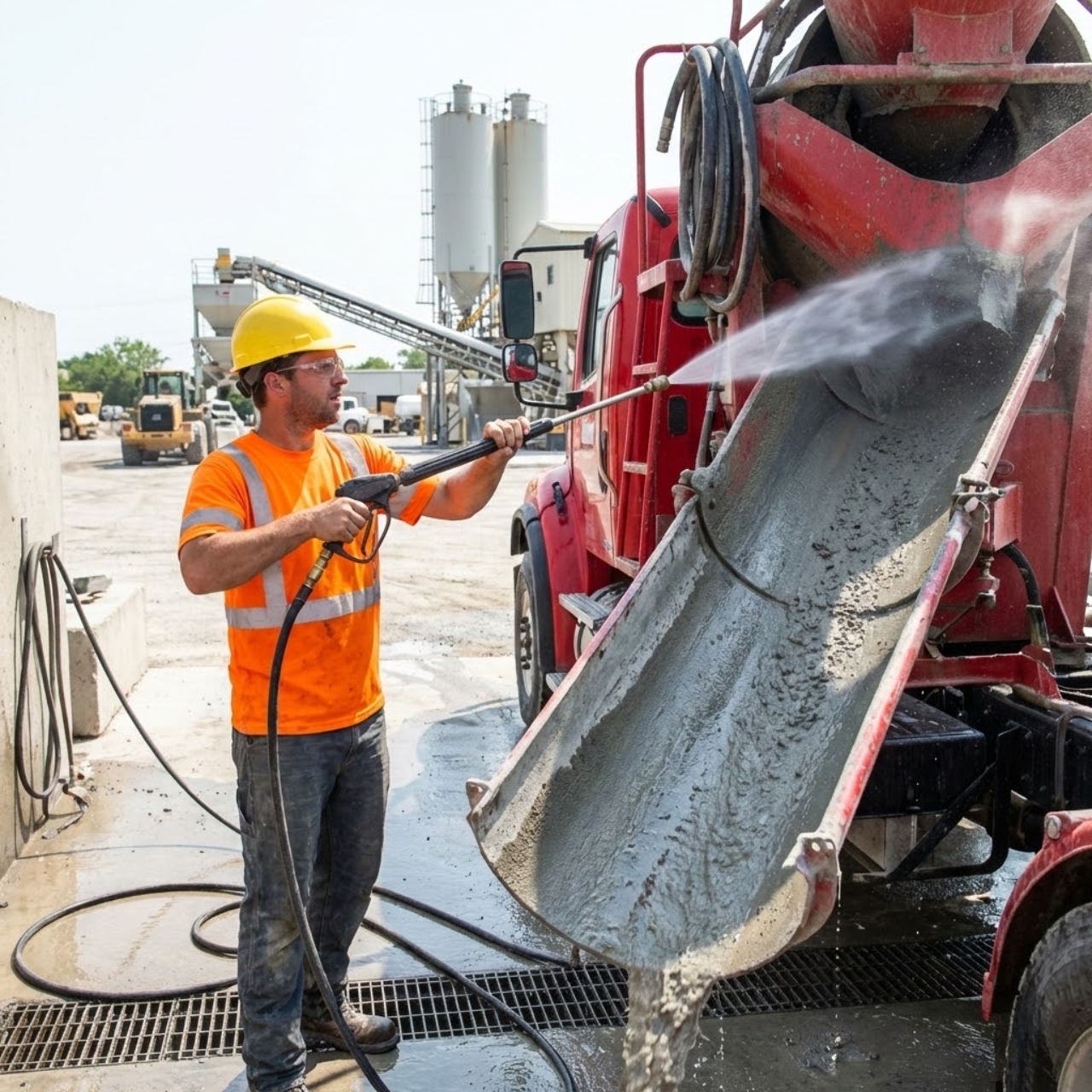
End-of-shift drum washing removes the day’s cement accumulation before overnight setting occurs. Complete drum rotation through automated spray systems takes 8-12 minutes and prevents the buildup that leads to capacity loss and increased fuel consumption. Weekly deep cleaning with extended spray cycles and manual inspection of blade recesses maintains optimal drum condition. Monthly drum capacity checks identify developing problems before they affect operational efficiency.
Concrete Pump Components
Immediate post-pour washing of pump hoppers, S-tubes, and receiver pipes prevents cement from setting in critical flow paths. High-pressure spray (2,000-2,500 kPa) through all pipeline connections flushes residue from internal surfaces. Pump pistons and seals require daily inspection and cleaning to prevent abrasive cement particles from accelerating wear. Quarterly disassembly and immersion cleaning of pump components removes accumulated cement from areas inaccessible during daily washing.
Formwork and Moulds
Post-pour formwork cleaning within 30 minutes of concrete placement prevents cement bonding to form surfaces. Spray washing removes bulk residue, followed by detail cleaning of tie holes, corners, and textured surfaces. Weekly application of release agents to cleaned formwork maintains surface condition and reduces cement adhesion in subsequent pours. Monthly inspection identifies areas developing persistent cement buildup that indicates inadequate cleaning or damaged release agent coatings.
Finishing Equipment
End-of-day cleaning of power trowel blades, screed plates, and float tools prevents cement accumulation that affects surface finish quality. Immediate washing after use maintains equipment in ready-to-use condition. Weekly inspection of blade edges identifies cement damage or wear patterns requiring attention. Seasonal deep cleaning and blade replacement maintains optimal finishing performance.
Batching Plant Equipment
Daily washdown of aggregate bins, cement silo discharge areas, and conveyor transfer points prevents cement accumulation at critical flow control points. Weekly high-pressure cleaning of conveyor belts and idlers removes cement buildup that causes tracking problems and premature wear. Monthly inspection of batching scales and weigh hoppers ensures cement residue has not affected accuracy or flow characteristics.
Chemical Cleaning Agents: When Water Pressure Is Not Enough
Cement that reaches initial or final set requires chemical treatment to break down the calcium silicate hydrate matrix before mechanical removal becomes practical.
Acidic Cleaners (pH 1-3): Dissolve hardened cement through chemical reaction with calcium compounds. Phosphoric acid formulations (10-15% concentration) provide controlled cement dissolution without the aggressive attack characteristics of hydrochloric or sulfuric acids. Application time of 15-30 minutes softens hardened cement sufficiently for mechanical removal with brushes or scrapers. These cleaners work effectively on steel components but require careful neutralisation and rinsing to prevent metal corrosion.
Alkaline Cleaners (pH 12-14): Work through different chemistry, using high pH to break down cement binders and suspend cement particles. These formulations clean effectively without the corrosion risks associated with acids but require longer contact times (30-60 minutes) to soften hardened cement. Alkaline cleaners suit applications where acid use presents safety concerns or material compatibility issues.
Enzyme-Based Cleaners: Provide a third approach, using biological catalysts to break down organic components in cement admixtures and facilitating mechanical cement removal. These products work more slowly than acids or alkalis but offer reduced environmental impact and improved worker safety. Application times of 2-4 hours or overnight soaking produce results comparable to chemical cleaners.
Chemical cleaning creates wastewater requiring proper disposal or treatment. Acidic cleaning solutions neutralised with alkaline compounds produce calcium salts that precipitate from solution, simplifying wastewater treatment. Concrete operations using chemical cleaners regularly should implement wastewater management systems that comply with local trade waste requirements and environmental regulations.
The economic comparison between preventative washing and chemical cleaning strongly favours prevention. Chemical cleaners cost $12-$25 per litre, with typical applications using 2-5 litres per heavily contaminated component. Labour time for chemical application, waiting, and subsequent mechanical cleaning adds 45-90 minutes per component. This same equipment washed immediately after use requires 5-8 minutes and no chemical costs – a 10:1 difference in total cleaning expense.
Water Recycling and Wastewater Management
Concrete equipment washing generates wastewater containing cement particles, aggregate fines, and chemical admixtures that require management before discharge or reuse.
Settling Tanks: Provide the primary treatment method for concrete wash water. Cement particles and aggregate settle by gravity when water velocity drops below the suspension threshold (typically 0.3-0.5 m/s). Three-chamber settling systems allow continuous operation while accumulated solids are removed from offline chambers. Tank sizing of 1,000-2,000 litres per wash station provides sufficient retention time (15-30 minutes) for effective particle removal.
Settled Solids Management: Settled solids from concrete wash water contain 60-75% cement and aggregate by weight, with the remainder being water. This material has limited reuse potential – the cement has partially hydrated and will not contribute to concrete strength if returned to batch plants. Most operations dispose of settled solids as inert waste or use them as fill material in non-structural applications.
Clarified Water Treatment: Clarified water from settling tanks contains residual cement fines (suspended particles under 75 microns) and dissolved cement compounds that affect pH. This water typically measures pH 11-13 due to dissolved calcium hydroxide. Direct discharge to sewer systems often violates trade waste pH limits (typically pH 6-10), requiring neutralisation with acid dosing systems before discharge.
Water Recycling Benefits: Water recycling systems reduce fresh water consumption by 60-80% in concrete equipment washing applications. Clarified water from settling tanks returns to wash stations for reuse, with makeup water added to replace losses from evaporation and carryout on cleaned equipment. Recycled wash water cleans effectively for cement residue removal, though the elevated pH and suspended solids may affect cleaning of other contaminants like oils or greases.
The economics of water recycling depend on local water and sewer costs, wash water volume, and available space for treatment systems. Operations using more than 500 litres daily typically achieve payback periods under 18 months for basic settling and recycling systems. Larger operations washing multiple trucks or pump lines daily see payback periods of 6-12 months.
Measuring Cleaning Effectiveness and Equipment Condition
Systematic assessment of cleaning results and equipment condition identifies protocol deficiencies before they cause operational problems or equipment damage.
Visual Inspection: Provides the first level of cleaning verification. Properly cleaned concrete equipment shows uniform metal or coating colour with no visible cement residue in recesses, threads, or complex geometries. Inspection immediately after cleaning while surfaces remain wet improves cement detection – residual cement appears as white or grey patches contrasting with clean metal surfaces.
Tactile Inspection: Supplements visual assessment by detecting thin cement films invisible to the eye. Running bare hands across cleaned surfaces identifies rough patches or buildup that indicates incomplete cleaning. This technique works particularly well for formwork panels and truck drum interiors where thin cement films affect subsequent concrete surface quality.
Capacity Measurements: Track cement accumulation in mixer drums and batching equipment. Monthly water filling tests comparing actual capacity to design specifications identify developing buildup. Capacity reductions exceeding 2% indicate cleaning protocols require adjustment. This measurement provides objective data that removes subjectivity from cleaning quality assessment.
Equipment Weight Tracking: Detects cement accumulation on portable equipment like power trowels, screeds, and pump components. Quarterly weighing compared to clean equipment baseline identifies developing problems. Weight increases exceeding 5% indicate significant cement buildup requiring additional cleaning attention.
Pressure Testing: Identifies internal cement accumulation in concrete pump lines before it causes operational failures. Monthly pressure tests at standard flow rates detect restrictions from cement buildup. Pressure increases exceeding 10% compared to clean baseline indicate internal contamination requiring line cleaning or replacement.
Photography Documentation: Creates a visual record of equipment condition over time. Monthly photos of critical equipment areas (mixer blades, pump components, formwork surfaces) allow comparison across cleaning cycles and identification of progressive deterioration. This documentation proves valuable for optimising cleaning protocols and justifying equipment replacement decisions.
Conclusion
Cement residue removal within the 30-minute window before initial set represents the most cost-effective approach to concrete equipment maintenance. The chemistry of cement hydration creates aggressive bonding that transforms simple cleaning into expensive mechanical removal once the setting process completes. Systematic cleaning protocols that address cement before crystallisation prevents the capacity losses, equipment damage, and labour costs that reactive maintenance creates.
Industrial parts washers designed for concrete applications deliver the pressure, temperature, and automation that effective cement removal requires. These systems reduce cleaning time by 60-75% compared to manual methods while improving consistency and extending equipment service life. The investment in proper cleaning equipment returns through reduced labour costs, extended equipment life, and eliminated chemical cleaning expenses.
Australian concrete operations benefit from locally manufactured cleaning systems that meet domestic electrical and safety standards while providing responsive technical support. Purpose-built equipment handles the specific demands of cement residue removal, delivering reliable performance across ready-mix, pumping, precast, and batching applications.
Operations serious about minimising cement-related equipment costs should evaluate their current cleaning protocols against the 30-minute window that determines cleaning difficulty and expense. Contact us to discuss cleaning systems matched to specific concrete equipment types, operational volumes, and site requirements. The team provides equipment specifications, protocol recommendations, and ROI analysis that demonstrates how systematic cement removal protects equipment investment and operational efficiency.
Share This Story, Choose Your Platform!


Leave A Comment