
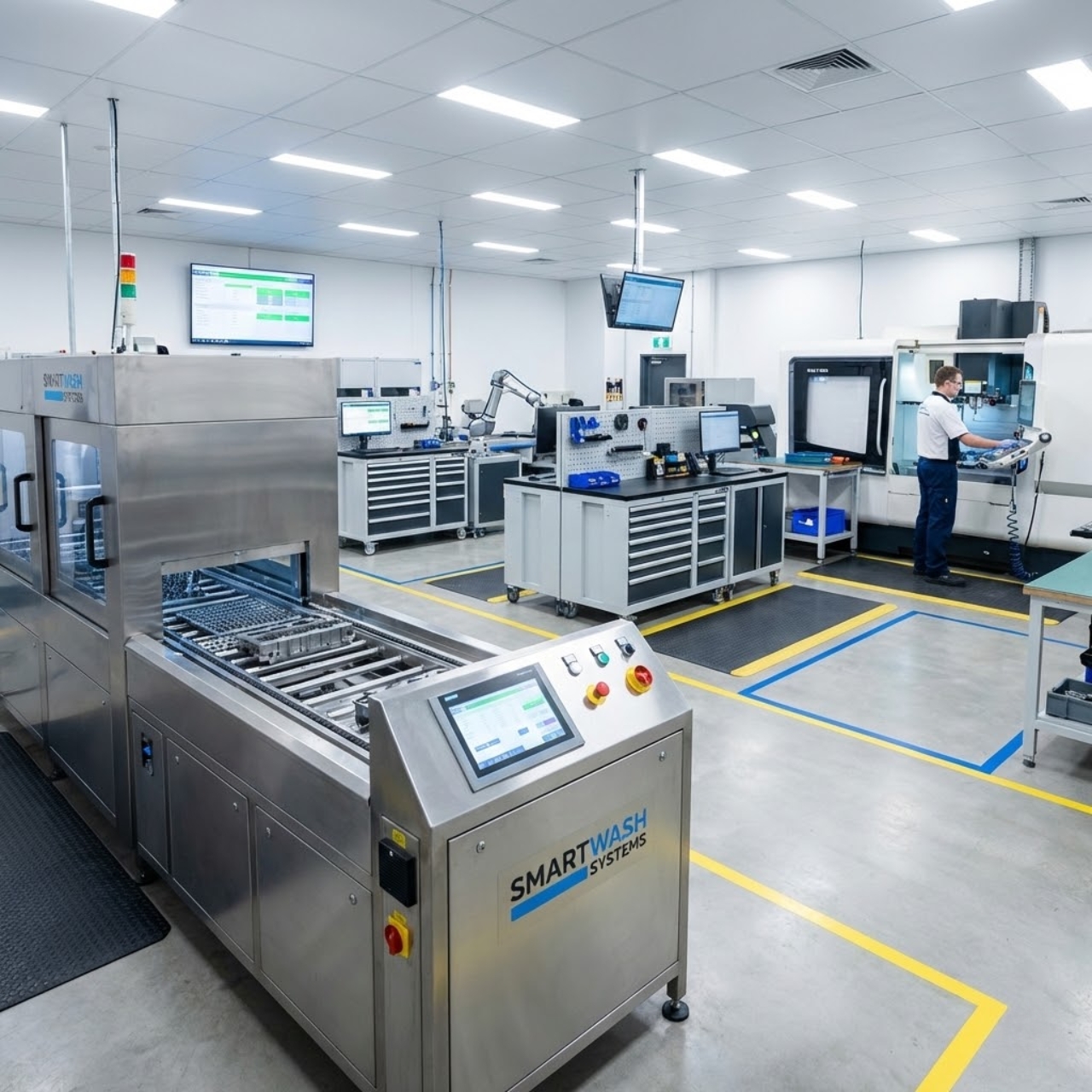
Most workshop owners face the same trap: the business runs smoothly when they’re present, but falls apart the moment they step away. This dependence on owner involvement limits growth, prevents time off, and ultimately caps the workshop’s value. The difference between a job and a business lies in systems – specifically, workshop automation systems that standardise processes and eliminate reliance on individual judgment calls.
Australian workshops that achieve true operational independence share a common approach: they replace manual, skill-dependent tasks with automated cleaning equipment that delivers consistent results regardless of who’s operating it. This shift transforms parts cleaning from a variable, labour-intensive process into a predictable system that runs without constant supervision. The result is measurable: reduced labour costs, eliminated quality variations, and the ability to scale operations without proportionally increasing management time.
The Real Cost of Manual Parts Cleaning Dependency
Manual parts cleaning creates three hidden costs that prevent owner independence. First, quality depends entirely on operator skill and effort level – a motivated worker delivers spotless parts, while a rushed or inexperienced employee leaves contamination that causes downstream problems. Second, the process consumes skilled labour hours that could generate revenue elsewhere. Third, and most critically, the owner must constantly monitor and quality-check work because there’s no standardised cleaning process to trust.
A typical automotive workshop allocating two hours daily to manual parts cleaning loses approximately 520 labour hours annually to a task that automated cleaning equipment completes in minutes. At $45 per hour for skilled labour, that’s $23,400 in direct costs before accounting for inconsistent quality or owner supervision time. The real figure multiplies when factoring in rework, delayed jobs, and the owner’s inability to step away from operations.
Automated Parts Washing: The Foundation System
Workshop automation systems eliminate the variability inherent in manual cleaning by standardising the entire process. Heavy-duty parts washers operate on programmable wash cycles that deliver identical results whether the operator has two years or two days of experience. This consistency creates the foundation for owner independence – the ability to trust that work meets standards without personal verification.
The operational shift is immediate. A manual parts cleaning process requires the operator to assess contamination levels, select appropriate cleaning methods, adjust chemical concentrations, determine wash duration, and verify results. An automated spray washer reduces this to loading parts, selecting the appropriate cycle, and unloading clean components. The system handles temperature control, pressure adjustment, chemical dosing, and cycle timing based on pre-programmed parameters the owner establishes once.
For workshops handling mining equipment components, fabrication parts, or automotive rebuilds, this standardisation prevents the quality variations that damage client relationships. A super heavy-duty parts washer processing large mining components delivers the same spotless result on the night shift as during day operations, eliminating the need for owner oversight across multiple shifts.
Matching System Capacity to Operational Requirements
Owner independence requires equipment scaled correctly to operational demands. Undersized systems create bottlenecks that pull the owner back into daily operations to manage workflow. Oversized systems waste capital and running costs without delivering proportional benefits.
Workshop capacity planning starts with throughput analysis. A fabrication workshop processing 40-60 parts daily requires different capacity than an automotive workshop cleaning 100+ smaller components. Extra heavy-duty parts washers suit operations handling large mining machinery components or heavy equipment parts, offering chamber dimensions and load capacities that accommodate substantial workpieces without requiring manual pre-cleaning or multiple wash cycles.
Smaller operations benefit from right-sized solutions. A manual parts washer provides professional-grade cleaning for workshops with lower volumes or limited floor space, while still supporting standardised cleaning processes and eliminating the inconsistency of sink-based manual cleaning. The key is matching equipment capacity to actual throughput requirements, not aspirational volumes.
Temperature and Pressure: Technical Specifications That Matter
The technical specifications that most impact operational independence are temperature range and pressure capacity. These determine whether the system handles contamination types without requiring manual intervention or pre-cleaning.
High-temperature cleaning systems – typically operating at 80-90°C – dissolve heavy grease, oil, and carbon deposits that lower-temperature equipment leaves behind. Hot blaster systems combine elevated temperatures with high-pressure spray patterns to tackle contamination that would otherwise require manual scrubbing. This eliminates the judgment call of “is this clean enough?” because the system’s thermal and mechanical action removes contamination completely.
Pressure capacity determines cleaning effectiveness on complex geometries. Components with blind holes, threaded sections, or intricate designs require sufficient pressure to force cleaning solution into recessed areas. Systems operating at 40-60 bar (580-870 PSI) provide the mechanical force necessary to clean thoroughly without manual brushing or detailed hand-cleaning of difficult sections.
For workshops servicing oil and gas equipment or processing heavily contaminated mining components, hot tank systems offer immersion cleaning that reaches every surface regardless of geometry complexity. The combination of chemical action, thermal energy, and complete immersion eliminates contamination that spray systems might miss, removing another variable that would otherwise require owner judgment.
Building Standard Operating Procedures Around Equipment Capabilities
Automated cleaning equipment enables standardised cleaning processes, but only if the owner establishes clear protocols. The transition from owner-dependent to system-dependent operations requires documenting exactly how equipment should be used for different part types and contamination levels.
Effective standard operating procedures for automated parts washing specify:
Pre-wash preparation requirements: Which parts require debris removal or heavy contamination reduction before loading into the washer. This prevents operators from overloading the system or attempting to clean components beyond its designed capacity.
Cycle selection criteria: Clear guidelines for which programmable wash cycles suit different part types and contamination levels. A three-cycle system might designate light cycles for daily-use tools, standard cycles for general workshop components, and intensive cycles for heavily contaminated mining or oil and gas parts.
Loading procedures: Proper orientation and spacing of parts within the wash chamber to ensure cleaning solution reaches all surfaces. This prevents incomplete cleaning that would require rewashing or manual finishing.
Quality verification steps: Simple, objective checks that any operator can perform to confirm cleaning effectiveness without requiring the owner’s judgment.
These procedures transform the automated system from equipment into a complete process. The owner’s knowledge transfers into documented standards that any trained operator can follow, creating the independence that allows business growth beyond the owner’s direct involvement.
Material Selection: Stainless Steel vs Powder-Coated Steel
The construction material of industrial parts washers directly impacts long-term reliability and maintenance requirements – factors that determine whether equipment truly reduces owner involvement or creates new management demands.
Stainless steel parts washers offer superior corrosion resistance and longevity in demanding environments. Food processing operations, commercial kitchens, and workshops requiring hygiene compliance benefit from stainless steel construction that withstands aggressive cleaning chemicals and maintains appearance over decades. The higher initial investment delivers lower long-term maintenance and extended service life, reducing the owner’s ongoing equipment management burden.
Powder-coated steel construction provides robust performance at lower capital cost, suitable for general industrial applications where hygiene certification isn’t required. The key consideration is matching material selection to actual operational demands rather than defaulting to the lowest initial price or assuming stainless steel is always necessary.
Integration With Existing Workshop Layout
Owner independence requires equipment that integrates seamlessly into existing workflows without creating new bottlenecks or requiring constant process adjustments. This means considering physical dimensions, utility requirements, and workflow positioning during equipment selection.
Chamber dimensions determine which components the system can accommodate. A workshop processing engine blocks, transmission assemblies, or large fabrication parts requires internal dimensions that handle these workpieces without requiring disassembly or multiple wash cycles. Conversely, operations focusing on smaller components benefit from compact systems that don’t consume excessive floor space.
Utility requirements – electrical supply, water connections, and drainage – must match existing workshop infrastructure or require clearly defined upgrades. Systems demanding three-phase power in a single-phase facility create installation complications that delay implementation and increase costs. Australian-manufactured equipment typically specifies standard Australian electrical requirements, simplifying installation and compliance.
Workflow positioning determines whether automated cleaning improves efficiency or creates new handling steps. Locating the parts washer between disassembly and inspection areas minimises component movement and establishes a logical process flow that operators follow naturally without requiring supervision.
The Role of Wet Abrasive Blasting in Complete System Independence
Some contamination types and surface preparation requirements exceed the capabilities of standard spray washing or immersion cleaning. Wet abrasive blasters handle rust removal, paint stripping, and surface preparation tasks that would otherwise require skilled manual labour and owner oversight.
The wet abrasive process combines mechanical abrasion with water suppression, preventing the dust generation associated with dry blasting while delivering aggressive surface treatment. This makes the technology suitable for workshops lacking dedicated blasting facilities or dealing with contamination that chemical cleaning alone cannot address.
For restoration workshops, fabrication operations, or facilities maintaining aging equipment, wet abrasive capability completes the workshop automation systems. Components requiring paint removal before rebuilding, parts with surface corrosion, or workpieces needing surface profile for coating adhesion all process through the wet blaster without requiring specialised contractor services or manual preparation.
Training Investment: From Operator Dependence to System Reliance
The transition to automated systems requires upfront training investment that pays ongoing dividends in owner independence. Effective training shifts operator focus from cleaning technique to system operation and basic troubleshooting.
Initial operator training should cover cycle selection, proper loading procedures, routine maintenance tasks, and basic troubleshooting. This typically requires 2-4 hours of hands-on instruction – a minimal investment that prevents operational problems and equipment misuse. The training creates competent operators who run the system correctly without requiring owner intervention for routine operations.
Documentation supplements training by providing reference materials for infrequent tasks or cycle selections. Laminated quick-reference guides mounted near the equipment remind operators of proper procedures without requiring them to memorise every detail.
The goal is creating operators who understand how to use the system effectively, not parts cleaning experts who apply judgment to every component. The system itself provides the expertise through its programmable wash cycles and mechanical capabilities.
Measuring Return on Investment in Owner Time
The financial justification for automated parts washing extends beyond direct labour savings to include the owner’s liberated time. This represents the most valuable return because it enables business development, strategic planning, and ultimately the option to step away from daily operations.
Calculate the baseline by tracking current weekly hours the owner spends on parts cleaning oversight, quality verification, rework management, and resolving cleaning-related delays. Multiply this by 50 working weeks to establish annual owner hours consumed by the current manual process.
Post-implementation measurement tracks the same metrics after workshop automation systems are operational and standardised cleaning processes are established. The reduction in owner involvement hours represents capacity for revenue-generating activities or, critically, the ability to take time off without operational disruption.
A workshop owner currently spending 8 hours weekly managing parts cleaning operations who reduces this to 1 hour of weekly system oversight recovers 350 hours annually. At a conservative $150 per hour value for the owner’s time in business development or strategic activities, this represents $52,500 in annual value beyond the direct labour savings the automated cleaning equipment delivers.
Building Redundancy and Backup Capacity
True operational independence requires planning for equipment maintenance and potential downtime. A single automated system that becomes a critical bottleneck simply transfers owner dependence from labour management to equipment availability management.
Workshops with high throughput or time-sensitive operations benefit from capacity redundancy. This doesn’t necessarily mean duplicate systems, but rather backup capacity that maintains operations during routine maintenance or unexpected repairs. A facility running dual shifts might operate two moderate-capacity systems rather than one large unit, ensuring continued operation if one system requires service.
Alternatively, maintaining a basic manual parts washer as backup capacity provides operational continuity for critical components during automated system maintenance. This approach costs less than duplicate automated systems while preventing complete workflow stoppage.
The key is identifying which components are genuinely time-critical and ensuring backup cleaning capacity exists for these items, even if it’s a lower-throughput manual process. This prevents equipment maintenance from creating emergencies that pull the owner back into daily operations.
Maintenance Schedules That Prevent Owner Involvement
Automated cleaning equipment delivers owner independence only if maintenance requirements are straightforward enough for operators to handle without specialised knowledge or constant owner oversight. This means establishing clear, calendar-based maintenance schedules that specify exactly what tasks occur at which intervals.
Daily maintenance typically includes basic cleaning of filters, checking solution levels, and verifying proper operation. These tasks take 5-10 minutes and should be assigned to the operator as part of shutdown procedures.
Weekly maintenance adds filter cleaning or replacement, inspection of spray arms or heating elements, and verification of cycle timing accuracy. A designated operator completes these tasks following documented procedures without requiring owner supervision.
Monthly and quarterly maintenance might include more detailed inspections, seal checks, and performance verification. These tasks can be handled by trained operators or scheduled with equipment suppliers as part of service agreements.
The critical factor is documentation. Maintenance procedures must be specific enough that operators can complete them correctly without interpretation or judgment. This transforms maintenance from an owner responsibility into a systematic process that occurs reliably without supervision, supporting true system-dependent operations.
Conclusion
Workshop independence emerges from replacing skill-dependent manual processes with workshop automation systems that deliver consistent results regardless of operator experience. Parts cleaning represents the ideal starting point because it’s labour-intensive, quality-variable, and typically requires owner oversight to maintain standards.
The transition requires matching equipment capacity to actual operational demands, establishing clear standardised cleaning processes, training operators on system use rather than cleaning technique, and building maintenance schedules that prevent equipment issues from becoming owner emergencies. Australian-manufactured equipment offers the durability and local support necessary for long-term reliability without constant management attention.
The return extends beyond direct labour savings to include the most valuable resource: the owner’s time. Automated cleaning equipment that runs reliably without supervision creates the capacity for business development, strategic planning, and ultimately the option to step away from daily operations while maintaining quality and productivity.
Contact us to discuss which automated parts washing systems suit workshop capacity requirements and operational goals. The conversation focuses on matching equipment capabilities to specific throughput, contamination types, and independence objectives – creating a system that genuinely runs without constant owner involvement.

Leave A Comment